
The term “pet-friendly” is often used as a vague marketing label, but for a UK homeowner, it has to be a technical specification. If you are searching for pet friendly artificial grass uk, you aren’t just looking for a green surface; you are looking for a solution to the endless cycle of muddy paws on your carpets and that sharp, lingering scent of urine during a rare British heatwave. We know the frustration of watching a well-kept garden get torn apart by a high-energy dog. It’s a common struggle, and to be perfectly frank, you deserve a space that works for every member of the family without the constant cleanup.
In this guide, we’ll cut through the jargon to show you exactly how to choose a durable, odour-free lawn that survives the “zoomies” and the rain alike. You’ll learn why the backing material matters more than the pile height and how the right drainage system keeps your garden safe and fresh. We’re going to walk you through the essential features of high-quality turf, from polyurethane backings to non-toxic fibres, ensuring your outdoor space remains a lush, mud-free sanctuary all year round.
Key Takeaways
- Understand why natural turf fails to survive the UK’s damp climate and how the right artificial solution permanently ends the cycle of muddy paws.
- Identify why Polyurethane (PU) backing is a non-negotiable technical requirement for preventing trapped moisture and unpleasant garden odours.
- Learn why a pile height between 25mm and 35mm provides the ideal balance of durability for “zoomies” and ease of cleaning for owners.
- Discover how specific sub-base materials and Zeolite infills work to neutralise smells at the source in your pet friendly artificial grass uk installation.
- Get direct, expert advice on matching your specific dog breed’s activity levels to the most resilient and safe turf options available.
Why Standard Lawns Fail UK Pet Owners (And the Artificial Fix)
Natural lawns and active dogs often exist in a state of constant conflict. In the UK, our climate doesn’t help. We face a relentless cycle where high-nitrogen pet urine scorches the grass, leaving unsightly yellow patches. When the inevitable British rain arrives, these dead spots quickly transform into mud baths. For many homeowners, maintaining a pristine garden feels like a losing battle against biology and the elements. Investing in pet friendly artificial grass uk breaks this cycle once and for all.
Unlike natural turf, synthetic fibres don’t react to nitrogen. They don’t die back or discolour. High-energy dogs often engage in “zoomies,” where sudden sprints and sharp turns tear natural grass out by the roots. Modern Artificial turf is engineered specifically for high-impact play. It provides a stable, durable foundation that looks as good in January as it does in July. By switching to a synthetic surface, you also eliminate the need for seasonal maintenance. There’s no more fertilising, no more weeding, and certainly no more reseeding. It’s a practical, long-term solution for those who value their time and their property’s appearance.
The Muddy Paw Problem
The most immediate benefit of a synthetic lawn is the physical barrier it creates. It separates your dog’s paws from the soil entirely. This stops mud from being tracked into the house, which directly protects the longevity of your indoor flooring. Whether you have plush carpets or sleek laminate flooring in your hallway, keeping grit and moisture outside is essential for preventing premature wear and tear. A cleaner garden simply means a cleaner home, reducing the time you spend with a mop or vacuum in hand.
Toxicity and Pet Safety
Safety is a non-negotiable priority at Frankly Flooring. Many people don’t realise that standard lawn care involves a cocktail of pesticides and fertilisers that can irritate a pet’s skin or paws. When you install pet friendly artificial grass uk, those chemicals become unnecessary. All our options are strictly lead-free and non-toxic. We define “pet-safe” as being entirely free from heavy metals and harmful dyes. This ensures your garden remains a healthy, hazard-free environment for your animals to play in every single day without the risk of chemical exposure.
The Anatomy of Pet-Friendly Grass: PU Backing vs. Latex
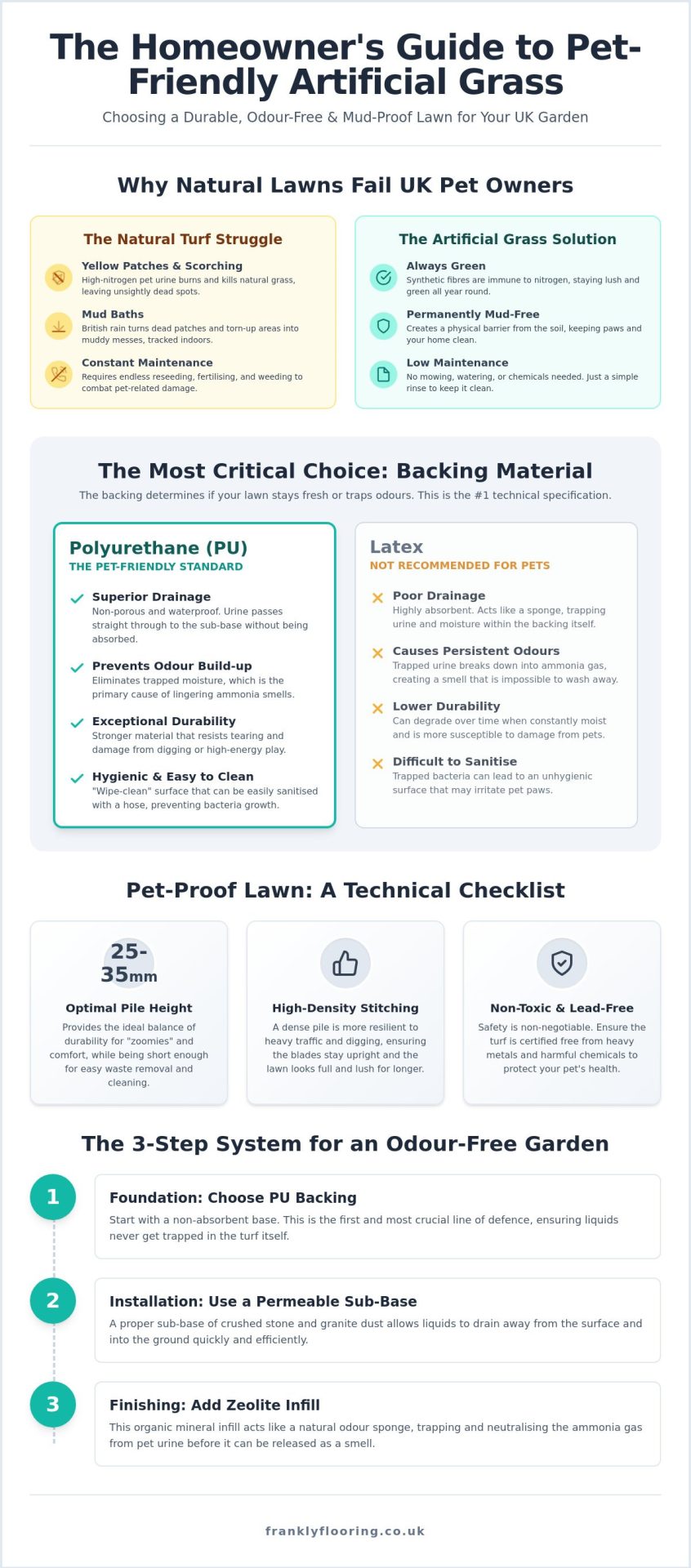
The backing of your lawn is its engine room. While the green blades get all the attention, the material underneath determines whether your garden stays fresh or becomes a source of frustration. Most standard artificial turf products in the UK use a latex backing. While latex is cost-effective and suitable for decorative areas, it’s a poor choice for dog owners. Latex is naturally porous and acts like a sponge. When your pet uses the lawn, the latex backing absorbs a portion of the urine. Over time, this liquid becomes trapped within the material itself, leading to persistent odours that are almost impossible to wash away.
Choosing pet friendly artificial grass uk requires a shift to Polyurethane (PU) backing. PU is a non-absorbent, “wipe-clean” material. Instead of soaking up liquids, it allows them to flow directly through the drainage holes and into the sub-base below. This technical difference is vital for maintaining a hygienic environment, especially when addressing wider environmental and health concerns regarding surface runoff and material safety. PU is also significantly more durable. It resists the “digging” instincts of active dogs and is far less likely to fray at the edges than its latex counterparts. If you want to see the difference for yourself, you can browse our curated range of artificial grass designed for high-performance use.
Why PU Backing Wins for Dog Owners
PU backing doesn’t just improve drainage; it transforms the hygiene of your garden. Because the material is non-porous, urine passes straight through without leaving a residue behind. This makes the surface much easier to sanitise with a simple hose-down. It’s the industry standard for hygiene in multi-pet households. You won’t have to worry about the backing degrading or holding onto bacteria that could irritate your pet’s paws.
The “Smell Test”: Preventing Ammonia Buildup
The dreaded “dog smell” in a garden is actually the scent of ammonia gas. This occurs when trapped urine is allowed to sit and break down. By using a PU-backed lawn with high-frequency perforations, you ensure vertical drainage is as fast as possible. This prevents the liquid from pooling or lingering. Another benefit of PU is its resilience to the British weather. It remains flexible in freezing winter temperatures, whereas latex can become brittle and crack, creating even more pockets for moisture to hide in.
Choosing the Right Pile Height and Density for Active Paws
Selecting the right turf isn’t just about what looks best in a sample book. It’s a technical decision that balances aesthetics with the daily reality of pet ownership. While a deep, plush lawn might feel great underfoot, it isn’t always the most practical choice for a garden used by dogs. For the majority of pet friendly artificial grass uk projects, a pile height between 25mm and 35mm is the sweet spot. This range offers enough length to look like a healthy, natural lawn while remaining short enough to make waste removal straightforward and efficient.
The shape of the individual fibres plays a massive role in how the grass performs over time. High-quality turf uses “C-shape” or “W-shape” blades. These aren’t just for show. These engineered shapes act like tiny springs, allowing the grass to bounce back after your dog has been running or lying on it. When you’re creating a pet-friendly garden, you need a surface that resists flattening. Flat grass doesn’t just look poor; it traps debris more easily and makes the garden harder to clean. A resilient fibre shape ensures the lawn stays upright and breathable for years.
Short vs. Long Pile: The Practical Reality
- Short piles (20-30mm): These are the workhorses of the pet world. They’re much easier to “scoop” and less likely to trap hair or organic matter. If you have high-traffic areas, a shorter pile is your best bet.
- Long piles (35mm+): These provide a more traditional, meadow-like appearance. However, they require more frequent brushing to prevent the blades from matting down under the weight of an active pet.
Our frank advice is simple. If you own a large, active dog that loves a high-speed chase, go for a shorter and denser product. It will handle the friction of paws much better than a longer, thinner alternative.
Durability Scores Explained
To understand the true quality of a lawn, you need to look at the “decitex” (Dtex) rating. This is a measure of the yarn’s weight. A higher Dtex generally means a thicker, more durable fibre that can withstand the “zoomies” without fraying. You should also check for UV stability. British sun might be unpredictable, but UV rays can still make inferior plastics brittle and prone to breaking over time. Pile density is the total number of tufts per square metre. A higher density score means more fibres are packed together, which provides better support and prevents the grass from looking sparse after heavy use.
Odour Control and Installation: How to Prevent the ‘Dog Smell’
A common concern for UK homeowners is the potential for a garden to develop a “dog smell” after a few months. While the choice of backing is crucial, the foundation beneath the turf is equally important. Even the highest quality pet friendly artificial grass uk will eventually smell if the installation process ignores drainage. You need a system that allows waste to be neutralised and washed away rather than letting it fester in the ground.
The secret weapon in odour management is Zeolite infill. This is a natural, volcanic mineral that you brush into the grass fibres. Zeolite works on a molecular level to trap ammonia ions before they can turn into gas. It acts as a filter, holding onto the source of the smell until the next rainfall washes it through the system. Unlike standard sand infill, Zeolite doesn’t clog the drainage holes or become a breeding ground for bacteria. It’s a technical addition that makes a massive difference in the long-term enjoyment of your garden.
The Sub-Base: Don’t Build on Sand
Most standard artificial lawn installations use sharp sand as a final levelling layer. For pet owners, this is a mistake. Sand is highly absorbent and will hold urine exactly like a giant litter tray. Instead, we recommend a granite dust (Grano) finish over a sub-base of Type 1 stone. Grano provides a firm, stable base while remaining exceptionally permeable. It allows liquid to pass through at a much higher rate than sand. You should also ensure your weed membrane is a high-quality, non-woven geotextile. This prevents weeds from pushing through while maintaining the vertical drainage path you’ve built.
Maintenance Myths vs. Reality
It’s a myth that artificial lawns are completely maintenance-free. While you won’t be mowing, you still have a responsibility to keep the surface hygienic. Solid waste must be removed immediately to prevent it from being trodden into the fibres. A quick weekly rinse with a hose is usually enough to keep things fresh. For a deeper clean, especially in the spring, use a pet-safe enzyme cleaner. These products break down organic matter at the root. You should also practice “cross-brushing” with a stiff broom. This pulls the fibres upright and prevents them from matting, which is essential for keeping the lawn breathable. If you’re ready to upgrade your garden, explore our range of artificial grass to find a durable solution.
Heat management is another practical consideration. During occasional UK heatwaves, synthetic surfaces can become warm. A simple two-minute spray with a garden hose will significantly drop the temperature of the lawn, making it comfortable for paws again. It’s a small task that ensures your garden remains a safe retreat regardless of the weather.
Finding Your Perfect Pet-Friendly Lawn at Frankly Flooring
Buying pet friendly artificial grass uk online shouldn’t be a gamble. We’ve spent over 20 years in the UK flooring industry, and we know that homeowners value clarity over corporate fluff. By choosing a UK-based expert, you avoid the middleman markups often found in local showrooms. We deliver nationwide directly to your door, ensuring your project stays on schedule and within budget. Our goal isn’t to rush you through a sales funnel but to guide you through a logical journey from initial inspiration to the final cleanup of your garden project.
Our approach is built on technical transparency. We don’t just tell you a product is “good”; we give you the Dtex ratings and backing specifications you need to make an informed choice. Whether you have a single lapdog or a pack of energetic retrievers, we provide direct advice on which specific turf suits your breed’s activity levels. We view your garden as a foundational element of your home’s character, not just a commodity to be sold. This quiet confidence in our craftsmanship is why so many UK homeowners trust us with their property.
The “Frank” Difference
- We’ve spent over 20 years refining our knowledge of the UK flooring and turf industry.
- No high-pressure sales tactics; just the technical specs and honest guidance you need.
- Nationwide delivery across the UK ensures your materials arrive safely at your doorstep.
- A commitment to long-term satisfaction rather than quick, low-quality wins.
Completing the Transformation
A mud-free garden is only half the battle. To truly protect your home, you need to consider the transition point where your pets enter from the garden. Pairing your new lawn with durable internal flooring like LVT creates a seamless, easy-to-clean environment. Luxury Vinyl Tile is waterproof and scratch-resistant, making it the perfect partner for a pet-friendly household. It handles the grit and moisture of a busy home without the warping or staining issues associated with natural wood.
For utility rooms or kitchens that lead out through bi-fold doors, consider high-performance vinyl flooring. It handles the occasional damp paw print or spilled water bowl with ease. By thinking about your home as a complete system, you ensure that the “mud-free” promise extends from the back fence all the way to your front door. This end-to-end approach is what makes the Frankly experience different. We look at the full project lifecycle to ensure your home remains as safe and clean as possible.
Don’t just take our word for it. Texture matters, especially for sensitive paws. We encourage you to order samples so you can feel the density and resilience of our pet friendly artificial grass uk before you commit to a full roll. Browse our range today and take the final step toward a garden that’s as practical as it is beautiful. We’re here to provide the expert, no-nonsense advice you need to get the job done right the first time.
Reclaim Your Garden for Every Member of the Family
Transforming your outdoor space into a durable, pet-safe environment is a straightforward process when you have the right technical specifications. By moving away from standard latex and choosing high-permeability PU backing, you ensure your lawn remains fresh and odour-free for years. We’ve seen how the right pile height and a solid “Grano” dust foundation can permanently end the frustration of muddy paws in your hallway. These aren’t just aesthetic choices; they are investments in the hygiene and longevity of your home.
At Frankly Flooring, we bring over 20 years of family-run expertise to help you find the most resilient pet friendly artificial grass uk has to offer. We provide direct UK-wide delivery, bringing professional-grade materials from our warehouse straight to your door. Our no-nonsense approach means you get the honest guidance you need to make the right choice for your specific breed and lifestyle. Browse our Pet-Friendly Artificial Grass range today and start your journey toward a cleaner, greener home. You deserve a garden that looks fantastic and stands up to the rigours of daily play.
Frequently Asked Questions
Is artificial grass safe for dogs and cats?
High-quality pet friendly artificial grass uk is entirely safe for your pets. We ensure our range is lead-free and manufactured without toxic dyes or heavy metals. By removing the need for chemical fertilizers and pesticides, you’re actually creating a much healthier environment for your animals to play in. It’s a clean, hypoallergenic surface that doesn’t harbor the parasites often found in damp, natural soil.
Does artificial grass get too hot for dog paws in the UK?
While synthetic surfaces absorb more heat than natural grass, UK heatwaves rarely make the surface uncomfortable for long. If the lawn feels warm to the touch, a two-minute spray with a garden hose will drop the temperature instantly. We also recommend choosing a product with a lighter green shade, as darker fibres tend to retain more heat during the peak afternoon sun.
How do I clean dog urine and waste off artificial grass?
Cleaning is a straightforward task that doesn’t require specialist equipment. You should scoop up solid waste just as you would on a normal lawn. For liquid waste, the high-permeability backing allows it to drain away naturally. We suggest a quick rinse with water once a week to keep things fresh. For a deeper clean, a pet-safe enzyme wash will break down any remaining organic matter.
Will my dog try to dig up the artificial grass?
Most dogs stop digging once the grass is installed because they can no longer smell the earth beneath the turf. The durable backing is specifically designed to withstand pawing and scratching. To be safe, we ensure the perimeter is securely fixed during installation. This prevents pets from getting their noses under the edges and trying to pull the grass up.
Can dogs be allergic to artificial grass?
It’s highly unlikely. In fact, many vets recommend synthetic turf for dogs that suffer from seasonal grass pollen allergies. Because the lawn doesn’t produce pollen, it can significantly reduce skin irritation and “itchy paw” syndrome. It’s a clean, dust-free alternative that helps your pet enjoy the garden without the sneezing or scratching associated with a traditional lawn.
How long does pet-friendly artificial grass last?
You can expect a high-quality installation to last between 10 and 15 years with basic care. The lifespan of pet friendly artificial grass uk depends heavily on the pile density and the quality of the sub-base. Regular “cross-brushing” to keep the fibres upright and ensuring the drainage holes remain clear will help your garden stay in top condition for over a decade.
Do I need a special infill for a pet-friendly lawn?
We always suggest using a specialist infill like Zeolite for homes with dogs. Unlike standard kiln-dried sand, Zeolite is a volcanic mineral that traps and neutralises ammonia. It prevents the “dog smell” from developing in the first place. It’s a technical addition that makes a massive difference to the hygiene and freshness of your garden over the long term.
What happens if my dog eats the artificial grass?
Our fibres are non-toxic and lead-free, so they won’t poison your pet if accidentally nibbled. However, most dogs find the texture of the plastic fibres unappealing and won’t try to eat them. If you notice your dog is persistently chewing the lawn, it’s usually a sign of boredom rather than an attraction to the material. Always monitor young puppies during their first few weeks on the new turf.