
Is solid wood flooring actually worth the extra cost and the potential maintenance headache, or are you just paying for a prestige label? It’s a common dilemma for UK homeowners who want the character of real timber but fear the reality of boards warping during a damp winter. You want a floor that adds genuine value to your property, yet the jargon surrounding timber grades and humidity levels can feel intentionally confusing.
We agree that choosing a floor should be about clarity, not guesswork. This guide delivers the honest truth about solid wood flooring, cutting through the high-pressure sales talk to focus on technical craftsmanship and long-term value. We’ll show you exactly how to choose the right grade for your lifestyle and what it takes to ensure your investment stays beautiful for decades.
We’ll break down the differences between Rustic and Prime grades, explain the installation realities for UK homes, and provide a clear roadmap for maintenance. You’ll gain the confidence to select a material that isn’t just a commodity, but a living, breathing part of your home’s history. By the end, you’ll have a professional’s perspective on how to achieve a floor that truly lasts a lifetime.
Key Takeaways
- Learn why solid wood flooring is a genuine 100-year investment, thanks to its ability to be sanded and refinished multiple times.
- Discover how to use technical tools like the Janka hardness scale to choose the right timber species for your home’s busiest rooms.
- Understand the critical differences between solid and engineered wood to ensure your choice can handle UK humidity and temperature changes.
- Master the essential rules of acclimatisation and subfloor preparation to protect your floor from future warping or gapping.
- Find out how a direct-to-consumer model provides access to premium timber grades without the traditional high-street overheads.
What is Solid Wood Flooring? The Timeless Investment for UK Homes
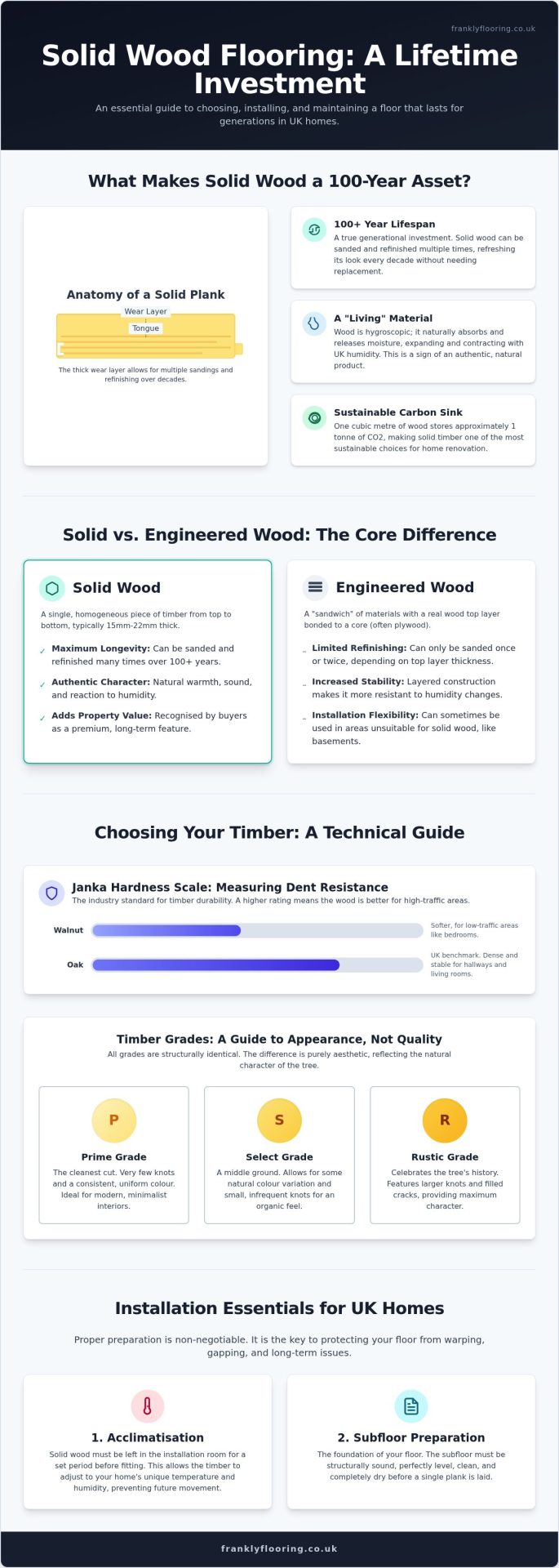
At its most basic level, wood flooring in its solid form is exactly what the name suggests. While many modern alternatives are a sandwich of different materials bonded together, solid wood flooring is a single, homogeneous piece of timber from the surface right down to the base. Typically, these planks are cut to a thickness between 15mm and 22mm. This isn’t just about a heavy feel underfoot; it’s about decades of potential. Because the entire plank is made of the same high-quality wood, you can sand it back and refinish it multiple times. In a typical UK home, a well-maintained solid floor can easily last 100 years, making it a generational investment rather than a temporary design choice.
The Anatomy of a Solid Wood Plank
Most solid planks use a traditional tongue and groove system. This profile allows the boards to slot together tightly, providing a stable surface while allowing for the natural expansion that real wood requires. The thickness of the board determines the “wear layer,” which is the amount of wood available above the tongue that can be sanded down during renovations. A 20mm board offers a significant wear layer, meaning you can refresh the look of your room every decade without ever needing to replace the material. Whether you choose narrow strips for a classic cottage feel or wide planks to create a sense of modern space, the structural integrity remains identical.
Why Solid Wood is a “Living” Material
Wood is hygroscopic. This is a technical way of saying it breathes. It absorbs and releases moisture based on the humidity levels in your home. In the UK, where our weather is famously unpredictable, your floor will naturally expand and contract. This isn’t a defect; it’s a sign of an authentic, natural product. We believe in being frank about these realities. You might see tiny gaps appear in the winter when the central heating is cranked up and disappear in the humid summer months. From an environmental perspective, solid timber is also a carbon sink. Research shows that one cubic metre of wood can store approximately 1 tonne of CO2, making it one of the most sustainable choices for a conscious renovation.
There’s a psychological weight to real timber that synthetic imitations simply cannot match. It isn’t just about the visual grain. It’s the unique sound of a footfall and the natural warmth underfoot that creates a foundational sense of character. For UK buyers, a solid wood floor is often a shorthand for quality. It signals that you’ve invested in the fabric of the building. This often translates into a higher resale value and a faster sale because buyers recognise they won’t need to replace the flooring for a lifetime.
Choosing Your Timber: Species, Grades, and Finishes Explained
Choosing the right species for your solid wood flooring involves more than just matching a colour swatch to your curtains. It’s a technical decision that affects how your floor handles daily life. We believe in transparency, so let’s look at the numbers. The Janka scale is the industry standard for measuring timber hardness. It determines how much pressure a plank can take before it dents. According to technical standards from the National Wood Flooring Association, knowing these ratings helps you decide if a timber is fit for a busy hallway or better suited for a quiet bedroom.
Oak remains the UK’s benchmark for stability. It’s a dense hardwood that resists the seasonal shifts of our climate better than many exotic alternatives. Walnut offers a luxurious, dark aesthetic, but it’s naturally softer. If you have large dogs or young children, an Oak floor with a textured finish will likely serve you better over the long term. Exotic timbers like Acacia or Merbau provide striking visuals, but they can be temperamental if your home’s humidity isn’t strictly controlled.
Understanding Timber Grades: Prime vs. Rustic
Timber grading is often where the most confusion happens. It’s not a measure of quality, but of appearance. A “Prime” board is structurally identical to a “Rustic” one; they just look different.
- Prime Grade: This is the cleanest cut. You’ll see very few knots and a consistent colour across the floor. It’s perfect for minimalist or modern interiors.
- Select Grade: A middle ground that includes some natural colour variation and small, infrequent knots. It feels more organic without being overwhelming.
- Rustic Grade: This celebrates the tree’s history. You’ll find large knots, filled cracks, and significant grain patterns. It offers the most “Frank” character and is incredibly forgiving of everyday wear and tear.
Surface Textures and Character
The feel of the wood is just as vital as the species. A brushed finish involves removing the softer springwood from the surface, leaving the tougher grain exposed. This creates a tactile surface that hides scratches beautifully. If you’re fitting out a new build and want “instant heritage,” distressed or hand-scraped planks provide a weathered look from day one. Most of our planks feature bevelled edges. These small V-grooves between boards aren’t just for show; they help disguise the natural movement of the timber as it reacts to humidity. If you want to see how these textures look in your own light, you can browse our curated wood collection to find your perfect match.
Your choice of finish determines your maintenance routine. A lacquered floor acts like a shield, sitting on top of the wood to provide a hard-wearing barrier against spills. An oiled finish, however, soaks into the grain. It provides a more natural, matte look and allows for “spot repairs.” If you scratch an oiled floor, you can often sand and re-oil just that small area. With lacquer, you’d usually need to sand and reseal the entire room to get a seamless repair.
Solid Wood vs. Engineered Wood: Making the Frank Choice
Choosing between solid and engineered options often comes down to a trade-off between absolute longevity and modern practicality. While solid wood flooring is a single, thick plank of timber, engineered boards are built like a sandwich. They feature a top layer of real wood bonded to multiple layers of plywood or high-density fibreboard (HDF). This multi-layered core is designed for stability. It limits the wood’s natural urge to expand or contract when the temperature shifts, which is a common occurrence in UK homes. If you want a floor that your grandchildren will walk on, solid timber wins. It can be sanded down and refinished far more times than an engineered board. However, this longevity comes with a responsibility. Solid wood is a pure, natural product that reacts to its environment. It requires more careful monitoring of your home’s humidity to prevent the boards from moving too much.
Engineered wood is often the ‘set and forget’ choice for many, but it won’t last the century that a solid plank can. Solid wood flooring thrives in environments where humidity is controlled, but it can be temperamental in the wrong setting. We believe in being direct about where these materials belong. A solid floor is a statement of heritage, best suited for upper-floor living rooms and bedrooms where environmental conditions remain relatively steady. For other areas of the home, the choice becomes more about technical limitations than aesthetic preference.
The Underfloor Heating (UFH) Reality Check
We need to be direct here: we generally advise against using solid wood over underfloor heating. Because it is a single thick block, it acts as an insulator, making your heating less efficient. More importantly, the intense, direct heat causes the wood to dry out too quickly. This leads to ‘cupping’, where the edges of the board rise, or ‘crowning’, where the centre bulges. If you have UFH, engineered wood flooring is the safe, stable alternative that won’t fail under pressure.
Moisture and Humidity: The Solid Wood Enemy
Bathrooms and kitchens are high-risk zones. Spills, steam, and fluctuating moisture levels can cause solid timber to swell and eventually rot or buckle. For these areas, we recommend looking at What Is LVT Flooring? instead. It provides the wood look with total waterproof security. Similarly, if you’re fitting out a basement or a ground floor with a history of dampness, solid wood is likely to struggle. The “Frank” recommendation is to always test your subfloor moisture levels before committing to a solid installation, as ignoring the ground conditions is the fastest way to ruin a premium investment.
The Installation Reality: Acclimatisation and Fitting
Installing solid wood flooring is not a weekend DIY project for the faint-hearted. While some retailers might suggest it’s a simple process, the reality is far more technical. If you rush the fitting, you’re essentially gambling with a premium product. The most critical step starts long before the first plank is laid: acclimatisation. You must leave your timber in the room where it will be installed for at least 7 to 14 days. This allows the wood to adjust to the specific temperature and humidity of your home. Skipping this step is the primary cause of boards buckling or shrinking shortly after installation.
A floor is only as good as what’s underneath it. Your subfloor must be dry, level, and structurally sound. Unlike engineered boards or laminate, solid wood cannot be “floated” over an underlay. Because the timber moves so much, it must be physically secured to the subfloor. This is usually done through secret nailing into a wooden subfloor or using a full adhesive bond on concrete. These methods keep the floor stable while allowing for the natural internal stresses of the wood. If you’re ready to start your project with the right materials, you can view our range of solid timber planks and accessories to get the job done properly.
Testing Subfloor Moisture Levels
For concrete bases, a moisture test is non-negotiable. Using a hygrometer ensures the moisture levels are low enough to prevent the wood from absorbing dampness from below. We also recommend a high-quality damp proof membrane (DPM) to act as a permanent barrier. When you are choosing the right underlay, ensure it is specifically rated for solid timber to provide the necessary structural support and moisture protection.
The Importance of Expansion Gaps and Scotia
Every room needs an expansion gap around the entire perimeter. As a rule of thumb, this gap should be at least 12mm to 15mm, depending on the room’s total width. Without this breathing room, the floor will have nowhere to go when it expands in the summer, leading to “heaving” in the centre of the room. You can hide these gaps using skirting boards or scotia beading for a professional finish. Don’t forget that this gap must continue through doorways, which requires the use of proper door bars to transition between different areas without restricting movement.
We’ve spent 20 years seeing what happens when these rules are ignored. A solid wood floor is a living material that needs space to breathe. By respecting the technical requirements of the installation, you ensure that your investment remains flat, silent, and beautiful for its entire 100-year lifespan. It isn’t just about making it look good on day one; it’s about making sure it still looks good in year fifty.
Investing in Character: Why Buy From Frankly Flooring?
Buying solid wood flooring is a significant decision. You aren’t just choosing a surface; you’re choosing a foundational element of your home’s character. At Frankly Flooring, we operate differently from high-street retailers. Our online-only model is a deliberate choice to cut out the massive overheads of physical showrooms, a strategy that prioritises Direct Product Sales to deliver maximum value to the customer. This allows us to deliver premium, sustainably sourced timber at prices that are fair and transparent. We don’t believe in high-pressure sales tactics. Instead, we rely on our 20 years of industry experience to guide you toward the right product for your specific room.
Our “Frank” promise is simple: we’ll tell you if a product isn’t right for your project. As we discussed earlier, solid timber has specific technical requirements. If you’re planning to install it over underfloor heating or in a damp basement, we’ll be direct and advise against it. We value your long-term satisfaction over a quick win. We only stock products we’d be proud to install in our own family homes, ensuring every plank meets our standards for grain quality and structural integrity. This commitment to excellence is why we focus on high-quality timber that can be a part of your home’s history for a century.
The Value of Family-Run Service
Being a family-run business means our advice is personal and grounded. We understand that a UK-wide delivery of heavy timber pallets needs careful coordination. We don’t just drop a pallet and disappear; we provide the support you need to ensure your floor is cared for years after the initial installation. Whether you need advice on the best oil for a refresh or help understanding the nuances of your specific timber grade, our team provides a level of technical depth that larger, corporate entities often skip. We take pride in the craftsmanship of our products and the success of your renovation.
Next Steps: Samples and Planning
Before you commit to a full order, we always recommend ordering samples. Wood is a natural material, and the grain pattern will look different under your specific home lighting compared to a digital screen. When you’re ready to plan your installation, remember the 10% waste rule. For solid wood installations, you need this extra margin to account for end-cuts and the natural variation found in authentic timber. Planning for this waste from the start prevents mid-project delays and ensures a seamless finish across your entire space. It’s a small technical detail that makes a massive difference in the final result.
Ready to find a floor that lasts a lifetime? Browse our full range of solid wood flooring and discover the beauty of authentic timber for your home.
Building a Foundation That Lasts a Century
Investing in solid wood flooring is a decision that pays dividends for decades. We’ve covered the essential technical realities, from the importance of choosing the right timber grade to the non-negotiable rules of acclimatisation and subfloor preparation. When you respect the natural characteristics of real wood, you create a surface that doesn’t just sit in a room but becomes part of its history.
Our team at Frankly Flooring is here to ensure you get it right the first time. We leverage over 20 years of family-run expertise to provide the honest, transparent advice you need to make an informed choice. We skip the high-street markups and offer direct-to-home UK delivery, ensuring you get premium quality without the unnecessary middleman costs. It’s about giving your home the quality it deserves with a straight-talking approach you can trust.
Browse our Solid Wood Flooring range and order your Frank samples today. We look forward to helping you build a floor that truly lasts a lifetime.
Frequently Asked Questions
Can I install solid wood flooring in a kitchen?
We generally advise against installing solid wood in a kitchen. Kitchens are high-moisture zones with frequent spills and humidity changes from cooking. Solid wood flooring is a living material that absorbs this moisture, which often leads to swelling or warping. If you want the look of real timber in a kitchen, engineered wood or LVT is a far more stable and practical choice for your home.
How long does solid wood flooring need to acclimatise?
Solid wood flooring requires a minimum of 7 to 14 days to acclimatise before installation. You should store the planks flat in the room where they will be fitted, with the heating set to a normal living temperature. This period allows the timber to reach an equilibrium with the local humidity. This prevents the boards from shrinking or expanding excessively once they are secured to your subfloor.
Is solid wood flooring compatible with underfloor heating?
No, solid wood is not compatible with underfloor heating systems. The direct heat causes the thick timber planks to dry out too quickly, which results in cupped edges or structural failure. We always recommend using engineered wood for any project involving underfloor heating. Its layered construction is specifically designed to handle temperature fluctuations without losing its shape or integrity.
How many times can you sand and refinish solid wood floors?
You can typically sand and refinish a solid wood floor between 5 and 10 times over its lifespan. This depends on the initial thickness of the plank and the depth of the wear layer above the tongue and groove. Because you are working with a single block of timber, a 20mm board provides enough material to refresh the surface every decade for a century or more.
What is the difference between Rustic and Prime grade wood?
The difference lies entirely in the visual character of the timber rather than its structural quality. Prime grade features a clean, uniform appearance with minimal knots and consistent colour. Rustic grade celebrates the tree’s natural history, including large knots and significant grain variation. Choosing between them is a matter of your personal aesthetic preference rather than a difference in durability.
How do I clean and maintain solid wood floors without damaging them?
Regular maintenance starts with sweeping or vacuuming with a soft brush attachment to remove grit that can scratch the surface. Use a well-wrung, damp mop rather than a soaking wet one, as standing water can damage the timber. We recommend using pH-neutral wood cleaners specifically designed for your floor’s finish to preserve the protective seal and keep the grain looking vibrant.
Why is my solid wood floor gapping in the winter?
Gapping usually occurs in the winter because central heating dries out the air, causing the natural timber to contract. This is a normal characteristic of a living material reacting to its environment. Once the heating is turned off and the spring humidity returns, the boards will typically expand back to their original positions. Maintaining a consistent indoor humidity level can help minimise these seasonal shifts.
Do I need a professional to fit solid wood flooring?
We strongly recommend hiring a professional installer for solid wood flooring projects. Unlike laminate or engineered boards, solid timber must be physically bonded or secret-nailed to the subfloor, which requires specialised tools and technical knowledge. A professional will also conduct essential moisture tests on your subfloor. This ensures the installation doesn’t fail due to rising dampness or improper expansion gaps.