
Your floor might be the only thing standing between you and a truly efficient home. While underfloor heating can use up to 40% less energy than traditional radiators, the wrong surface material will act as an insulator, trapping heat where you don’t need it. If you are trying to decide what flooring is best for underfloor heating, you have to look beyond the surface aesthetics. With the 2026 Future Homes Standard now influencing how we heat our spaces, choosing a material with high thermal conductivity is no longer a luxury; it is a necessity for keeping energy bills manageable.
It’s natural to worry about wood floors warping under heat or whether a thick carpet will block the warmth entirely. You want a home that feels cosy without the fear of your floorboards gapping or your system working overtime. This guide cuts through the jargon to give you straight answers on heat transfer and material durability. We will walk you through the Tog ratings for carpets, the stability of engineered wood, and why LVT is often the smartest choice for modern systems, giving you the confidence to finish your project right.
Key Takeaways
- Learn how thermal conductivity determines efficiency and why dense materials like LVT and stone offer the fastest heat-up times.
- Discover exactly what flooring is best for underfloor heating to ensure your system meets the energy efficiency standards of the 2026 Future Homes Standard.
- Get the frank truth on timber, including why engineered wood is the only reliable choice for preventing heat-related warping or gapping.
- Use the 2.5 Tog rule to select carpets and underlays that provide comfort without insulating your home against its own heating system.
- Prepare for a successful project by mastering the essential steps of moisture testing and material acclimatisation before you begin.
How Heat Moves: The Science of Thermal Conductivity
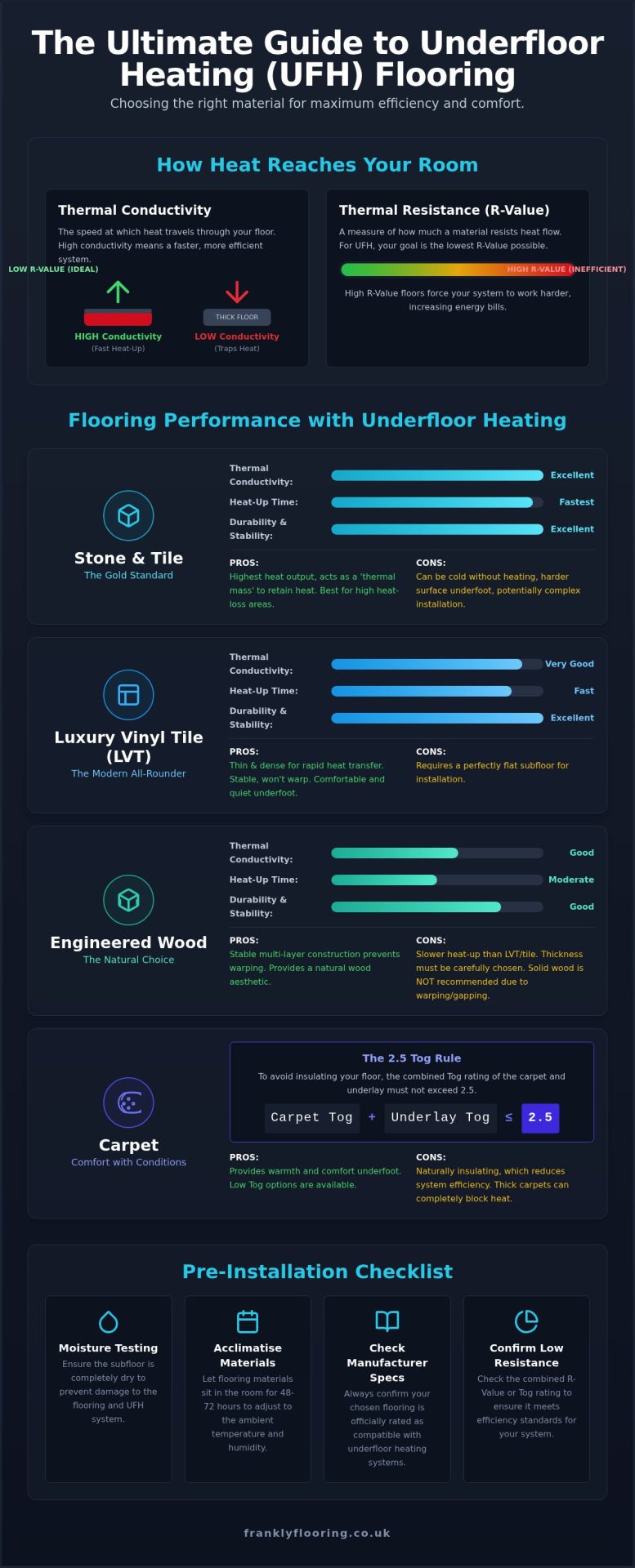
Thermal conductivity is effectively the speed limit for heat. It dictates how quickly the energy from your heating system reaches the surface of your floor and, ultimately, your feet. If you choose a material with poor conductivity, you are essentially placing a thermal blanket over your heater. This forces your system to run longer and hotter to achieve a comfortable room temperature. When homeowners ask what flooring is best for underfloor heating, they are really asking which material offers the least resistance to energy flow. You can explore the technical principles of how these systems distribute warmth through The Science of Thermal Conductivity, which highlights why conduction is the primary driver of comfort in a heated floor.
Why Material Density Matters for UFH
Density is your best friend. In practical terms, dense materials like stone, porcelain, or high-quality Luxury Vinyl Tile (LVT) have a tightly packed molecular structure with very few air pockets. Air is a poor conductor; it’s why we use it in loft insulation to trap heat. In a floor, those same air pockets act as a barrier. Stone and ceramic are the undisputed champions because they absorb and emit heat almost immediately. Modern LVT has been engineered to mimic this performance. Because it’s thin and dense, it allows for a rapid response time. This means your room reaches its target temperature much faster than it would with thick timber or heavy carpets, which have a looser molecular structure that slows down the transfer of energy.
Understanding the R-Value and Energy Efficiency
You will often see ‘R-Value’ or ‘Thermal Resistance’ mentioned in manufacturer data sheets. It’s a simple concept: the higher the R-Value, the more the material resists the flow of heat. For a high-performance underfloor system, your goal is the lowest R-Value possible. This is vital because the UK’s Building Regulations now require new water-based systems to operate at a maximum flow temperature of 55°C. If your floor has high resistance, that lower flow temperature might struggle to push enough warmth into the room. Choosing the wrong material doesn’t just result in cold toes; it makes your system work twice as hard. This leads to higher energy bills and unnecessary wear on your heat pump or boiler. Always check the specific thermal data for your chosen product to ensure it’s up to the task.
Thickness also plays a significant role in the daily performance of your heating. While a very thick stone slab might eventually get warm and hold that heat for a long time, the initial “warm-up” time can be frustratingly slow. For most UK homes, finding the sweet spot between density and a manageable thickness is the key to a responsive, energy-efficient system. Understanding what flooring is best for underfloor heating starts with choosing a material that works with your system rather than fighting against it.
The Efficiency Winners: Stone, Tile, and LVT Flooring
If you want the absolute highest efficiency from your system, stone and porcelain are the gold standard. They possess the highest thermal conductivity of any floor covering available. However, for most UK homeowners, the decision often comes down to a balance between raw performance and practical daily use. When determining what flooring is best for underfloor heating in a busy household, Luxury Vinyl Tile (LVT) has quickly become the modern frontrunner. It offers a unique combination of rapid heat transfer and a surface that feels comfortable underfoot even when the heating is turned off.
Why LVT is the Modern Favourite for UFH
LVT is incredibly thin, usually ranging between 2mm and 6mm in thickness. This thin profile is its greatest asset because it offers very little resistance to the rising heat. It allows your room to warm up almost as quickly as it would with a tiled floor, but without the technical challenges of heavy stone. It’s also a remarkably stable material. Unlike natural timber, it won’t expand or contract significantly as the temperature rises and falls. If you are new to this material, you can read our guide on what is lvt flooring to understand how its layers are specifically constructed for long-term durability in heated environments.
Stone and Ceramic: Maximum Heat Output
In rooms with high heat loss, such as conservatories or older extensions, stone and ceramic tiles are often the only way to meet the required heat output. They provide a ‘thermal mass’ effect, meaning they act like a storage heater by holding onto warmth long after the system has powered down. This is a core part of Preparing Your Home for UFH Flooring, as you must ensure your subfloor can handle the additional weight and that any building regulations regarding U-values are met. While stone is unmatched for heat, it does require a more intensive installation process compared to click-system alternatives.
Both stone and LVT are exceptionally durable and won’t dry out or crack under constant heat stress. For those who love the look of oak but worry about the technical limitations of timber, LVT is the most frank choice we can recommend. It gives you the aesthetic of wood with the thermal performance of a hard surface. Knowing what flooring is best for underfloor heating allows you to invest in a finish that won’t degrade under the constant cycle of heating and cooling. If you’re ready to see how these materials look in person, you can browse our latest UFH-compatible collections to find the right fit for your project.
Engineered Wood and Laminate: Style Without the Warp
There is a lot of misinformation regarding timber and heat. If you are looking for the frank truth, here it is: never use solid wood with underfloor heating. Solid wood is a natural, “living” material that reacts to changes in temperature and humidity by expanding and contracting. When placed directly over a heat source, these planks will inevitably warp, cup, or develop unsightly gaps. When considering what flooring is best for underfloor heating for a timber aesthetic, you must look at engineered alternatives that have been specifically built to handle the stress of a heated subfloor.
Engineered Wood vs Solid Timber
Engineered wood is the only reliable choice for timber lovers. Unlike solid planks, engineered boards are constructed from multiple layers of wood pressed together in a cross-grain pattern. This structure creates a stable core that resists the natural urge to move when the heating kicks in. For the best balance between a premium feel and thermal efficiency, we recommend a thickness of 14mm to 15mm. This is the “sweet spot” where the floor feels solid underfoot but isn’t so thick that it blocks the heat. You can find more detail on selecting the right grade and finish in our Engineered Wood Flooring guide.
Laminate Flooring and Heat Stability
Laminate is often overlooked in UFH discussions, but it is a surprisingly high-performance option. Most modern laminates use a High-Density Fibreboard (HDF) core. Because this core is so dense, it conducts heat better than many people expect. It is also incredibly stable. The click-system installation used for laminate allows the entire floor to move as a single unit, which is vital for managing the slight expansion that occurs during a heating cycle. It’s an excellent, budget-friendly way to get the look of real wood without the maintenance concerns. For a closer look at the best options for UK homes, check out our Laminate Flooring UK guide.
Regardless of whether you choose engineered wood or laminate, you must respect the 27°C limit. Most manufacturers specify that the floor surface temperature should never exceed 27°C. Exceeding this can dry out the material too quickly, leading to structural damage over time. Most modern thermostats include a floor probe to manage this automatically. When you understand what flooring is best for underfloor heating, you realize that success isn’t just about the material; it’s about staying within these technical boundaries to protect your investment for the long term.
Can You Have Carpet with Underfloor Heating?
Many homeowners assume carpet is off-limits for underfloor heating. It’s a common misconception, but there is a grain of truth to the worry. Carpet is a natural insulator. If it’s too thick, it will trap the warmth beneath the floor, preventing it from reaching the room and causing your boiler or heat pump to work much harder than necessary. While it might not be what flooring is best for underfloor heating in terms of raw thermal efficiency, you can certainly make it work by paying close attention to technical specifications and material density.
Navigating Tog Ratings for Carpets
Tog is the standard measure of thermal resistance in textiles. The general industry rule for underfloor heating is that the combined Tog rating of your carpet and underlay should not exceed 2.5. If you go beyond this limit, the system will struggle to overcome the “thermal blanket” you’ve laid over it, leading to slow response times and higher energy bills. For a successful installation, we suggest looking for carpets with a rating of 1.5 Tog or lower. This leaves enough “thermal head room” for a high-quality underlay. You can find more advice on balancing comfort and performance in our guide to choosing the right carpet.
Material choice is equally important for heat flow. Synthetic carpets, such as polypropylene or nylon, generally have better thermal conductivity than 100% wool. Wool is a fantastic insulator, which is usually a benefit in a traditional home, but in a UFH setup, it can be too effective at blocking heat. An 80/20 wool-synthetic blend is often a good middle ground. It provides the luxury of natural fibres while allowing enough heat to pass through to keep the room comfortable during the colder months.
The Secret Ingredient: UFH-Specific Underlay
Your underlay is just as critical as the carpet itself. Standard crumb rubber or thick felt underlays are designed to trap air, which makes them terrible for heat transfer. Instead, you should look for specialist “low-tog” or perforated underlays. These are specifically manufactured with a higher density and a thinner profile to let heat pass through while still providing the cushioned feel you expect. Tog is essentially the measure of how much a material resists heat, so a low-tog underlay is your secret weapon for efficiency.
Backing also plays a significant role in how well your room warms up. Hessian-backed carpets are much better than felt-backed options because the weave is more open, allowing warmth to rise more freely from the subfloor. Avoid felt-backed carpets where possible; they add an extra layer of insulation that your heating system will have to fight against every single day. If you’re ready to find a carpet that won’t block your warmth, shop our range of UFH-compatible carpets and underlays today to ensure your home stays both cosy and efficient.
A Frank Checklist: Preparing Your Home for UFH Flooring
Choosing the right material is only half the battle. Even after you have identified what flooring is best for underfloor heating for your specific project, the installation phase is where the long-term success of your floor is decided. Underfloor heating creates a unique environment that puts constant stress on adhesives and material structures. If you rush the preparation, you risk seeing your beautiful new floor buckle, gap, or delaminate within the first few months of use. Success depends on a stable, dry, and patient approach to the subfloor.
Subfloor Preparation and Moisture
Moisture is the silent enemy of any flooring project, but underfloor heating accelerates the damage. If you lay your floor over a damp screed, the heat will draw that moisture up, trapping it directly beneath your floor covering. This lead to bubbling in LVT or structural failure in engineered wood. You must use a hygrometer to check the Relative Humidity (RH) of your subfloor. For a safe installation, the RH needs to be below 75% before you begin. Using high-quality smoothing compounds and primers is also essential. These products ensure a perfectly flat surface and a reliable bond that won’t degrade when the temperature starts to rise.
Acclimatisation and Initial Heat-Up
Your new floor needs to “live” in the room before it is laid. We recommend leaving your flooring in the target room for at least 48 to 72 hours. This allows the material to reach the same temperature and humidity levels as the space it will inhabit. Keep the packs flat and stacked neatly to prevent any bowing. Once the floor is installed, the “First Heat” protocol is non-negotiable. You should never jump straight to your target temperature on day one. Start by turning the system on at a low setting and increase the temperature by just 1 or 2 degrees Celsius per day. This gradual process allows the floor and any adhesives to settle without the shock of sudden thermal expansion.
Expansion gaps are always necessary, but they are absolutely critical when underfloor heating is involved. Heat causes materials to expand more than they would in a traditionally heated room. Without a sufficient gap around the perimeter, your floor will have nowhere to go, leading to “peaking” or “tenting” at the joints. Ensure your installer leaves the manufacturer-recommended gap, usually between 10mm and 15mm, which can be hidden by skirting boards. When you understand what flooring is best for underfloor heating and pair it with these preparation steps, you ensure a finish that looks great and performs efficiently for decades.
Ready to Warm Up Your Home?
You now have the technical knowledge to make an informed choice for your renovation. Remember that density and a thin profile are your best friends for efficiency, making LVT and stone the undisputed top performers. If you prefer the look of timber, stick to engineered boards to avoid the warping issues common with solid wood. When deciding what flooring is best for underfloor heating, always prioritise low thermal resistance and proper subfloor preparation to protect your investment for the long term.
We are a family-run UK business with over 20 years of experience, and we include expert advice on every product page to help you choose with confidence. From initial inspiration to national UK delivery, we are here to support your project every step of the way. Browse our UFH-compatible LVT and Wood Flooring ranges today to find a style that matches your home’s character.
Transforming your space with underfloor heating is one of the best ways to improve both comfort and energy efficiency. With the right materials and a patient installation, you’ll enjoy a warm, beautiful floor that stands the test of time.
Frequently Asked Questions
Is LVT better than laminate for underfloor heating?
LVT is generally superior to laminate because it has a thinner profile and higher density. This allows for faster heat transfer and a more responsive system. While modern laminate is a stable choice, LVT’s molecular structure allows it to react more quickly to temperature changes. This efficiency is why many experts suggest LVT when asked what flooring is best for underfloor heating in high-traffic areas like kitchens and hallways.
Can I put underfloor heating under existing floorboards?
You can install specific “between-joist” systems under existing floorboards, but it is rarely the most efficient method. Solid timber boards are natural insulators and may warp or gap when heat is applied directly from below. If you want to keep your original floor, you must ensure the boards are well-seasoned and that you have adequate insulation beneath the heating elements to prevent heat from escaping into the floor void.
What is the maximum Tog rating for carpet with underfloor heating?
The combined Tog rating for your carpet and underlay should not exceed 2.5. Going above this limit creates a thermal barrier that prevents warmth from entering the room effectively. For the best results, look for a carpet with a rating of 1.5 Tog or less. This leaves enough room for a specialist low-tog underlay. It ensures your home stays warm without forcing your boiler or heat pump to work overtime.
Does underfloor heating work with solid oak flooring?
We strongly advise against using solid oak or any solid timber with underfloor heating. The natural moisture content in solid wood makes it prone to significant movement as it heats and cools. This leads to cupping, bowing, or large gaps between the planks. If you love the look of oak, engineered wood is the frank choice. Its multi-layered construction provides the stability needed to handle temperature fluctuations without failing.
How long should I wait to turn on UFH after laying a new floor?
You should typically wait at least 48 hours for floating floors and up to a week for floors that require adhesive or screed. Once that period has passed, you must increase the temperature gradually by 1 or 2 degrees Celsius per day. Cranking the heat up to maximum immediately can shock the material. This often causes the adhesive to fail or the boards to warp, leading to expensive repairs later.
Will underfloor heating damage my vinyl flooring?
Modern Luxury Vinyl Tile (LVT) is designed to withstand heat, provided you don’t exceed the manufacturer’s limit, which is usually 27°C. Using a floor probe with your thermostat is essential to prevent hotspots. When people ask what flooring is best for underfloor heating, LVT is a top recommendation. It is incredibly stable and won’t dry out or crack like traditional sheet vinyl might under the stress of a constant heating cycle.
Do I need a special underlay for underfloor heating?
You must use a specialist underlay with low thermal resistance. Standard underlays are often designed to act as insulators, which is exactly what you want to avoid with a heated floor. Look for products specifically labelled as “UFH-compatible” or those with a very low Tog rating. These are often denser or perforated to allow heat to pass through freely while still providing the necessary cushioned support for your floor covering.
What is the best flooring for water-based underfloor heating?
Stone and porcelain tiles are the most efficient choices for water-based systems because they have the highest thermal conductivity. However, LVT is a popular alternative for UK homeowners due to its thin profile and ease of installation. Both materials allow the lower flow temperatures of modern hydronic systems to heat the room effectively. This ensures your home stays comfortable while keeping your daily energy bills as low as possible.