
Click-lock vinyl plank is usually the easiest flooring to install yourself. If you’re asking what the easiest flooring is to install yourself, start with this option: the planks lock together without the more involved fitting methods used for some other floors. Click-lock laminate is another approachable choice, though it takes a little more care.
It’s understandable to want a floor you can fit yourself, but an easy locking system won’t compensate for a poorly prepared surface. The subfloor needs to be clean, level and dry, and preparation depends on the flooring and the room. Getting this right helps prevent problems during installation.
This guide compares beginner-friendly flooring options, explains when a floating floor can go over existing tiles, and covers the preparation that makes a DIY fit more manageable. It also outlines how vinyl, LVT, laminate and carpet tiles differ, helping you choose based on the room and the work you’re comfortable taking on.
Key Takeaways
- Floating flooring can go over existing tiles when the surface is flat, sound and clean. Learn how to judge whether your tiles are a suitable base.
- Carpet tiles offer a manageable option for smaller areas, with straightforward cutting and placement.
- Compare click-lock vinyl, laminate and wood flooring to see how fitting methods and preparation affect the DIY job.
- Good subfloor preparation is key to a neater vinyl fit. Explore Frankly Flooring’s LVT options as you weigh up your flooring choice.
1. Can I lay a floating floor over tiles?
Yes, floating flooring can go over existing tiles when they’re flat, sound and clean. First check for loose tiles, raised edges and debris. Unevenness can affect how the new floor sits, so prepare the surface before laying the first plank.
Carpet tiles are another option for a small refresh. Available as peel-and-stick or loose-lay squares, they’re easier to handle than a full carpet roll. Use a sharp knife and straight edge to trim tiles neatly against walls and doorways.
Peel-and-stick carpet tiles can be fitted with a sharp knife, but careful measuring still matters. Work across the floor in a planned pattern, then cut edge tiles to fit. DIY installation is described as a difficulty rating of 2, with fitting estimated at 3–5 hours per room. In a heavy-traffic area, residential carpet tiles may last 5 or 10 years.
According to the Scottish Government, floor coverings are not part of building regulations. This statement concerns Scotland, and tenancy terms are separate. If you rent, follow your tenancy agreement before removing or changing the carpet.
There’s no single DIY carpet cost per square metre. Calculate it using the flooring’s price per square metre and the area to cover, then allow for tools, underlay or adhesive where needed, and offcuts. The room’s shape and fitting method affect how much material you’ll need.
Replacing fitted carpet can be quicker if the underlay and gripper rods are already in place. Start in a smaller space, such as a hallway or bedroom, where the roll is easier to handle. In a larger room, someone helping to hold and position the carpet can make fitting less strenuous.
2. What is the easiest flooring to install?
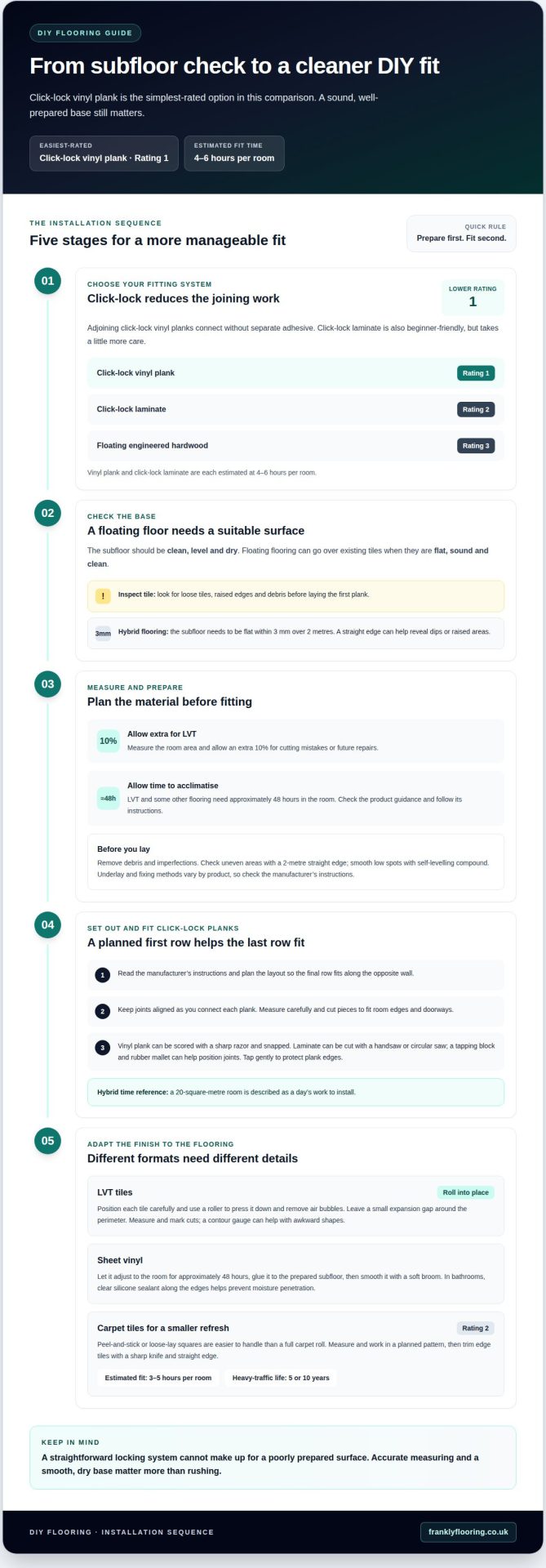
Click-lock vinyl plank is a straightforward DIY choice because adjoining planks connect without separate adhesive. Its difficulty rating is 1, compared with 2 for click-lock laminate. Both systems suit careful beginners, but vinyl plank has the lower rating. Installation is estimated at 4–6 hours per room for either option.
For a neat click-lock fit, plan the layout before joining the first row. Check the manufacturer’s instructions and arrange the planks so the final row fits along the opposite wall. Keep each joint aligned as you connect the next plank. Measure carefully and cut planks to fit at doorways and room edges.
Drop-in-place systems can reduce the work of joining boards, but the floor underneath still matters. Click-lock hybrid flooring needs a subfloor that’s flat within 3 mm over 2 metres. A 20-square-metre room is described as a day’s work to install. A straight edge helps reveal dips or raised areas before fitting begins.
Click-and-lock laminate is another beginner-friendly option. The planks connect mechanically rather than being fixed individually with adhesive, and you can cut them to fit edges or doorways with a handsaw or circular saw. A tapping block and rubber mallet can help bring joints into position. Tap gently to avoid damaging the plank edges.
Choose by matching the system to your room and preparation skills. Vinyl plank has the lower difficulty rating; laminate also offers a click-and-lock method and a similar estimated room installation time. Hybrid flooring adds a firm flatness requirement, so assess the subfloor before deciding. For a closer look at vinyl and laminate flooring, compare the options available for your project.
3. DIY vinyl flooring and subfloor preparation
Measure the room and calculate its square metre area before buying vinyl. For LVT, allow an extra 10% of flooring for cutting mistakes or future repairs. Let the material acclimatise in the room for approximately 48 hours, or follow the manufacturer’s instructions. Some flooring requires a 48-hour acclimation period, so check the product guidance before fitting.
Preparation starts with the subfloor. It needs to be clean, level and dry, with debris and imperfections removed. Check for uneven areas using a 2-metre straight edge. A low spot can disrupt the finished surface, so smooth uneven areas with self-levelling compound before laying the floor.
Separate underlay isn’t automatically required for every vinyl product. Check the manufacturer’s instructions to see whether it’s needed. LVT fixing methods also vary: adhesive may go on each tile or directly onto the subfloor. Follow the specified method for your product rather than treating every material alike.
For LVT tiles, position each piece carefully, then use a roller to press it into place and remove air bubbles. Leave a small expansion gap around the room perimeter. Measure and mark cuts before trimming, especially around door frames, pipes and bathroom fittings. A contour gauge can help you make a template for awkward shapes.
Sheet vinyl needs careful handling too. Leave it in the installation room for approximately 48 hours to adjust to the temperature. Glue it to the prepared subfloor, then smooth it with a soft broom to help prevent bubbles and sagging. In bathrooms, seal vinyl flooring edges with clear silicone sealant to help prevent moisture penetration.
Keep the tools you need close at hand: a tape measure, straight edge, cutting tool, contour gauge, roller or soft broom, and the specified adhesive. Lay out the material before fixing it and work methodically across the room. Accurate measuring and a smooth, dry base matter more than rushing.
4. Comparing vinyl plank with hardwood and laminate
Click-lock vinyl plank is generally the simplest of these options to fit. It can be scored with a sharp razor and snapped, making straight cuts less involved than cutting wood. Floating engineered hardwood has a difficulty rating of 3, while click-lock laminate is rated 2. Those ratings offer a useful guide, but the floor’s condition and room shape still affect the work.
Laminate uses a click-and-lock system, so planks join without fixing each one separately to the subfloor. Before installation, let the boards acclimatise in the room for at least 48 hours. The subfloor should be clean, level and dry. Leave a small expansion gap around the perimeter, allowing the floor to move as conditions change.
Vinyl plank and laminate can both be installed as floating floors, but they’re cut differently. Vinyl plank can often be scored and snapped; laminate may need a handsaw or circular saw for edges and doorways. A tapping block and rubber mallet can help join laminate planks. Use controlled taps to avoid damaging their edges.
Engineered hardwood takes more time and care. Floating installation is estimated at 6–8 hours per room for a DIYer, and its difficulty rating is higher than laminate’s. Board width can also affect fitting speed: 5-inch-wide flooring is easier to install than 3-inch-wide flooring. Consider how much cutting and joint fitting you’re prepared to manage.
For floating floors, leave at least a 1/4-inch expansion gap around walls and fixed objects. Keep the gap consistent, then cover it with the appropriate finishing trim. This detail matters for laminate as well as other floating flooring, because boards need room to move rather than pressing tightly against the room’s edges.
Choose vinyl plank for simpler cutting, laminate for a click-lock fit, or engineered hardwood if you’re comfortable with a longer installation. Compare vinyl and laminate flooring to find a material that suits your room and DIY approach.
Frankly Flooring: LVT
Frankly Flooring sells LVT for readers considering a practical flooring option after comparing DIY fitting methods. If you’re leaning towards LVT, weigh the room, subfloor condition and product fitting instructions together. The right choice depends not only on how the planks connect, but also on whether the surface is suitable and what preparation the product requires.
Compare the available LVT options with your project needs before deciding. Awkward edges or fittings may require more careful measuring and cutting than a simple rectangular room. Consider these details alongside the flooring type, rather than choosing on fitting method alone.
Explore LVT at Frankly Flooring, or visit franklyflooring.co.uk to browse the range.
Choose a floor that suits the way you live
Choosing the easiest flooring to install yourself means looking beyond the fitting method. Consider how you use the room, the finish you want and the preparation you’re comfortable doing. A practical choice should suit your home after installation, not just feel manageable on fitting day.
Before choosing, measure the room and note its doorways, alcoves and fixed features. These affect how much cutting and careful fitting the job involves. Consider how the floor will meet adjoining rooms, too, so your choice works with the surrounding spaces.
Frankly Flooring sells LVT, wood and carpet, giving you different materials to compare with your room’s needs and preferred look. Decide what matters most: comfort underfoot, appearance or a DIY process you feel confident managing. Those priorities can help narrow your options.
For advice as you consider your flooring choices, contact Frankly Flooring for advice. Take the next step when you’re ready, with a clearer idea of what will work in your home.
Frequently Asked Questions
What is the easiest flooring to install?
Click-lock vinyl plank is generally the easiest choice for a beginner. Its joined planks form a floating floor, so you don’t need to spread adhesive across the room. In a simple rectangular room, plan the starting row carefully and keep the joints aligned as you work. Doorways, narrow sections and uneven surfaces still require extra cutting and preparation, even with an easy-fit system.
Can I lay a floating floor over tiles?
Yes, if the existing tiles are flat, sound and clean. For example, a firm tiled kitchen floor can provide a base for floating flooring if there are no loose or raised tiles. Check the whole area, including edges and thresholds. Address any damaged or uneven sections first, because the new floor follows the shape of its base.
How long does it take to lay 50 square metres?
A professional can lay 50 square metres of floating flooring in a day. A DIY job takes longer to plan and complete, particularly if the room has alcoves, several doorways or awkward cuts. The product’s fitting system and the amount of preparation also affect progress. Measure and clear the area beforehand to spend more time fitting and less time moving obstacles.
How to Decide: DIY or Call a Pro?
DIY is well suited to a room with a sound base, a straightforward shape and a flooring system you can cut and join confidently. Consider professional fitting if the subfloor needs substantial levelling, the room has complex edges or the material requires precise adhesive work. Also consider whether you have the tools and time to prepare the space properly, not just fit the visible floor.
What type of flooring is easiest to install yourself?
Click-lock vinyl plank is a practical starting point for self-installation. Peel-and-stick tiles can suit a small, uncomplicated area, while carpet tiles are manageable squares for targeted replacements. Choose according to the room: a porch may need a different material from a busy living space. Check the fitting method and surface requirements before choosing based on appearance alone.
Is click-lock vinyl plank flooring easier to install than laminate?
Click-lock vinyl plank is generally easier to install than click-lock laminate. Your choice may also depend on the cuts the room requires: vinyl plank can be scored and snapped, while laminate may need a handsaw or circular saw at the edges. If the room has several door frames, include careful measuring and cutting in your plan for either material.