
Most “stain-proof” claims are nothing more than a temporary surface spray that wears off before your toddler hits their next growth spurt. It’s a bold statement, but at Frankly Flooring, we believe in being direct about what you’re putting under your feet. If you’ve ever spent a frantic Saturday scrubbing a pet accident or felt your heart sink as red wine hit the pile, you know that a standard stain resistant carpet often fails right when you need it most. We understand that “shoes-off” anxiety; it’s the result of being sold a promise that doesn’t match the reality of a busy home.
In this guide, I’ll share the honest truth about modern fiber technology and how to spot a carpet that can actually survive real life. You’ll discover why solution-dyed materials are a game-changer for 2026 and which fibers are naturally repellent without the need for harsh chemicals. We’ll also clear up the confusion around “bleach cleanable” claims to help you find a stylish, high-spec floor that offers genuine value for money. By the end, you’ll have the confidence to choose a carpet that stays looking fresh, even in the middle of a chaotic family household.
Key Takeaways
- Distinguish between temporary surface treatments and inherent fibre science so your stain resistant carpet stands up to long-term family use.
- Understand why 100% Polypropylene is the industry standard for stain-heavy areas and how new Polyester blends provide a softer feel without sacrificing resilience.
- Learn what “bleach cleanable” really means and why the wrong cleaning method can ruin your floor’s foundation even if the fibres survive.
- Select the right pile style for your lifestyle, specifically why Twist piles outperform Loop styles in homes with active pets and children.
- Gain practical knowledge on moisture-barrier underlay and the “blot, don’t rub” rule to maintain your floor’s integrity for years to come.
What is Stain Resistant Carpet? Defining the Technology
Let’s get one thing straight: there’s no such thing as a stain-proof carpet. If someone tells you otherwise, they’re likely trying to sell you something you’ll regret in six months. A stain resistant carpet is designed to either repel liquids or resist the penetration of dyes into the core of the fibre. It buys you time to grab a cloth and clean up the mess before it becomes a permanent part of your home’s history. Most modern carpets achieve this through either a chemical coating or the physical properties of the materials themselves.
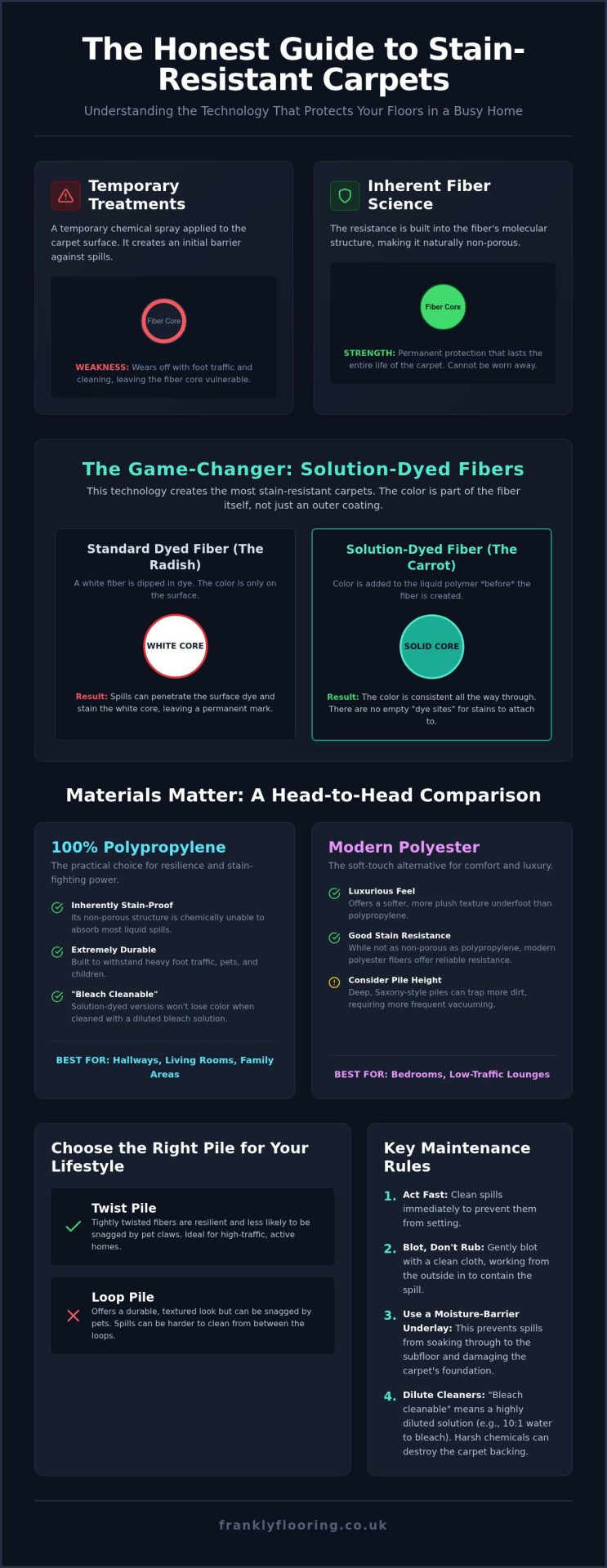
The Frank truth is that resistance is about management, not magic. The most effective technology in 2026 is solution dyeing. Instead of making a white carpet and dipping it in dye, the colour is added to the liquid polymer before the fibre is even created. Think of it like a carrot versus a radish. A radish is only red on the outside; once you scratch it, you see white. A carrot is orange all the way through. This means the colour is locked in, leaving no “dye sites” for that spilled glass of Merlot to latch onto.
Topical Treatments vs. Inherent Fibres
Some manufacturers apply a chemical finish to the surface of the pile. It works much like a non-stick pan, creating a temporary barrier that keeps spills on top. While effective initially, these treatments are surface-level only. Every time you walk across the room, you’re essentially sanding away that protection. In contrast, inherent resistance is built into the Carpet fiber materials. Synthetic options like polypropylene are naturally non-porous. They don’t need a chemical spray to do their job; they’re born ready for the chaos of a family home.
The Science of Repelling Spills
It all comes down to surface tension. When a liquid hits a high-quality synthetic fibre, it should bead up like water on a freshly waxed car. This happens because the material is hydrophobic. Natural fibres like wool are beautiful, but they have microscopic “dye sites” that act like tiny pockets, eagerly soaking up any pigment they touch. Synthetic fibres, especially 100% polypropylene, are the industry leaders for a reason. They have no such pockets. Because the material is essentially a type of plastic, it doesn’t absorb moisture. This makes it much harder for a spill to turn into a permanent stain.
Materials Matter: Polypropylene vs. Treated Polyester
Choosing the right material is where most people get tripped up. You aren’t just picking a colour; you’re picking the chemical foundation of your room. Polypropylene is chemically incapable of absorbing most liquid spills because its non-porous polymer structure has no moisture-receptive sites for dyes or water to bond with. This makes it the undisputed king of easy-clean flooring. While natural fibres like wool are beautiful, they are highly porous and will drink up a spill faster than you can find a paper towel. This is why many modern homes opt for synthetic blends or 100% man-made fibres to achieve a truly stain resistant carpet.
Polypropylene: The Practical Choice
If you have pets that treat the house like a race track or toddlers prone to juice-box disasters, this is your best bet. Because it’s a synthetic polymer, it’s incredibly resilient. Most polypropylene carpets are solution-dyed, meaning the colour is baked into the fibre itself. This allows for incredible colourfastness. You can scrub these carpets with a diluted bleach solution without turning your stylish grey floor white. It’s a straightforward, high-performance option for high-traffic areas like hallways and lounges. For more on how to balance these technical specs with your home’s aesthetic, take a look at our guide on Choosing the Right Carpet.
The Polyester Alternative
Polyester has come a long way. It used to be seen as the budget choice, but modern high-performance polyester offers a soft-touch appeal that polypropylene often lacks. It feels more luxurious underfoot, making it a popular choice for bedrooms where you want that sink-in feeling. There is a trade-off, though. If you choose a deep Saxony pile, you’re creating more surface area for dirt to hide in. While the fibre itself is a stain resistant carpet staple, the physical height of the pile can make it harder to vacuum out dry soil.
Regardless of which material you choose, following carpet maintenance best practices is essential for longevity. Even the best fibres need a bit of help to stay looking their best over twenty years. If you’re ready to see how these materials look in your space, you can browse our full range of carpets online to find the perfect fit for your lifestyle.
Bleach Cleanable Carpets: Myth vs. Reality
The term “bleach cleanable” is one of the most misunderstood phrases in the flooring industry. Many homeowners imagine they can pour a bottle of thick, concentrated bleach onto a spill and watch it vanish. That’s a recipe for disaster. When we talk about a stain resistant carpet being bleach-safe, we’re strictly referring to a solution of diluted thin bleach. Using the wrong type or concentration won’t just void your warranty; it can permanently damage the structure of your floor.
Here is the Frank truth that big-box retailers often gloss over: while the fibres themselves might be immune to the bleach, the carpet backing is not. Most carpets use a secondary backing held together by a latex adhesive. If you over-saturate the pile and that bleach solution reaches the base, it can eat away at the glue. This leads to delamination, where the carpet literally peels away from its foundation. You’ll be left with a stain-free carpet that’s lumpy, buckled, and ruined from the inside out.
| Cleaning Component | Recommended Ratio |
|---|---|
| Thin Household Bleach | 1 Part |
| Lukewarm Water | 10 Parts |
| Application Method | Spray or Blot (Never Soak) |
The Pros and Cons of Bleach-Cleanable Fibres
Bleach-safe fibres are unrivalled when dealing with organic disasters like red wine, coffee, or mud. Because the colour is locked into the fibre, the bleach removes the pigment of the stain without touching the colour of the carpet. However, bleach is useless against oil-based spills. Things like butter, candle wax, or motor oil require specific solvents. If you try to bleach an oil stain, you’ll likely just damage the surrounding area. Always ensure you rinse the area with clear water after cleaning. Leaving bleach residue in the pile can attract dirt, making a “shadow” stain appear weeks later.
When to Use Professional Cleaners Instead
There are times when the DIY approach does more harm than good. If you’re dealing with a “set-in” stain that has already dried, or if you suspect the spill has reached the underlay, stop scrubbing. This is common with pet accidents where “wicking” occurs. You clean the surface, but the moisture stays trapped underneath, only to travel back up the fibres as the carpet dries. While top stain-resistant carpet brands design their products for durability, they still benefit from professional heat-extraction every 12 to 18 months. This process removes the deep-seated grit that acts like sandpaper on your fibres, ensuring your stain resistant carpet actually lasts its full lifespan.
Choosing the Right Style for Your Lifestyle
Picking the right fibre is only half the battle. If you choose a delicate style for a high-traffic area, even the best stain resistant carpet will look tired within a year. For most busy households, a Twist Pile is the undisputed champion. It’s constructed from tightly twisted yarns that stand upright, making it incredibly resilient against crushing and far better at hiding those inevitable footprints. If you have a cat or a dog, I strongly suggest you avoid Loop Pile, often called Berber. While stylish, those loops act like a trap for pet claws. One excited dash from a Labrador can snag a loop and pull a permanent “run” through your entire floor.
Your choice of colour is equally strategic. While solid, minimalist greys are a 2026 staple, they are notoriously unforgiving. Every stray hair or speck of dust stands out like a beacon. Mid-toned “heathered” carpets, which blend several shades of yarn together, are much more forgiving for family life. A speckled or flecked design is a secret weapon against visible lint and crumbs. It creates a visual depth that masks the small bits of debris that accumulate between vacuuming sessions.
High-Traffic Areas: Stairs and Hallways
Stairs and hallways are the ultimate stress test for any flooring. Because the footfall is concentrated in the same narrow path, lower-quality carpets will “flat-out” or develop a permanent grey path. You need a dense twist pile here. High density prevents the fibres from splaying, which in turn prevents dirt from sinking deep into the base. Safety is also a factor on stairs. Ensuring your carpet is secured with the correct hardware is vital to prevent slips. You can read our Carpet Gripper Guide to understand how to achieve a professional, secure finish on your staircase.
The “Frank” Room-by-Room Framework
In the living room, you want to balance comfort with practicality. A Saxony pile offers that deep, luxurious feel, but it’s harder to clean than a twist. If your lounge is a “no-food” zone, go for the Saxony. If it’s the hub of the home, stick to a high-spec twist. For dining rooms, I’ll be blunt: I rarely recommend carpet. Between dropped gravy and chair legs scraping the pile, it’s a losing battle. Most of our customers find that What is LVT Flooring provides a much more sensible, wipe-clean alternative for eating areas. Bedrooms are the only place where you can afford to ignore the rules. Since traffic is low and spills are rare, you can finally prioritize that cloud-like softness over extreme stain guarding.
Ready to find a floor that actually works for your home? You can shop our full carpet collection and filter by material and style to find your perfect match.
Installation and Maintenance: The Frankly Flooring Approach
Investing in a stain resistant carpet is a smart move for any busy home, but it is only half the story. If you don’t back it up with the right underlay and a solid maintenance plan, you are essentially buying a high-performance car and putting budget tyres on it. At Frankly Flooring, we cut out the “showroom premium” by operating entirely online. This allows us to offer direct-to-consumer pricing while maintaining our commitment to straight-talking advice and national UK delivery. We have spent 20 years in this industry, and we know that a great floor starts with what you cannot see.
The Role of Underlay in Stain Protection
Most people view underlay as just a way to make the floor feel softer. In reality, it is a vital component of your carpet’s defence system. Cheap, low-density underlay acts like a sponge. If a liquid spill penetrates the carpet backing, a cheap underlay will soak it up and hold it. This leads to “wicking,” where the stain travels back up the fibres as the carpet dries, causing the mark to reappear days later. We recommend a high-density underlay that acts as a moisture barrier. It keeps spills near the surface where they are easier to clean. We also provide all the accessories you need, from grippers to door bars, to ensure a professional finish that lasts for years.
Maintenance Tips for Long-Term Performance
The most important rule for any stain resistant carpet is the “First 30 Seconds” rule. Speed is your best friend. When a spill happens, you must act immediately. The golden rule is to blot, never rub. Rubbing a stain pushes the liquid deeper into the pile and can permanently distort the fibres. Use a clean, white cloth or paper towel to soak up as much as possible.
You should also avoid the temptation to reach for the washing-up liquid. While it is great for plates, it is a nightmare for carpets. Most dish soaps contain bleaching agents or silicones that leave a sticky residue behind. This residue acts like a magnet for dirt, meaning you will end up with a dark, grimy patch where the spill used to be. Stick to clear water or a specialist carpet cleaner designed for synthetic fibres. If you are ready to find a floor that can handle whatever life throws at it, browse our candidly curated Carpet Collection for honest value and reliable quality.
Build a Home That Handles Real Life
Finding the perfect balance between style and durability doesn’t have to be a gamble. By choosing a high-spec stain resistant carpet, you’re investing in a floor that prioritises fibre science over marketing buzzwords. Remember that 100% polypropylene remains the king of easy-clean materials, especially when paired with a dense twist pile and a high-quality moisture-barrier underlay. These technical choices ensure that your flooring survives the red wine spills and pet accidents that are part of a normal, busy household.
We’ve spent 20 years building Frank industry expertise to provide straight-talking advice to homeowners who value integrity and long-term quality. As a family-run business, we take pride in cutting out the showroom fluff to deliver honest value directly to your door. With our national UK delivery, you can skip the high-pressure sales tactics and select your new flooring from the comfort of your own sofa. Browse our range of life-proof, stain-resistant carpets today and find a style that truly fits your lifestyle. You deserve a home where you can relax without shoes-off anxiety. We’re here to help you get it right the first time.
Frequently Asked Questions
Is stain-resistant carpet really worth the extra money?
Yes, it is worth the investment. While the initial cost might be slightly higher than entry-level rolls, a high-quality stain resistant carpet saves you money on professional cleaning and premature replacement. It provides peace of mind in busy households where spills are inevitable. You aren’t just paying for the material; you are paying for the chemical engineering that prevents a glass of wine from becoming a permanent part of your decor.
Can I use any bleach to clean my polypropylene carpet?
You must be careful here. Only “thin” household bleach is suitable, and it must be diluted at a ratio of one part bleach to ten parts water. Never use thick, concentrated, or scented bleaches as these can leave a sticky residue or damage the fibre structure. Always rinse the area thoroughly with clear water afterwards to ensure no chemical remains in the pile, which could eventually damage the carpet backing or underlay.
How long does the stain-resistant coating actually last?
It depends on the technology used. Topical treatments, which are sprayed onto the surface, typically last between two and five years depending on foot traffic and cleaning frequency. However, inherent resistance found in solution-dyed fibres like polypropylene lasts for the entire lifespan of the floor. Because the resistance is part of the fibre’s DNA rather than a surface coating, it won’t wear away or wash out over time.
Is stain-resistant carpet safe for pets and crawling babies?
Absolutely. Modern synthetic fibres are chemically inert and don’t off-gas like older materials might have done. Polypropylene is a particularly safe choice for pets and crawling babies because it is non-porous and hydrophobic. This means it doesn’t absorb moisture or organic matter, making it much harder for bacteria, mould, or allergens to take hold in the depths of the pile compared to natural fibres like wool.
What is the best colour of carpet to hide stains?
Avoid solid blacks, whites, or very dark greys. These colours show every speck of lint, pet hair, and dried mud. The most effective choice is a mid-toned “heathered” or “flecked” design. These carpets use a blend of different coloured yarns to create a textured look that naturally masks small bits of debris and minor stains. It’s a practical secret for maintaining a clean-looking home between regular vacuuming sessions.
Do stain-resistant carpets feel rough or plastic-like?
Not anymore. Advancements in manufacturing mean that modern synthetic stain resistant carpet options are incredibly soft. While early versions felt a bit like plastic, today’s high-performance polyester and “soft-touch” polypropylene fibres are designed to mimic the feel of wool. You can achieve a luxurious, sink-in feeling in your bedroom without sacrificing the practical benefits of a material that is easy to clean and maintain.
Can I install stain-resistant carpet myself?
While we sell the carpet and all necessary accessories online, we generally don’t recommend DIY installation for beginners. Fitting a carpet requires specific tools and a high level of physical skill to stretch the material correctly over grippers. A poor installation can lead to ripples, premature wear, and even safety hazards on stairs. It is usually better to hire a professional fitter to ensure your investment looks its best and lasts.
What happens if a stain gets through to the underlay?
This often leads to a problem called “wicking.” When liquid soaks into the underlay, it stays wet long after the surface feels dry. As the carpet eventually dries out, the moisture travels back up the fibres, bringing the stain with it. This is why we recommend using a high-density underlay with a moisture barrier. It prevents spills from sinking deep into the subfloor, making them much easier to remove completely.