
The most expensive mistake you can make when buying an oak coffee table isn’t necessarily paying too much; it is paying for a “solid” label that hides poor craftsmanship. It’s easy to feel overwhelmed by confusing terminology or the fear that a new centrepiece will clash with your existing flooring. We know you aren’t just looking for a surface to hold a remote. You’re looking for a durable, reliable anchor for your home that won’t succumb to the first coffee spill or stray set of keys.
At Frankly Flooring, we believe in being direct about quality because we’ve seen how the wrong choice leads to warped wood and mismatched tones. You deserve a piece that balances timeless British style with the practical reality of a busy household. This guide offers a candid look at the differences between solid oak and veneers, helping you navigate maintenance and wood-matching with total confidence. From technical construction to grain harmony, we will explain how to choose a piece that stands the test of time and truly earns its place in your living room.
Key Takeaways
- Understand why oak’s natural density and durability outlast cheaper MDF and pine alternatives in a busy family home.
- Learn the frank difference between solid wood and veneers so you can choose an oak coffee table built for longevity and repairability.
- Master the golden rules of sizing to ensure your table sits at the correct height and length relative to your sofa.
- Discover how to harmonise wood tones and use rugs to prevent your new furniture from clashing with your existing flooring.
Why Oak Remains the Gold Standard for British Coffee Tables
Choosing an oak coffee table is often the first step toward creating a living room that feels grounded. For decades, oak has been the default choice for British homes, and that isn’t just due to tradition. It’s a pragmatic decision based on how the wood handles the chaos of daily life. While pine is soft enough to dent with a fingernail and MDF swells at the first sign of a damp coaster, oak remains remarkably indifferent to wear. It’s a hardwood that offers a level of structural integrity that cheaper alternatives simply cannot match. It doesn’t just sit in your room; it anchors it.
The Durability and Grain of European Oak
The secret to oak’s longevity lies in its biological makeup. When you examine the properties of oak wood, you find a high density that makes it naturally resistant to fungal attacks and moisture. This density is why an oak coffee table feels heavy and substantial. It doesn’t wobble when the kids lean on it, and it doesn’t warp easily when the central heating kicks in during winter. Beyond the strength, there’s the visual character. Oak features unique medullary rays, those silver-flecked ribbons that run perpendicular to the grain. These aren’t defects; they’re the hallmark of a premium cut of timber that adds a layer of sophistication to any room.
Sustainable Style: Why Longevity Matters
We need to be frank about the “fast furniture” cycle. Buying a cheap, flat-pack table every few years is a false economy that creates unnecessary waste. It’s bad for your wallet and worse for the environment. Oak is a long-term investment. It’s a material that actually gains character as it ages, developing a rich patina that tells the story of your home. Whether your style is a rustic farmhouse look or a sleek, modern minimalist aesthetic, oak adapts. It survives changing interior trends because quality never goes out of fashion. By choosing quality furniture, you’re opting for a piece that can be sanded down, refinished, and passed on to the next generation. It’s the ultimate antidote to the throwaway culture that dominates the modern market.
Solid Oak vs. Oak Veneer: The “Frank” Comparison
Terminology in the furniture industry is often designed to be vague. You will see labels like “oak finish” or “real wood” used to gloss over the fact that a piece isn’t actually solid timber. Choosing an oak coffee table requires you to look past the marketing speak and understand exactly what is under the surface. It isn’t just about the price tag; it is about how the piece will handle a spilled drink or a house move five years down the line.
When to Choose Solid Oak Furniture
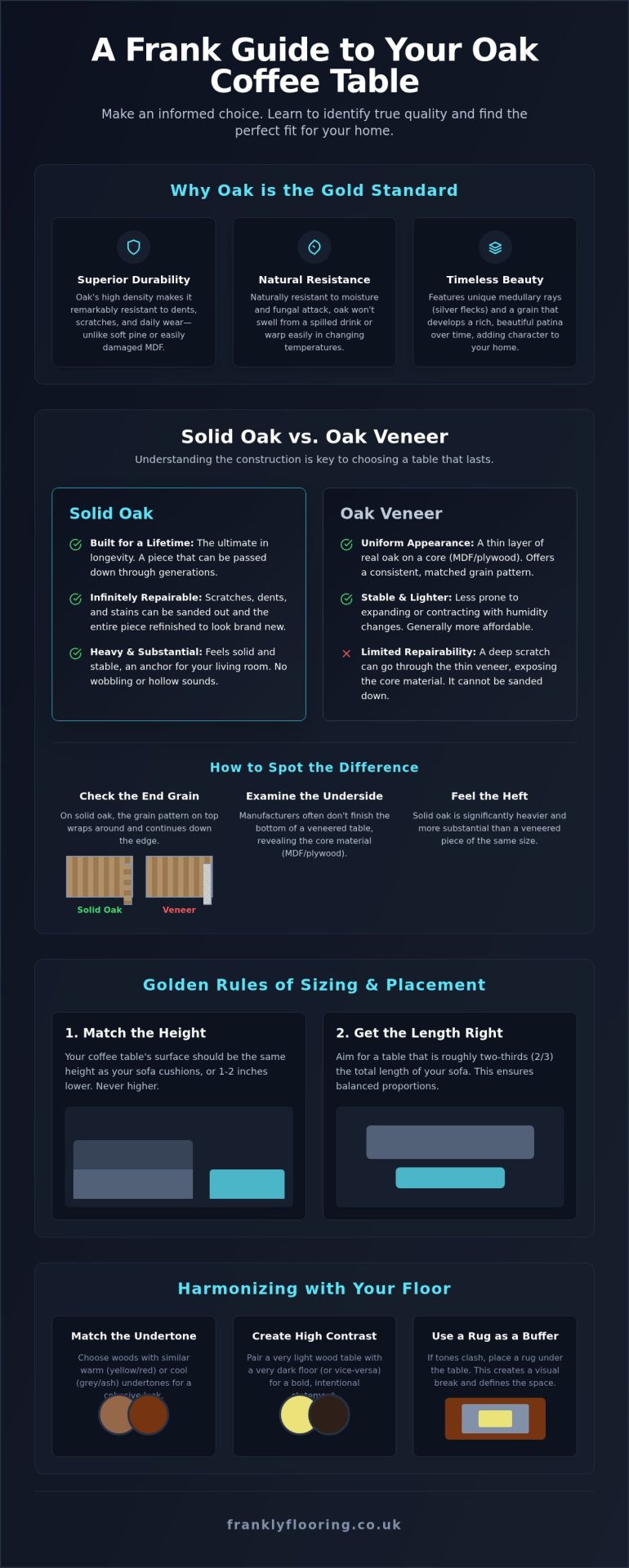
Solid oak is exactly what it sounds like: planks of timber cut straight from the tree. The primary benefit here is repairability. If you scratch a solid piece, you can sand it down and refinish it. It is built to last a lifetime. Professional methods for judging furniture quality involve looking for traditional joinery. Check the corners for dovetail joints or mortise and tenon construction. These indicate a level of craftsmanship that relies on the wood’s strength rather than just glue and staples. You will feel the “heft” immediately. A solid table won’t wobble, and it won’t feel hollow when you tap the surface.
To spot the difference quickly, look at the end grain. On a solid oak coffee table, the grain pattern on the top surface should wrap around the edge and continue down the side. If the grain on the top stops abruptly and a different pattern starts on the edge, you are looking at a veneer. Also, check the underside. Manufacturers rarely finish the bottom of a veneered table as nicely as the top, making it easier to see the core material.
Understanding Modern Oak Veneers
Veneers aren’t inherently “bad,” but they serve a different purpose. A veneer is a thin slice of real oak glued onto a stable core like plywood or MDF. High-quality veneers allow for a very uniform look with perfectly matched grain patterns that are hard to achieve with solid planks. They are also less likely to expand or contract with temperature changes. However, they have a major limitation: once you scratch through that thin top layer, the table is effectively ruined. You can’t sand it back. If you are on a budget, a veneered piece can look fantastic, but you have to be honest about the trade-off in longevity.
Engineered oak is often the smarter middle ground. It uses a thick layer of real oak over a multi-layered core, providing the stability of a veneer with more of the durability of solid wood. If you want a piece that balances these technical benefits with a fair price, our curated range of furniture focuses on builds that prioritise long-term structural integrity over quick sales.
Finding the Right Shape and Size for Your Space
Choosing an oak coffee table isn’t just about the timber; it’s about the maths. A table that is too small looks like an afterthought, while one that is too large makes your living room feel cramped. To get the proportions right, follow the two-thirds rule. Your table should be approximately two-thirds the length of your sofa. If you have a standard 210cm three-seater, look for a table around 140cm long. This creates a visual balance that anchors the room without overwhelming the seating area.
Height is equally critical for comfort. Ideally, your table should sit level with your sofa cushions, or perhaps an inch or two lower. Anything higher creates an awkward reach for a drink; anything significantly lower makes the piece look diminutive and impractical. You also need to consider the “flow” of the room. Leave at least 45cm of clearance between the table and the sofa. This gives you enough legroom to sit comfortably while ensuring there is a clear path to walk around the furniture without shimmying sideways.
Rectangular vs. Round: Which Suits Your Layout?
The shape you choose should be dictated by your existing furniture and how you move through the space. Rectangular tables are the classic choice for standard sofas and narrow rooms because they mimic the long lines of the seating. If you have a large L-shaped corner sofa, a square oak coffee table often works better as it fills the “void” in the crook of the sectional more effectively.
Don’t overlook round or oval designs, especially in smaller homes or households with young children. Round tables have a smaller footprint and no sharp corners, which improves safety and makes a room feel less “boxy.” They are excellent for breaking up the straight lines of a traditional lounge and allow for easier movement in tight thoroughfares.
Coffee Tables with Storage: Practicality vs. Style
We need to be frank about clutter. If your living room is a sanctuary for remote controls, magazines, and coasters, a table with drawers is a lifesaver. It allows you to sweep away the mess in seconds. However, storage comes with a stylistic trade-off. Tables with deep drawers can look “heavy” or bulky, which might not suit a minimalist interior.
If you want a lighter, more airy feel, consider an open-shelf design. This provides a spot for books or baskets without the visual weight of a solid base. It’s a great way to keep the room feeling spacious while still having a place to put things. Just remember that an open shelf requires more discipline; if you fill it with junk, the whole room will feel untidy. Choose a design that matches your lifestyle, not just your Pinterest board.
Styling Your Oak Coffee Table: Matching with Your Flooring
An oak coffee table doesn’t exist in isolation; it lives on your floor. One of the most common mistakes we see is the “clashing woods” trap, where a beautiful table is lost against a floor of a nearly identical tone. When wood grains are too similar, they compete for attention and make the room look flat. To avoid this, follow our frank rule: aim for at least two shades of difference between your table and your flooring. If your floor is dark, go for a light, natural oak. If your floor is pale, a smoked or darker stained oak will provide the necessary definition.
Modern LVT flooring provides an excellent, stable foundation for heavy oak furniture. Because LVT can mimic stone or darker woods, it creates a deliberate contrast that makes the oak grain pop. If you prefer a softer look, the warmth of light oak creates a stunning, clean contrast against a deep grey carpet. This pairing is particularly effective in modern British homes where you want to balance traditional materials with a contemporary colour palette.
Pairing Oak with Wood and Laminate Floors
If you have a laminate floor or real wood boards, pay attention to the grain direction. We suggest placing your table so its grain runs perpendicular to the floorboards. This breaks up the visual lines and prevents the room from feeling like a continuous wooden box. Texture also matters. A rustic, textured laminate floor works brilliantly with a smooth-finished oak coffee table. The difference in surface feel creates a sense of depth and deliberate design that “matchy-matchy” furniture sets simply cannot achieve.
The Role of Rugs in Your Living Room
Rugs are more than just a soft spot for your feet; they are a vital buffer. If you can’t achieve that two-shade difference between your floor and table, a rug provides the necessary separation. It defines the seating area and protects your floor from the weight of solid wood legs. Choose a texture that contrasts with the hard oak surface. A chunky wool knit or a high-pile rug softens the overall look and makes the space feel more inviting. Just ensure the rug is large enough. A common error is buying a rug that is too small. For the best look, the oak coffee table should sit entirely on the rug with plenty of space to spare on all sides.
If you are ready to anchor your room with a piece that truly fits your layout, you can view our curated furniture collection to find a style that works with your home.
The Frankly Flooring Approach to Quality Furniture
Choosing an oak coffee table is more than a simple transaction; it’s an investment in your home’s character. We’ve spent over 20 years as a family-run business building a reputation for directness. We don’t believe in high-pressure sales tactics or hiding behind industry jargon. Our goal is to provide honest advice that helps you find a piece you’ll still love a decade from now. While we started as flooring specialists, our move into sourcing quality furniture was a natural progression. We saw too many customers struggle to find tables that matched the standard of their new floors, so we decided to curate a range that actually meets our criteria for longevity.
Our national UK delivery service is designed to be as straightforward as our advice. We understand that waiting for furniture can be frustrating, so we focus on clear communication and reliable timelines. You won’t find any hidden fees or vague delivery windows here. We treat every order with the same care we’d give to a member of our own family, ensuring your new centrepiece arrives in perfect condition and ready to anchor your living space.
No-Nonsense Quality Control
We’re picky about what we sell. Our team vets every furniture range for structural integrity before it ever makes it onto our website. This means checking the density of the wood, the strength of the joints, and the durability of the finish. The “Frank” promise is simple: we’re transparent about every material used. If a piece uses a veneer for stability, we’ll tell you. If it’s 100% solid timber, we’ll explain why that matters for your specific needs. We value long-term customer satisfaction over quick sales because we want you to come back to us the next time you’re refreshing your home.
Expert Advice for Your Home Project
Our background in flooring gives us a unique perspective on furniture. We don’t just look at the table; we look at how it sits on the grain of a wood floor or the pile of a carpet. This technical knowledge allows our team to offer practical advice on matching styles and colours that you won’t get from a standard furniture retailer. If you’re unsure if a specific oak coffee table will clash with your LVT or laminate, just ask. We’re here to help you get the details right the first time.
Before you click “buy,” run through this final checklist to ensure you’ve made the right choice:
- Size: Is the table approximately two-thirds the length of your sofa?
- Height: Does it sit level with or slightly below your seat cushions?
- Clearance: Have you left 45cm of space to walk around it?
- Tone: Is there a clear two-shade difference between the table and your floor?
- Build: Have you chosen the right material (solid vs. veneer) for your lifestyle?
Investing in a Centrepiece That Lasts
Choosing an oak coffee table is a decision that impacts the daily flow and long-term aesthetic of your home. By understanding the frank difference between solid timber and veneers, you can invest with confidence rather than crossing your fingers. Remember the golden rules we have discussed: aim for that two-thirds length relative to your sofa and ensure a clear two-shade difference from your flooring to create a room that feels balanced and intentional.
At Frankly Flooring, we bring 20+ years of industry expertise to every piece we source. As a family-run UK business, we prioritise technical craftsmanship over high-pressure sales, ensuring our national delivery service brings only the best to your door. It is time to move past the confusion of marketing jargon and choose a table that truly stands the test of time. Browse our curated range of quality oak furniture and find the piece that will anchor your living room for years to come.
Frequently Asked Questions
Is solid oak better than oak veneer for a coffee table?
Solid oak is generally better if you want a piece that lasts a lifetime. It allows you to sand out scratches or dents that would ruin a veneer. However, if your home has significant temperature fluctuations, a high-quality veneer over a stable core can sometimes resist warping better. For most British households, the weight and repairability of a solid oak coffee table make it the superior long-term investment.
How do I protect my oak coffee table from water rings and heat?
Prevention is the only guaranteed method. Always use coasters for drinks and mats for anything hot. If a water ring does appear on an oiled table, you can often sand it back and re-oil the area. Lacquered finishes provide better initial protection but are harder to spot-repair. We recommend keeping a dedicated wood cleaner on hand and wiping up spills immediately to prevent the grain from raising or staining.
Does an oak coffee table have to match my oak flooring?
An exact match often looks like a mistake rather than a design choice. It is better to create contrast by choosing a table that is at least two shades lighter or darker than your flooring. If you have light oak floors, a smoked or medium-toned table provides the necessary definition. This prevents the furniture from disappearing into the floor and ensures your living room has clear visual layers.
What is the best way to clean and maintain a solid oak table?
Start with a soft, lint-free cloth for daily dusting. For deeper cleaning, use a damp cloth with a mild, pH-neutral wood soap rather than multipurpose household sprays. If your table has an oiled finish, you should re-apply a high-quality furniture oil every six to twelve months. This keeps the wood nourished and maintains its natural resistance to moisture. Always wipe in the direction of the grain to avoid streaks.
Are oak coffee tables still in style for 2026?
Oak remains a foundational material in 2026 interior design. Current trends have shifted away from the pale, “scandi” look toward warmer, darker stains and more organic, curved silhouettes. Because oak is so versatile, it easily adapts to these changes. Its status as a natural, durable material aligns perfectly with the modern “buy better, buy less” mentality that defines the current UK oak coffee table market.
How do I know if an oak table is made from sustainable wood?
Check for FSC (Forest Stewardship Council) or PEFC labels in the product description. These certifications ensure the timber is harvested from responsibly managed forests. Beyond labels, consider the lifespan of the piece. A well-built oak table that lasts thirty years has a significantly lower environmental impact than three or four cheap, composite-wood alternatives that end up in a landfill within a decade.
Can I use an oak coffee table on a carpeted floor?
You can certainly use an oak table on carpet, but you should consider the weight. Solid oak is heavy and can leave deep indentations in the pile over time. If you have a thick, plush carpet, the table might feel slightly less stable than it would on a hard surface. Using a large, flat-weave rug over the carpet can provide a more stable base and help distribute the weight more evenly.
What is the standard height for a living room coffee table?
Most tables sit between 40cm and 48cm high. The frank truth is that the “standard” doesn’t matter as much as your specific sofa. Your table should be level with your sofa cushions or up to 5cm lower. If the table is higher than the seating, it becomes awkward to use for drinks and snacks. Always measure your seat height before purchasing to ensure the proportions feel natural in your space.