
The lower-priced boards don’t always make the lower-cost floor. If you’re comparing solid wood vs engineered wood cost uk, the product price is only one part of the decision: board specification, room conditions, fitting requirements and future maintenance can all affect the overall value.
It’s understandable to start with the price per square metre. But two floors aren’t a fair comparison unless their thickness, finish and other specifications are similar, and the wider project costs are considered too. Subfloor preparation, underlay, adhesives and finishing details may all change the budget.
This guide explains what drives the relative cost of solid and engineered wood flooring in the UK, so you can compare like with like rather than relying on the shelf price alone. We’ll look at product specifications, fitting and preparation requirements, and the implications of maintenance and refinishing over time. The aim is to help you choose a floor that suits the room, your budget and how long you plan to live with it.
Key Takeaways
- A lower board price doesn’t necessarily mean a lower overall project cost; compare the full requirements for your room.
- Make a fair comparison by matching wood species, grade, finish, board dimensions and pack coverage.
- A solid wood vs engineered wood cost uk comparison is most useful when it separates product costs from preparation, accessories, fitting and care.
- Measure your room and use the coverage shown on each product pack to estimate how much flooring you’ll need.
- Choose the construction that suits your room conditions, preferred appearance and plans for maintaining the floor over time.
Solid Wood vs Engineered Wood Flooring Cost in the UK: What Are You Comparing?
The short answer is that relative value depends on the board specification, room conditions and the scope of the project. A useful solid wood vs engineered wood cost uk comparison starts with construction, then looks beyond the product price to the other requirements of the floor.
Solid wood flooring is made from boards cut from a single piece of timber. Engineered wood has a real-wood surface layer bonded to a constructed core. Both use real wood at the visible surface, but their construction differs. The Wood flooring overview provides a neutral introduction to these flooring types and their construction.
Neither board price tells the whole story. Accessories, subfloor preparation and fitting may also affect the project budget, and those requirements depend on the room and the product selected.
| Comparison point | Solid wood | Engineered wood |
|---|---|---|
| Construction | One piece of wood | Real-wood surface over a constructed core |
| Product cost factors | Species, grade, dimensions, finish and specification | Surface-layer thickness, core construction, finish and board format |
| Flexibility | Suitability depends on the room and product guidance | Construction may suit different project requirements; check product guidance |
| Maintenance | Care depends on the finish and product instructions | Care depends on the finish; refinishing potential relates to the wood surface layer |
What does the cost of solid wood flooring include?
The listed product price reflects more than the wood type. Species, grade, board dimensions, finish and other specification details all shape what you’re comparing. Keep the flooring material separate from accessories, subfloor preparation and fitting when building a project budget. These are distinct cost considerations, and the work required can vary from room to room.
What does the cost of engineered wood flooring include?
Compare the thickness of the real-wood surface layer, the core construction, finish and board format. The visible layer is wood; the layers beneath form the engineered core, so products with different specifications aren’t automatically like-for-like. For broader specification advice, see the Engineered Wood Flooring buying guide. Comparing those details makes the solid and engineered wood options easier to assess on their actual merits.
Why Solid and Engineered Wood Flooring Have Different Cost Drivers
There’s no universal rule that makes solid or engineered wood the more expensive choice. The solid wood vs engineered wood cost uk comparison depends on the products being compared and the work needed in the specific room. A higher price may reflect a different grade, finish or board format, rather than the construction alone.
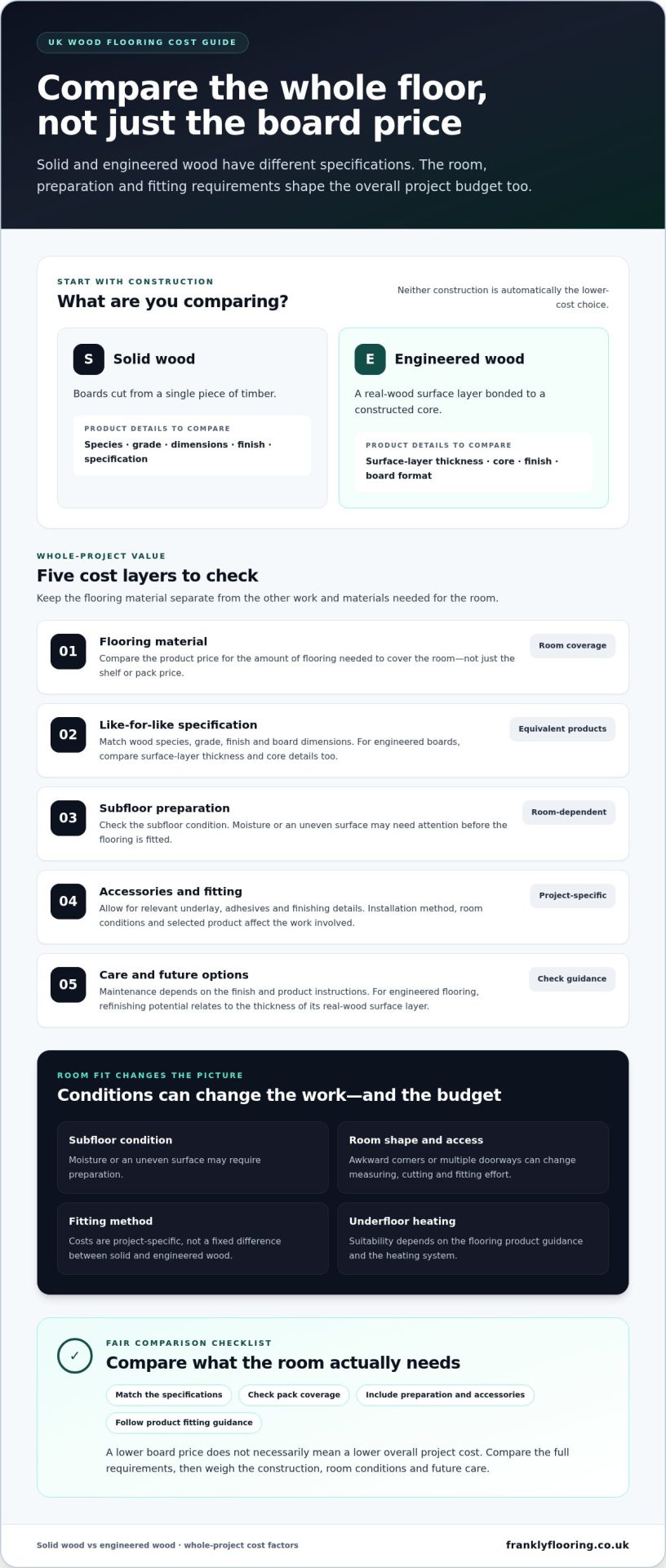
Start with equivalent specifications: compare the same wood species and grade, similar finishes and board dimensions, and the coverage in each pack. A pack covering less floor area can make a product look cheaper at first glance, so compare the cost for the amount needed to cover the room, not just the pack price.
How construction and specification affect the comparison
Solid boards are wood throughout, while engineered boards combine a real-wood surface with a constructed core. Engineered products can differ in both core construction and the thickness of that surface layer. That thickness matters when assessing the specification and potential future options such as refinishing, but it doesn’t by itself establish how a particular product should be maintained. Read the product details rather than assuming all engineered boards are built alike. For a general overview of wood-floor construction, see wikipedia.org.
Which room and subfloor factors can change the project budget?
The boards are only one part of the calculation. Subfloor condition can affect preparation needs: moisture or an uneven surface may require attention before flooring is fitted. Room shape and access can also affect the work involved. A straightforward rectangular room and a space with awkward corners or multiple doorways may call for different measuring, cutting and fitting effort.
Fitting costs are project-specific, not a fixed difference between solid and engineered wood. The installation method, room conditions and selected product all matter. Underfloor heating suitability also depends on the product’s guidance and the heating system, so don’t assume either construction is automatically compatible. Follow the selected flooring’s fitting instructions and seek suitable installation advice for the room and system.
Once you’ve identified the room requirements, browse wood flooring options and compare the specifications that matter to your project.
Solid Wood vs Engineered Wood: Compare Whole-Project Value, Not Just Board Prices
A fair comparison keeps the flooring product separate from the work and materials needed to complete the room. Use the table as a checklist, then compare products with similar specifications. For background on wood flooring and its different constructions, see wikipedia.org.
| Cost factor | What to compare |
|---|---|
| Material | Product price for the amount of flooring needed to cover the room. |
| Specification | Equivalent species, grade, finish, board dimensions and pack coverage. For engineered boards, include the surface-layer thickness and core details. |
| Accessories | Underlay or other accessories only where the product’s specification and fitting method require them. |
| Preparation | Any work needed to address the subfloor or make it suitable for the selected flooring. |
| Fitting | A separate, project-specific fitting estimate based on the room, product and chosen installation method. |
| Care | Routine cleaning and maintenance in line with the manufacturer’s instructions. |
Which cost factors should be compared like for like?
Start by matching species, grade, finish and board dimensions as closely as possible. Check pack coverage too: a lower pack price may not represent better value if it covers less floor area. Then list product costs, required accessories, preparation and fitting separately. This makes it easier to see which differences come from the flooring itself and which come from the room or project.
Don’t assume every floor needs the same underlay or accessories. Use the selected product’s specification and fitting guidance to identify what’s suitable. Preparation and fitting aren’t fixed costs attached to solid or engineered construction; subfloor condition, room layout and installation method can all affect the work involved.
How should maintenance and potential lifespan affect value?
Care requirements depend on the specific product and finish, so follow the manufacturer’s cleaning and maintenance guidance rather than relying on broad rules about either construction. Refinishing potential also varies. Check the product’s construction and instructions before treating refinishing as a future option, and don’t assume a particular service life without product-specific evidence.
Over time, the value a floor delivers depends on how well it suits the room, how it’s used and how it’s cared for, as well as its original specification. For a grounded solid wood vs engineered wood cost uk comparison, weigh those practical considerations alongside the upfront product and project requirements. Browse the wood flooring range to compare product specifications.
How to Budget for Solid or Engineered Wood Flooring in the UK
A clear budget starts with the room, not the product price. Use the same measurements and assumptions for each option, then keep flooring and project costs separate. That makes a solid wood vs engineered wood cost uk comparison more useful and helps explain where any difference comes from.
- Measure the floor area. For a simple rectangular room, multiply its length by its width. For example, a room measuring 4m by 3m has a floor area of 12m². Measure separate areas individually if the room has an irregular shape.
- Check pack coverage. Divide the floor area by the coverage stated for a pack, then round up to a whole number of packs. If a pack covers 2m², a 12m² room needs six packs before any allowance for cuts or waste. Apply the same sensible allowance to both products, following product guidance and the room layout.
- Compare suitable specifications. Match species, grade, finish and dimensions as closely as possible. Check construction and intended room suitability too, so you’re not comparing products that meet different needs.
- Build separate budget lines. Record the flooring, any required accessories, subfloor preparation, delivery and fitting as distinct items. Include accessories only where the selected product and fitting method require them. Fitting and preparation costs depend on the project; they aren’t fixed differences between solid and engineered wood.
- Review the details before totalling. Check current product information, pack coverage and fitting instructions. Make sure the subfloor and, where relevant, heating conditions suit the chosen floor.
How do you make two flooring budgets comparable?
Use one set of room measurements and the same approach to coverage and waste for both estimates. Keep the product price separate from preparation, accessories, delivery and fitting, so a lower material total doesn’t hide other requirements. If one option needs different accessories or preparation, note why rather than treating it as a standard cost of that construction.
What should you check before choosing a wood floor?
Review the product’s construction, finish, dimensions and fitting guidance against the room’s conditions. Check any instructions relating to the subfloor, moisture and heating system. Before fitting, preparation matters too; consult the wood flooring acclimatisation guide for relevant considerations, and follow the selected product’s instructions.
Ready to compare specifications for your project? Browse wood flooring options and use the product details to build a like-for-like budget.
Choose the Wood Flooring That Fits Your Budget and Home
There isn’t one construction that suits every room or budget. The best choice depends on the specific product, the conditions it will be used in, the look you want and how you plan to care for it. A useful solid wood vs engineered wood cost uk comparison considers those factors alongside the full project budget, rather than treating one type as automatically cheaper or better.
When might solid wood suit your priorities?
Solid wood may appeal if you want boards made from wood throughout. Its appearance, species, grade, finish and dimensions all contribute to the specification, so look beyond the construction label when comparing options. Check the product’s guidance against the room and subfloor conditions, and consider the care it requires. The right fit depends on the particular board and project, not simply on the fact that it’s solid wood.
When might engineered wood be the more practical fit?
Engineered wood may suit a project where the construction and specification of the selected board match the room’s requirements. Products vary, so compare the real-wood surface layer, core, finish and fitting guidance instead of assuming all engineered flooring performs alike. For a closer look at what to check, refer to the Engineered Wood Flooring buying guide.
Whichever construction you’re considering, read the product details carefully. Check the dimensions, finish, room suitability and fitting instructions, then weigh these against your budget and the maintenance you’re prepared to carry out. If you’re considering a sample, use it to assess the colour and grain in your room’s light, while relying on the product specification for technical details. Appearance matters, but it isn’t a substitute for checking suitability.
That’s the practical takeaway: choose a floor that works for the space and your plans, not just the price on the product page. Compare the available specifications at your own pace, then browse Frankly Flooring’s wood flooring range to explore options for your home.
Make Your Wood Flooring Choice With Confidence
The solid wood vs engineered wood cost uk comparison isn’t settled by the board price alone. Match products by specification, then account separately for accessories, subfloor preparation and fitting. The room’s conditions, the floor’s intended use and the care it needs all influence the value you’ll get over time.
Solid wood may appeal if you want boards made from wood throughout. Engineered wood may suit a project where its particular construction and specification fit the room. Neither is automatically the cheaper or better option: check the product details and fitting guidance before deciding.
Frankly Flooring is a family-run flooring business with over 20 years of industry experience. Browse its online selection of wood flooring and related accessories, comparing product details at your own pace. Browse wood flooring and compare your options.
A clear, like-for-like comparison can help you choose a floor that works for your home, budget and longer-term plans. Take the time to check the details, and you can move ahead with confidence.
Frequently Asked Questions
Is solid wood flooring more expensive than engineered wood in the UK?
Not always; the relative cost depends on the products’ specifications and the project requirements. Species, grade, finish, board dimensions and pack coverage can all affect the product comparison, while preparation, accessories and fitting influence the wider budget. Compare suitable products on a like-for-like basis, then consider how each construction fits the room and your plans for care. There isn’t one option that’s automatically more expensive or better value.
How much does solid wood flooring cost compared with engineered wood?
There isn’t one reliable figure for either type without comparing specific products and project requirements. Solid and engineered wood prices vary by species, finish, dimensions and construction details. To assess the difference, check current product prices and pack coverage, then calculate how much flooring the room needs. Keep accessories, subfloor preparation, delivery and fitting separate from the material total so the comparison reflects the full project rather than board prices alone.
What is the main cost difference between solid and engineered wood flooring?
The main difference is the product construction and specification, not a fixed price gap. Solid wood boards are made from wood throughout; engineered boards have a real-wood surface over a constructed core. Compare equivalent species, grade, finish and dimensions, and check the engineered surface-layer thickness and core details. The final budget also depends on room-specific preparation, suitable accessories and fitting, so separate those costs from the flooring itself.
Is engineered wood flooring cheaper to fit than solid wood?
Not as a rule. Fitting costs depend on the chosen product, fitting method, subfloor condition, room shape and access. Those variables can affect either type, so don’t assume engineered wood will always cost less to fit. Compare fitting estimates separately from the product price and check the flooring’s instructions, including requirements for the subfloor and any accessories. Frankly Flooring sells wood flooring and related accessories, but does not provide fitting services.
Can engineered wood flooring be refinished like solid wood?
Some engineered flooring may be suitable for refinishing, but it depends on the particular product and the thickness of its real-wood surface layer. Don’t assume it can be refinished as often or in the same way as solid wood. Check the product specification and manufacturer’s guidance before treating refinishing as a future option. The finish, wear and condition of the boards also matter, so product-specific advice is more useful than a general rule.
Which lasts longer: solid wood or engineered wood flooring?
There’s no dependable answer based on construction alone. How long a floor remains suitable depends on the product specification, room conditions, use and care. Solid wood and engineered products vary, so avoid relying on general lifespan promises when comparing them. Review the manufacturer’s instructions for maintenance and suitability, then consider whether the floor’s appearance and care requirements fit your plans. Good value comes from choosing an appropriate product and looking after it correctly.
Is engineered wood flooring suitable for underfloor heating?
Some engineered wood products may be suitable for underfloor heating, but compatibility depends on the specific flooring and heating system. Check the product’s fitting instructions for any conditions or limitations, and make sure the subfloor and system meet those requirements. Don’t assume every engineered board is suitable just because of its construction. Confirm the complete installation guidance before choosing a floor for a heated room, and follow the instructions for both the flooring and heating system.