
Could a flooring fault appear genuine and still fall outside the warranty? If you’re searching for “flooring warranty explained uk”, look beyond the number of years on the paperwork. Cover can vary between carpet, wood, laminate and LVT, and the conditions attached to it matter just as much.
It’s understandable to expect a warranty to cover problems with your floor. But normal wear, accidental damage, unsuitable cleaning or fitting that doesn’t follow the manufacturer’s instructions may be treated differently from a product defect. That can make warranties hard to compare, especially when you’re choosing flooring for a particular room and its day-to-day use.
This guide explains what flooring warranties commonly cover, what they often exclude and how fitting, moisture, room conditions and maintenance can affect cover. It also explains how a manufacturer’s warranty sits alongside your consumer rights, and what to keep if an issue arises, including receipts, warranty documents, care instructions and clear photos. With the right information to hand, you can make a more informed flooring choice and know what steps to take if something goes wrong.
Key Takeaways
- For flooring warranty explained uk, start with the written terms: cover, duration, exclusions and claim steps can differ by product and manufacturer.
- A manufacturer’s warranty is separate from your statutory consumer rights, so an expired warranty doesn’t automatically settle every complaint.
- Check that the flooring’s stated use suits the room, and understand how fitting requirements and care instructions may affect cover.
- Before buying, identify who provides the warranty, what evidence a claim needs and which situations may be excluded.
- Keep your receipt, warranty documents, product details and care records together so you have useful evidence if a problem develops.
What does a flooring warranty cover in the UK?
A flooring warranty is a written promise that sets out what the issuer will do if a product has a fault covered by the warranty’s terms. Its scope, duration and conditions are specific to the product, so a warranty for one floor isn’t a reliable guide to another. If you’re searching for “flooring warranty explained uk”, that distinction is a useful starting point.
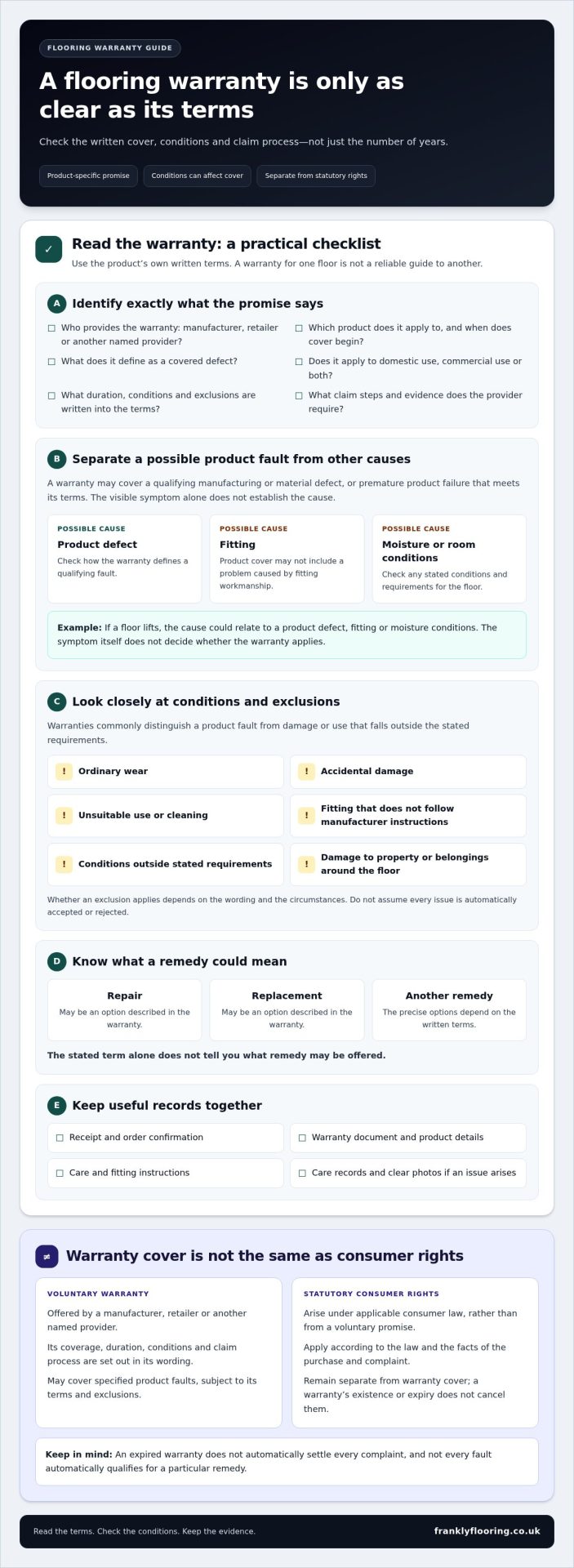
A flooring warranty is a product-specific written promise that describes which faults may be covered, for how long and under what conditions. Read it alongside the product information before buying. Check what the warranty defines as a defect, when cover begins, whether it applies to domestic or commercial use, and what steps it sets out for making a claim. The stated term alone doesn’t tell you what remedy may be offered.
What kinds of flooring problems may be covered?
Depending on its wording, a warranty may cover a qualifying manufacturing or material defect, or premature product failure that falls within its terms. A fault in the flooring material itself might be considered, while the same visible problem could have another cause. The warranty’s definitions, evidence requirements and remedies determine whether an issue qualifies. These examples don’t guarantee cover for LVT, wood, carpet or laminate.
Look for specific wording rather than relying on broad phrases such as “long-lasting” or “durable”. A warranty may describe expected performance, identify circumstances that affect cover and explain whether the response could involve repair, replacement or another remedy. The precise options depend on the terms. Separate legal protections may also apply: a product warranty doesn’t replace your rights under the Consumer Rights Act 2015.
What a warranty does not automatically promise
A stated warranty term isn’t a promise that the floor will remain free from every kind of damage for that whole period. Warranties commonly distinguish a product fault from ordinary wear, accidents, unsuitable use or damage caused by conditions outside the stated requirements. Whether an exclusion applies depends on the wording and circumstances, so don’t assume every issue is automatically rejected or accepted.
- Product performance: The written cover may address a defined fault in the flooring itself.
- Fitting workmanship: The product warranty may not cover a problem caused by how the floor was fitted.
- Other damage: Damage to the property or belongings around the floor may fall outside the product warranty.
For instance, if a floor lifts, the cause could relate to a product defect, fitting or moisture conditions. The symptom alone doesn’t establish the cause or decide whether the warranty applies. Check the relevant exclusions and requirements, and keep the product details and purchase records. This gives you a clearer basis for understanding the written cover instead of treating its duration as blanket protection.
Flooring warranties and UK consumer rights: what is the difference?
A flooring warranty and your statutory consumer rights are related, but they aren’t the same protection. A warranty is a voluntary promise with its own terms. Statutory rights arise under consumer law and don’t depend on a manufacturer choosing to offer a warranty. Put simply: warranty terms and statutory rights are separate protections, and a warranty doesn’t remove any statutory rights that apply.
This distinction matters if a problem develops. The warranty may set out a route for reporting a specified product fault, while your legal rights depend on the transaction and circumstances. Don’t assume an issue is resolved simply because a warranty has expired, or that every fault automatically qualifies for a particular remedy. For current UK consumer information, consult the official UK consumer rights guidance on GOV.UK.
| Voluntary warranty | Statutory consumer rights |
|---|---|
| Offered by a manufacturer, retailer or another named provider. | Arise under applicable consumer law, rather than from a voluntary promise. |
| Coverage, duration, conditions and claim process are set out in its wording. | Apply according to the law and the facts of the purchase and complaint. |
| May cover specified product faults, subject to its terms and exclusions. | Are separate from warranty cover and aren’t cancelled by the existence or expiry of a warranty. |
Is a manufacturer warranty the same as a retailer guarantee?
Not necessarily. A manufacturer may offer a product warranty, while a retailer may provide its own written promise or guarantee. The label alone doesn’t tell you who is responsible or what is covered. Read the document to identify the provider, the product it applies to, the start and end of cover, relevant conditions and how to raise a claim. Terms can vary, even between flooring products in the same broad category.
Keep the warranty document with your order confirmation, receipt and product details. If the paperwork refers to care or fitting instructions, retain those too. Having the records together makes it easier to identify which promise you’re relying on and describe the issue accurately.
Where do statutory rights fit alongside a warranty?
Contractual warranty cover sits alongside any statutory consumer rights that apply to your purchase. A warranty can offer a defined way to address certain product problems, but it shouldn’t be treated as a replacement for legal protections. The details may depend on where and how you bought the flooring and the circumstances of the fault, so don’t rely on a general summary to decide your individual case.
If you’re comparing flooring, read the product information and warranty terms together, then consider whether the floor suits the room and its intended use. Browse flooring options at Frankly Flooring to compare material types as part of your decision. For a complaint or a question about your legal position, use current official guidance before deciding what steps to take.
How flooring type, use and fitting affect warranty terms
Warranty wording can vary with the material, the setting and how the floor is fitted. There isn’t one standard term or set of conditions for every product. The same flooring category can carry different warranty terms depending on the specific product, its intended use and the conditions set by its provider. Comparing the written details is more useful than comparing headline durations alone.
For a practical flooring warranty explained uk, check what applies to the specific floor you’re considering. These are useful variables to compare, not fixed rules for every product:
- LVT: Check the stated setting and permitted use, along with any fitting, cleaning or environmental conditions in the product documents.
- Laminate: Look for terms about intended use and care, and whether the instructions specify particular subfloor or underlay requirements.
- Wood: Read the conditions on room environment, fitting and maintenance. Product documents may set specific requirements that differ between wood floors.
- Carpet: Check how the warranty defines covered performance or defects, and whether its conditions distinguish between domestic and commercial settings.
Why use class and room conditions matter
Some flooring information uses a use class to describe the type and intensity of setting a product is designed for. It can help distinguish a domestic room from a commercial space or indicate different levels of expected traffic. The relevant class and its meaning should be stated in the product information. Don’t assume a rating or warranty condition transfers from one product to another.
Match the stated use to the room you’re planning for. A quiet bedroom and a busy entrance may put different demands on a floor, while a home office used throughout the day may see more traffic than an occasional-use room. Consider the actual conditions, not just the room’s name. When choosing flooring for a particular space, compare its intended use and care requirements alongside its appearance and material.
How fitting and maintenance conditions affect cover
Follow the instructions supplied for the exact product. Depending on the flooring, they may specify how to prepare the subfloor, whether the floor needs to acclimatise before fitting, or which underlay and accessories are suitable. Treat these as product-specific directions, not universal rules. Keep the documents so you can refer to them and show which requirements you followed if a question arises.
A product warranty may assess fitting problems differently from a manufacturing defect. For example, lifting could relate to the product, the subfloor or the fitting conditions. The appearance alone won’t establish the cause. Maintenance matters too: use the care method and products stated for that floor rather than assuming advice for another material applies. If you’re unsure how a concern about faulty goods relates to separate consumer protections, Which? offers a guide to faulty goods and consumer rights.
What can invalidate a flooring warranty, and how can you protect it?
A warranty claim can depend on more than what the floor looks like. Its terms may set conditions for fitting, cleaning and room use, but a possible exclusion isn’t automatically grounds to reject every claim. The cause of the problem and the exact wording both matter. For a practical flooring warranty explained uk, treat the warranty as a document to refer to from the start, not paperwork to search for only after something goes wrong.
Common exclusions to look for in the small print
Read the exclusions and conditions alongside the coverage section. Check how the document describes accidental damage, misuse and normal wear, and whether it refers to environmental conditions such as moisture or direct sunlight. These terms can be product-specific. A floor showing wear or damage doesn’t, by itself, settle whether a claim is covered.
Pay close attention to fitting-related wording too. The terms may refer to subfloor preparation, installation methods or specified underlay and accessories. Cleaning requirements can matter as well: a product document may restrict certain chemicals or cleaning methods. Don’t assume a condition applies unless it appears in the relevant product instructions or warranty. If the cause isn’t clear, record what you can observe rather than guessing at a diagnosis.
A simple routine for protecting your cover
Keep the key records together, ideally in a folder you can find easily. Include:
- Proof of purchase: Save the invoice or order confirmation, including the date and product details.
- Warranty and product information: Keep the full warranty wording, care guide and fitting instructions supplied for that floor.
- Fitting records: Note who fitted the floor, when the work took place and any details you have about preparation or accessories used. Keep related paperwork where available.
- Care details: Follow the product’s cleaning and maintenance guidance, and keep relevant records or product labels if they help identify what you used.
If you notice a change, make a dated note of when it first appeared, where it is and how it develops. Take clear photographs from more than one angle, including a wider view showing the location and a closer image of the affected area. Keep the original files and add later photographs if the issue changes. Describe what you see, such as a lifted edge or visible mark, without assuming its cause.
This evidence won’t guarantee a particular outcome, but it can make it easier to explain the timeline and refer to the correct instructions if you need to raise a concern. Organising documents and recording care can save uncertainty later. As you compare flooring for your home, explore flooring options with the room’s use and product information in mind.
How to check a flooring warranty before you buy
Read the warranty before choosing a floor, not just after a problem appears. The phrase “flooring warranty explained uk” is useful only if you connect the written terms to the exact product, room and way you plan to use it. This six-point check helps you compare documents without assuming that similar flooring has identical cover.
A six-point checklist for reading warranty terms
- Identify the provider. Find out whether the promise is made by the manufacturer, retailer or another named party. Note how the document says to contact them about a claim.
- Match it to the exact product and purchaser. Check the product name or reference and any limits on who can use the cover. Don’t assume terms for a similar-looking floor apply to your selection.
- Find the start date and duration. See when cover begins, how long it lasts and whether the wording mentions a deadline for reporting a fault. The term alone doesn’t explain what is covered.
- Read the coverage wording. Look for the specific faults or performance issues the warranty describes, and note any conditions attached to them.
- Check exclusions and responsibilities. Review requirements for fitting, room use, cleaning and maintenance, along with any stated exclusions. Check whether the instructions specify particular accessories or preparation.
- Understand the claim process. Note how to report an issue, what information or evidence is requested and what remedy the wording describes. Keep the warranty with your proof of purchase and product details.
Choosing flooring with clear information
Compare the warranty alongside the product details, not in isolation. Think about the room’s traffic, likely exposure to moisture and the care routine you can follow. A floor suited to one setting may not be right for another, even if its headline warranty appears attractive. Check that the stated use matches your plans, and read the relevant fitting guidance before deciding.
Material guides can help you understand the practical differences between options. If you’re weighing up LVT, use an LVT flooring guide to explore its characteristics. If wood is on your shortlist, an engineered wood flooring guide can help you consider that category. Pair that information with the individual product’s warranty rather than treating general guidance as a substitute for its terms. A guide to buying flooring online with confidence can also help you organise the checks to make before placing an order.
Clear, product-specific information makes comparison more straightforward. Take the time to read it, save the documents and choose flooring that suits both the room and your intended use. If you’re ready to compare options, browse flooring at Frankly Flooring.
Choose your next floor with confidence
Make your next step practical: shortlist flooring that suits the room, then read the product information and warranty before deciding. “Flooring warranty explained uk” is a reminder to look for terms that fit the exact floor you’re considering, rather than relying on assumptions about its material or headline cover.
Frankly Flooring is a family-run business with more than 20 years of flooring-industry experience. Its online range includes LVT, wood, carpet and laminate, along with accessories such as underlay, adhesives and tools. Compare the product details and choose a floor that works for your home and how you use it. Clear information supports a more considered choice.
Keep the warranty and product information with your purchase records so you can refer to the exact terms later.
Frequently Asked Questions
Does a flooring warranty cover scratches and everyday wear?
Usually, scratches and gradual wear aren’t treated the same as a manufacturing fault, but the exact answer depends on the product’s warranty wording. For example, a mark from dragging furniture may be classed as accidental damage, while premature deterioration could need a closer assessment against the stated terms. Check how the document defines wear, what level of performance it promises and whether the damage could have another cause.
Can a flooring warranty be void if I install the floor myself?
Not automatically. Some product warranties allow self-installation, while others set fitting requirements that may affect cover. Before starting, read the instructions for the exact flooring and check whether they specify subfloor preparation, acclimatisation, underlay or other accessories. Keep the instructions and any records of the work. If a problem appears later, those details can help show whether the stated fitting conditions were followed.
How long does a flooring warranty last in the UK?
There’s no single standard duration for every flooring warranty in the UK. The term depends on the product and its written conditions, and different products in the same category may have different cover. Check the start date as well as the length of the term, and see whether the document separates types of cover or sets claim deadlines. If you’re looking for “flooring warranty explained uk”, start with the paperwork for the specific product.
What should I do if my flooring develops a fault?
Record the issue promptly. Take dated photographs, note when you first noticed it and describe what has changed without guessing at the cause. Gather your receipt, product details, warranty wording and relevant care or fitting instructions. Then follow the stated claim process and keep copies of messages or other correspondence. If you’re unsure how to proceed, consult current official UK consumer guidance for your circumstances.
Does a flooring warranty cover fitting or installation problems?
Don’t assume a product warranty covers fitting workmanship. The document may cover defects in the flooring itself while treating installation issues separately, and terms can differ by product. If a floor has lifted, for example, the cause might relate to the product, fitting or conditions underneath it. Check what the warranty says about fitting, and retain any paperwork describing the work and materials used.
Can I still use my statutory rights if my flooring warranty has expired?
An expired warranty doesn’t automatically end any statutory rights that may apply. Those rights are separate, and whether you can make a claim depends on the circumstances and relevant legal time limits. In England and Wales, the limitation period for bringing a court claim for faulty goods is generally six years; in Scotland, it’s five. These aren’t warranty extensions or guaranteed remedies, so check current official guidance for your situation.
Can I transfer a flooring warranty to a new homeowner?
Sometimes, but transferability depends on the warranty’s wording. Check whether cover is limited to the original purchaser or can pass to a new owner, and whether the provider requires notification or proof of the original purchase. Keep the product documents and receipt available for the next homeowner. Don’t assume the warranty transfers with the property unless the terms say it does and any stated conditions are met.
Explore flooring at Frankly Flooring and compare options for your home.