
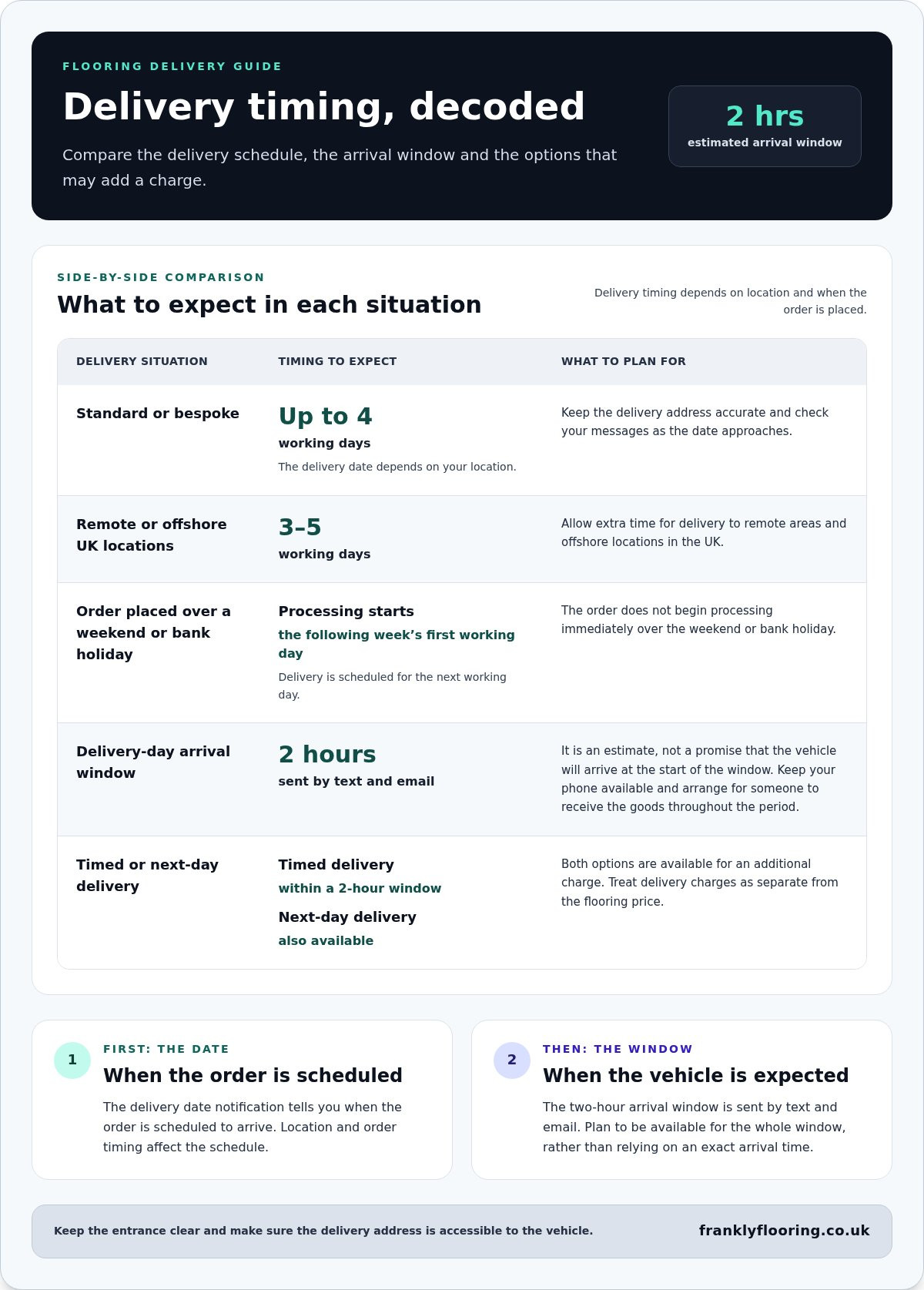
A flooring delivery can take longer and need more planning than a simple drop-off. To understand what to expect from a flooring delivery, allow up to 4 working days for standard or bespoke flooring, depending on location, and look out for a two-hour delivery window sent by text and email.
It’s worth planning beyond the arrival time, especially when your order is coming on a large pallet. Some large-plank and wood flooring deliveries may incur an additional charge per pallet, while restricted access can affect whether the delivery can be completed.
This guide explains how delivery windows work, what to check when your flooring arrives, and how to unload and store it before installation. You’ll also learn what to do if something is damaged or missing, and which details can affect delivery charges, so you can prepare your space and avoid preventable surprises.
Key Takeaways
- Allow up to 4 working days for standard or bespoke flooring delivery, depending on location, and plan around the two-hour window sent by text and email.
- Inspect the order as it arrives, record visible damage or missing items, and report delivery problems in writing within 72 hours.
- Prepare a clear, accessible place for unloading; for Express Kerbside Delivery, expect a call 30 minutes before arrival.
- Keep flooring packs flat and supported while stored, and leave engineered flooring packages sealed until just before installation.
- Check the delivery terms for large pallets, as some large-plank and wood flooring deliveries may incur an additional per-pallet charge.
Delivery time windows
Knowing what to expect from a flooring delivery starts with distinguishing the delivery date from the arrival window. In the UK, both depend on your location and when you place the order.
Delivery Date Notifications
A delivery date notification tells you when the order is scheduled to arrive. Standard and bespoke flooring delivery can take up to 4 working days, depending on location. Orders placed over a weekend or bank holiday are processed on the following week’s first working day, for delivery on the next working day.
For example, a weekend order begins processing on the next week’s first working day, rather than immediately. Remote areas and offshore locations in the UK should allow 3-5 working days. Keep the delivery address accurate and check your messages as the date approaches, so you can plan to receive the order.
Estimated Delivery Time Windows
An estimated delivery window is the period when the vehicle is expected to arrive at your address. Customers receive a two-hour window by text and email, helping you organise your day without relying on an exact arrival time.
Delivery options can give you more control. Timed delivery can be arranged within a two-hour window for an additional charge, and next-day delivery is also available at an additional charge. These options may suit projects with tighter schedules, while standard delivery offers more flexibility around the arrival date.
Treat these as delivery charges, separate from the flooring price. When planning your order, account for any additional charge for a timed or next-day option.
Delivery-Day Texts and Two-Hour Windows
On delivery day, a text confirms the two-hour period when your order is expected. The same window is sent by email, so check both channels. Knowing what to expect from a flooring delivery makes it easier to arrange for someone to receive the goods and complete the handover.
Keep your phone available during the window and clear the entrance beforehand. A two-hour window is an estimate, not a promise that the vehicle will arrive at its start. If you’ve arranged a timed option, plan to be available throughout its window and ensure the delivery address is accessible to the vehicle.
Knowing what to expect from a flooring delivery also means fitting the date around your practical plans. Arrange access and a recipient for the full window, rather than relying on a quick handover. This preparation helps the delivery fit your day without treating the estimated arrival as an exact appointment.
Inspecting deliveries and noting visible damage
When a flooring delivery arrives, check the goods and order details, then report any problems promptly. A careful inspection helps you identify visible damage, missing items or incorrect products before putting the order away.
Checking Goods for Damage
Check the packaging and any accessible flooring for visible faults as the order arrives. Look for crushed corners, splits, tears or signs of impact, and check exposed boards for obvious chips or cracks. Take clear photos of any damage, showing both the affected pack and the wider delivery.
Compare what you can see with the delivery paperwork and note any concerns before the driver leaves. A damaged outer pack does not necessarily mean every board is affected, but keep the evidence and identify the specific pack. You can open a sample of boards to check them before installation, and should leave any defective boards out of the installation.
Identifying Missing Items
To identify missing items, compare the delivery with your order details and paperwork. Check product descriptions, pack counts and listed accessories, then note what is present or missing. For example, if the paperwork lists several packs but fewer arrive, record the quantity received rather than relying on memory.
Keep the paperwork with your photos and notes, and separate items that appear incorrect from those that match the order. A clear record helps distinguish a short delivery from an incorrect product or damaged goods. Check every package before storing it, while the delivery details are easy to match to the order.
Reporting Damage or Order Problems
Reporting a delivery problem means sending a written description of damage, missing goods or incorrect products to the supplier. Delivery problems must be reported in writing within 72 hours of delivery. Include the delivery date, a description of each issue, the number of affected or missing items, and photographs where available.
Keep a copy of your written report and any reply with the order paperwork. If you noted damage with the driver, include that detail, but don’t rely solely on a verbal conversation. A written report records what happened and when, whether the issue involves damaged boards, a short delivery or goods that don’t match your order.
Before accepting the delivery, use a short check: match the paperwork to the goods, note visible damage, and record anything missing or incorrect. Then send the written report within the 72-hour period. Once the goods are checked and recorded, you can organise them for storage without losing track of affected packs. For your next flooring project, browse flooring options.
Kerbside delivery and unloading
Kerbside delivery means the goods are unloaded at the kerb or another accessible point, rather than carried into your home. Plan for someone to receive the flooring and a safe route from the vehicle to its storage area.
For Express Kerbside Delivery, the delivery team will call 30 minutes before arriving. Are there special delivery requirements for laminate, hardwood, vinyl and carpet? The main preparation is to make access and unloading arrangements for the order; the material type alone doesn’t establish a different delivery process. What happens during a flooring delivery in the UK? The vehicle arrives at the agreed address, the goods are unloaded at the kerbside, and the recipient checks the order and completes any required signing.
Kerbside Pallet Delivery and Unloading
With a kerbside pallet delivery, the pallet is placed at an accessible point by the kerb, not inside the property. Clear the approach before the vehicle arrives, including the route from the unloading point to your planned storage area.
Arrange help to move the flooring from the kerb if needed, and don’t assume the delivery team will carry it indoors. Decide where the pallet can be received without blocking a shared entrance or driveway. Restricted access may affect whether the vehicle can safely reach the intended drop-off point.
Delivery Signatures
A delivery signature records that the order has been handed over at the delivery address. Keep the recipient available throughout the agreed window so the handover can be completed without avoidable delays.
Read the delivery paperwork before signing and make sure it relates to the order you’re receiving. If you notice visible damage or missing items, record the issue clearly on the paperwork where possible, then take photos. A signature records the handover, so keep your own notes of any problems rather than relying on the signature alone.
Special Requirements by Flooring Type
Special delivery requirements are the practical arrangements needed to receive and unload a particular flooring order. Laminate, hardwood, vinyl and carpet can differ in packaging and handling, so prepare a clear receiving space suited to the goods you’ve ordered.
Keep the delivery route clear and decide where each package will go before unloading begins. For a pallet, make sure the delivery vehicle can reach the chosen drop-off point. Focus on access and safe handling rather than assuming every flooring material needs a different vehicle or service.
What Happens During Delivery
A UK flooring delivery involves handing over the order at its stated address, unloading it and checking the goods. The driver or delivery team brings the order to the agreed point, and the recipient prepares to receive it.
Use the arrival to match the goods against the paperwork and look for visible damage before moving items into storage. For Express Kerbside Delivery, expect a call 30 minutes before arrival. Keep the route clear, stay available for signing, and note any issue promptly so the handover and follow-up record are clear.
Storing and acclimatising flooring before installation
Before delivery, prepare a clear, dry storage area with enough space to keep flooring packs flat and supported. This helps protect the order while it waits for installation.
To prepare your home, clear the route from the entrance to the storage area, then choose a level spot away from damp and building work. Keep the delivery paperwork with the flooring so you can refer to the product details and any recorded moisture information.
Store flooring packs flat on a supported surface, not upright or leaning on their edges against a wall. Keep them in their packaging where the product instructions require it, and avoid placing heavy objects on top. A cramped hallway can make access difficult, while a damp area may expose materials to unsuitable conditions.
Acclimatisation allows flooring to adjust to room conditions before installation. The right approach depends on the flooring type and its instructions, so don’t apply one material’s preparation steps to every order. Keep engineered flooring packages sealed until immediately before installation. For other preparation, including solid wood flooring, follow the product guidance rather than choosing an arbitrary waiting period.
For solid wood, prepare the boards according to the product’s installation requirements and the conditions in the room where they’ll be fitted. Solid and engineered wood can have different handling instructions, so identify which type you have before opening packs. Keep the delivery paperwork nearby, as it may include information about the flooring’s condition at despatch.
The flooring’s moisture content is checked and recorded at despatch, and the figure appears on the delivery or despatch note. Keep that note with your order and share the recorded information with the person responsible for installation. It provides a reference for the delivered flooring, but doesn’t replace the product’s preparation instructions.
Finish work that could create dust or moisture before moving flooring into the room. Keep the route clear so packs can be placed flat without being moved repeatedly. If installation is delayed, maintain the recommended storage position and keep engineered packs sealed. Don’t open them early to start acclimatisation: engineered flooring packages stay sealed until immediately before installation.
Delivery charges for large flooring pallets
A pallet delivery charge is an additional cost for transporting a large flooring load.
The charge is separate from the flooring price. Check the delivery details at checkout, especially if your order involves large-plank or wood flooring. If it contains more than one pallet, establish how the listed per-pallet charge applies before completing checkout. This makes the delivery total clearer before you place the order.
The type and format of the delivery determine the charge. Don’t assume every wood product incurs the same charge or that every pallet has identical handling terms.
Delivery choices can also change the total. Saturday morning delivery slots, next-day delivery and timed delivery options are available at additional charges. Compare the timing you need with the options shown at checkout, and include any applicable charge in your order total.
Restricted access can also lead to extra costs. A redelivery fee may apply if access restrictions cause a delivery to fail because bespoke delivery wasn’t selected at checkout. Consider the vehicle’s route to the property, any narrow entrance and whether it can reach the drop-off point. Choose the appropriate delivery option at checkout for the access conditions to help avoid a failed attempt.
Before placing the order, use this quick check:
- Review the number of pallets and the delivery charges shown at checkout.
- Decide whether a Saturday morning, next-day or timed slot suits your schedule, noting that each has an additional charge.
- Assess access for the delivery vehicle and choose bespoke delivery at checkout where restricted access requires it.
The practical takeaway is simple: compare the pallet, timing and access details before checkout, not after a delivery fails. For flooring choices that suit your project, explore flooring options.
Frankly Flooring: LVT
Frankly Flooring is a practical next step when you’re ready to choose flooring or plan the items around a room. Its range includes carpet, while furniture can help complete a space once you’ve settled on your flooring choice. Use the delivery guidance above to plan for access, receiving the order and storing it before installation. That preparation is useful whether you’re refreshing one room or coordinating flooring with new furniture. Browse Frankly Flooring’s options at your own pace, then choose what suits your home and project. For details about available choices, visit franklyflooring.co.uk.
Plan Your Flooring Project With Confidence
Knowing what to expect from a flooring delivery is one part of planning a successful project. Next, choose a floor that suits how you use the room and fit delivery arrangements around your renovation schedule. Leave time and space to receive and store the order rather than treating delivery as an afterthought.
Frankly Flooring offers LVT, wood and carpet, giving you options to consider for your home. Think about the room’s needs and the overall look you want before making your choice. A clear decision makes it easier to coordinate your order with your plans for the space.
If you’re weighing up flooring choices or want to discuss delivery advice, contact Frankly Flooring. Take the next step at your own pace, with a practical plan for the floor and the room around it.
Frequently Asked Questions
If Something Doesn’t Go to Plan?
If delivery plans change, keep the order details and delivery messages together so you can explain the issue clearly. For example, if roadworks or a parked vehicle block access, note the problem and whether the driver could reach the agreed address. If the delivery is delayed, use the order communication channel for an update before rearranging other trades or changing work dates.
Questions about delivery?
For a delivery query, have your order reference, delivery address and scheduled date ready. These details help identify the order, especially if you’ve placed more than one. Be clear about what you need to know, such as access arrangements, the delivery option selected or the paperwork to expect. Keep the reply with your order records for delivery day.
Do flooring deliveries include carrying materials inside or upstairs?
Kerbside delivery means the flooring is unloaded at an accessible point by the kerb, rather than carried into your home or upstairs. Plan how the packs will reach their storage area before ordering, particularly if the entrance has steps, a shared hallway or a narrow turn. Arrange suitable help to move the goods from the drop-off point and keep the route clear.
How much does flooring delivery cost in the UK?
These are delivery charges, not flooring prices. Check the charge for your chosen delivery option and order before checkout, as timing choices and pallet requirements can affect the total.
What delivery options and time slots do UK flooring suppliers offer?
Options can include standard delivery, next-day delivery, timed delivery and Saturday morning slots. Standard or bespoke delivery can take up to 4 working days, depending on location, while remote and offshore UK destinations should allow 3-5 working days. Customers receive a two-hour window by text and email. Next-day, timed and Saturday options carry additional charges.
How should flooring be stored and acclimatised after delivery?
Store flooring packs flat, supported and away from damp, rather than leaning them on their edges against a wall. Keep engineered flooring packages sealed until immediately before installation. Acclimatisation instructions depend on the flooring type, so follow the product guidance instead of applying one waiting period to every material. Keep the delivery paperwork nearby, including any recorded moisture information for wood flooring.
How do I check flooring for damage or missing items on delivery?
Compare the delivered packs and listed accessories with your order details and paperwork. Look for crushed packaging or visible damage, count the items received and photograph any concerns. For example, note the pack count if the paperwork lists more packs than arrived. Keep affected goods separate from undamaged items, and record exactly what appears damaged, missing or incorrect.
What should I do if a flooring delivery is late, damaged or incomplete?
If flooring is damaged, missing or incorrect, report the problem in writing within 72 hours of delivery. Include the delivery date, the affected product or pack, the shortfall, and photographs where useful. Keep a copy of your message and order paperwork. For a late delivery, check the latest delivery notification and contact the supplier through its order communication channel for an update.