Most pet owners choose synthetic turf based on how soft it feels under their hand, but that’s the fastest way to end up with a garden that smells like a kennel by July. When searching for the best artificial grass for dogs, the secret isn’t in the pile height or the lush green colour. It’s actually hidden in the backing. If the drainage isn’t up to scratch, you aren’t just buying a lawn; you’re buying a giant, plastic sponge for urine. At Frankly Flooring, we’ve spent 20 years seeing exactly where cheap, poorly designed turf fails and how it impacts your home.
We know you’re likely tired of the “muddy paw” season and the constant battle against yellow patches on real grass. You want a garden that looks great without the fear of toxic materials or lingering smells. This guide is designed to help you cut through the marketing fluff and choose a durable, high-drainage surface that stands up to high-energy play. We’ll preview the latest 2026 technology, including cooling fibres and antimicrobial infills, so you can build a lush, pet-safe space that stays fresh year-round.
Key Takeaways
- Learn why the best artificial grass for dogs requires a specific pile height of 30mm to 35mm to balance underfoot comfort with long-term durability.
- Understand why the sub-base is more important than the grass itself when it comes to preventing lingering pet urine odours in your garden.
- Discover the hidden risks of using sharp sand in pet-focused installations and how it can trap moisture instead of aiding drainage.
- Compare the lifetime maintenance costs of synthetic turf against real grass, focusing on the elimination of mud and nitrogen burn patches.
- Identify the technical markers of high-quality turf that prevent it from acting as a sponge for pet waste, ensuring a fresh lawn for years to come.
Why Standard Artificial Grass Fails Dog Owners
Most homeowners reach a breaking point where their garden looks more like a construction site than a lawn. It usually happens after the third or fourth time they’ve mopped muddy paw prints off the kitchen floor in a single afternoon. Natural grass simply isn’t built to withstand the combination of the British climate and an active pet. Yellow patches, or nitrogen burn, are another constant headache. Dog urine is high in nitrogen, and while a little is good for grass, the concentrated amounts from a pet act like a chemical burn, leaving permanent dead spots that no amount of watering can fix.
If you’re hunting for the best artificial grass for dogs, don’t be fooled by every product that carries a pet-friendly label. Many retailers use this as a buzzword for standard turf that hasn’t actually been modified for animals. The history and composition of artificial turf shows it was originally designed for sports fields, not for handling pet waste. Cheap, standard turf typically features a latex backing with small punched holes for drainage. While this works for occasional rain, it’s woefully inadequate for a dog’s daily business. Without specialist backing, urine gets trapped between the grass and the base, leading to bacterial growth and a garden that smells like a public toilet by the time summer rolls around.
The Mud and Mess Cycle
British weather is the primary enemy of the natural lawn. With significant rainfall levels throughout much of the year, real grass stays damp and the soil remains soft. When a high-energy dog runs or skids, they don’t just flatten the blades; they tear the roots out of the ground. This creates a cycle where you’re constantly buying “hard-wearing” seeds and expensive fertilisers that never quite fix the problem. It’s a losing battle and a waste of money. High-quality synthetic turf breaks this cycle by providing a stable, porous surface that stays green regardless of the weather or the intensity of play.
Hygiene and Safety Concerns
Beyond the aesthetics, real grass and low-quality synthetic alternatives present hidden risks. Long or damp natural grass is a haven for pests like ticks and fleas. Maintaining a natural lawn also usually requires chemical weed killers that aren’t always safe for animals to roll around on. When you choose the best artificial grass for dogs, you eliminate these variables. We’ve seen over 20 years how the right materials make a difference. Quality turf is manufactured to be lead-free and non-toxic, ensuring your pet’s safety during every zoomie. It also removes the need for any chemical treatments, creating a much cleaner environment for both your dog and your family.
- Non-toxic, lead-free materials are essential for pet health.
- High-density fibres prevent dogs from digging through to the sub-base.
- No need for harsh chemical fertilisers or pesticides.
Technical Features of the Best Artificial Grass for Dogs
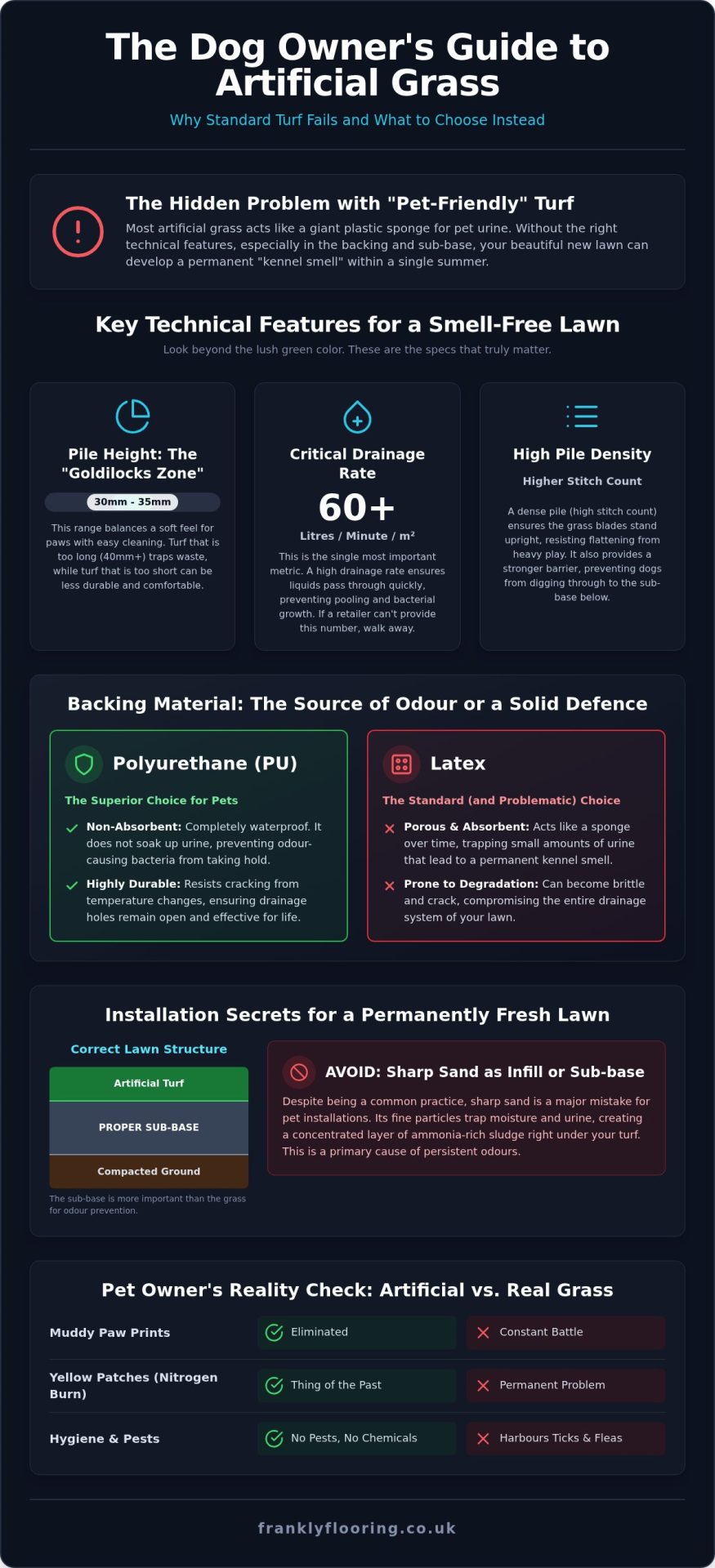
Choosing the best artificial grass for dogs requires looking past the surface aesthetics. While a lush, 45mm pile looks beautiful on a sample board, it is often a mistake for pet owners. Longer fibres trap solid waste and make thorough cleaning much harder. We recommend a pile height between 30mm and 35mm. This is the “Goldilocks” zone. It provides enough cushion for paws and looks like a well-kept lawn, but it remains short enough to brush and sanitise easily. Pile density is just as vital. A higher stitch count ensures the grass stands upright even after your dog has spent the afternoon doing laps around the garden.
Drainage is the most critical technical specification you need to check. You should look for a drainage rate measured in litres per minute per square metre. A high-quality product should comfortably handle over 60 litres per minute. If a retailer cannot provide this specific number, they probably aren’t selling professional-grade turf. If you want to see how these technical specs look in practice, you can browse our pet-safe turf options to find the right fit for your garden.
The PU Backing Advantage
While traditional latex backings are the industry standard for general use, they are often the root cause of lingering smells in pet-filled homes. Latex is naturally porous. Over time, it acts like a sponge, absorbing small amounts of urine that eventually lead to a “kennel smell” that is almost impossible to wash away. Polyurethane (PU) backing is the superior choice for dog owners. It is non-absorbent and much more durable. PU backing does not expand or contract as much with temperature changes, which prevents the backing from cracking and ensures the drainage holes remain clear and functional for the lifetime of the lawn.
Yarn Shape and Durability
The shape of the individual grass blades determines how well the lawn “bounces back” after use. Flat yarns mat down quickly under the weight of a running dog. C-shaped or W-shaped yarns are engineered with structural integrity. These shapes act like a spring, allowing the blades to return to an upright position after being stepped on. Dtex is a technical measurement of the yarn’s weight per 10,000 metres; it directly influences the thickness and overall durability of the grass blades. Finally, ensure the product has high UV stabilisation. This prevents the fibres from becoming brittle or fading after years of exposure to the sun and pet waste.
Artificial Grass vs Real Grass for Pets: A Frank Comparison
A natural lawn is often a subscription service you never signed up for. You pay in time, effort, and money every single month. While the initial investment for the best artificial grass for dogs is undeniably higher, it pays for itself by eliminating the need for lawnmowers, edge trimmers, and expensive seasonal treatments. When you look at the total cost over five or ten years, the synthetic option often proves to be the more sensible financial choice for a busy household.
Aesthetic consistency is where the comparison really ends. A natural lawn is at the mercy of the seasons. It is a patchy brown mess in a dry July and a swampy quagmire in January. Synthetic turf provides a consistent, lush green surface 365 days a year. It doesn’t matter if your dog is doing high-speed laps or if the kids are playing football; the surface remains level and intact. From an environmental perspective, you also stop using petrol-powered mowers and eliminate the need for fertilisers and weedkillers, which often contain phosphates that can be harmful to local waterways and your pet’s health.
Maintenance Realities
Let’s be honest about “self-cleaning” turf. It doesn’t exist. While rain helps to rinse the fibres, it isn’t a substitute for a proper cleaning routine. You still need to scoop solid waste just as you would on a natural lawn. For liquid waste, a quick hose down is usually enough, but we recommend using pet-safe enzyme cleaners at least once a month. These cleaners don’t just mask smells with artificial scents. They contain biological agents that break down the uric acid that causes odours in the first place, ensuring your garden remains a pleasant place for the whole family.
The Heat Factor
A common concern for pet owners is whether synthetic turf will burn paws during the summer. In the UK, temperatures rarely reach the extremes seen in other climates, but artificial grass does retain more heat than natural turf. Lighter yarn colours and products with slightly lower density tend to stay cooler because they absorb less solar energy. If we do experience a rare heatwave, a simple thirty-second spray with the garden hose will drop the temperature of the turf significantly. The water evaporates and cools the fibres instantly, making it safe and comfortable for your dog to lounge on without any risk of discomfort.
Installation Secrets for an Odour-Free Pet Lawn
You can invest in the best artificial grass for dogs, but if your installation cuts corners on the foundation, you are wasting your money. The sub-base is the engine of your lawn. If it doesn’t drain, the project fails. Many installers still use sharp sand because it is cheap and easy to level. This is a disaster for pet owners. Sand absorbs urine and holds onto it, creating a permanent layer of bacteria right under your feet. For a truly odour-free garden, you must insist on a granite-based system. To ensure your project succeeds from the ground up, you can shop our professional-grade artificial grass and accessories to get the right materials for the job.
A free-draining system relies on stone, not sand. Granite dust, often called granite fines, is the industry secret for pet-friendly installs. It provides a stable, flat surface for the turf to sit on while allowing liquid to pass through immediately. This prevents the “puddling” effect that leads to smells and ensures the backing of your grass stays as dry as possible. When combined with the PU backing we discussed earlier, this creates a garden that stays fresh even during the peak of summer.
The Correct Sub-Base Layers
The process starts with a significant dig-out. You need to remove at least 75mm to 100mm of existing soil and turf. Once the area is clear, lay a 50mm to 75mm layer of MOT Type 1. This provides the structural integrity needed to prevent sinking or dipping over time. The final layer is the most important for drainage; use 20mm to 25mm of 6mm granite fines. This material compacts into a smooth surface but remains entirely porous, allowing liquid to escape instantly into the ground below.
Finishing Touches for Stability
Edges are a frequent point of failure for dog owners. High-energy pets love to find a loose corner and pull. Secure your turf to a perimeter of treated timber or composite battens using galvanised screws. This keeps the lawn taut and prevents curious paws from causing damage. Regarding weed membranes, place them at the very bottom, beneath the stone layers. Placing a membrane directly under the grass creates a trap for pet hair and silt, which eventually blocks the drainage holes in the backing. Finally, brush in a pet-specific infill like Zeolite. This volcanic mineral is a game-changer; it naturally captures and neutralises ammonia before it has a chance to create an odour.
Choosing Quality Over Marketing Fluff
Cheap turf is often the most expensive thing you can buy for your garden. It sounds like a contradiction, but we’ve spent two decades watching homeowners replace budget-tier grass after just two or three years because it couldn’t handle the reality of a high-energy pet or a wet British winter. When you’re looking for the best artificial grass for dogs, the up-front price is only half the story. You have to consider the cost per year over the product’s lifespan. A professional-grade lawn with a proper PU backing can last 15 to 20 years. In contrast, a cheap latex-backed alternative often starts shedding fibres and trapping odours before the second summer ends.
At Frankly Flooring, we don’t believe in high-pressure sales or hiding behind vague marketing buzzwords. Our approach is built on transparency and technical honesty. To read a spec sheet like a pro, ignore the “ultra-soft” claims and focus on the stitch rate and the Dtex. If a supplier is vague about these numbers, it’s usually because the product is thin and won’t survive heavy use. Look for a high stitch count to ensure the pile doesn’t flatten, and always verify that the drainage rate meets the high-capacity thresholds we discussed in our installation section. If the data isn’t there, the quality usually isn’t either.
What to Look for in a Supplier
Experience matters in the UK market. We’ve been a family-run business for 20 years, and that longevity provides a level of accountability you won’t find with faceless corporations. When you buy from us, you’re getting two decades of technical expertise and a commitment to quality that is personal. Always check for comprehensive warranties that cover both UV stability and pile loss. A solid warranty is the manufacturer’s way of proving they trust the longevity of their materials. It ensures your lawn stays green and intact even with constant exposure to the sun and pet activity, giving you peace of mind that your investment is protected.
Ready to Transform Your Garden?
Before you order, take the time to measure your lawn accurately. We recommend drawing a simple layout on paper and adding 10% to your total measurements to account for cuts and shaping. This simple step minimises waste and ensures you have enough material for a seamless finish without awkward joins. You can browse our full range of artificial grass online to find the perfect match for your home and your pet. If you are also planning how your outdoor space connects to your interior, check our engineered wood flooring guide for indoor transitions that offer the same level of durability and style for your home.
Ready for a Mud-Free Garden?
You’ve seen that the secret to a fresh, durable lawn isn’t just about the green fibres on top. It’s about the non-absorbent PU backing and a granite-based foundation that allows urine to drain away instantly. By choosing a 30mm to 35mm pile height, you ensure that cleaning up after your pet is simple and hygienic. We’ve spent 20 years providing no-nonsense advice to help homeowners find the best artificial grass for dogs without the typical marketing fluff. Our family-run business values quality over quick wins, ensuring your property gets a foundational element that lasts for years. Direct UK shipping means you’re only a few days away from a garden that stays lush regardless of the weather or your pet’s energy levels.
Browse our durable, pet-friendly artificial grass collection to find a solution that prioritises integrity and technical craftsmanship. It’s time to stop worrying about muddy paws and start enjoying a garden that looks professional year-round. You deserve a space that’s as resilient as it is beautiful.
Frequently Asked Questions
Is artificial grass safe for all dog breeds?
Yes, professional-grade turf is safe for every breed from Chihuahuas to Great Danes. The key is ensuring the product is certified lead-free and non-toxic. Because dogs spend so much time with their noses to the ground, high-quality materials are non-negotiable. It provides a consistent surface that won’t harbour the same parasites or bacteria often found in damp, natural soil.
How do I stop my dog from digging up the artificial turf?
Most dogs lose the urge to dig once the scent of fresh earth is gone. If you have a particularly determined digger, the secret lies in the installation. Secure the perimeter with a solid timber or composite frame and use galvanised fixers. A high-density stitch count also makes it much harder for a dog to get their claws between the fibres to start a tear.
Will artificial grass smell if my dog uses it as a toilet?
When you choose the best artificial grass for dogs, it won’t hold onto odours. Smells only become a problem if you use a latex backing that absorbs liquid or a sand sub-base that traps it. By using a Polyurethane (PU) backing and a granite dust base, urine passes straight through into the ground. This prevents the bacteria buildup that causes that dreaded “kennel smell.”
Can I install artificial grass for dogs myself or do I need a pro?
What is the best way to clean dog urine from artificial grass?
Skip the bleach and reach for a pet-safe enzyme cleaner. While water rinses away the bulk of the waste, enzyme-based products actually digest the uric acid that causes lingering smells. A quick spray once a month is usually enough for most gardens. It’s a simple, effective routine that keeps the turf fresh without using harsh chemicals that could irritate your dog’s paws.
How long does artificial grass last with a high-energy dog?
A premium lawn will easily survive 15 to 20 years of high-energy play. The lifespan depends on the quality of the yarn and the density of the tufts. High-Dtex fibres are designed to withstand constant running, skidding, and jumping without snapping or thinning. Regular brushing helps to keep the fibres upright, ensuring the lawn looks as good in year ten as it did on day one.
Does artificial grass get too hot for my dog in the summer?
It does get warmer than natural grass, but it rarely becomes a safety issue in the UK. On the hottest days of the year, you’ll notice the surface temperature rise. A thirty-second spray with a garden hose provides instant evaporative cooling. This drops the temperature significantly, making it comfortable for your dog to lie on almost immediately.
Is artificial grass better for dogs with allergies?
It is a game-changer for pets with seasonal hay fever or skin irritations. Natural grass is a major source of pollen and often hides harvest mites or fleas. By switching to synthetic turf, you remove these common triggers. It’s often the best artificial grass for dogs that suffer from “grass itch,” as it provides a clean, pollen-free environment for them to enjoy year-round.