
The cheapest carpet in the shop is almost never the best carpet for stairs. That might sound obvious, but thousands of British homeowners discover it the hard way every year, watching a perfectly attractive carpet flatten and grey on the nose of each step within months of fitting. The problem isn’t always the price. It’s the pile type, the density, and whether the carpet was ever designed to handle the kind of relentless, concentrated footfall a staircase takes.
You already know that stairs are different. Every step lands in exactly the same spot, day after day, and most carpets simply aren’t built to recover from that. Add a muddy dog, a toddler with a juice cup, and a household that actually uses its stairs, and the challenge becomes clear.
This guide cuts through the noise and gives you straight, practical advice on what actually works. You’ll learn why density and pile recovery matter far more than colour or cost, which materials hold up under real family traffic, and what to look for so your staircase still looks sharp years from now, not just on the day it’s fitted.
Key Takeaways
- Stairs are the hardest-working surface in any British home, and choosing the best carpet for stairs means prioritising density and pile recovery over price or colour alone.
- Material matters more than most people realise — wool outperforms on resilience and fire resistance, while polypropylene can work well on a budget only if the quality is genuinely high.
- Twist pile is the safest choice for staircases; loop and Berber styles carry a real risk of snagging and opening up on the nosing of each step.
- Never reuse old underlay — the right high-density underlay fitted beneath new carpet is what protects the backing and extends the life of your investment significantly.
- Measuring accurately and ordering samples to check colours in your actual hallway lighting will save you costly mistakes before you buy a single roll.
Why Choosing the Right Carpet for Stairs Matters
Stairs take a punishment that no other surface in your home comes close to matching. Every single person who moves through the house uses them multiple times a day, landing in precisely the same spot on each tread, at the same angle, with the same concentrated force. A living room carpet gets walked across. A stair carpet gets drilled into. That distinction changes everything about how you should choose one.
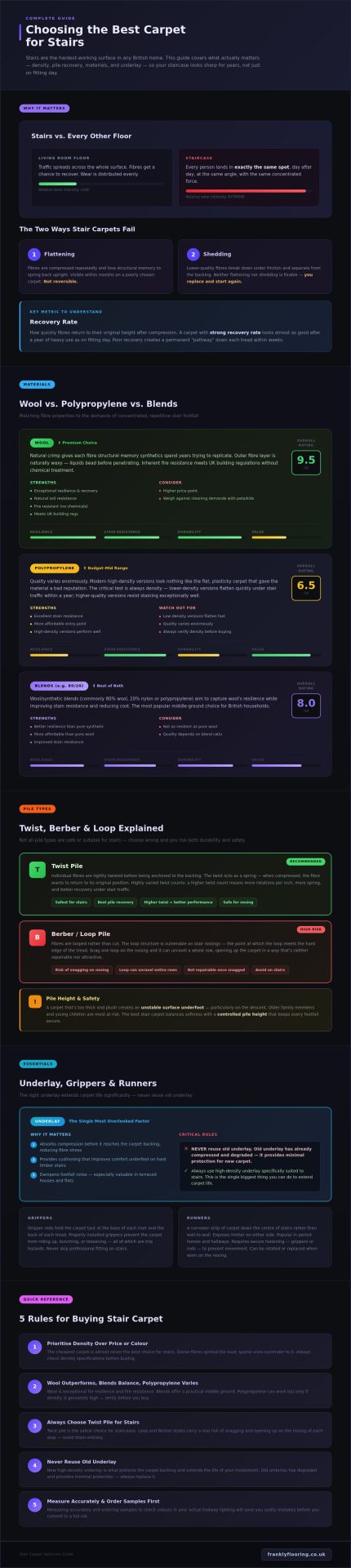
Two failure modes account for the vast majority of stair carpet complaints in British homes: flattening and shedding. Flattening happens when fibres are compressed repeatedly and lose the structural memory to spring back upright. Shedding occurs when lower-quality fibres break down under friction and begin to separate from the backing. Both are visible within months on a poorly chosen carpet, and neither is reversible. You can’t restore a flattened pile or re-bond shed fibres. You replace the carpet and start again.
There’s also a safety dimension that rarely gets the attention it deserves. Pile height directly affects grip on a steep incline. A carpet that’s too thick and plush creates an unstable surface underfoot, particularly on the descent. Older family members and young children are most at risk. The best carpet for stairs balances a degree of softness with a controlled pile height that keeps every footfall secure.
This is where recovery rate becomes the metric that separates a good stair carpet from a great one. Recovery rate describes how quickly fibres return to their original height after compression. A carpet with strong recovery rate looks almost as good after a year of heavy use as it did on fitting day. One with poor recovery starts to show a permanent “pathway” down the centre of each tread within weeks.
The “Nose” of the Step: Where Carpets Fail
The nosing, the very edge of each tread, is where every stair carpet goes to die. The ball of your foot strikes that edge at a downward angle on the way up and drags across it on the way down. That concentrated friction is relentless. On thinner carpets, the backing compresses so severely that the structure beneath begins to show through, giving each step a worn, translucent look across the nose. This isn’t a cosmetic issue; it’s a structural one. Pile density, the number of fibres packed into a square inch of backing, is what resists this. A denser pile spreads the load. A sparse one surrenders to it.
Sound Insulation and Comfort
Beyond durability, the right carpet does something a hard floor simply can’t: it absorbs sound. In a busy household, the difference between a carpeted staircase and a bare timber one is the difference between a quiet morning and a series of heavy thumps echoing through every room. A well-chosen carpet with appropriate underlay dampens footfall noise significantly, which matters in terraced houses and flats where sound travels easily. There’s also a subtler benefit: the psychological comfort of a soft, warm landing in a hallway sets the tone for the whole home. The challenge is finding a carpet that delivers that comfort without sacrificing the density and resilience a staircase genuinely demands.
Materials Comparison: Wool vs. Polypropylene vs. Blends
Not all carpet fibres behave the same way under the specific punishment a staircase delivers. Choosing the right material isn’t about finding the most luxurious option or the cheapest one. It’s about matching fibre properties to the demands of concentrated, repetitive footfall. Here’s what each major material actually does, and where each one falls short.
Wool is genuinely exceptional. Its natural crimp gives each fibre a structural memory that synthetic alternatives spend years trying to replicate. Wool compresses underfoot and springs back. It resists soiling because the outer layer of each fibre is naturally waxy, causing liquid to bead before it penetrates. It also carries an inherent fire resistance that meets UK building regulations without chemical treatment. The honest drawback is cost. Pure wool carpets sit at a higher price point, and in a household with dogs, muddy boots, and heavy daily traffic, that investment needs to be weighed carefully against cleaning demands.
Polypropylene is where the market gets complicated. Modern, high-density polypropylene looks nothing like the flat, plasticky carpet that gave the material a bad reputation. The problem is that quality varies enormously. Lower-density polypropylene flattens quickly under stair traffic, losing its pile height and texture within a year. Higher-quality versions resist staining exceptionally well and hold their appearance under moderate use. The critical test is always density, not the fibre type alone.
Nylon, often listed as polyamide on British product specs, is the quiet high-performer that doesn’t get enough credit. It offers outstanding abrasion resistance, which is precisely what the nosing of each step demands. It dyes well, holds colour under UV exposure, and recovers from compression better than polypropylene at comparable price points. For genuinely high-traffic staircases, nylon deserves serious consideration.
The 80/20 Rule for British Stairs
An 80% wool, 20% synthetic blend is the recommendation that comes up consistently among flooring professionals, and for good reason. The wool provides the natural resilience and recovery rate that keeps the pile looking fresh. The synthetic component, typically nylon, adds tensile strength to the fibre structure, reducing the risk of shedding and pilling under friction. The result is a carpet that performs closer to pure wool over a ten-to-fifteen year lifecycle but sits at a noticeably more accessible price point. For most British households, this blend represents the most sensible long-term investment when choosing the best carpet for stairs.
Bleach-Cleanable Synthetics: A Parent’s Best Friend
There’s a growing category of high-quality polypropylene carpets specifically engineered to tolerate diluted bleach cleaning. For families with young children or pets, this changes the maintenance equation entirely. A juice spill on a wool carpet requires careful, immediate treatment with specialist products. The same spill on a bleach-cleanable synthetic can be addressed with a mild solution and a cloth. The trade-off is that these carpets typically don’t match wool’s long-term resilience, but for households where hygiene and ease of cleaning outweigh everything else, they’re a genuinely practical choice.
The key is knowing which scenario fits your home before you buy. If you’d like to explore carpet options across all these material types, browse the carpet range at Frankly Flooring where the selection covers everything from wool blends to high-performance synthetics suited to real family life.
Pile Types: Twist, Berber, and Loop Explained
Pick the wrong pile type and even the most expensive fibre won’t save you. The structure of the pile, how the yarn is cut, looped, or twisted, determines how a carpet behaves when it bends over a step nosing, how it holds up under concentrated foot traffic, and whether it stays safe underfoot over years of use.
Why Twist Piles Win on Stairs
Twist pile is the clear frontrunner for staircases, and the reason comes down to manufacturing. Each yarn strand is tightly twisted before it’s anchored into the backing, and that twist is heat-set so it holds its form under compression. When the pile is crushed underfoot, the twist structure pulls the fibre back upright rather than allowing it to mat flat. That recovery is exactly what the nosing of each step demands.
Within twist piles, you’ll encounter two visual styles worth knowing about:
- Heathered twist: Uses two or more tones of yarn blended together. This is the smarter choice for stairs because the tonal variation disguises footprints, vacuum tracks, and the uneven wear that develops over time on the nose of each tread.
- Plain twist: A single-colour yarn that looks clean and contemporary but shows every footprint and hoover mark with far less forgiveness.
On pile height, keep it controlled. A pile height of roughly 8mm to 12mm is the practical range for stair safety. Below that, the carpet can feel thin underfoot. Above it, you start introducing instability on the descent, which is a genuine hazard for older family members and young children.
The Loop Pile Warning
Loop pile carpets, including Berber styles, deserve a direct caution here. The issue isn’t aesthetic; it’s structural. When a loop pile carpet bends over the nosing of a step, the backing is forced to flex at a sharp angle. Over time, this causes “grinning”, where the backing becomes visible through the pile as the loops are pulled apart by repeated bending. On a flat floor, this rarely happens. On stairs, it’s a common failure mode.
There’s also a snagging risk that often goes unmentioned. Pet claws and stiletto heels can catch in the loop structure and pull a single strand loose. Once one loop opens, the damage spreads quickly and can’t be repaired neatly. If you’re set on a loop pile, choose a very low-profile, high-density version and accept that the risk, while reduced, isn’t eliminated.
Saxony and deep shag piles present a different problem: they’re simply too thick for safe stair use. The plush pile compresses unevenly underfoot, creating a soft, unstable surface that reduces grip on the descent. They look beautiful in a bedroom. They don’t belong on a staircase.
Wilton and Axminster weaves sit at the premium end of the spectrum and earn their reputation. Both are woven constructions rather than tufted, meaning the pile is structurally integrated into the backing rather than glued or needle-punched in. This gives them exceptional dimensional stability, which is why they’ve been used on high-traffic commercial staircases for generations. If you’re choosing the best carpet for stairs in a period property or a home where longevity genuinely outweighs budget, a woven Wilton or Axminster is worth the investment.
The Essentials: Underlay, Grippers, and Runners
The carpet gets all the attention. The underlay, grippers, and fitting method quietly determine whether that carpet lasts five years or fifteen. Get these elements wrong and even the best carpet for stairs will fail ahead of schedule, no matter how well you chose the pile or fibre.
Choosing the Right Underlay
Replace the underlay. Every time. This isn’t a sales tactic; it’s practical reality. Old underlay compresses and loses its structural integrity over years of use. Laying new carpet over spent underlay is like fitting new tyres on a buckled rim. The carpet backing sits unevenly, the pile compresses faster, and the whole installation feels cheaper than it should.
Stair underlay has a specific requirement that bedroom underlay doesn’t: density. A softer, thicker underlay that feels luxurious under a bedroom carpet will compress too readily on a stair tread, causing the carpet to shift slightly underfoot with each step. That micro-movement accelerates backing wear and creates a subtle instability that you feel before you see it. A high-density foam underlay in the 9mm to 11mm range, such as products in the Cloud 9 category, provides the right balance: enough cushioning to protect the carpet backing and improve underfoot comfort, without introducing the softness that causes movement on an incline.
There’s a secondary benefit that’s easy to overlook. Quality underlay adds a measurable layer of thermal insulation to the staircase, which matters in older British homes where draughts travel freely through uninsulated floors. A carpeted stair with good underlay feels noticeably warmer underfoot than one fitted directly over a cold tread.
Grippers: The Unsung Hero of a Secure Fit
A quality carpet gripper is what keeps the whole installation anchored. On stairs, grippers are fitted along both the tread and the riser of each step, holding the carpet taut at the angle where it bends over the nosing. Cheap or incorrectly spaced grippers allow the carpet to lift slightly at the nose, which is precisely where the most foot traffic lands. Over time, that lifting creates a loose edge that catches underfoot and accelerates the very wear you’re trying to prevent. Don’t cut corners here.
Stair Runners: Style Meets Wood
A stair runner leaves a strip of timber visible on either side of each tread, and in a home with original pine or oak staircases, that’s often exactly the right choice. The exposed wood adds character. The runner adds grip and noise reduction. Together, they suit period properties particularly well.
Practically, runners are typically fitted between 60cm and 80cm wide on a standard British staircase, leaving a border of roughly 10cm to 15cm of timber on each side for a balanced look. Fitting methods vary: carpet rods hold the runner in place without permanent fixing and allow you to shift it periodically to redistribute wear, while stapling gives a cleaner finish but commits the runner to a fixed position.
Calculating the right width before you order is essential. Measure the stair width, decide on your border, and order a sample length to check how the pattern or pile direction reads on the angle of the tread before committing to a full roll. Frankly Flooring’s carpet range includes options suited to runner applications across a range of materials and pile types, so you can browse and order samples directly before making a final decision.
Buying Your Stair Carpet: The Frank Way to Quality
All the research in the world counts for nothing if you order the wrong quantity or pick a colour that looks nothing like you expected once it’s on your stairs. These are the mistakes that cost real money and real frustration. Here’s how to avoid them.
Measuring for Success
The rise-and-tread method is the most reliable way to calculate how much carpet you need. Measure the depth of one tread (the horizontal surface you step on) and the height of one riser (the vertical face beneath it), then add those two figures together. Multiply that total by the number of steps in your staircase. That gives you your running length. Add the width of the stair to confirm your roll width requirement.
Two areas catch people out. First, the landing at the top: it’s easy to forget it needs covering too, so measure it separately and add it to your total. Second, bullnose steps, those rounded or projecting bottom steps that some staircases have, require a little extra material to wrap neatly. Measure them individually rather than assuming they match the standard tread depth.
Once you have your total, add 10% for waste. This isn’t padding for the retailer’s benefit; it’s a standard industry safety net that accounts for cutting errors, pattern matching, and the small offcuts that are inevitable when fitting around angles and nosings. Order short and you’ll face a costly top-up order. The 10% buffer is cheap insurance.
The Final Checklist Before You Click Buy
Before you confirm your order, run through these four points:
- Check the wear rating. The product page should clearly state a “Heavy Domestic” or “Heavy Contract” rating. If it doesn’t, the carpet isn’t designed for stair traffic. Don’t assume.
- Order your samples first. Hallway and staircase lighting is often the most variable in a home, mixing natural light from a front door with artificial overhead lighting. A colour that looks warm and neutral in a shop can read entirely differently in your specific space. Ordering samples before committing to a full roll is the single most effective way to avoid an expensive mistake.
- Confirm your gripper quantity. You’ll need carpet gripper for every individual tread and riser. Work out your step count and order accordingly; running short mid-fit is an avoidable delay.
- Check delivery logistics. Carpet rolls are bulky. Confirm the delivery lead time before you book your fitter, and ensure someone will be available to receive the order. A missed delivery on a long roll can set your whole project back by days.
Frankly Flooring’s direct-to-consumer model means you’re getting honest pricing without the showroom markup, backed by more than 20 years of industry experience. The advice here is the same you’d get from a straight-talking professional who’d rather you buy the right thing once than the wrong thing twice. If you’re also thinking about flooring elsewhere in your home, the full guide to choosing the right carpet covers every room, every material, and every budget in the same no-nonsense way.
Finding the best carpet for stairs doesn’t require a degree in flooring science. It requires measuring carefully, testing colours in your actual space, and choosing a product built for the job. Do those three things and you’ll get a staircase that still looks sharp years from now.
Your Staircase Deserves Better Than a Guess
Finding the best carpet for stairs comes down to three decisions made in the right order: choose the right material, confirm the pile type suits a staircase (not just a living room floor), and back it with quality underlay that actually protects your investment. Get those three things right and you’ll have a staircase that looks sharp and performs safely for years, not months.
The honest truth is that most stair carpet failures are avoidable. They happen when people prioritise price over density, skip the underlay, or order without checking samples in their actual hallway light. None of those mistakes are difficult to sidestep once you know what to look for.
Frankly Flooring has spent over 20 years giving customers straight advice rather than steering them towards the most expensive option. With national UK delivery and direct-to-consumer pricing that cuts out the showroom markup, you get genuine quality at a fair price. Browse the full range of heavy-duty stair carpets at Frankly Flooring and order your samples before you commit. Your staircase will thank you for it.
Frequently Asked Questions About Stair Carpet
What is the most hard-wearing carpet for stairs?
A high-density twist pile in an 80/20 wool-nylon blend is the most hard-wearing option for the vast majority of British staircases. The tight twist structure resists compression on the nosing of each step, while the nylon component adds tensile strength that reduces shedding and pilling over time. For households with very heavy traffic, a woven Wilton construction offers exceptional dimensional stability and a longer service life still.
Whatever fibre you choose, density is the deciding factor. A “Heavy Domestic” or “Heavy Contract” wear rating on the product specification confirms the carpet was engineered for this kind of use. Without that rating, you’re guessing.
Is wool or nylon better for high-traffic stairs?
Both perform well, but they suit different priorities. Wool offers superior natural resilience and fire resistance, and its inherent crimp gives it a recovery rate that most synthetics can’t match over a long lifecycle. Nylon edges ahead on abrasion resistance, which is the specific stress a stair nosing delivers, and it typically costs less. For the best of both, an 80/20 wool-nylon blend combines wool’s recovery properties with nylon’s durability at a more accessible price than pure wool.
Can I use a loop pile carpet on my stairs?
It’s not recommended, and the reason is structural rather than aesthetic. When a loop pile carpet bends over the nosing of a step, the backing flexes at a sharp angle repeatedly. Over time this causes “grinning,” where the backing becomes visible as the loops are pulled apart. There’s also a snagging risk: pet claws and heels can catch a single loop and unravel a section that can’t be repaired neatly. If you’re set on a loop pile, choose the lowest-profile, highest-density version available and accept the risk is reduced rather than eliminated.
How much extra carpet should I order for stairs?
Add 10% to your calculated total as a standard safety margin. This accounts for cutting errors, the small offcuts that are unavoidable when fitting around angles and nosings, and any pattern matching requirements. Measure each tread depth and riser height, add them together, then multiply by your step count. Don’t forget the top landing, which is easy to overlook, and measure any bullnose steps individually as they typically require more material to wrap cleanly.
Does stair carpet need a special kind of underlay?
Yes, and the difference matters more than most people expect. Stair underlay needs to be high-density rather than soft and thick. A plush bedroom-style underlay compresses too readily on a tread, causing the carpet to shift slightly underfoot with each step. That micro-movement accelerates backing wear and creates a subtle instability on the descent. A high-density foam underlay in the 9mm to 11mm range provides the right balance: enough cushioning to protect the carpet backing without introducing the softness that causes movement on an incline. Always replace old underlay rather than fitting new carpet over spent foam.
How do I prevent my stair carpet from flattening?
Start with the right product. The best carpet for stairs is a high-density twist pile; the tight twist structure has the memory to spring back after compression in a way that a lower-density pile simply doesn’t. Beyond material choice, vacuuming regularly in both directions lifts the pile and removes the grit particles that act like sandpaper on fibre roots. A heathered twist colour also disguises the visual appearance of wear far better than a plain single-tone carpet, buying you more time before the tread pattern becomes obvious.
What is a “bullnose” step and how does it affect the carpet fit?
A bullnose step is the rounded or projecting bottom step found on many British staircases, typically wider or more curved than the steps above it. It affects the fit because the carpet needs to wrap around a larger, more complex profile than a standard tread, which requires additional material and more precise cutting. Measure bullnose steps individually rather than assuming they match your standard tread depth, and factor the extra material into your order. An experienced fitter will know how to handle the wrap, but ordering short is an avoidable and costly mistake.
How often should I replace my stair carpet?
A quality high-density twist pile in a wool or wool-blend fibre, fitted over good underlay, should perform well for ten to fifteen years in a typical household. Lower-quality synthetics in a busy home may show significant wear within five years. The honest indicators that replacement is due are visible backing on the nosing of each tread, pile that no longer recovers after vacuuming, or edges that have begun to lift from the grippers. Catching those signs early and replacing before the backing deteriorates further protects the stair structure beneath.