
Skipping the acclimatisation phase is the fastest way to turn a high-quality investment into a buckled, warping headache that costs upwards of £3,200 to replace. We understand the pressure to finish a renovation quickly, especially when you are living out of one room and just want the furniture back in place. It’s tempting to ignore the boxes stacked in the hallway and start laying planks the moment the delivery driver leaves. You are likely asking how long should flooring acclimate because you have heard conflicting advice and want to avoid a costly installation failure.
At Frankly Flooring, we take a candid approach to technical craftsmanship, prioritising your long-term satisfaction over a rushed finish. This guide provides the exact conditioning timelines for LVT, solid wood, and laminate, helping you navigate British Standards with confidence. We will explain how to stack your materials correctly and which moisture thresholds actually matter, ensuring your new floor remains a foundational element of your home for decades to come. By following these transparent, expert steps, you can move forward with the quiet confidence that your floor is built to last.
Key Takeaways
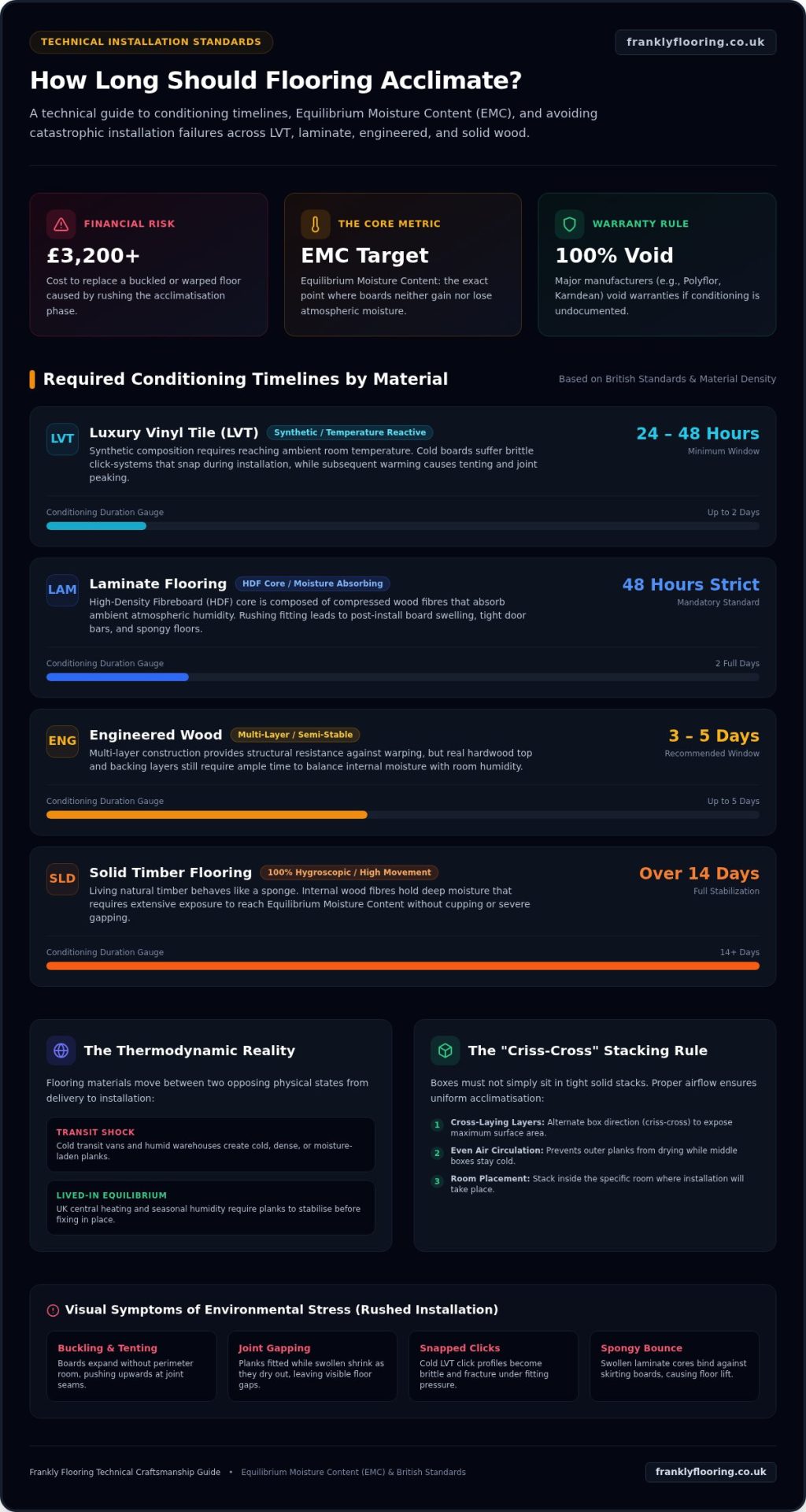
- Understand that every material has a unique requirement, ranging from 24 hours for LVT to over 14 days for solid timber, to ensure long-term stability.
- Learn exactly how long should flooring acclimate to reach moisture equilibrium and prevent common post-installation disasters like buckling or gapping.
- Master the “criss-cross” stacking technique to guarantee even airflow and consistent temperature across every single plank before the first one is laid.
- Discover the “Ideal Zone” for temperature and humidity, and why a simple hygrometer is your best defence against a £3,000 installation failure.
- Identify the visual warning signs of environmental stress so you can halt a failing installation before it becomes a permanent and costly mistake.
Why Flooring Acclimatisation is Non-Negotiable
Acclimatisation is far more than a simple waiting game; it is a vital thermodynamic process. When your new flooring arrives, it has likely spent time in a cold warehouse or a damp delivery van. Bringing those materials into a heated, lived-in home creates an immediate environmental shock. Acclimatisation is the process of allowing the material to reach moisture equilibrium with its final surroundings. Without this step, you are essentially installing a moving target.
Temperature and humidity are the silent enemies of any floor. In the UK, our climate swings from soggy, humid winters to dry, centrally-heated summers. Natural materials like wood are hygroscopic, meaning they act like a sponge, absorbing and releasing moisture from the air. Even synthetic options like LVT are subject to thermal expansion. If you don’t account for these shifts, the floor will expand or shrink after it has been pinned or glued down, leading to structural failure. Homeowners often ask how long should flooring acclimate because they are eager to see the finished result, but rushing this stage is the primary cause of installation disasters.
The Science of Equilibrium Moisture Content (EMC)
Every material has a specific point where it stops reacting to the air around it. This is known as the equilibrium moisture content (EMC). For a floor to be stable, its internal moisture level must match the average humidity of the room. EMC is the point where flooring neither gains nor loses moisture. Just because a plank feels dry to the touch doesn’t mean it is stable. Wood fibres can hold significant internal moisture that only balances out after several days of exposure to your home’s unique micro-climate.
Frankly Speaking: Why Manufacturers Require This for Warranties
We believe in being direct about the risks. Almost every major flooring manufacturer, including brands like Polyflor or Karndean, will void your warranty immediately if you fail to document proper acclimatisation. It is a legal and financial reality that skipping the wait can lead to a total loss of your investment. Professional fitters often record moisture readings and room temperatures before they start work to protect themselves from liability. A “quick job” might save you 48 hours today, but it could cost you thousands in repairs when the boards start to cup or gap six months down the line. Integrity in craftsmanship starts with patience.
Acclimatisation Times by Material: LVT, Wood, and Laminate
The answer to how long should flooring acclimate isn’t universal. It varies based on the material’s density, composition, and how it reacts to the local UK climate. While some retailers suggest a blanket 48-hour rule, this oversimplification is exactly what leads to installation failure. You need to treat synthetic materials and natural timbers with different levels of respect to ensure your floor stays flat for life.
LVT and Laminate: The 48-Hour Standard
Many homeowners assume that because LVT is waterproof, it doesn’t need to settle. This is a mistake. LVT flooring is highly sensitive to temperature. It needs at least 24 to 48 hours to reach the ambient temperature of your room. If you install LVT while it is still cold from a delivery van, the click systems can become brittle and snap during fitting. Once the room warms up, the planks will expand, potentially causing the floor to peak or “tent” at the joints.
Laminate flooring requires a strict 48-hour window. Its core is made of High-Density Fibreboard (HDF), which is essentially compressed wood fibres that are incredibly thirsty for atmospheric moisture. If you rush the installation, the boards may swell after they are laid. This makes fitting internal door bars difficult and can lead to a “spongy” feel underfoot as the floor pushes against the walls. Before you commit to a fitting date, browse our latest flooring collections to ensure you’ve picked the right material for your room’s conditions.
Engineered and Solid Wood: The 3 to 7 Day Rule
Wood is a living material that never truly stops moving. Engineered wood flooring is constructed in layers to improve stability, but it still requires 3 to 5 days to reach equilibrium. Solid wood is far more temperamental and demands a minimum of 7 days. This patience is vital because wide plank boards carry much larger cumulative expansion potential than narrow strips. Even a 1% change in moisture can cause a wide board to shift significantly.
This isn’t just trade folklore. Detailed Forest Products Laboratory research on wood flooring movement confirms that moisture content is the primary driver of shrinkage and swelling across all hardwood species. If your project involves “wet trades” like recent plastering or painting, you must extend these timelines. Plaster can take weeks to dry, and the moisture it releases into the air will be sucked up by your new floor if you bring it into the room too early. Always ensure the building is fully dried out and the heating has been running at a normal living temperature for at least five days before delivery.
How to Correctly Acclimatise Your New Flooring
Simply leaving your new floor in the hallway isn’t enough. To get the best results, you must prepare the environment before the delivery truck arrives. The room should be at a constant temperature, ideally between 18°C and 22°C, with the central heating running as it normally would. You aren’t just storing the material; you’re introducing it to the specific conditions it will live in for the next twenty years. If you’re wondering how long should flooring acclimate, remember that the quality of the environment matters as much as the number of days on the calendar.
Step-by-Step: The Stacking Protocol
Professional fitters use the “Criss-Cross” method to ensure every plank receives equal exposure to the air. Instead of stacking boxes in one giant block, lay the first layer of boxes flat on the floor with gaps between them. Place the next layer perpendicular to the first. This lattice structure allows air to circulate around all four sides of the packaging. Following a strict NWFA flooring acclimation protocol ensures that the core of the stack reaches the same temperature as the outer boxes.
- External Walls: Keep all packs at least 50cm away from exterior walls. These walls are often colder and more prone to dampness, which can create uneven moisture levels within your stack.
- Flat Storage: Never lean boxes against a wall. Gravity will cause the planks to bow or “crowning,” making them nearly impossible to click together during installation.
- No Outbuildings: It’s tempting to store materials in a garage or shed to keep the house tidy. Don’t do it. The high humidity and temperature swings in unheated spaces will ruin the material before it even touches your subfloor.
Box Management: When to Open the Packaging
There is a lot of conflicting advice about breaking the plastic seals on your flooring. For Luxury Vinyl Tile (LVT), you should generally leave the boxes sealed. LVT only needs to reach the room’s temperature, and the factory packaging helps keep the planks flat and protected. Laminate should also stay in its wrapper until the hour of fitting to prevent it from sucking up excess moisture from a damp subfloor or fresh plaster.
Real wood is different. Because timber needs to reach a specific moisture equilibrium, you should carefully slit the ends of the plastic wrapping to allow the wood to “breathe” without fully exposing it to dust. Managing this process while living in the room can be a challenge, but keeping the stacks in a low-traffic corner ensures the floor “rests” undisturbed. Understanding how long should flooring acclimate helps you plan your renovation timeline so you don’t feel rushed into making these common storage mistakes.
Understanding the Role of Humidity and Temperature
Achieving a successful installation requires more than just counting days; it requires controlling the atmosphere. The “Ideal Zone” for most UK indoor environments is a constant temperature between 18°C and 22°C, paired with a relative humidity (RH) of 45% to 60%. These figures aren’t arbitrary. They represent the average conditions your floor will experience throughout its life. In the UK, our damp winters and dry, centrally-heated summers make the question of how long should flooring acclimate heavily dependent on your ability to stabilise the room’s climate before the material even arrives.
A digital hygrometer is the most valuable tool you can own during a renovation. For less than £20, this small device monitors the air and tells you exactly when the room is stable. New-build homes are particularly risky because the “wet” construction methods used in modern UK housing mean that concrete screeds and breeze blocks can hold moisture for months. If you bring your flooring into a room that hasn’t properly dried out, the material will absorb that excess moisture, leading to structural buckling or joint failure once the heating is eventually turned up.
Acclimatisation with Underfloor Heating (UFH)
Installing over underfloor heating requires a specific technical approach. You must never acclimatise flooring on a “hot” subfloor, as this forces moisture out of the material too quickly and can cause the planks to warp or crack. Instead, use the “gradual ramp” method. The UFH should be commissioned and cycled for at least 7 to 14 days before the flooring is delivered. Once the material arrives, the heating should be turned off or lowered to a steady 18°C. For LVT, manufacturers strictly specify that the subfloor temperature must not exceed 27°C during or after installation to prevent the click systems from failing or the adhesive from de-bonding.
Dealing with High Humidity: New Plaster and Paint
Fresh plaster is a major source of hidden moisture that many DIYers overlook. As a rule of thumb, you should wait at least four weeks after major plastering work before bringing your flooring into the building. While a dehumidifier can help speed up the drying process, you must be careful not to pull moisture out too aggressively, as this can cause cracks in timber or “case hardening” in plaster. Flooring should never enter a room until all “wet trades” are finished. This ensures the material isn’t exposed to the high-humidity spikes caused by painting and decorating. To ensure you have the right tools and materials for a professional finish, browse our full range of flooring products and prepare your space correctly.
The Cost of Cutting Corners: Avoiding Installation Failure
The “Frank” reality of flooring is that gravity and thermodynamics don’t care about your project deadline. If you ignore the advice on how long should flooring acclimate, you’re essentially gambling with thousands of pounds. A rushed job often results in a floor that looks perfect for the first forty-eight hours but begins to self-destruct as soon as the seasons change or the central heating kicks in. In most cases, a floor that has failed due to poor conditioning cannot be “fixed” with a bit of glue; it usually requires a total replacement, costing upwards of £3,200 for a standard-sized room.
Repairing minor issues like cupping or buckled planks can still set you back between £200 and £1,500 in labour and materials. This is why we prioritise transparency over high-pressure sales. We’d rather you waited an extra three days to start your project than see your investment ruined by impatience. Success in flooring isn’t about how fast you can lay the planks, but how well you’ve prepared the material for its new life in your home.
Common Failure Symptoms
- Gapping: This occurs when boards were installed while they were too “wet” or humid. As the UK winter sets in and the air dries out, the boards shrink, leaving unsightly gaps that collect dirt and compromise the floor’s structure.
- Buckling and Tenting: If planks are installed while cold and dry, they will expand as they warm up. With no room to move, they push against each other, lifting off the subfloor in a peak. This is often called “tenting” and can be a serious trip hazard.
- Click Failure: For LVT, the delicate locking mechanisms are designed to hold tight under stable conditions. Rapid thermal expansion puts immense pressure on these joints, causing them to snap and leave the floor loose underfoot.
Preparation is 90% of the Result
A patient DIYer who follows the rules will almost always achieve a better long-term result than a professional who is rushing to get to their next job. Integrity in your work means respecting the material. If you’ve decided that the wait for timber or LVT is too much for your current schedule, you might consider soft flooring instead. You can read our guide on carpet grippers to see if a professional carpet installation fits your timeline better.
Before you open that first pack, run through this final checklist. Is the room between 18°C and 22°C? Has your hygrometer confirmed a stable humidity for at least 48 hours? Have your boxes been cross-stacked away from external walls? If the answer is yes, you’re ready to begin. The few days you spend waiting now are a small price to pay for a floor that will remain a foundational character of your home for decades. It’s about doing it once and doing it right.
Secure Your Home’s Foundation with Patience
Acclimatisation isn’t a suggestion; it’s a technical requirement for a floor that lasts. Whether you’re installing engineered oak or modern LVT, matching the material to your home’s unique environment prevents the structural failures that haunt rushed projects. You now know that the question of how long should flooring acclimate depends on specific factors like moisture equilibrium and proper criss-cross stacking. Following these steps protects your warranty and ensures those first few days of patience pay off for decades.
At Frankly Flooring, we bring 20+ years of industry expertise to every order. As a family-run business, we value integrity and long-term satisfaction over quick wins. We provide direct UK delivery on all materials and accessories, ensuring you have everything needed for a professional finish. Ready to start your transformation? Browse our full range of LVT, Wood, and Laminate flooring at Frankly Flooring and build a home with character that stands the test of time. Your new floor is a foundational element of your property; treat it with the respect it deserves and it will reward you for a lifetime.
Frequently Asked Questions
Does LVT flooring really need to acclimatise if it is waterproof?
Yes, LVT must acclimatise because it is sensitive to temperature rather than moisture. While the material is waterproof, the vinyl layers expand and contract based on the heat of the room. If you install cold planks in a warm room, they will expand and cause the joints to peak or “tent.” You should allow at least 24 to 48 hours for LVT to reach ambient temperature before fitting.
Can I leave my flooring in the garage to acclimatise?
No, you should never leave flooring in a garage or shed to acclimatise. These spaces don’t have the controlled heating or insulation found in your living areas. Acclimatisation only works if the material is exposed to the exact temperature and humidity it will live in permanently. Storing it in a damp, unheated garage will likely ruin the product before the installation even begins, voiding your manufacturer warranty.
What happens if I install my laminate floor without waiting?
Laminate installation without waiting leads to structural failures like buckling or joint peaking. Laminate has a high-density fibreboard core that reacts quickly to changes in humidity. If the boards expand after they are locked together, they will push against your walls and lift off the subfloor. This creates a “spongy” feel underfoot and can eventually break the click system, requiring a full and expensive floor replacement.
Is 24 hours enough time for engineered wood flooring?
No, 24 hours is insufficient for engineered wood flooring. Most manufacturers require a minimum of 3 to 5 days to ensure the timber layers reach moisture equilibrium. Wood is a natural material that moves more than synthetics. Rushing this process is a common mistake that voids your warranty and risks long-term stability issues like cupping. We always recommend following the specific manufacturer guidelines provided with your delivery.
How should I stack the boxes while they are acclimatising?
You should stack the boxes flat in a criss-cross or lattice pattern to allow for maximum airflow around the packaging. This ensures that every box in the pile reaches the same temperature and moisture level at the same rate. Keep the stacks at least 50cm away from external walls and never lean them upright. Leaning boxes causes the planks to bow permanently, making them nearly impossible to fit correctly.
Should I turn my heating off while the floor is acclimatising?
No, you should keep your heating running at a normal, comfortable level while the floor rests. The goal is to introduce the material to its permanent living conditions. If you turn the heating off, the floor won’t reach the correct equilibrium. Ask yourself how long should flooring acclimate in a cold room; the answer is that it won’t truly acclimate until the heating is back on.
Do I need to open the boxes of laminate before installing?
You should generally keep laminate boxes sealed until you are ready to start the installation. Laminate is incredibly sensitive to sudden moisture spikes. Keeping the packs closed helps the boards reach the room’s temperature slowly and evenly. Only open the packaging once you have confirmed the room’s humidity is within the ideal range of 45% to 60% using a digital hygrometer for the best results.
What is the ideal room temperature for flooring acclimatisation?
The ideal room temperature for flooring acclimatisation is between 18°C and 22°C. This range reflects the typical living conditions for most UK homes throughout the year. Maintaining a steady climate within this bracket helps the material settle without being shocked by extreme heat or cold. Consistency is the most important factor when determining how long should flooring acclimate for a successful, long-lasting installation.