
What if the biggest fear holding you back from a low-maintenance lawn is actually a simple physics problem you can solve in seconds with a garden hose? Most UK homeowners worry about their pets’ paws or young children when the British summer finally decides to show up, and it’s a valid concern. You’ve likely heard the stories about synthetic turf becoming a literal frying pan. We’re here to be direct about the reality of the situation and answer the core question: does artificial grass get hot? The short answer is yes, but it’s far from a safety dealbreaker for your home.
We understand you don’t want to make an expensive mistake that leaves your garden unusable in July. You’ll discover exactly how heat affects different turf materials, including why surface temperatures can reach 40 to 50 degrees Celsius when the ambient air hits 30 degrees. We’ll also explain how modern cooling technologies and simple maintenance habits can keep your lawn perfectly safe for the whole family. This guide walks you through everything from IR-reflective pigments to the impact of reflected sunlight, giving you the quiet confidence to choose a product that’s truly fit for your specific garden.
Key Takeaways
- Get a direct, honest answer to the question “does artificial grass get hot” and learn how it compares to common garden surfaces like timber decking and paving.
- Understand how technical factors like polymer type, pile density, and turf colour influence heat retention and your overall comfort.
- Discover simple, practical methods for instant temperature relief, including the “quick spritz” technique for your lawn.
- Learn the “7-second rule” and other safety protocols to ensure your outdoor space remains safe for children and pets during a heatwave.
- Find out how to choose the right materials and shading strategies to maintain a cool, usable garden without the need for high-pressure sales gimmicks.
The Frank Truth: Does Artificial Grass Actually Get Hot?
We believe in giving you the facts straight, without the marketing fluff. If you’re wondering, “does artificial grass get hot?” the answer is a definitive yes. It’s a synthetic product, after all. Natural grass has a built-in cooling system; it draws moisture from the earth and releases it into the air through transpiration. Because artificial turf lacks this biological process, it absorbs solar radiation and retains that energy in its blades and infill. It isn’t a design flaw; it’s just physics.
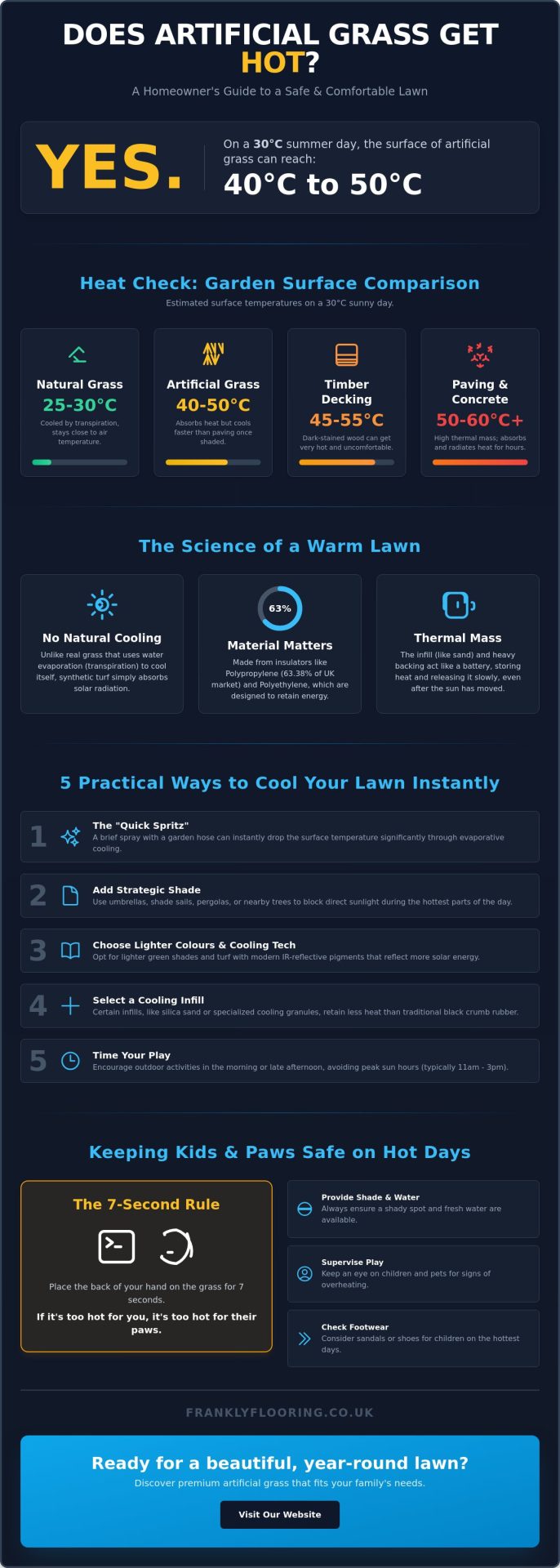
On a standard British summer day where the air temperature reaches 30°C, the surface of your lawn will likely sit between 40°C and 50°C. This might sound high, but it’s important to put those numbers into context. For most of the year in the UK, this heat retention is actually a benefit. It helps the garden dry out faster after a spring shower and feels pleasant underfoot in the cooler months. During those rare heatwaves, it simply requires a bit of common sense and basic management to keep things comfortable.
How Artificial Grass Compares to Other Surfaces
Context is everything when looking at garden temperatures. While synthetic turf gets warmer than natural grass, it often performs better than other common landscaping materials. Most synthetic fibers used in modern turf are designed to be more heat-efficient than the plastic products of a decade ago. Here’s how it stacks up against other garden features:
- Paving and Concrete: These materials have high thermal mass. They get very hot and stay hot long after the sun sets, radiating heat back into your home.
- Timber Decking: Dark-stained wood can reach temperatures similar to artificial turf, often becoming uncomfortable for bare feet in direct sun.
- Natural Soil and Grass: These remain the coolest options, but they don’t offer the same year-round usability or cleanliness that many families need.
In peak UK sunlight, artificial turf typically maintains a surface temperature roughly 10 to 20 degrees Celsius higher than the ambient air temperature. Unlike a heavy concrete patio that radiates heat for hours, artificial grass tends to lose its heat relatively quickly once the direct sun moves away or a cloud passes over.
The ‘Lava Lawn’ Myth vs. Reality
Social media can sometimes exaggerate the heat issue, leading to fears of a “lava lawn” that melts shoes or causes immediate burns. This simply isn’t the reality for UK homeowners. We don’t experience the sustained, extreme UV levels found in Arizona or Dubai. Does artificial grass get hot enough to be noticed? Yes. Is it going to cause a safety crisis in a typical suburban back garden? Not if you’ve chosen a quality product and follow basic care steps.
The Science of Heat: Why Synthetic Turf Retains Energy
To understand why your lawn feels like a radiator in August, we need to look at the ingredients. Most synthetic turf is made from polyethylene or polypropylene. These are plastics. Specifically, polypropylene accounted for 63.38% of the UK artificial turf market revenue in 2025. These materials are excellent insulators. They don’t just reflect sunlight; they absorb it. Unlike natural grass, which uses water to stay cool through a biological process called transpiration, synthetic blades have no moisture to evaporate. This lack of a cooling cycle means the energy has nowhere to go but into the grass itself.
One common misconception we hear is that UV stabilizers will keep the grass cool. Frankly, that isn’t how they work. UV stabilizers are added to the polymer to prevent the sun from breaking down the plastic and making it brittle or faded. They protect the longevity of your investment, but they don’t change the laws of thermodynamics. The question isn’t just “does artificial grass get hot”, but how long it stays that way. This is where thermal mass comes in. The heavy backing and the infill act like a battery, storing heat energy and releasing it slowly over time, even after the sun has moved behind a cloud.
Material Matters: Polyethylene vs. Polypropylene
Polyethylene is generally the softer, more resilient choice, while polypropylene is often used for its durability in high-traffic areas. However, construction is just as vital as the material itself. Modern blade shapes, such as C-shape or W-shape profiles, do more than just look realistic. These geometries create tiny pockets of shade on the surface and allow for better air circulation between the fibres. This airflow helps to dissipate surface heat more effectively than older, flat blades that simply mat together and trap energy. Choosing a product with the right density and backing can mitigate some of these effects. You can browse our curated selection of artificial grass to see how different specifications might suit your garden’s sun exposure.
The Role of Infill in Temperature Control
The material sitting between the blades has a massive impact on your garden’s climate. We always recommend high-quality sand infill for UK homes. Sand is a natural mineral that doesn’t retain heat nearly as aggressively as rubber alternatives. You might see rubber crumb infill used on professional sports pitches, but we advise against it for domestic gardens. Rubber is a heat magnet. It can raise the surface temperature significantly compared to sand. The colour of your infill matters too. Lighter sands reflect more light, helping to keep the overall system a few degrees cooler than darker, more absorbent materials. This small technical detail can be the difference between a lawn that feels warm and one that feels uncomfortable.
Choosing the Right Turf to Minimise Heat
While we’ve established that the material itself is prone to warming, the specific product you select plays a massive role in how that heat is managed. Not all synthetic lawns are created equal. If you’re asking “does artificial grass get hot” because you’re worried about usability, you need to look beyond the surface aesthetics. The construction of the grass, from the colour of the yarn to the structure of the backing, dictates how much solar energy is absorbed and how quickly it can dissipate.
Marketing departments often talk about “cooling technology” as if it’s a magic wand. In reality, these features usually involve IR-reflective pigments in the yarn or specialized blade geometries designed to create micro-shadows. Some premium products in the 2026 market, such as those using TigerCool technology, claim to reduce surface temperatures by up to 10 to 15 percent. While these are beneficial, they don’t change the fact that the turf will still be warmer than natural soil. We prefer to focus on the tangible elements of construction that offer reliable, long-term performance.
Lighter Shades vs. Deep Forest Greens
The “Colour Rule” is the simplest law of physics to remember: dark colours absorb more light energy than light ones. Many homeowners gravitate toward deep forest greens for a lush, manicured look, but these are often the hottest products on the market. A lighter, multi-tonal grass with a tan or olive thatch layer can stay noticeably cooler. This thatch layer doesn’t just add realism by mimicking the natural dead grass at the base of a lawn; it also breaks up the solid block of green plastic, allowing more light to be reflected rather than absorbed. When you’re comparing samples, we always recommend placing them in direct sunlight in your own garden for an hour to feel the difference for yourself.
Construction Features that Aid Cooling
Density is another factor that requires a careful balance. A very high-density, long-pile grass might look incredibly soft, but it can also trap heat by restricting airflow between the blades. Lower density or specific blade shapes, like C-shape or W-shape profiles, allow air to circulate more freely. This movement of air helps to shed heat from the surface much faster than a flat, matted pile.
The backing system is just as vital. A high-quality, perforated backing ensures that moisture can drain away quickly, which is essential if you plan to use the “spritz” method for cooling. When you choose a premium Artificial Grass, you’re investing in a system designed for the UK’s shifting climate. Look for products that prioritise breathability and drainage over sheer bulk. A thinner, more technologically advanced backing often performs better than a thick, heavy one that acts as a thermal insulator.
5 Practical Ways to Cool Your Lawn on Scorching Days
Knowing that synthetic turf absorbs energy is one thing; living with it during a British heatwave is another. You don’t need to treat your garden like a restricted zone when the sun comes out. If you find yourself asking does artificial grass get hot enough to ruin your afternoon, the answer is usually only if you let it. By using a few straightforward tactics, you can keep the surface comfortable for everyone, even when the mercury hits 30 degrees.
The Power of Evaporative Cooling
One of the most effective tools for temperature control is already sitting in your garden. A quick, 30-second spritz with a garden hose can drop the surface temperature of the fibres by as much as 20 degrees almost instantly. This isn’t just about the cold water hitting the plastic. Because high-quality turf is installed with a sand infill, that sand holds onto the moisture. As the sun beats down, the water slowly evaporates, creating a cooling effect that can last for up to 30 minutes.
Many homeowners worry about whether it’s safe to put water on their lawn. We can be very direct here: it is perfectly safe. Artificial grass is designed for the British climate, meaning it’s built with a perforated backing specifically for high-volume drainage. The water won’t pool or damage the fibres; it simply does its job and then drains away into the sub-base, leaving you with a significantly cooler lawn for your children or pets to enjoy.
Creating Artificial Shade
Shade is your best friend during peak sun hours. If you have a south-facing garden with no natural cover, you’ll need to be strategic. Moveable solutions like parasols or pop-up gazebos are excellent because you can shift them as the sun moves across the sky. For a more permanent look, sail shades are a popular choice in 2026. They provide a modern aesthetic while blocking the UV rays that cause the most heat build-up.
Your garden layout also plays a role. Strategic placement of Quality Furniture can provide functional shade for smaller pets who naturally seek out cooler spots. A heavy garden table or a set of deep-seated chairs creates a permanent micro-climate of shade on the grass beneath them. This simple bit of garden planning ensures there is always a “safe zone” for paws and feet during the hottest parts of the day.
Finally, remember the “Footwear Rule” and timing. Between 12:00 PM and 3:00 PM, the sun is at its most intense. This is the time to wear flip-flops or use the spritz method before letting the dog out. If you’re still in the planning stages of your project, you can view our range of artificial grass to find products with the breathable backing and blade shapes that make these cooling methods even more effective.
Is It Safe for Pets and Children? A Frank Assessment
The safety of your family is usually the final hurdle when deciding on a new lawn. We’ve been honest about the fact that it warms up, but the real question isn’t just “does artificial grass get hot”, it’s whether that heat poses a genuine risk. For the vast majority of the year in the UK, the answer is no. However, during those few weeks of intense summer sun, you need a reliable way to gauge the surface before letting the kids or the dog run wild.
We recommend the “7-Second Rule” as your go-to safety check. Simply place the back of your hand firmly on the grass. If you can’t comfortably hold it there for a full seven seconds, it’s too hot for bare feet or sensitive paws. It’s a low-tech, foolproof method that takes the guesswork out of garden safety. If it fails the test, it’s time for the “quick spritz” method we discussed earlier or a few hours of shade until the sun moves.
It’s also helpful to maintain some perspective. On a 30°C day, black asphalt or dark patio slabs can reach temperatures far higher than synthetic turf. Unlike those hard surfaces, artificial grass doesn’t have the same density, meaning it doesn’t store quite as much “stinging” heat. It’s also significantly softer, providing a cushioned landing for toddlers that a concrete patio simply can’t match.
Protecting Paws and Little Feet
Most pets are remarkably intuitive. If a surface feels uncomfortable, they’ll naturally migrate toward the shade or back onto the cooler kitchen tiles. However, some dogs are so focused on a ball or a bird that they might ignore the heat until it’s too late. Watch for signs of discomfort like lifting paws, heavy panting, or a sudden reluctance to move. If you see these, get them into the shade and cool the grass immediately.
Despite these considerations, artificial grass remains a versatile, low-maintenance solution for modern British homes because the benefits of a mud-free, usable space far outweigh a few days of heat management. It provides a durable play area that stays green and clean regardless of the season.
The Frankly Flooring Conclusion
Our “Frank” approach to this topic is simple: artificial grass is a synthetic product that behaves like one. It gets warm because it’s built to be durable and weather-resistant, not because it’s inherently dangerous. Thousands of UK homeowners choose it every year because they value a garden that looks pristine with minimal effort.
By choosing a high-quality product with a breathable backing and using the simple cooling tactics we’ve outlined, you can enjoy all the benefits without the worry. Don’t let the fear of a few hot days stop you from transforming your outdoor space. Buy with confidence, stay smart with your maintenance, and you’ll have a foundational element of your home’s character that lasts for years. If you’re ready to see the difference for yourself, you can browse our full range of artificial grass and find the perfect fit for your garden.
Enjoy Your Garden with Confidence
Understanding that the answer to “does artificial grass get hot” is a matter of simple physics allows you to manage your garden effectively rather than fearing the sun. By choosing products with advanced blade geometries and utilizing basic cooling methods like the “quick spritz,” you can maintain a safe, beautiful lawn for your children and pets all summer long. We’ve spent over 20 years as a family-run business helping homeowners find the right balance between technical performance and aesthetic appeal.
Our commitment is to transparency and integrity, offering direct-to-consumer prices on premium materials without any high-pressure sales tactics. Whether you are looking for durability or a lush finish, we provide national UK delivery on all our flooring solutions to make your project as stress-free as possible. You can browse our range of high-quality Artificial Grass at Frankly Flooring to find the perfect fit for your outdoor space. Take the next step toward a low-maintenance garden that looks fantastic in every season.
Frequently Asked Questions
Can artificial grass melt in the UK sun?
Artificial grass won’t melt from ambient UK air temperatures alone. Even when the surface hits 50°C, the melting point of polyethylene is much higher. However, concentrated sunlight reflected from energy-efficient windows or mirrors can create intense hot spots that reach extreme temperatures. This is a real risk that can cause localized melting or discolouration if you don’t use strategic shading or window film to break up the reflection.
Is artificial grass hotter than paving or decking?
It’s often comparable to timber decking or dark paving slabs in direct sun. While natural grass stays cooler because of transpiration, synthetic turf and hard landscaping both absorb solar energy. The key difference is that artificial grass has less thermal mass than a thick concrete patio. It might feel hot to the touch, but it typically loses that heat much faster once the sun moves or a cloud passes by.
How do I cool down artificial grass quickly for my dog?
A 30-second spray with a garden hose provides instant relief for your dog’s paws. This method works through evaporative cooling; the water settles into the sand infill and slowly evaporates, dropping the surface temperature by up to 20 degrees. It’s a highly effective way to manage the question of does artificial grass get hot during peak afternoon hours. Always test the surface with your hand before letting your pet out.
Does the colour of artificial grass affect how hot it gets?
Darker greens and deep forest tones absorb significantly more solar radiation than lighter shades. If your garden is south-facing and gets constant sun, choosing a multi-tonal product with lighter olive blades and a tan thatch layer can help. These lighter pigments reflect more light energy, keeping the overall system a few degrees cooler than a solid, dark green lawn that acts as a heat magnet.
Is there a specific type of artificial grass that stays cool?
There isn’t a product that stays as cool as natural grass, but certain technologies help. Look for turf featuring IR-reflective pigments or C-shaped and W-shaped blade profiles. These shapes create micro-shadows and allow for better airflow between the fibres. Some premium products in the 2026 market claim to reduce surface temperatures by 10 to 15 percent compared to standard flat-blade designs.
Can I use a sprinkler on my artificial lawn to keep it cool?
Using a sprinkler is an excellent way to maintain a comfortable temperature across a large lawn. Because quality synthetic turf is built with a perforated backing, it’s designed to handle high-volume drainage without pooling. Running a sprinkler for just five minutes can provide a sustained cooling effect. The water trapped in the infill acts as a temporary heat sink, making the garden usable even on the hottest days.
Will hot weather damage the glue or backing of my grass?
Hot weather won’t damage the professional-grade adhesives or backing used in a quality installation. These materials are engineered to withstand the expansion and contraction caused by the UK’s seasonal shifts. While the grass might feel warm, the structural integrity remains intact. We prioritize technical craftsmanship to ensure the backing remains breathable and durable, even when surface temperatures reach 40 to 50 degrees Celsius during a summer heatwave.
Is it safe for toddlers to crawl on artificial grass in the summer?
It is safe for toddlers as long as you perform a quick temperature check. Use the back of your hand to test the surface; if you can’t hold it there for seven seconds, it’s too hot for a child’s skin. Does artificial grass get hot enough to be uncomfortable? Yes, but it’s also softer than a patio. Simply hose the area down first to ensure it’s cool and comfortable for crawling.