
Why would you spend the equivalent of a small car on solid timber when modern printing technology makes it almost impossible to tell the difference from the comfort of your sofa? It’s a question we ask often at Frankly Flooring, because we believe you shouldn’t have to overpay for a beautiful home. You’re likely here because you want that classic herringbone or chevron look, but you’re worried about laminate parquet flooring looking cheap or plastic once it’s actually under your feet. You might also be staring at AC ratings and millimetre thicknesses, wondering if you’re being upsold on features your spare bedroom doesn’t actually need.
We’ve spent over 20 years giving homeowners the straight talk they deserve. We agree that a floor should be a foundational part of your home’s character, not a source of installation anxiety or maintenance regret. This guide promises to strip away the marketing fluff and give you the honest facts about durability, water resistance, and which underlay actually works. We’ll preview the 2026 shifts toward honey-toned oaks and realistic textures, ensuring you have the confidence to choose a floor that looks like a million pounds without the high-pressure sales pitch.
Key Takeaways
- Understand why laminate parquet flooring is a high-performance design choice rather than a budget compromise, focusing on the difference between patterns like Herringbone and Chevron.
- Learn why an AC4 rating is the ideal standard for most UK homes and how choosing the right thickness impacts the sound and stability of your room.
- Discover the honest truth about where laminate beats LVT on price and scratch resistance, and where its water-resistance limits actually lie.
- Get practical advice on subfloor preparation and why the 48-hour acclimatisation period is the one step you can never afford to skip.
- Identify the 2026 colour trends, from the versatile “Greige” hybrids to deep, library-style smoked oaks that add instant character to your property.
What is Laminate Parquet Flooring? The Frank Truth
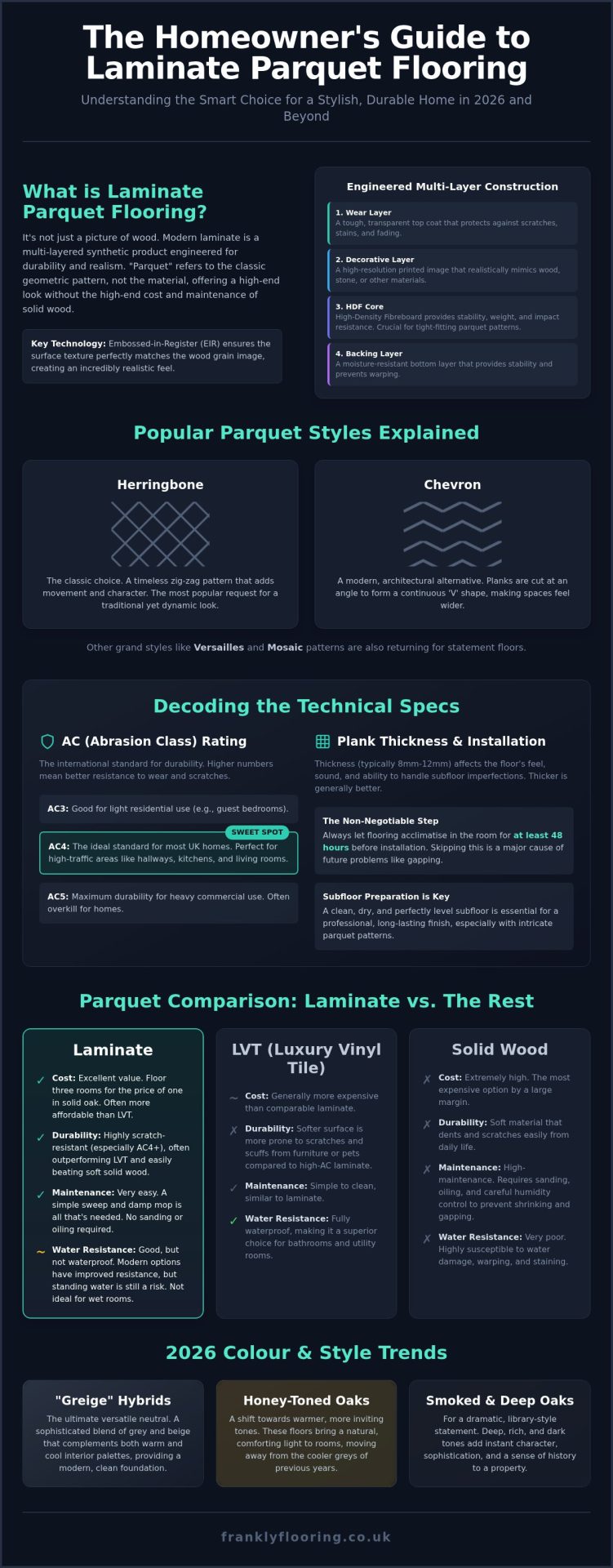
Let’s be frank about what you’re actually buying. A laminate parquet flooring plank isn’t just a printed picture of wood; it’s a sophisticated stack of materials engineered to survive your daily life. At its core, it’s a multi-layered synthetic product. It uses a high-density fibreboard (HDF) core to provide the weight and stability you’d expect from a solid floor, topped with a high-definition decorative layer. In 2026, the gap between laminate and real timber has closed significantly. Thanks to Embossed-in-Register (EIR) technology, the texture of the plank now perfectly matches the grain of the image. When you run your hand over it, you feel the knots and grooves exactly where you see them.
It’s vital to understand that “parquet” describes the pattern, not the material itself. Historically, parquet was made from small, solid wooden blocks laid in geometric shapes. Today, we achieve that same high-end aesthetic using modern laminate planks. This allows you to enjoy the prestige of a traditional manor house floor without the structural headache or the eye-watering price tag of solid oak blocks.
The Evolution of Parquet Styles
The style you choose defines the entire rhythm of your room. Traditional Herringbone remains our most popular request. It uses a classic zig-zag pattern that adds a sense of movement and history to any space. If you want something sharper and more architectural, Chevron is the modern alternative. It features planks cut at an angle to create a continuous “V” shape, which can make a narrow British hallway feel much wider. For those looking for a grand statement, we’re seeing a return of Versailles and Mosaic patterns. These are often sold as larger square tiles that mimic the intricate, hand-inlaid floors found in French palaces.
Why Laminate Over Solid Wood?
We’ve spent 20 years helping people choose floors, and the honest reality is that solid wood isn’t always the best fit for a busy home. Laminate offers three distinct advantages:
- Cost: The price difference per square metre is massive. You can often floor three rooms with high-quality laminate for the price of one room in solid oak.
- Durability: Real wood is soft. It dents when you drop a mug and scratches when the dog gets excited. Modern laminate with an AC4 rating is built to withstand high-traffic living rooms and light commercial use.
- Maintenance: Real wood requires sanding, oiling, and specific humidity controls. Laminate just needs a quick sweep and a damp mop. It doesn’t shrink or gap when your central heating kicks in during a cold UK winter.
Choosing laminate isn’t about compromising on style. It’s about making a smart, long-term decision for your property’s character and your own peace of mind.
Technical Specifications: AC Ratings, Thickness, and Textures
Don’t let a pretty pattern distract you from what actually matters. The longevity of your laminate parquet flooring depends entirely on the “guts” of the plank. When you’re comparing options, you’ll see a lot of technical jargon, but three specific areas deserve your attention: the AC rating, the plank thickness, and the core density. These aren’t just numbers on a box; they’re the direct indicators of how your floor will handle the chaos of a busy home or a high-traffic hallway.
The core of the plank is usually made from High-Density Fibreboard (HDF). For parquet patterns like herringbone or chevron, high density is non-negotiable. Because these patterns involve more joins than standard straight planks, the core must be stable enough to hold the click-lock system tight over many years. A cheap, low-density core will eventually lead to gapping, which ruins the classic look you’re trying to achieve.
Decoding AC Ratings for 2026
The Abrasion Class (AC) rating is the international standard (EN 13329) for durability. In 2026, we consider AC4 to be the absolute sweet spot for most UK residential projects. It’s tough enough for kitchens and lounges but remains more affordable than heavy commercial alternatives. Here is how to break them down:
- AC3: Suitable for light residential use, such as guest bedrooms or home offices.
- AC4: The standard for high-traffic areas like hallways, kitchens, and living rooms.
- AC5: Designed for heavy commercial spaces; it’s often overkill for a home but offers maximum scratch resistance.
Thickness and Visual Depth
Plank thickness usually ranges from 8mm to 12mm. While 8mm is perfectly functional on a flat subfloor, 12mm planks offer much better sound dampening and a “solid” feel that mimics real wood. If you’re worried about the floor sounding “clicky” or hollow, go for a thicker plank combined with a high-quality underlay. This extra mass helps the floor sit more securely, which is especially important for the intricate geometry of parquet.
The final touch is the texture. Registered Embossed technology is the gold standard for laminate realism in 2026. This process aligns the physical texture of the surface with the visual grain of the wood print. If you see a knot in the oak design, you’ll feel a knot in the surface. You also need to choose between a square edge for a seamless look or a V-groove. A V-groove defines each individual “block” in the pattern, which is essential if you want that traditional, hand-laid parquet aesthetic. If you want to see how these specs look in person, you can explore our full range of laminate options to find the right balance for your budget.
Parquet Comparison: Laminate vs LVT vs Engineered Wood
Choosing between these three materials often feels like a balancing act between your bank account and your aesthetic goals. Let’s be frank; laminate parquet flooring is almost always the most budget-friendly way to achieve a high-end look. While Luxury Vinyl Tile (LVT) and engineered wood have their own merits, they come with price tags and installation requirements that don’t always suit every project or property. Understanding the trade-offs now prevents expensive regrets later.
The “Frank” take on water resistance is simple: LVT is the undisputed king for bathrooms because it’s 100% waterproof. However, don’t write off laminate for your kitchen or hallway. Modern 2026 laminate technology features water-resistant coatings that protect the HDF core from spills for several hours. It isn’t flood-proof, but for a typical family home where things get spilled and wiped up quickly, it’s more than capable. Installation is another area where laminate shines. Its click-system is a DIY dream compared to the labour-intensive glue-down process required for LVT or the specialist tongue-and-groove fitting often needed for engineered wood. You’re trading the ability to refinish the floor for a massive saving on both materials and fitting time.
Laminate vs Luxury Vinyl Tile (LVT)
LVT is often praised for its durability, but laminate has a secret weapon: scratch resistance. The resin-based wear layer on a high-quality laminate is significantly harder than the vinyl surface of LVT. This makes it a superior choice if you have large dogs with heavy claws. Laminate also offers more warmth underfoot. Because it’s thicker and sits on an underlay, it doesn’t feel as cold or “hard” as thin LVT planks that are glued directly to a concrete subfloor. If you’re still torn between the two, check out our guide on LVT vs Laminate Flooring: Which Is Right For You?
Laminate vs Engineered Wood
The authenticity test is where engineered wood usually wins, but only if you’re looking closely. From a standing position, a 2026 high-definition laminate is almost indistinguishable from real timber. Laminate actually has a major advantage when it comes to sunlight resistance. Real wood fades and changes colour when exposed to UV rays through patio doors or large windows. Laminate is essentially “colour-fast,” meaning the honey oak you buy today will look exactly the same in ten years. For a deeper dive into the premium alternative, read our Engineered Wood Flooring: The Frank 2026 Guide to see if the investment is right for your home.
The Frank Guide to Installation: Subfloors and Patterns
Some retailers will tell you that installing a parquet pattern is just as easy as a standard plank. We won’t. While laminate parquet flooring uses a user-friendly click-lock system, the geometry of the pattern demands much higher precision. If your subfloor isn’t perfectly level, those intricate herringbone joins will eventually “bounce” and separate. For a successful installation, your subfloor deviation must be less than 2mm over a 2-metre span for parquet laminate. If it’s more than that, you’ll need to look at a self-levelling compound or a high-quality plywood overlay before you even think about opening a box.
Acclimatisation is another step people love to skip. You must leave your flooring in the room where it will be fitted for at least 48 hours. Laminate is made of wood fibres; it expands and contracts based on the temperature and humidity of your home. If you fit it cold and then turn the heating on, you’ll see the edges lift. Similarly, you must leave an expansion gap of 8-10mm around the entire perimeter. You can hide this with skirting boards or scotia, but the gap itself is non-negotiable. If you don’t give the floor room to breathe, it will eventually buckle.
Choosing the Right Underlay
Because parquet involves many small joins, the click system is under more pressure than a standard floor. You need an underlay with high compression strength to prevent the planks from shifting. A soft, spongy underlay might feel nice, but it will allow too much movement, which eventually snaps the click-locks. Good underlay also helps with sound reduction, stopping that hollow “clack” sound when you walk. While you’re sorting your accessories, you might also need a carpet gripper for adjacent rooms to ensure a clean transition between different floor types.
The Complexity of the Click
Herringbone laminate isn’t made of identical planks. You’ll usually find “A” and “B” planks in your boxes, which are mirror images of each other. If you try to force two “A” planks together, you’ll ruin the joint. You also need to plan your starting point in the dead centre of the room to ensure the pattern looks symmetrical against the walls. Symmetry is everything. Because of the intricate cuts needed at the edges, we recommend ordering 10-15% extra for wastage. If you’re ready to start your project, you can browse our full range of laminate and accessories to make sure you have everything you need for a professional finish.
Finding Your Style: 2026 Trends and Buying Tips
Choosing the right laminate parquet flooring is about more than just picking a colour you like in a magazine. You have to live with it every day. In 2026, we’re seeing a decisive shift away from the sterile, cool greys that dominated the last decade. The rise of “Greige” is the biggest story this year. These grey-beige hybrids successfully bridge the gap between modern and traditional, offering a neutral backdrop that doesn’t feel cold in the weak natural light we often get in the UK. If you’re looking for something more substantial, darker tones like smoked oak and walnut are making a comeback. They create a “library-style” feel that adds instant gravity and history to a property, even if it’s a new build.
We always tell our customers that a floor looks different in every house. The way a silk finish reflects light in a south-facing lounge is completely different from how it looks in a north-facing hallway. That’s why using a sample service is non-negotiable. Put the planks on your floor, look at them in the morning and again at night under your own lamps. While you’re at it, don’t forget the finishing touches. A beautiful parquet floor can be ruined by cheap, mismatched door bars or poorly fitted beading. We recommend matching your scotia and door bars to the floor itself to create a seamless, professional transition between rooms.
Matching Flooring to Room Size
The scale of your parquet pattern can change the perceived size of your room. In smaller spaces, light oaks combined with a narrow herringbone pattern can make the floor feel less “busy” and more expansive. For large, open-plan areas, you have the freedom to be bolder. A wide-plank chevron creates a dramatic, architectural statement that grounds a large room. You should also consider the finish. Matte finishes are excellent for hiding the occasional scratch or pet hair, while silk finishes interact beautifully with natural light to highlight the texture of the grain.
Why Buy From Frankly Flooring?
We’ve spent 20 years learning exactly what works in British homes, and we’ve built our reputation on being direct. We’re a family-run business that values long-term satisfaction over a quick sale. If we think a particular laminate parquet flooring isn’t right for your specific project, we’ll tell you. Our national reach means we can get high-quality materials to your doorstep without the heavy markups you’ll find in high-street showrooms. We focus on providing the end-to-end support you need, from technical advice on underlay to ensuring you have the right accessories for the final cleanup. When you’re ready to transform your home, you can Browse our full range of Laminate Parquet Flooring and see the difference that honest expertise makes.
Step Into a More Stylish Home
Choosing a new floor shouldn’t feel like a gamble. You now have the facts about laminate parquet flooring, from the importance of an AC4 durability rating to the precision required for a perfect herringbone layout. We’ve explored how 2026 printing technology and warmer “greige” tones allow you to achieve a high-end look without the maintenance or cost of solid timber. By focusing on subfloor preparation and the right high-density underlay, you can ensure your floor remains stable and quiet for years to come.
At Frankly Flooring, we’ve built our reputation on 20 years of family-run expertise and a commitment to transparent pricing and Frank advice. We don’t just sell planks; we provide the end-to-end support needed to transform your property, backed by national UK delivery. If you’re ready to upgrade your space with a floor that balances durability with timeless design, we’re here to help. Explore our Frank range of Laminate Parquet Flooring today and find the perfect foundation for your home’s character. You’ve got the knowledge; now it’s time to get the floor you deserve.
Frequently Asked Questions
Is laminate parquet flooring waterproof?
Most laminate parquet flooring is water-resistant rather than 100% waterproof. Modern 2026 manufacturing processes use moisture-repellent coatings that protect the HDF core from spills for several hours. However, it cannot be submerged or left with standing water. If you need a floor for a wet room or a high-spill area, we’ll tell you straight that LVT is the better choice for total peace of mind.
Can I install herringbone laminate over underfloor heating?
Yes, you can usually install laminate parquet over water-based underfloor heating systems. Laminate is dense enough to transfer heat effectively without warping, provided the surface temperature doesn’t exceed 27 degrees Celsius. You must follow a gradual heat-up protocol after installation to let the material settle. Always check the specific manufacturer’s guidelines for your chosen range to ensure the warranty remains valid.
How much extra flooring should I order for a parquet pattern?
We recommend ordering 10% to 15% extra to account for wastage. Parquet patterns require significantly more intricate cuts at the edges of the room compared to standard straight planks. If your room has an irregular shape or many alcoves, aim for the higher end of that scale. It’s always better to have half a box left over for future repairs than to run out mid-project.
Does laminate parquet flooring need underlay?
Yes, a high-quality underlay is essential for a professional finish. It provides a vital moisture barrier, levels out minor subfloor imperfections, and reduces the hollow sound of footsteps. For parquet patterns, you specifically need a high-density underlay with high compression strength. This prevents the planks from shifting and protects the delicate click-lock joins from snapping under pressure over time.
Is laminate parquet suitable for kitchens and bathrooms?
It’s perfectly suitable for kitchens, but we don’t recommend it for bathrooms. Kitchens deal with occasional spills that are easily wiped up, but bathrooms involve high humidity and frequent standing water. The fibreboard core in laminate parquet flooring will eventually swell if exposed to constant moisture. For bathrooms, we’ll always guide you toward waterproof vinyl or LVT to avoid a failed floor in a few years.
How do I clean and maintain my parquet laminate floor?
Maintenance is simple; just keep it dry and free of grit. Regular sweeping or vacuuming with a soft brush attachment prevents scratches from dirt and debris. When you need to mop, use a well-wrung damp mop rather than a soaking wet one. Avoid using wax, polish, or abrasive cleaners, as these can dull the decorative wear layer and leave a streaky residue on your floor.
Can I lay laminate parquet over an existing tiled floor?
You can lay it over tiles as long as they are flat, level, and securely bonded to the subfloor. If your tiles have deep grout lines, you might need to use a levelling compound or a specific underlay to prevent those lines from showing through to your new floor. Remember that adding laminate on top of tiles will increase the floor height, so check your door clearances before you start.
What is the difference between herringbone and chevron laminate?
The difference lies in the way the planks meet. In a herringbone pattern, rectangular planks are laid at a 90-degree angle to one another to create a broken zig-zag effect. Chevron planks are cut at an angle at the ends, allowing them to meet in a perfect point and create a continuous “V” shape. Chevrons often look more architectural and modern, while herringbone offers a classic, traditional feel.