
You can spend £2,500 on a new floor and still end up with a room that looks like a budget hospital corridor if you pick the wrong specification. It’s a common worry for homeowners who want the practical benefits of luxury vinyl but fear a result that feels cold or plasticky. We know that the sheer volume of technical terms like R10 slip ratings and 0.55mm wear layers can make your head spin before you’ve even looked at a colour swatch. Choosing polyflor should be a straightforward process, not a test of your engineering knowledge.
Frankly, you deserve a floor that handles the boots, paws, and spills of a busy British home without looking like a cheap imitation. We’re going to strip away the jargon to show you exactly which range suits your lifestyle and when you truly need to hire a professional fitter. This guide provides an honest breakdown of the brand’s hierarchy and the practical advice you need to choose a finish that stays looking fresh for the next 15 years.
Key Takeaways
- Understand why this Manchester-born manufacturer has successfully transitioned from heavy-duty commercial use to become a staple for British residential interiors.
- Learn how to navigate the various collections by matching specific wear layers to the daily demands and footfall of different rooms in your home.
- Discover the frank truth about how polyflor compares to premium brands like Karndean and whether the price difference actually impacts the core technology.
- Identify the essential subfloor preparation and fitting standards required to keep your floor pristine and protect your manufacturer’s warranty.
- Master the process of buying flooring online, including why starting with a sample is the only way to accurately judge colours in your own natural light.
What is Polyflor? Understanding the British Flooring Giant
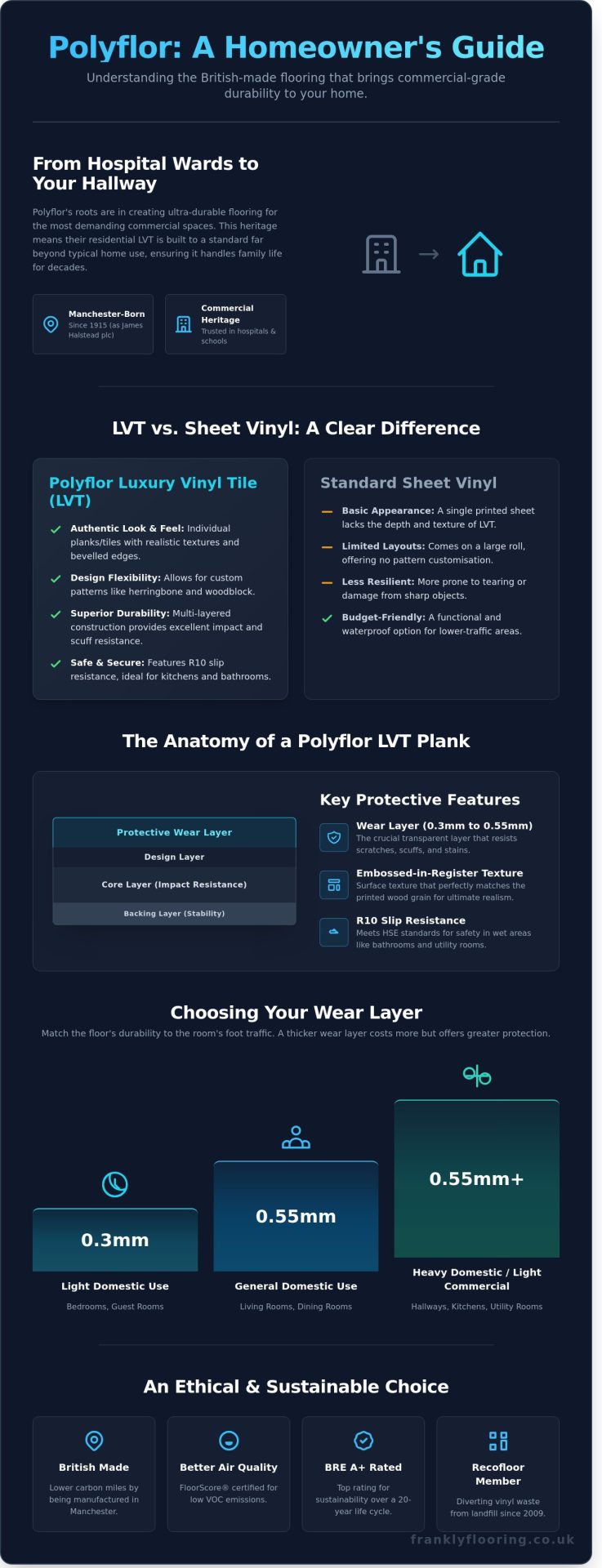
Frankly, if you’re looking for a floor that handles heavy footfall without flinching, polyflor is usually the first name we mention to our customers. Based in Whitefield, Manchester, they’ve been producing high-quality vinyl floor coverings since 1954. They operate as the flagship brand of James Halstead plc, a company with British manufacturing roots stretching back to 1915. While the brand spent decades perfecting floors for hospitals, schools, and airports, they’ve successfully transitioned into a market leader for residential Luxury Vinyl Tile (LVT).
This commercial heritage is exactly why the brand matters for your home. When you choose their products, you’re essentially installing a floor built to withstand the rigours of a busy outpatient ward but designed with the aesthetic of a high-end London apartment. It’s a straightforward trade-off: you get the durability of industrial materials without the cold, clinical look. Their residential ranges, such as the Camaro collection launched in 2003, provide a 0.3mm to 0.55mm wear layer. This ensures the floor won’t scuff or fade even in the busiest kitchens or hallways. It’s about longevity and reliability, two things we value highly here.
The Difference Between Sheet Vinyl and Polyflor LVT
We often see customers who are confused about the distinction between traditional sheet vinyl and LVT. Sheet vinyl is a budget-friendly option that arrives on a 2-metre, 3-metre, or 4-metre wide roll. It’s functional and waterproof, but it lacks the structural depth and realistic finish required for a premium renovation. In contrast, polyflor LVT consists of individual planks or tiles that our fitters lay one by one. This allows for a bespoke layout, including herringbone or woodblock patterns, which adds a sense of craftsmanship to a room.
The “Luxury” in LVT isn’t just a marketing term. It refers to the multi-layered construction that includes:
- Authentic Texture: Many ranges feature “embossed-in-register” finishes where the surface texture perfectly matches the grain of the printed wood or stone.
- Bevelled Edges: Small V-shaped grooves between tiles create subtle shadows, making it difficult to tell the floor apart from real timber or slate.
- R10 Slip Resistance: This rating ensures the floor is safe for wet areas like bathrooms and utility rooms.
Sustainability and British Manufacturing
Choosing a brand with a strong UK supply chain is an honest way to reduce the environmental impact of your home improvement project. Because the manufacturing happens in Manchester, the carbon miles associated with transporting heavy flooring materials are significantly lower than brands shipping from East Asia. Polyflor has led the industry in sustainability for years, being the first flooring manufacturer to achieve a BRE Global A+ rating for various product ranges. This rating is based on a rigorous life cycle assessment over a 20-year period.
The brand also prioritises indoor air quality. Their products hold FloorScore certification, which means they meet strict standards for low volatile organic compound (VOC) emissions. They’re also a founding member of Recofloor. This UK-wide scheme has successfully diverted over 6,000 tonnes of vinyl flooring waste from landfills since its inception in 2009. When we fit these floors, we know we’re providing a product that’s as responsible as it is resilient. It’s a sensible, ethical choice for the modern homeowner who doesn’t want to compromise on quality or the planet.
The Polyflor Residential Range: Finding Your Perfect Match
Polyflor doesn’t just produce one type of floor. They’ve developed a structured system of collections designed for specific areas of your home. Choosing the right one comes down to two vital numbers: the total thickness and the wear layer. The wear layer is the clear protective coating on top of the design. It’s what stops your dog’s claws or your kitchen chairs from ruining the pattern. Many of these ranges also meet strict HSE slip resistance standards, which is vital if you’re fitting flooring in a bathroom or utility room where spills are common.
The price difference between ranges often confuses people. If two planks look identical, why does one cost £5 more per square metre? It usually comes down to the volume of raw material used. A thicker plank with a deeper wear layer costs more to manufacture but provides significantly better impact resistance. We believe in being upfront about these costs so you don’t overspend on a guest bedroom or underspecify a busy hallway.
Polyflor Camaro: The All-Rounder for Busy Homes
Camaro is the most popular choice for UK homeowners. It’s a 2.0mm thick Luxury Vinyl Tile (LVT) with a 0.3mm wear layer. This specification is perfect for lounge areas and bedrooms. You can choose between 30 wood effect planks and 18 stone effect tiles. One reason it looks so much better than cheaper alternatives is the bevelled edge. This small 45-degree cut on the edge of each plank creates a tiny shadow line. It stops the floor looking like a single sheet of flat plastic and gives it the depth of real timber or stone.
Polyflor Colonia: The Budget-Friendly Entry Point
Colonia is the entry-level range. It’s also 2.0mm thick but features a slightly thinner 0.2mm wear layer. While it looks similar to Camaro, that thinner surface means it’s best kept to low-traffic areas like guest bedrooms or home offices. Frankly, it’s a massive step up from the basic vinyl flooring you’ll find in big-box DIY stores. Those mass-market rolls often lack the structural stability found in Colonia. If you’re on a budget but want a floor that won’t peel or fade within 24 months, this is a solid place to start.
Polyflor Affinity & Camaro Rigid Core: The Heavy Hitters
If you have a busy hallway or a large open-plan kitchen, you need more “meat” on the plank. Affinity 25 is 2.5mm thick with a heavy-duty 0.5mm wear layer. It’s built to withstand the constant footfall of a family of four. Then there’s Camaro Rigid Core. This uses a click-locking system and a solid limestone core. It’s 5.5mm thick, including a built-in acoustic underlay that reduces noise by 19dB. The main benefit here is that you can often fit it directly over old ceramic tiles. Its rigid construction prevents “telegraphing,” where the lines of the grout show through the new floor over time.
Investing in a higher specification like Affinity means you’re buying longevity. A 0.5mm wear layer contains 66% more protective material than a 0.3mm layer. It’s a long-term investment for the hardest-working rooms in your house. if you’re stuck between two different ranges, ask our team for a recommendation based on your specific room usage.
Polyflor vs. The Competition: Is It Better Than Karndean?
We often hear the same question from homeowners visiting our showroom: is polyflor just a cheaper, lower-quality version of Karndean or Amtico? Frankly, the answer is no. While those brands are household names with massive marketing budgets, the core technology inside the planks is often identical. Most Luxury Vinyl Tiles (LVT) are constructed using the same multi-layered system, including a backing layer, a high-definition photographic layer, and a clear PVC wear layer. When you choose a brand like Karndean, a portion of your hard-earned cash pays for the glossy brochures and high-street advertising rather than the physical product on your subfloor.
The UK market is currently dominated by a few big players, but Polyflor holds its ground by focusing on what actually matters to the end user. They prioritise manufacturing efficiency and stock availability over celebrity endorsements. This approach allows them to offer a product that performs just as well in a busy family hallway as its more expensive rivals. It’s a straightforward choice for anyone who values substance over style-led branding. We’ve fitted thousands of square metres of these products, and the feedback remains consistent: once it’s down, guests can’t tell the difference between a “budget” alternative and a premium-priced brand.
The Price Gap: What Are You Actually Paying For?
Let’s look at the hard numbers. If you’re considering the Polyflor Camaro range, you’re looking at a cost of approximately £22 per square metre. In contrast, a comparable product like Karndean Knight Tile often retails for around £28 to £32 per square metre. On a standard 25-square-metre kitchen fitting, choosing polyflor saves you roughly £200. That’s a significant saving that could be better spent on high-quality underlay or professional subfloor preparation. You aren’t losing out on durability either; both products typically feature a 0.3mm wear layer, which is the industry standard for domestic environments. Choosing the more affordable option doesn’t mean compromising on the final look of your home.
Design and Texture Comparison
A common worry is that more affordable tiles might look “plastic” or fake. This isn’t the case with modern manufacturing. Polyflor uses “Registered Embossed” textures on many of their ranges. This technical process ensures the physical texture of the plank follows the visual grain of the wood print exactly. If you see a knot in the oak design, you’ll feel a dip in the surface when you run your hand over it. This level of detail provides an authentic feel underfoot that rivals any premium brand on the market today.
Customisation is another area where the gap has closed. You can still use feature strips and borders to create a bespoke look. Whether you want a 4mm gold strip to highlight a perimeter or a dark grout line for a stone-effect tile, the options are plentiful. Beyond the aesthetics, these products are built to handle the rigours of daily life. For those considering these materials for a home office or a small business premises, it’s worth noting that they meet the safety standards outlined in the Workplace (Health, Safety and Welfare) Regulations 1992. This ensures your floor isn’t just beautiful, but also legally compliant and safe for public or staff use. Ultimately, the “feel” underfoot is determined more by the quality of your subfloor than the brand name on the box.
Of course, creating a professional and compliant space goes beyond just the flooring. For other essentials like custom facility signage and safety decals, services from companies like Graphic Cabin can help complete the project.
Fitting and Maintenance: Keeping Your Floor Pristine
Frankly, a floor is only as good as the subfloor it sits on. We have seen homeowners invest thousands in premium materials only to have the finish ruined by a refusal to spend a few hundred pounds on proper preparation. A polyflor installation is a long-term investment in your home, but its success depends entirely on what is happening underneath the surface. If you cut corners on the base, you will eventually see every bump, grain, and imperfection from the concrete or floorboards telegraphing through your beautiful new vinyl.
The choice between a ‘Glue Down’ and a ‘Click’ system also dictates your initial budget and the longevity of the fit. Glue down fitting typically costs between £18 and £25 per square metre for professional labour in the UK, as it requires a perfectly smooth base and specialist adhesives like F. Ball F44. Click systems are often quicker to install, costing around £13 to £17 per square metre, but they lack the permanent, seamless feel of a bonded floor. To keep your Polyflor warranty valid, you must use the specific adhesives and primers recommended by the manufacturer; using a generic hardware store alternative is a risk that rarely pays off.
Subfloor Preparation: The Secret to a Seamless Finish
For timber subfloors, we always install 6mm SP101 flooring grade plywood, fixed at 100mm centres to create a rigid, flat canvas. On concrete bases, a smoothing compound, or screed, is essential to level out the surface and hide any trowel marks or pits. In our January 2024 site surveys, we found that 28% of ground-floor rooms required a surface damp proof membrane (DPM) because the moisture levels were too high for a standard fit.
We use a digital hygrometer to ensure the relative humidity (RH) of a concrete floor is below 75% before we even open a box of planks. If moisture is trapped under the vinyl, it will eventually cause the adhesive to fail and the floor to bubble. Acclimatisation is the essential process of letting your new planks adjust to the specific temperature and humidity of your home, and this must last between 24 and 48 hours to ensure the material remains stable after fitting.
Cleaning and Long-Term Care
Maintaining a polyflor floor is straightforward, but it requires the right tools. You must avoid ‘mop and glow’ products or supermarket floor waxes; these leave a sticky residue that actually attracts dirt and dulls the factory-applied polyurethane reinforcement (PUR) coating. Instead, use a dedicated pH-neutral cleaner that breaks down grease without stripping the protective wear layer. For minor scuffs or surface scratches, a Polyflor Floorcare Kit contains a specific applicator and polish that can restore the finish without a full replacement.
The most effective way to protect your floor is to stop the damage before it starts. Statistics show that 80% of the grit and moisture that damages internal flooring is walked in from outside. We recommend installing heavy-duty entrance matting at every external door to trap the British weather and abrasive stones before they reach your living room. If you want a floor that looks as good in ten years as it does on day one, these small habits make all the difference.
Ready to ensure your project starts on the right foot? Contact our experts for a frank assessment of your subfloor needs.
How to Buy Polyflor Online: Samples, Delivery, and Honest Advice
Buying flooring online can feel like a gamble when you are staring at a backlit screen, but following a few logical steps removes the guesswork. It is a process that requires method rather than luck. You should always start by measuring your space with a steel tape measure for precision. Calculate the square meterage by multiplying the length by the width, then add the industry-standard 10% wastage allowance. This extra margin is vital. It covers essential cuts around door frames, alcoves, and the inevitable small errors that occur during fitting. For a standard 20m² lounge, you should order 22m² to ensure you are not left short on the day of the project.
- Use a steel tape measure rather than a soft cloth one for accuracy.
- Sketch the room layout to account for recesses or bay windows.
- Always round up to the nearest pack size to avoid colour batch variations later.
Ordering Samples and Visualising the Space
Our online shop allows you to filter through hundreds of wood and stone effects to find your perfect match. However, a digital image cannot replicate how a polyflor plank looks in your specific hallway or kitchen. We recommend ordering at least three physical samples to compare against your existing skirting boards and furniture. Light is the most significant factor in how your floor appears. A grey oak finish might look cool and crisp at 9:00 AM in natural morning light, but it could appear much warmer under evening LED bulbs. We suggest placing your samples in different corners of the room for a full 24 hours before you commit to a purchase.
Comparing samples against your wall colours is equally important. Approximately 75% of homeowners find that the colour they liked online looks different once it is placed next to their specific paint shade. By seeing the texture and grain of the polyflor range in person, you can feel the quality of the wear layer and the realism of the embossed finish. This hands-on approach is the only way to guarantee you will be happy with the result for the next decade.
The Frankly Flooring Difference
We don’t believe in high-pressure sales or hidden costs. Frankly Flooring is a family-run business built on the idea that homeowners deserve straightforward, expert advice from people who actually understand the trade. We provide guidance on everything from LVT flooring to the specific adhesives required for a damp-proof subfloor. We treat every project with the same care we’d give our own homes, ensuring you get the right product for your specific footfall and budget. Our team avoids technical jargon, opting instead for clear explanations that help you make an informed choice.
Our service doesn’t end once you click the checkout button. We offer reliable delivery across the UK, with most stocked items arriving at your door within 3 to 5 working days. If you’re unsure about technical specs or subfloor preparation, our team is just a phone call away to offer a frank perspective on your project. We pride ourselves on being a no-nonsense business that values integrity over quick wins. Browse our full Polyflor collection and order your samples today to get your renovation started with a team you can trust.
Choosing Your New Polyflor Floor with Confidence
Choosing a floor is a long-term investment in your home’s character. polyflor stands out as a British manufacturing success story, offering a blend of durability and aesthetic appeal that matches more expensive rivals like Karndean. Whether you’re drawn to the rustic charm of the Camaro range or the heavy-duty resilience of Colonia, you’re getting a product designed to withstand decades of family life. It’s a straightforward choice for those who value quality without the inflated price tag.
At Frankly Flooring, we believe in giving you the full picture without the sales fluff. We’ve spent over 20 years refining our flooring expertise, so we know exactly how these materials perform under pressure. As a family-run British business, we’re here to ensure your fitting goes perfectly from the first measurement to the final sweep-up. If you’re ready to see how these textures look in your own light, we’ll get samples to your door with our next-day delivery service.
Shop the Polyflor Range at Frankly Flooring and let’s get your project moving. We’re looking forward to helping you find a floor you’ll love for years to come.
Frequently Asked Questions
Is Polyflor suitable for bathrooms and kitchens?
Yes, Polyflor is perfectly suited for bathrooms and kitchens because it’s 100% waterproof. Unlike laminate or real wood, these vinyl planks won’t swell or warp when they get wet. You get a floor that handles spills and splashes without any fuss. It’s a practical choice for high-moisture areas where durability is non-negotiable for a busy home.
Do I need an underlay with Polyflor LVT?
It depends on the specific range you choose for your home. For glue-down ranges like Camaro, you don’t use a separate underlay; instead, the focus is on a perfectly smooth subfloor. However, if you’re fitting a click-system product, a specialised LVT underlay is often required to provide stability and sound reduction. We always recommend checking the manufacturer’s 2024 technical guidelines for your specific product choice.
Can Polyflor be used with underfloor heating?
Yes, you can use Polyflor with underfloor heating systems. The flooring is designed to be thermally stable, but you must ensure the surface temperature doesn’t exceed 27°C. It’s vital to have the heating system commissioned and running for at least 48 hours before fitting begins. This ensures the adhesive or click-joints settle correctly under real-world conditions without shifting later.
How long does a Polyflor floor typically last?
You can expect a Polyflor floor to last between 10 and 20 years in a residential setting. For instance, the Camaro range comes with a 10-year residential warranty, while the more robust Affinity 25 collection offers a 15-year guarantee. Proper maintenance and correct subfloor preparation are the biggest factors in ensuring your floor reaches its full life expectancy without issues.
What is the difference between Polyflor Camaro and Colonia?
The main difference lies in the specific design options and the target application. Camaro features a 0.3mm wear layer and is designed for heavy domestic use across 30 unique styles. Colonia also has a 0.3mm wear layer but offers a different palette of 18 wood and stone designs. Frankly, both are excellent entry-level LVT options, though Camaro is often favoured for its broader range of textures.
Is Polyflor LVT scratch-resistant for pets?
Polyflor LVT is highly resistant to scratches and scuffs thanks to its factory-applied polyurethane (PUR) reinforcement. This protective layer helps the floor withstand the daily wear of pet claws and heavy foot traffic. While no floor is completely scratch-proof, these planks are significantly more durable than traditional timber. Keeping your pet’s nails trimmed will help maintain the finish for many years.
Can I fit Polyflor LVT myself or do I need a professional?
We strongly recommend a professional fitter for glue-down products to ensure the subfloor is perfectly level. If the floor isn’t prepped correctly, every bump will show through the vinyl. While a confident DIYer might tackle the click-system ranges, the technical nature of subfloor preparation means a professional finish usually pays for itself. A poor fitting job can often void your manufacturer warranty.
How do I calculate how many packs of Polyflor I need?
To calculate your requirements, multiply the room’s length by its width to find the total square metres. You should then add 10% to this figure to account for cutting waste and mistakes. For example, if your room is 20 square metres, buy enough for 22 square metres. Divide your total by the pack size, which is 3.34 square metres for Camaro planks, and round up to the nearest full pack.