
Quality underlay is defined by density and material purpose, not just how thick it feels between your fingers. It’s easy to feel overwhelmed by technical jargon when you’re simply looking for an honest carpet underlay guide to help you build a comfortable home. You likely worry about your new carpet “bottoming out” in the hallway or failing to work with your underfloor heating, but the sea of options often feels designed to confuse rather than help.
Frankly, what’s underneath your floor matters just as much as the carpet itself. We’re here to provide a transparent look at how to choose the right material to extend your floor’s lifespan and improve insulation. We’ll explain why the combined TOG rating must stay below 2.5 for underfloor heating and how the BS EN 14499:2024 standards affect your choice in 2026. We’ll show you how to pick the right density for every room, ensuring you get a better underfoot feel and a fitting that stands the test of time.
Key Takeaways
- Understand why underlay acts as the essential foundation of your floor, absorbing impact to stop carpet fibres from breaking down.
- Use this carpet underlay guide to distinguish between PU foam, rubber, and felt while prioritizing material density over simple thickness.
- Identify the correct TOG and decibel ratings to improve your home’s energy efficiency and sound insulation without compromising underfloor heating performance.
- Learn how to select the right grade for every room, allowing you to maximize comfort in lounges while ensuring durability in high-traffic hallways.
- Get a clear checklist for buying online, including how to calculate the standard 5 to 10 percent wastage for a straightforward fitting.
Why Carpet Underlay is the Most Important Thing You’ll Never See
Choosing a new carpet is the exciting part of any home renovation, but the material you place beneath it dictates how long that excitement lasts. Think of Carpet Underlay as the structural foundation of your flooring. Without it, your carpet sits directly on a cold, hard subfloor, leaving the delicate pile to take 100% of the impact from every footstep. This carpet underlay guide aims to show you why skimping on this layer is a mistake that will cost you more in the long run. At Frankly Flooring, we believe in giving you the full picture; underlay isn’t an “optional extra” tacked onto your bill, it’s the engine room of your floor.
Beyond comfort, underlay acts as a vital hygiene barrier. It prevents dust and fine grit from settling into the subfloor, which can eventually grind away at the back of your carpet like sandpaper. There is also the matter of your manufacturer’s warranty. Most major carpet brands explicitly state that their guarantees are only valid if the carpet is fitted over a suitable, new underlay. If you try to cut corners here, you might find yourself without protection if the carpet develops a fault early in its life.
The Invisible Benefits: Longevity and Insulation
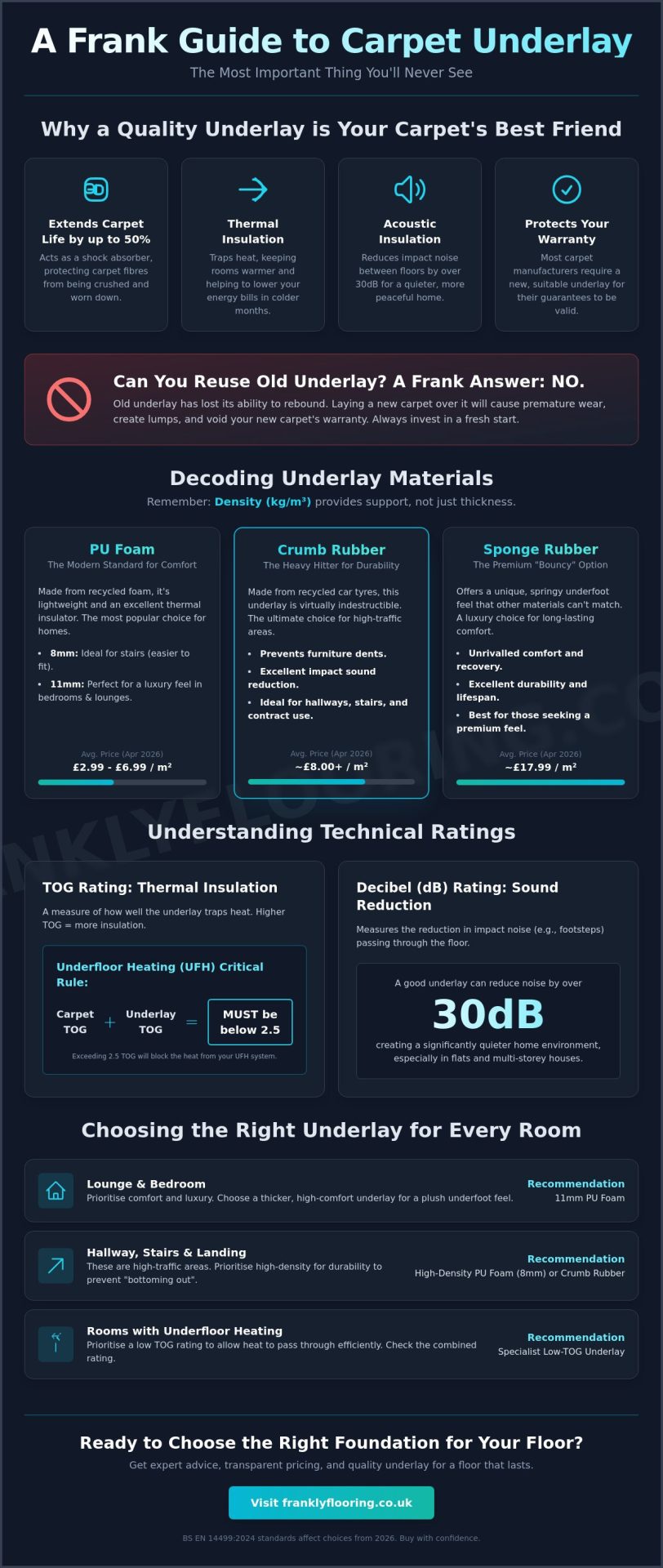
Investing in a high-quality underlay can extend the life of your carpet by up to 50%. It works as a shock absorber, protecting the carpet fibres from being crushed against the subfloor. For British homes, the thermal benefits are just as significant. A dense underlay traps heat, helping to lower energy bills during the colder months. It also provides essential acoustic insulation. In multi-storey houses, the right underlay can reduce impact noise transfer between floors by over 30 decibels, making for a much quieter, more peaceful home environment.
Can You Reuse Old Underlay? A Frank Answer
It’s the most common question we hear in our showroom: “Can I just use the old padding to save some money?” Our honest answer is always no. Underlay is a high-performance product that loses its “rebound” ability over time. After several years of use, especially in busy walkways, the cells within the material collapse. If you lay a fresh carpet over old, tired underlay, the new pile will quickly mirror the wear patterns of the old one. You also risk the old material crumbling into a fine dust or creating uneven ridges. This makes your expensive new carpet look lumpy and feel thin underfoot. To get the best out of your investment, a fresh start is the only way forward.
Decoding Underlay Materials: PU Foam, Rubber, and Felt
Historically, heavy rubber was the industry standard, but the market has shifted significantly. By April 2026, recycled PU foam has become the dominant choice for British homeowners, accounting for a large portion of residential fittings. When using this carpet underlay guide, it’s vital to understand that thickness is not the only metric for quality. While a thick underlay feels soft, density is what provides the structural support. Density is measured in kg/m³; a higher number means more material is packed into every centimetre, which prevents the carpet from “bottoming out” against the hard subfloor in high-traffic areas like hallways.
Choosing the right material also has environmental implications. In 2026, consumer preference is leaning heavily toward sustainable options. Most modern underlays are now manufactured from recycled materials, whether that’s old car tyres or furniture foam offcuts. This shift doesn’t just help the planet; it results in products that are lighter to handle and more effective at trapping heat than the solid materials used decades ago.
PU Foam: The Modern Standard for Comfort
Most homes today rely on PU Foam Underlay because it’s incredibly versatile. It’s made from recycled foam offcuts, making it a lightweight and highly effective thermal insulator. In April 2026, prices for an 8mm PU foam start at approximately £2.99 per m², while a luxury 11mm version typically costs around £6.99 per m². We generally recommend the thinner 8mm versions for stairs, as they are easier to fit around the treads, while the 11mm versions are perfect for creating a plush feel in bedrooms and lounges.
Crumb Rubber and Sponge: The Heavy Hitters
If you’re worried about heavy furniture leaving permanent dents in your new carpet, rubber is the answer. Crumb rubber is made from recycled tyres and is virtually indestructible, making it ideal for the busiest rooms in the house. Sponge rubber is the premium “springy” alternative. It provides a distinct bounce that PU foam can’t quite match. As of April 2026, an 11.4mm sponge rubber option costs about £17.99 per m², reflecting its position as a luxury, long-life product. If you want a floor that feels as good in ten years as it does on day one, rubber is a solid investment.
Traditional Felt: Why It Still Has a Place
Felt underlay is often wool-rich and provides a very firm, traditional feel. It doesn’t have the “squish” of foam, but it offers incredible support for high-end woven carpets like Axminsters or Wiltons. Because felt is so dense, it’s also the best material for hiding minor subfloor imperfections or “smoothing out” a floor that isn’t perfectly level. If you’re investing in a bespoke woven carpet, felt is often the only material that provides the stable foundation those carpets require. To ensure you’re matching the right material to your specific room, you can always ask our team for a frank recommendation based on your carpet type.
Understanding TOG Ratings and Sound Reduction (dB)
Technical specifications like TOG and decibel (dB) ratings often feel like they’re written for architects rather than homeowners. However, these figures are the only way to measure how your floor will actually perform once the fitting is complete. In this part of our carpet underlay guide, we’ll strip away the jargon to explain how to read these numbers. Getting the balance right means the difference between a house that feels draughty and loud, or one that’s warm and peaceful. For most British homes with standard central heating, a combined TOG value between 2.5 and 3.0 provides the ideal balance of warmth and efficiency.
Keeping the Heat In: TOG Ratings Explained
A TOG rating measures thermal resistance. The higher the number, the better the material is at stopping heat from escaping through the floor. If you’re fitting carpet on a cold ground floor, especially over a concrete subfloor, you want a high TOG rating of 2.5 or above to act as a thermal barrier. This helps keep your toes warm and your energy bills down. However, you need to be careful if you have underfloor heating. In these cases, you can’t just pick the most insulating option available.
If you choose an underlay with too much thermal resistance, you’ll “tog out” your heating system. This means the heat gets trapped beneath the floor and never reaches the room, which can actually damage the heating elements. For underfloor heating to work efficiently, the combined TOG of your carpet and underlay shouldn’t exceed 2.5. If you’re considering different flooring types for different rooms, our engineered wood flooring guide explains how subfloor preparation changes depending on your choice of material.
Shushing the Footsteps: Acoustic Insulation
Sound reduction is measured in decibels (dB), but it’s important to differentiate between types of noise. Underlay is primarily designed to tackle impact noise, which is the sound of footsteps, dropped objects, or furniture moving across the floor. It’s less effective against airborne noise, such as voices or the TV. For upstairs bedrooms or flats, a 35dB rating is widely considered the gold standard for peace and quiet.
Density plays a huge role in acoustic performance. A dense, high-quality underlay prevents the “drumming” sound often heard when walking on wooden subfloors. By absorbing the energy of each step, the underlay stops vibrations from travelling through the floor joists and into the room below. This is particularly important in multi-storey dwellings where Approved Document E of the UK Building Regulations sets strict standards for sound insulation between homes. Choosing a product with a high dB rating ensures you aren’t just improving your own comfort, but staying on the right side of modern building standards too.
Choosing the Right Underlay for Every Room
Most homeowners assume they should buy one type of underlay for the whole house. Frankly, that’s rarely the most efficient way to spend your budget. A smart carpet underlay guide should help you allocate your funds where they’ll make the most difference. You might want the ultimate “squish” in your master bedroom, but putting that same material on your stairs could be a safety risk. By mixing and matching grades, you ensure every room performs its best without overspending on luxury where it isn’t needed.
It’s also worth remembering that even the best underlay can’t do its job without a quality carpet gripper to hold everything in place. The gripper provides the tension needed to keep the carpet taut. This prevents ripples that can cause the underlay to wear unevenly or “bunch up” over time. Getting the combination of gripper and underlay right is what separates a professional fitting from a DIY job that looks tired after six months.
High-Traffic Areas: Hallways and Stairs
Hallways and stairs are the workhorses of the home. On stairs, safety is the priority. If the underlay is too thick, it rounds off the “nose” of the step, creating a trip hazard and making the carpet harder to fit securely into the crotch of the stair. We recommend a high-density crumb rubber or a very firm 8mm PU foam for these areas. These materials resist “tramlining”, which are those unsightly worn paths that appear where people walk most often. A dense base ensures the carpet pile doesn’t collapse under constant pressure, keeping your stairs looking fresh for years.
Maximum Comfort: Bedrooms and Lounges
For bedrooms and lounges, the goal changes to pure comfort and relaxation. This is where you can opt for the 11mm or 12mm PU foam options. A thicker underlay with a high TOG rating creates a cosier atmosphere, especially on cold winter mornings. If you want a truly premium feel, sponge rubber offers a “walking on air” sensation that makes a lounge feel significantly more luxurious. Because these rooms see less heavy foot traffic than a hallway, you can prioritize that “plush” feel without worrying as much about the material bottoming out.
If you’re looking for one product to do it all, a high-density 10mm PU foam is our “Frank” recommendation. It’s thick enough for a plush bedroom feel but dense enough to handle a busy landing. If you’re ready to see how these materials feel in person, you can visit our showroom to test the different densities for yourself.
How to Buy Underlay Online with Confidence
Buying flooring online doesn’t have to be a gamble. We’ve designed this carpet underlay guide to remove the guesswork and provide a straightforward path to a better floor. One of the most efficient ways to manage your project is to order your underlay and carpet at the same time. This ensures that the technical specifications, like the TOG ratings we discussed earlier, are perfectly compatible. It also simplifies your delivery logistics, meaning your fitter has everything they need on day one without multiple delivery charges.
Most underlay is sold in standard rolls, typically covering around 15 square metres. However, you should never order the exact square meterage of your room. Professional fitters always recommend adding a wastage margin of 5 to 10 percent. This covers the offcuts created when trimming the material into corners, alcoves, and doorways. If your room is particularly irregular, stick to the higher end of that percentage to avoid running short mid-fitting. By following this carpet underlay guide, you’ll avoid the frustration of a project stalling because of a simple calculation error.
Measuring Up Like a Pro
Accurate measurements are the foundation of a stress-free installation. Start by measuring the length and width of your room at its widest points. This must include any bay windows or doorways where the carpet will tuck under the threshold. Don’t forget to measure into the back of alcoves. Once you have your base figures, add 10cm to each dimension as a safety net for the fitter. This extra bit of “give” allows for precise trimming against the skirting boards and ensures a seamless finish.
Before your delivery arrives, take a moment to inspect your subfloor. Whether it’s floorboards or concrete, it needs to be clean, dry, and level. If you find loose boards or significant cracks, address them now. A quality underlay can hide minor imperfections, but it can’t fix a structural issue. Preparing the surface properly ensures that your new underlay sits flat and performs its role as a shock absorber without any annoying squeaks or dips later on.
The Frankly Flooring Promise
At Frankly Flooring, we bring over 20 years of family-run expertise to every order in the UK market. We don’t believe in high-pressure sales or hiding costs in the small print. Our curated selection of underlays is chosen for durability and performance in real homes. We offer national delivery, ensuring that whether you’re in a city centre or a rural village, you have access to professional-grade materials that the big retailers often overlook.
We take pride in being the straight-talking experts you can trust with your home keys. Our team handles the process from the moment you browse our site to the final delivery, ensuring a seamless experience. If you’re ready to upgrade your home’s comfort and longevity, Explore our range of high-quality underlays today and discover the difference that honest advice makes to your fitting.
Build a Better Foundation for Your Home
Choosing the right underlay shouldn’t be a guessing game. By focusing on material density and technical ratings rather than just thickness, you’ve already taken the biggest step toward a floor that lasts. Whether you’ve decided on high-density PU foam for your lounge or durable crumb rubber for the stairs, you now have the tools to make an informed choice. This carpet underlay guide was designed to give you the frank truth about what your home needs to stay warm, quiet, and comfortable for years to come.
At Frankly Flooring, we’ve spent over 20 years as a family-run business providing straight-talking advice and quality materials across the UK. We don’t believe in hidden costs or sales pressure; we just believe in getting the job done right from the first measurement to the final fitting. With national UK delivery on all accessories, we make it easy to get professional-grade products delivered straight to your door. Browse our honest range of carpet underlays today and start your project on the right foot. You’re well on your way to a home that feels as good as it looks.
Frequently Asked Questions
Do I really need new underlay for a new carpet?
Yes, you absolutely need new underlay. Old material has already been compressed by years of foot traffic and loses its ability to protect the new carpet’s backing. Reusing old padding often voids manufacturer warranties and leads to uneven wear patterns within 12 to 18 months. Fresh underlay ensures your investment lasts its full intended lifespan, typically 10 to 15 years, depending on the material quality and usage levels in your home.
Which underlay is best for thick pile carpets?
A high-density 11mm PU foam is the best choice for thick pile carpets to enhance that luxury feel. While the carpet pile provides surface softness, the underlay provides the structural bounce. For a premium finish in a lounge, sponge rubber is an excellent alternative because it resists furniture indentations better than lower-grade foams. This combination ensures your floor feels plush without the carpet fibres crushing prematurely under heavy weight or frequent use.
What is the best underlay for underfloor heating?
The best underlay for underfloor heating is a specialized low-TOG product, often made of thin, perforated rubber. To keep your system running efficiently, the combined TOG of your carpet and underlay must not exceed 2.5. If you exceed this limit, the heat stays trapped beneath the floor, wasting energy and potentially damaging the heating elements. Always check the specific thermal resistance rating before finalizing your carpet underlay guide for heated rooms.
Can underlay reduce noise from noisy neighbours?
Underlay is highly effective at reducing impact noise, such as footsteps or moving furniture, but it has a limited impact on airborne noise like voices or music. To significantly quieten a room, look for a product with a sound reduction rating of at least 35dB. This high-density barrier absorbs vibrations before they travel through the floor joists. For the best results in multi-storey flats, ensuring a tight fitting against the skirting boards is essential for acoustic performance.
Is 12mm underlay too thick for stairs?
Yes, 12mm is generally considered too thick for stairs and can be a safety hazard. Thick underlay makes it difficult for a fitter to wrap the material tightly around the stair nosing, which can lead to the carpet slipping or rounding off the step edge. We recommend a firmer 8mm or 9mm high-density underlay for these areas. This provides enough protection for the carpet without compromising the stability of your footing on the treads.
What does a TOG rating mean on carpet underlay?
A TOG rating is a standardized measurement of thermal resistance used across the UK. In the context of flooring, it tells you how much heat the underlay will trap. A rating of 2.5 or higher is excellent for ground floors where you want to prevent heat loss into a cold subfloor. Conversely, a lower TOG is required for rooms with underfloor heating to allow warmth to pass through into the living space effectively without wasting energy.
How much underlay wastage should I allow for?
You should typically allow for 5 to 10 percent wastage when ordering. Standard underlay rolls usually cover 15 square metres, but every room has alcoves, doorways, or chimney breasts that require custom trimming. If you’re fitting a hallway or a room with many odd angles, aim for the higher 10 percent margin. Having a small amount left over is far better than having your fitting stop halfway through because you’ve run short of material.
Can I use carpet underlay for laminate or LVT flooring?
No, you cannot use carpet underlay for laminate or LVT. Carpet underlay is far too soft and thick, which would cause the click-joints of laminate or LVT to snap under pressure. These hard floors require a much thinner, high-density underlay, usually between 2mm and 5mm thick. Using the wrong material will void your flooring warranty and lead to a bouncy, unstable floor that will eventually fail. Always follow a specific carpet underlay guide for the correct material match.