
That plush, deep-pile carpet that feels like a dream in the showroom might actually become your biggest headache once it’s fitted in your busy hallway. It’s a common frustration for homeowners who invest in luxury only to find that every footstep and vacuum line stays visible for days. We understand that you want a home that looks pristine without having to constantly groom the floor, especially when you’re weighing up the twist vs saxony carpet debate for your next renovation.
Frankly, the “best” carpet doesn’t exist; there is only the best carpet for your specific lifestyle. This guide will give you a clear, honest look at the technical differences between these two popular styles so you can choose with confidence. We’ll explain why twist piles are the standard for 85% of high-traffic areas like stairs, how saxony construction creates that signature “shading” effect in bedrooms, and how to pair your choice with the correct underlay for a finish that looks superb well into 2026. By the time you finish reading, you’ll know exactly which pile belongs in which room without needing to touch a single sample.
Key Takeaways
- Understand the visual trade-off between textured durability and uniform luxury to ensure your new flooring matches your home’s character.
- Learn the technical science behind yarn “set” and pile density so you can invest in a carpet that won’t flatten under heavy furniture.
- Compare twist vs saxony carpet using our “Footprint Test” to determine which style is truly practical for high-traffic areas like stairs and hallways.
- Discover why choosing a single carpet for the whole house is rarely the best move and how to tailor your selection room-by-room for the best long-term value.
- Get a frank guide on reading specification sheets and why ordering physical samples is the only way to guarantee a perfect match for your home.
Understanding the Basics: What is Twist vs Saxony Carpet?
Both twist and saxony carpets belong to the cut-pile family, a category that currently accounts for approximately 70% of residential carpet sales across the UK. While they share a similar manufacturing origin, their personalities are worlds apart. One is a rugged workhorse designed for the chaos of a family hallway; the other is a refined, luxury surface meant for bare feet and quiet evenings. Choosing between twist vs saxony carpet isn’t just about the price per square metre, which typically ranges from £15 to £45 for mid-market options, it’s about understanding how the yarn behaves under daily pressure.
The visual first impression tells you everything you need to know. A twist carpet looks textured and matte, whereas a Saxony looks uniform and plush. This difference stems from how the yarn is treated during production. Saxony carpets often require more yarn density to maintain their upright structure, which can push the cost slightly higher than a standard twist. However, the real cost isn’t the initial fitting; it’s the price of replacing a carpet that wasn’t fit for purpose. Frankly, picking a plush Saxony for a high-traffic stairs area is a recipe for premature wear and a flattened appearance within two years.
What is a Twist Pile Carpet?
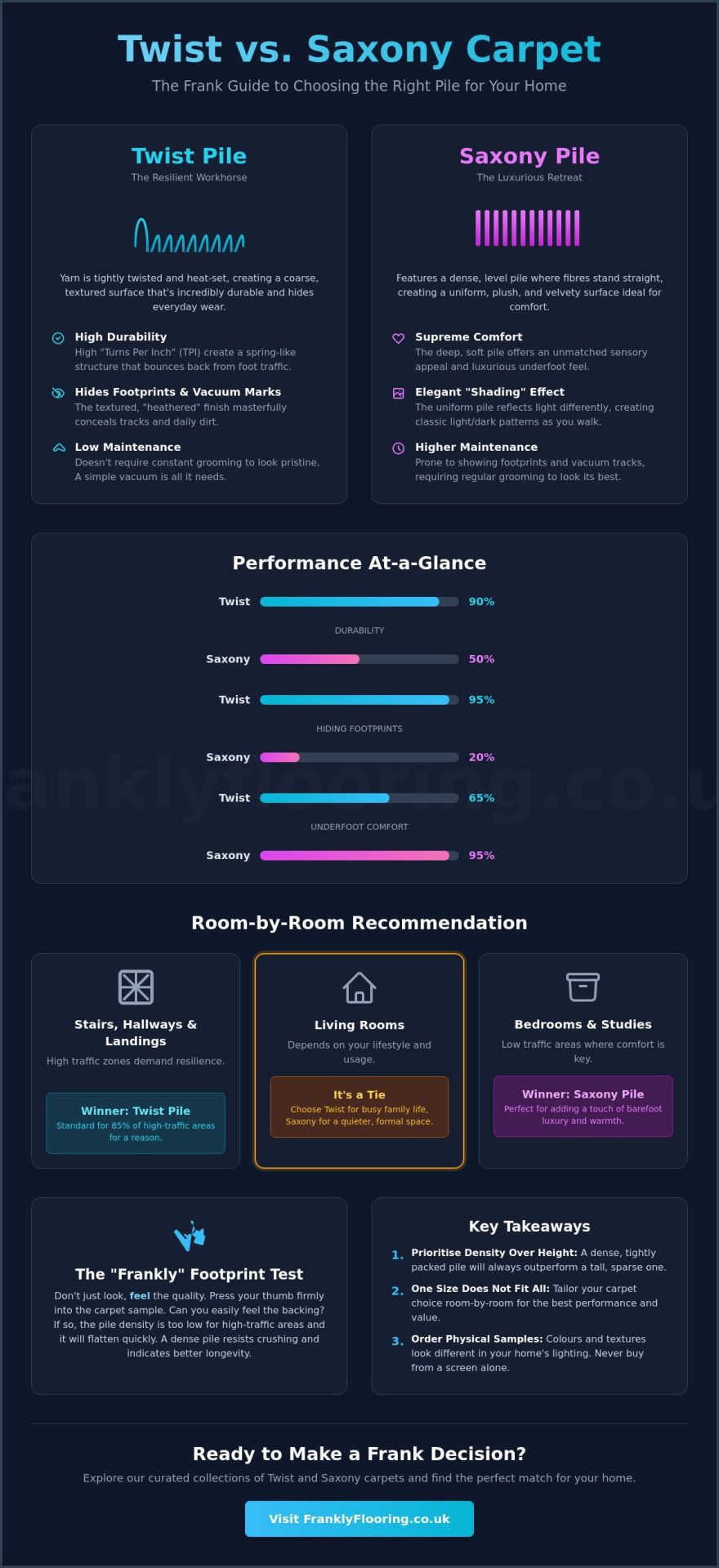
Twist pile carpets are the backbone of many British homes. The construction involves twisting the yarn tightly and then heat-setting it to lock that shape in place permanently. This creates a surface that looks slightly coarse or “heathered,” often blending multiple tones of the same colour into a “tweed” effect. This texture is a deliberate design choice for resilience. By creating an uneven finish, the carpet effectively hides footprints and vacuum tracks. It’s a straightforward, durable option that doesn’t demand constant grooming to look its best.
What is a Saxony Carpet?
If a twist is the practical choice, Saxony is the indulgent one. It’s defined by its upright, level pile where every fibre stands straight. This construction creates a deep, plush surface that many consider the gold standard for comfort. You’ll generally find two variations in a local showroom. The “velvet” Saxony has a smooth, uniform finish that creates those classic light and dark shading effects when walked upon. The “shag” Saxony features longer, looser fibres for a more relaxed, contemporary look. Both styles offer a sensory appeal that a twist simply cannot match, provided they are fitted in the right rooms.
Construction and Texture: The Technical Differences
To understand the real-world performance of a twist vs saxony carpet, you have to look at the yarn. Most modern carpets undergo a process called heat-setting. This involves using high-temperature steam to “lock” the fibres into their specific shape. Without this treatment, a carpet would lose its texture and look like a matted mess within 18 months of fitting. It is this thermal “memory” that keeps a twist tight and a Saxony standing tall.
Many homeowners mistakenly judge quality by pile height. They assume a taller carpet is a better one. In reality, density is the metric that actually dictates longevity. A carpet with a high tuft density, where the fibres are packed tightly together, will resist crushing far better than a tall, sparse pile. When you are comparing samples in a showroom, press your thumb into the pile. If you can easily feel the backing, the density is likely too low for high-traffic areas like stairs or landings.
TPI, or Turns Per Inch, measures the number of times a yarn strand is twisted around itself to create a resilient, spring-like structure. Material choice also dictates how these styles behave. Wool remains a premium choice in the UK, making up about 25% of high-end installations due to its natural “crimp” that aids resilience. Polypropylene is the go-to for stain resistance, while Nylon offers the highest durability for busy households.
Turns Per Inch: The Secret of the Twist
Twist carpets rely on mechanical strength. By using a high TPI count, manufacturers ensure the yarn cannot easily unravel or fray under the friction of foot traffic. This twisted structure acts like a shock absorber. When you step on it, the fibre coils and then bounces back. This structural integrity is why twist carpets are the preferred choice for carpet gripper tensioning on stairs. The yarn can handle being stretched and tucked without losing its form or balding at the tread edge.
Pile Alignment: The Saxony Signature
Saxony carpets are defined by their uniform direction. Every fibre is cut to the exact same length and stands vertically, creating a smooth, velvet-like surface that feels exceptionally soft underfoot. However, there is a trade-off. Because the fibres aren’t tightly twisted together for support, they are prone to “shading” or “pooling.” This happens when light hits misaligned fibres that have been pushed in different directions by feet or vacuum cleaners. It creates the classic light and dark patches that some love for their luxury look, while others find them high-maintenance.
Choosing between these two comes down to whether you value the rugged resilience of a tight twist or the formal elegance of a Saxony. If you want an honest opinion on which style suits your specific room dimensions, you can book a home visit with Frankly Flooring to see the samples in your own light.
Performance Comparison: Durability and Maintenance
Choosing between a twist vs saxony carpet often comes down to how much effort you want to put into your home maintenance routine. While both styles look exceptional on the day of fitting, they react differently to the physics of a busy household. A carpet in a quiet spare room faces different challenges than one on a staircase handling 20 climbs a day. Understanding how these piles recover from pressure will determine whether your floor looks “lived-in” or simply worn out after 24 months.
The footprint test is the most immediate differentiator. Saxony carpets are famous for “tracking,” which means they show every footstep and vacuum line. Some homeowners love this as a sign of a freshly cleaned room, while others find it untidy. Twist piles are the opposite. The textured, multi-directional finish hides these marks, making them a more forgiving choice for those who don’t want to rake their carpet after walking across it. Regarding heavy furniture, twist yarns are generally heat-set to retain their shape. While a heavy mahogany sideboard will leave an indent in any material, a high-quality twist pile typically recovers its height faster than the straight, upright fibres of a Saxony.
Resilience in High-Traffic Zones
Twist pile is the honest choice for hallways, stairs, and landings. Its construction involves tightly twisting the yarn, which creates a built-in “crush resistance.” In these busy thoroughfares, the carpet fibres are hit from multiple angles. Twist piles mask the resulting wear. Conversely, Saxony is prone to matting in areas with high footfall. Within 3 years of use, a Saxony in a narrow corridor can develop a visible “pathway” where the long fibres have been pushed down and tangled. For the 70% of UK homeowners who prioritise longevity in their communal areas, the twist remains the standard recommendation.
The Maintenance Myth: Is Saxony Harder to Clean?
There is a common assumption that deeper, plush carpets are harder to keep hygienic. Frankly, the open structure of a Saxony can sometimes make deep cleaning more straightforward because the vacuum suction can reach the backing more easily. Most modern Saxony and twist options are now manufactured from 100% polypropylene. This fibre is inherently stain-resistant and can be cleaned with a diluted bleach solution (usually 1 part bleach to 10 parts water) without losing its colour.
- Twist Maintenance: Requires a vacuum with a rotating beater bar to agitate the tight fibres and flick out trapped grit.
- Saxony Maintenance: Best served by a vacuum with adjustable height to prevent the suction from “sealing” against the long pile.
- Long-term view: After 5 years, a well-maintained twist will likely look closer to its original state, whereas a Saxony may show its age through slight fibre separation.
A twist vs saxony carpet decision should factor in your vacuuming habits. If you prefer a quick once-over, the twist is your best friend. If you enjoy the ritual of deep cleaning a plush surface, the Saxony offers a rewarding finish that feels luxurious underfoot for years.
Room-by-Room Guide: Which Carpet Goes Where?
Choosing between a twist vs saxony carpet isn’t just about what looks best in the showroom. It’s about matching the pile to the daily reality of your home. We often see homeowners try to simplify things by fitting the same carpet throughout every room. Frankly, this is rarely the right move. Your hallway faces a different level of combat than your spare bedroom; your carpet choice should reflect that utility. A “whole-house” single carpet approach might save you 10% on the initial off-cut waste, but it usually costs you more when the stairs look battered within 18 months while the bedrooms still look new.
You should also consider the barefoot factor. In private spaces, you want a sensory experience that feels indulgent. In social areas, you need a surface that doesn’t hold onto every footprint or vacuum mark. The bedroom is the natural home for Saxony luxury. It is the one place where you can prioritise comfort over crush-resistance without regret.
The Living Room: Balancing Style and Stamina
Your lounge is the heart of the home, which means it’s also the primary target for spills and heavy footfall. Evaluating your lifestyle is the first step here. If you have two dogs and a toddler, a plain, deep-pile Saxony will look tired very quickly. For these busy households, a heathered twist is the frank choice. The multi-tonal yarn does a brilliant job of hiding crumbs and pet hair between vacuuming sessions. However, if your lounge is a “shoes-off” zone with light social frequency, a low-pile Saxony can work. It offers a sophisticated, velvet-like finish that suits modern lounges, provided you’re happy to accept the “shading” effect where the fibers move.
Stairs and Hallways: The Ultimate Durability Test
Stairs are the most demanding area of any house. We always recommend a high-quality twist for these high-impact zones. The reason is simple: the “stair-nose” wear pattern. Because Saxony fibers are longer and straighter, they tend to part or flatten over the edge of the step. This often reveals the backing material or the wood beneath far sooner than a resilient twist would. A tight, hard-wearing twist stays upright and maintains its structure under the pressure of constant climbing. For a deeper look at planning your project, check out our Choosing the Right Carpet guide. Making the right call on your twist vs saxony carpet selection now prevents a costly replacement in three years. If you’re still unsure which pile fits your specific layout, visit our showroom for a hands-on comparison.
Ready to see the difference for yourself? Book a professional home measurement and consultation today.
Buying Online: How to Make a Frank Decision
Buying flooring online is convenient, but you shouldn’t rely on a digital image alone. Digital screens vary wildly in how they display colour; a shade that looks like a warm beige on your phone might arrive looking like a cold grey. To avoid an expensive mistake, always order physical samples. Feeling the texture helps you settle the twist vs saxony carpet debate for your specific room. It lets you see how the light in your home, which is different from a studio photograph, hits the fibres at different times of day.
Reading a specification sheet is the best way to spot a bargain from a dud. Don’t just look at the price per square metre. Focus on the GSM (Grams per Square Metre). A carpet with a weight of 1,200g will significantly outlast a 600g alternative, even if they look identical in photos. Pile height also matters; a Saxony with a 15mm pile feels deeper than a 10mm Twist, but it requires more maintenance to keep it upright. High density is the secret to longevity. If the fibres are packed tightly, the carpet won’t flatten as quickly under foot traffic.
The hidden cost of cheap carpet usually reveals itself within the first 12 months. Low-weight options often lack the structural integrity to handle daily life. If you’re looking for a seamless fitting experience, your next step is to measure your room accurately, adding 10% for cutting waste. This ensures your fitter has enough material to work with without leaving unsightly joins in the middle of the floor.
The Underlay Synergy
Your choice of underlay is just as vital as the carpet itself. For a Saxony, a firm, high-density underlay is essential to protect the long pile from crushing. If you’ve chosen a budget twist, pairing it with a premium 11mm or 12mm underlay, such as Cloud 9, can make it feel like a luxury product. This combination provides the “bounce” people crave while ensuring the carpet backing doesn’t rub against the subfloor.
Checking the Backing: Action vs Felt
Most carpets come with either an Action Back or a Felt Back. Action Back is a woven synthetic material that is incredibly strong and stable. It requires a separate underlay and grippers, but it offers the best long-term performance. Felt Backing is often marketed as a DIY-friendly option that doesn’t need underlay, but we frankly don’t recommend it for high-traffic areas. It lacks the stretch and durability of Action Back. For a professional finish that lasts, stick with Action Back for both your twist and Saxony choices. Use this final checklist before you buy your carpet online:
- Order at least three samples to compare shades in your own light.
- Check the GSM to ensure you’re getting a durable weight.
- Confirm the backing type matches your installation needs.
- Ensure you’ve accounted for professional fitting and quality underlay.
Finding the Right Fit for Your Home
Choosing the right flooring shouldn’t be a guessing game. When you weigh up the twist vs saxony carpet debate, the decision usually comes down to your home’s daily rhythm. A twist carpet offers a resilient, textured finish that’s ideal for busy UK hallways where footfall is high. If you’re looking for that plush, deep-pile luxury in a master bedroom, a Saxony remains the gold standard for comfort in 2026. It’s about matching the construction to the specific needs of your room.
At Frankly Flooring, we’ve spent over 20 years helping homeowners find the right balance between style and practical performance. As a family-run business, we don’t believe in high-pressure sales or hiding the truth about how a carpet will wear over time. We provide frank, honest advice on every product to ensure you’re making a choice that lasts. Whether you need a durable twist for the stairs or a soft Saxony for the lounge, we offer national UK delivery on all flooring and accessories. You can trust our experience to get the job done properly without any unnecessary fluff.
Browse our full range of Twist and Saxony carpets at Frankly Flooring. We’re ready to help you transform your space with quality you can feel.
Frequently Asked Questions
Does Saxony carpet show vacuum marks?
Yes, Saxony carpets are famous for showing vacuum tracks and footprints due to their long, upright pile. When the fibres are pushed in different directions, they reflect light differently, which creates those characteristic shading marks. If you prefer a floor that looks uniform after a quick clean, a twist carpet might be a more practical choice for your home. This is a key factor to consider when looking at the twist vs saxony carpet debate for high-traffic areas.
Is a twist carpet better for pets than a Saxony?
A twist carpet is almost always the better option for households with pets. The tightly curled fibres are less likely to snag on claws compared to the longer, plusher piles of a Saxony. Because twist piles are denser and more textured, they also hide pet hair and small bits of debris more effectively between deep cleans. It’s a straightforward choice if you want a floor that stands up to paws and claws without looking worn.
Which carpet type is more expensive, twist or saxony?
There isn’t a fixed rule, but Saxony carpets often carry a higher price tag because they require a higher pile weight to achieve that luxurious feel. You can find budget options for both, but a high-quality Saxony often costs 15% to 20% more than a standard twist of the same fibre. Frankly, the total cost usually depends more on the material, such as wool versus polypropylene, than the specific twist vs saxony carpet style itself.
Can I use a Saxony carpet on my stairs?
We don’t recommend fitting a Saxony carpet on stairs or in busy hallways. The long pile is prone to flattening under the heavy, concentrated weight of footsteps on stair treads, which can lead to a crushed look very quickly. For these areas, a durable twist or a tight loop pile is a much safer bet. This ensures your flooring doesn’t look exhausted within the first 12 months of use.
How long should a good quality twist carpet last?
A high-quality twist carpet should last between 10 and 15 years if it’s maintained correctly and fitted with a decent underlay. According to the Carpet Foundation, regular vacuuming can extend a carpet’s lifespan by up to 30% by removing abrasive grit that cuts into fibres. Choosing a 80/20 wool blend twist will generally offer the best longevity for busy British homes compared to pure synthetic options.
What is the best fibre for a Saxony carpet to avoid flattening?
If you want to avoid flattening, a Polyamide fibre, also known as Nylon, is the best choice for a Saxony. Nylon is incredibly resilient and bounces back much better than Polyester or Polypropylene after being walked on. While it’s often more expensive, it keeps that plush “new carpet” look for significantly longer in rooms like the master bedroom. It’s the honest choice for those who value long-term aesthetics over the initial purchase price.
Do twist carpets feel rough to walk on?
Twist carpets aren’t rough, but they offer a firmer, more textured sensation underfoot than the silky softness of a Saxony. Modern manufacturing means even hard-wearing polypropylene twists feel comfortable and springy. If you want the best of both worlds, a wool-blend twist provides a natural softness while remaining tough enough for a busy living room. It’s about choosing the right balance between comfort and durability for your specific room.
Can I mix twist and saxony carpets in the same house?
You can certainly mix different styles to suit the specific needs of each room in your home. Many homeowners choose a hard-wearing twist for the stairs and landing, then switch to a luxurious Saxony in the bedrooms for added comfort. Just try to keep the colours within a similar tonal range. This ensures the transition between rooms feels seamless and intentional rather than looking like a patchwork of different remnants.