
Most standard vinyl floors aren’t actually designed to survive the 40-degree temperature spikes recorded during recent UK summers. It’s a frustrating reality that many homeowners discover only after their new floor begins to warp or gap during a heatwave. You want a space that looks like authentic oak or limestone, yet you’re likely worried about the practicalities of expansion, buckling, and the fading caused by direct sunlight.
Frankly, we believe you deserve a floor that’s as resilient as it is beautiful. This guide cuts through the marketing jargon to reveal the honest truth about lvt for conservatories in 2026. We’ll explain why the choice between high-temperature glue-down and rigid core click systems is the most important decision you’ll make for your home’s stability. You’ll learn how to achieve a seamless, easy to clean finish that stays warm underfoot in December and remains perfectly flat when the sun is at its peak.
Key Takeaways
- Understand why standard vinyl fails and how to choose high-stability lvt for conservatories that withstands the UK’s unpredictable temperature swings.
- Discover why rigid core technology often outperforms traditional glue-down methods in sun-drenched, glass-heavy rooms.
- Learn the “frank” truth about subfloor preparation and why skipping expansion gaps is a recipe for a buckled floor.
- Explore 2026’s top style trends and how your colour choice can subtly influence the perceived temperature of your living space.
- Find out how to secure showroom-quality flooring at online prices by cutting out the middleman for a more straightforward, honest value.
Why LVT is the Honest Choice for a UK Conservatory
A conservatory is often the most difficult room in a British home to floor correctly. It is essentially a glass box that traps heat in the summer and loses it rapidly in the winter. Because of these extremes, standard flooring materials often fail. Choosing lvt for conservatories isn’t just about aesthetics; it’s a practical decision based on how materials react to solar gain. To understand the technology behind these planks, it helps to look at What is Luxury Vinyl Tile (LVT) and how its multi-layered construction provides a level of durability that traditional materials simply can’t match.
Frankly, the old myth that vinyl floors warp or “bubble” in direct sunlight is outdated. While cheap, thin vinyl from a decade ago might have struggled, modern luxury vinyl is a different beast entirely. High-stability LVT is designed with a rigid core or specialized glass fibre layers that prevent the floor from shifting. It offers a straightforward solution for homeowners who want the look of natural wood or stone without the inevitable maintenance headaches that come with the UK’s unpredictable weather.
The Conservatory Climate Challenge
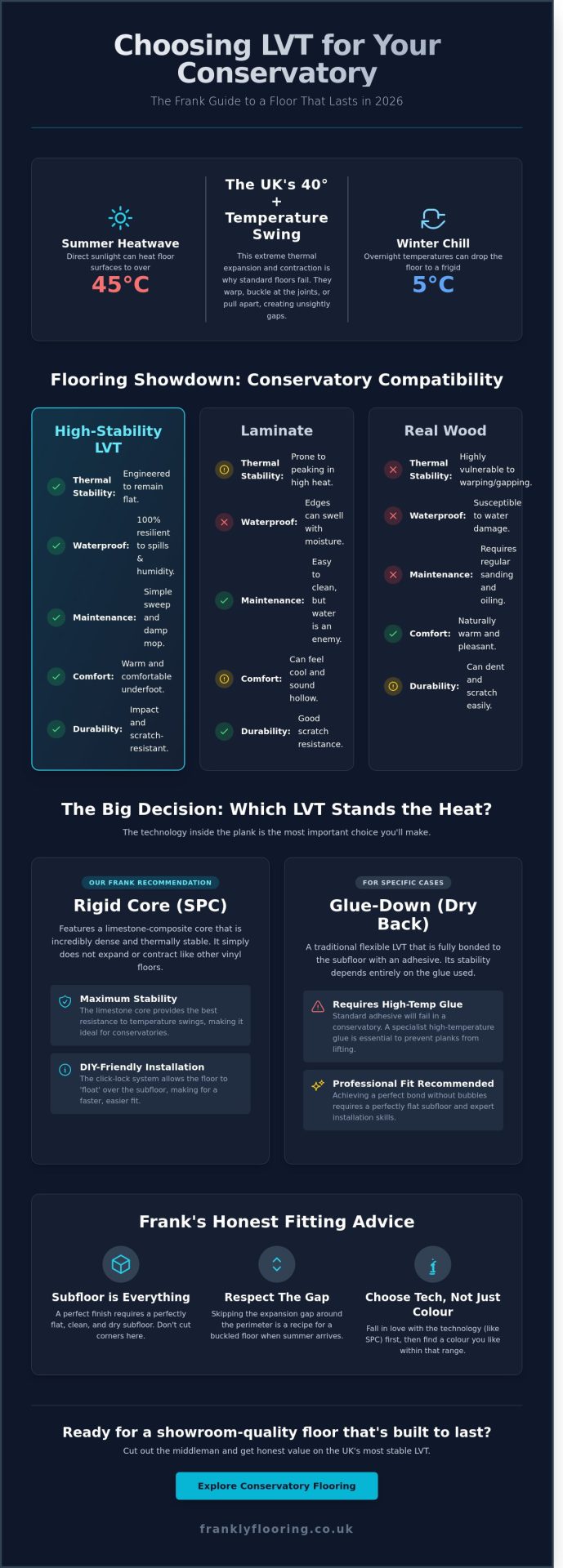
The primary issue with UK conservatories is the 40-degree temperature swing. On a frosty January morning, the floor temperature might sit at 5°C, only to climb to 45°C by mid-afternoon if the sun breaks through the clouds. This rapid thermal expansion is what ruins most floors. Solid wood is particularly vulnerable, as the organic fibres soak up moisture and expand when hot, leading to boards that pop or gap. Modern lvt for conservatories utilizes dimensional stability technology. This means the planks are engineered to remain the same size and shape regardless of whether it’s a heatwave or a cold snap. It stays flat, stays put, and keeps the room looking seamless.
LVT vs. Laminate and Real Wood
When comparing materials, moisture resistance is a major factor, especially if your conservatory leads directly into a garden. While many people consider laminate flooring for its price point, it often struggles with the humidity levels found in glass-roofed rooms. If a door is left open during a summer rain shower, laminate edges can swell and peel. LVT is 100% waterproof, making it much more resilient to damp shoes or accidental spills.
- Maintenance: Real timber requires regular sanding and oiling to stop it from drying out under UV rays. LVT requires nothing more than a quick sweep and a damp mop.
- Comfort: Ceramic tiles are a common choice but they feel like ice underfoot during the winter months. LVT is much warmer to the touch, providing a comfortable surface for bare feet even when the heating isn’t on.
- Durability: Unlike real stone, which can crack if a heavy pot plant is dropped, LVT is impact-resistant and won’t chip.
We believe in giving you the full picture before you commit to a fitting. LVT offers a balance of thermal performance and ruggedness that makes it the most reliable option for these high-exposure areas of the home.
Rigid Core vs. Glue-Down: Which LVT Stands the Heat?
Choosing lvt for conservatories isn’t as simple as picking a colour you like from a sample book. Luxury Vinyl Tile is a broad umbrella term that covers several distinct manufacturing technologies. If you choose the wrong one, your floor will likely fail during the first summer heatwave. We see it often; standard flexible vinyl planks expand in the sun, hit the skirting boards, and then lift or “peak” at the joints because they have nowhere else to go. To be honest, the choice usually comes down to how the material handles the “greenhouse effect” where glass-heavy rooms reach surface temperatures exceeding 40°C.
The two primary fitting methods, floating click-lock and permanent glue-down, offer very different levels of protection against these thermal shifts. While both look identical once they’re on the floor, their internal chemistry determines whether they’ll stay flat or start to curl when the sun comes out.
SPC (Stone Plastic Composite) Explained
SPC is a specific type of rigid core flooring that features a limestone-based core. Unlike traditional flexible vinyl that relies on PVC, this stone-composite core doesn’t expand or contract significantly when temperatures fluctuate. The click-lock system allows the floor to “float” over the subfloor, making it a favourite for DIY projects and quick renovations. SPC is the most thermally stable LVT option on the market today.
The Case for Glue-Down (Dry Back) LVT
While rigid core is our standard recommendation, glue-down LVT still has its place in specific UK homes. It’s often preferred in very large, open-plan spaces where a floating floor might feel less stable underfoot or where you want a seamless transition into other rooms without threshold strips. However, you cannot use standard pressure-sensitive adhesive in a conservatory. You must use specialist high-temperature (HT) adhesives that are rated to withstand direct sunlight without softening. Your subfloor must also be prepared to a professional standard, usually requiring a fresh layer of smoothing compound or 6mm flooring-grade plywood to ensure a perfectly flat surface.
Frankly, for the vast majority of conservatory projects in 2026, Rigid Core SPC is the clear winner. It eliminates the mess of adhesives and offers a much higher tolerance for the temperature extremes common in British conservatories. If you’re unsure which path fits your specific room layout, you can always chat with our fitting team for a straightforward, honest recommendation based on your subfloor type.
Style and Durability: Choosing Your Conservatory Look
Choosing the right aesthetic for your conservatory involves balancing personal taste with the practical realities of a glass-walled room. For 2026, the trend landscape is moving toward organic textures that blur the line between the garden and the home. Light oaks with cool undertones and realistic stone effects, such as tumbled travertine or muted slate, are the primary choices for homeowners seeking a modern look. These styles don’t just look contemporary; they serve a functional purpose. Floor colour significantly impacts the perceived temperature of the space. Darker floors act as thermal masses, absorbing solar energy and making the room feel considerably hotter during July and August. Lighter shades reflect that light, helping to maintain a more comfortable ambient temperature.
Durability in a conservatory is non-negotiable. Because these rooms often serve as the bridge between the garden and the house, they face constant traffic, moisture, and grit. When browsing lvt for conservatories, you should look for a wear layer of at least 0.55mm. This thickness is the professional standard for high-traffic residential areas, providing a robust shield against scratches and dents. While many homeowners love the look of engineered wood flooring, LVT is often the more pragmatic choice for this specific environment. It mimics the grain and texture of real timber perfectly but won’t warp or cup when the humidity levels fluctuate or if a plant pot leaks.
UV Stability and Fading
The intense sunlight in a conservatory can be brutal on interior finishes. Modern LVT is engineered with advanced UV-resistant coatings specifically designed to prevent sun bleaching and maintain colour integrity over time. If your conservatory is south-facing, we recommend opting for lighter wood or stone effects. These shades are naturally more forgiving if any minor fading occurs over a decade of use. The Frank tip: always choose a matte finish for your conservatory. High-gloss surfaces tend to highlight every speck of dust and every footprint when the sun hits them at a low angle, whereas matte textures keep the room looking clean and effortless.
Herringbone and Parquet Trends
Herringbone patterns have seen a massive resurgence in UK homes, particularly in smaller conservatories. The geometry of the pattern creates a visual illusion of extra space. By drawing the eye diagonally toward the corners of the room, herringbone can make a narrow lean-to feel significantly wider than it actually is. Parquet designs offer a timeless, traditional garden room aesthetic that pairs beautifully with wicker furniture and indoor greenery. These directional patterns allow you to guide the flow of the room, pointing the “V” of the planks toward the garden doors to create a seamless transition between your indoor living space and the outdoors.
Fitting LVT in a Conservatory: Avoiding Common Blunders
Let’s be frank: even the highest quality lvt for conservatories will fail if the fitting is rushed or sloppy. The secret to a floor that lasts 20 years instead of two lies in the preparation. We often see homeowners focus entirely on the design while neglecting the subfloor. Your subfloor must be level, bone-dry, and structuraly sound. If there’s a deviation of more than 3mm over a 2-metre span, your planks won’t sit right and the click system will eventually snap under pressure.
Sound reduction and insulation are equally vital. Because conservatories often lack the thick insulation of a standard room, a high-density underlay is a non-negotiable addition. It acts as a thermal break to keep the floor from feeling like an ice rink in January. It also dampens the “click-clack” sound of footsteps, often reducing impact noise by up to 19 decibels. If you’re planning a DIY fit, don’t try to make do with kitchen scissors and a hammer. You’ll need a specific set of tools to achieve a professional finish:
- A heavy-duty utility knife with plenty of spare blades.
- A rubber mallet for securing joints without damaging the wear layer.
- Expansion spacers to maintain a consistent gap.
- A tapping block and pull bar for tight corners.
- A reliable tape measure and a carpenter’s square.
The Art of Acclimatisation
Vinyl is a stable material, but it still reacts to temperature shifts. You must let your LVT packs sit in the conservatory for 48-72 hours before you even think about opening them. Don’t lean the boxes against the wall; stack them flat on the floor in a “log cabin” style or side-by-side to ensure even airflow and temperature distribution. Skipping acclimatisation is the #1 cause of floor failure in conservatories. If the material is fitted while cold and then expands under direct sunlight, it will warp and peak at the seams.
Expansion Gaps and Finishing Touches
In a glass-heavy room, heat fluctuations are extreme. You must leave a perimeter expansion gap of exactly 8-10mm around the entire room. This gives the floor space to breathe as it expands in the heat of a British summer. You can hide these gaps professionally by using moisture-resistant scotia or by fitting new skirting boards over the top of the flooring. When you reach door frames or the conservatory base-wall, don’t try to cut the LVT to the shape of the wood. Instead, undercut the door frames so the flooring can slide underneath, creating a seamless, “built-in” look that handles movement without buckling.
If you want a floor that stands the test of time without the DIY headaches, we’re here to help. Book a free home consultation with our team today.
Buying LVT Online: Quality Without the Showroom Price
Choosing the right lvt for conservatories doesn’t mean you have to pay a premium for a fancy high street showroom. Large retailers often hide the costs of their expensive premises and heavy staffing within the price per square metre. At Frankly Flooring, we’ve stripped away those overheads. By cutting out the middleman, we offer high-grade flooring at prices that make sense for a realistic home renovation budget. It’s a direct route to quality that avoids the unnecessary markups found in traditional retail models.
We believe in a straight-talking approach. You won’t find high-pressure sales scripts here. Instead, you get honest advice based on what actually works in a sun-drenched conservatory. It’s about finding the right fit for your home, not just the most expensive box on the shelf. Quality should extend through the whole house. If you’re updating the lounge next, you’ll need the same level of detail for your carpet gripper to ensure a professional finish across every threshold. We focus on the small details because that’s what makes a floor last for decades.
Why a Family-Run Online Business Wins
Our team brings over 20 years of experience in the British flooring industry to your project. This history means we’ve seen every trend and technical challenge imaginable. Being a family-run online business allows us to be completely transparent with our pricing. There are no hidden markups or “limited time” fake discounts. You see the honest price from the start. Plus, our national delivery service ensures that bulky, heavy orders arrive safely at your doorstep anywhere in the UK. This saves you the hassle of hiring vans or lugging boxes from a local store yourself.
Next Steps for Your Project
Getting started is straightforward. First, measure your floor space. Simply multiply the length by the width of the room. Always add 10% to this total to account for cuts and waste. This ensures you aren’t left short during the final stages of fitting. Once you have your measurements, order your free samples. This is a vital step. Conservatory lighting changes dramatically throughout the day. You need to see how the texture and tone of your chosen lvt for conservatories look under the midday sun and in the softer evening light before making a final decision.
Ready to transform your space? Browse our full range of LVT today and find the perfect match for your conservatory project.
Get Your Conservatory Project Moving for 2026
Choosing the right floor for a space that gets as hot as a greenhouse in July and as cold as a fridge in January shouldn’t be a guessing game. By 2026, the technology behind rigid core systems has made lvt for conservatories the most reliable option for handling 30 degree temperature swings without buckling. You now know that while glue-down options have their place, the stability of a stone plastic composite core is often the smartest choice for UK homes. We’ve spent 20 years in the industry learning exactly what works and what fails when the sun hits the glass. It’s about finding a balance between a floor that looks like real oak and one that handles the heat. We provide no-nonsense British advice to help you get the job done right the first time. Buying online allows you to skip the showroom markups while still receiving a premium product. If you’re ready to start your project, we’ll get free samples delivered nationally to your door so you can see the quality for yourself. We’re here to make sure your flooring is a foundational element of your home’s character for years to come.
Browse our Frank Range of Conservatory-Ready LVT
Frequently Asked Questions
Is LVT better than laminate for a conservatory?
LVT is generally the superior choice for a conservatory because it handles extreme temperature fluctuations much better than laminate. While laminate features a wood-fibre core that swells and warps when exposed to moisture or heat, LVT is made from stable synthetic materials. In a room where temperatures often swing from 10°C to 40°C, lvt for conservatories provides a durable, moisture-resistant surface that won’t peak or gap like traditional laminate boards.
Will LVT fade in a south-facing conservatory?
Most high-quality LVT products include a UV-protective wear layer, but prolonged exposure in south-facing rooms can lead to slight fading over 5 to 10 years. We recommend choosing a product with a high UV rating or using blinds during peak sun hours to protect your investment. Frankly, even the best materials react to the sun, so using window film that blocks 99% of UV rays is a smart way to keep your colours vibrant.
Do I need special glue for conservatory LVT?
You must use a specific high-temperature (HT) adhesive if you’re opting for dry-back LVT in a conservatory. Standard glues can soften and fail when the floor temperature reaches 30°C, which causes the planks to shift or lift. HT adhesives are formulated to maintain a firm bond even when the subfloor heats up significantly. It’s a critical step in the fitting process that ensures your floor stays exactly where we put it, regardless of the weather.
Can I use underfloor heating with LVT in a conservatory?
LVT is perfectly compatible with underfloor heating, provided the system doesn’t exceed a surface temperature of 27°C. This limit is set by most manufacturers to prevent the vinyl from softening or expanding excessively. It’s an efficient way to keep the space usable during the colder British months. We always check your heating specifications during our initial measurement visit to ensure the lvt for conservatories you’ve chosen is up to the task.
How much expansion gap do I need for LVT in a conservatory?
You should leave a 10mm expansion gap around the entire perimeter of the room to allow for natural movement. In a conservatory, the material expands more than in a standard lounge because of the direct solar gain. If you don’t leave this space, the floor will likely buckle or “tent” against the walls. We hide these gaps using colour-matched scotia or by fitting the planks under the existing skirting boards for a seamless, professional finish.
Is Rigid Core LVT better than standard click vinyl for heat?
Rigid Core LVT, often called SPC, is significantly more stable than standard flexible click vinyl when exposed to heat. The stone-plastic composite core is denser and doesn’t expand or contract as much when the sun hits it. While standard click vinyl might soften at 35°C, Rigid Core remains structurally sound. It’s the honest recommendation we give to clients with large glass areas who want a floor that stays flat and secure all year round.
How do I clean LVT flooring in a conservatory?
Cleaning LVT is straightforward and only requires a soft brush and a damp mop with a pH-neutral cleaner. Avoid using steam mops, as the intense heat can damage the wear layer and potentially weaken the adhesive underneath. For daily maintenance, a quick sweep removes the grit and dust that often blows in through conservatory doors. This simple routine keeps the surface looking fresh without the need for expensive specialist chemicals or heavy-duty scrubbing.
Can I fit LVT in a conservatory myself?
While you can fit click-system LVT yourself, we generally advise professional fitting for conservatories due to the complex subfloor preparation required. The floor needs to be perfectly level and moisture-tested to avoid future issues. If the subfloor isn’t right, even the best LVT will fail. Our team handles everything from the initial measurement to the final sweep-up, giving you the peace of mind that comes with a guaranteed, expert installation that’s built to last.