
Did you know that 53% of Gen Z and 52% of millennials now prefer a smaller, better-built home over a sprawling floor plan? As we move into 2026, the trend toward compact, high-quality living is undeniable. However, living with less square footage often leads to a common frustration: the struggle to host a Sunday roast without the room feeling like an obstacle course. Finding an extending dining table for small space areas is a spatial puzzle that requires more than just a tape measure.
We understand the hesitation. Nobody wants a table that’s impossible to open alone or, worse, one that leaves deep dents in your carpet and scratches on your LVT. You deserve a versatile dining area that works for both your daily life and your occasional guests. In this guide, we’ll give you a frank assessment of the latest table mechanisms to help you choose the right fit for your room shape. You’ll also learn how to protect your flooring investment from the weight of heavy furniture, ensuring your home stays as pristine as the day you moved in.
Key Takeaways
- Compare butterfly, gateleg, and drop-leaf mechanisms to find the most efficient storage solution for your specific room layout.
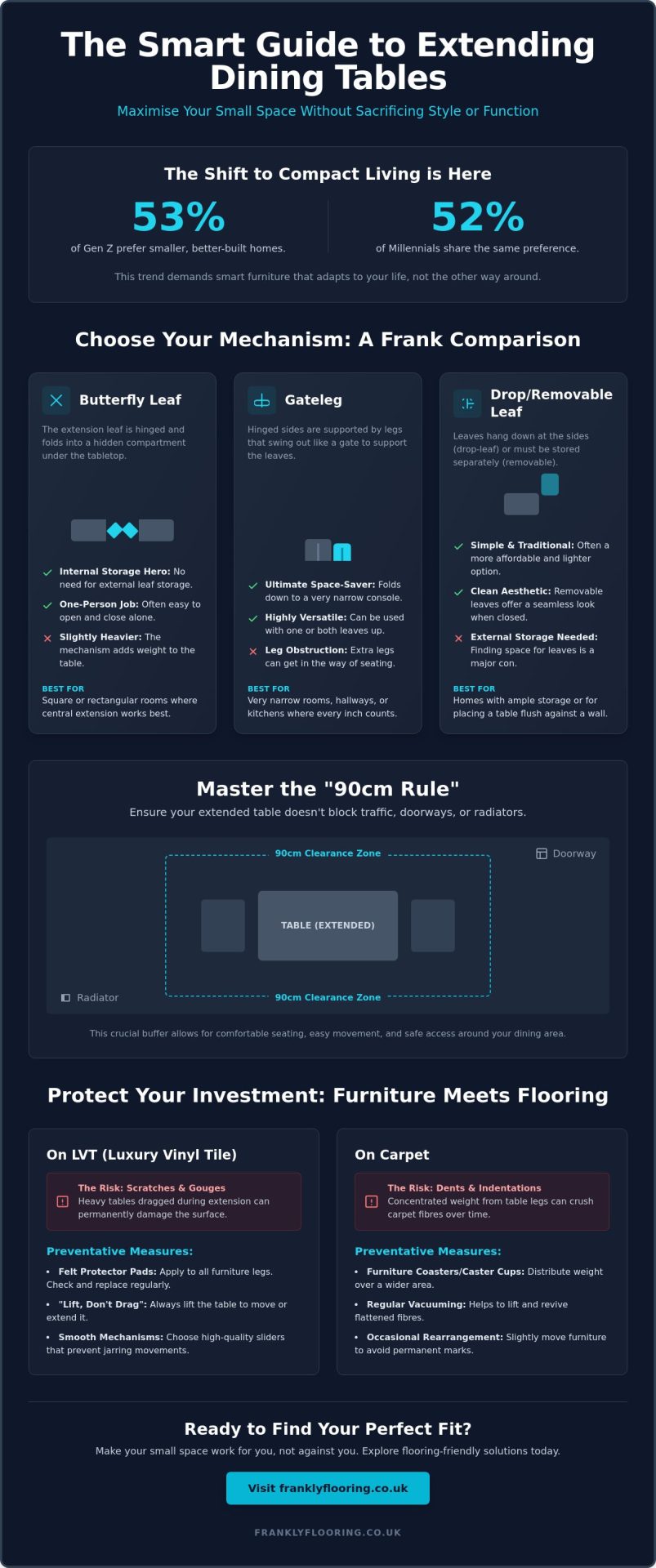
- Master the “90cm Rule” to ensure your extending dining table for small space doesn’t block radiators or doorways when fully extended.
- Identify potential pressure points to prevent furniture legs from scratching LVT or denting carpets during frequent adjustments.
- Understand why internal leaf storage is often superior to external storage for maintaining a clutter-free, functional home.
- Calculate the difference between closed and open footprints to ensure your furniture supports, rather than hinders, daily traffic flow.
The Frank Truth About Small Space Dining in 2026
A fixed, large table might look grand in a showroom, but in a real-world flat or terrace, it becomes a permanent obstacle. By choosing an extendable version, you reclaim your floor space for the 360 days a year you aren’t hosting a banquet. There is a tangible psychological benefit to a clear floor area. When the table is closed, the room feels lighter and less cluttered, which is vital for mental clarity in multi-functional spaces. It’s about making your home work for you, not the other way around.
Daily Use vs. Hosting Reality
We often fall into the trap of buying furniture for the “what if” scenarios. We imagine huge dinner parties that, in reality, happen maybe twice a year. The danger of buying for the exception rather than the everyday rule is that you end up cramped in your own home. Before you commit, assess your daily foot traffic. A compact footprint allows natural light to reach further into the room and makes the space feel larger than it is. If you only need extra seating for Christmas or birthdays, a traditional Gateleg table or a butterfly leaf system offers the perfect compromise without sacrificing your daily comfort.
Materials and Longevity
In 2026, the trend is moving toward sustainable, locally sourced materials that add long-term value to your home. When selecting an extending dining table for small space needs, consider the weight. Solid wood is beautiful and durable, but it’s heavy. This puts significant pressure on your flooring, whether you have carpet or LVT. Veneer options are lighter and often more affordable, but they might not withstand the heat and scratch demands of a table that doubles as a desk. You want a surface that can handle a laptop and a coffee cup just as well as a hot serving dish. Look for high-quality finishes that offer resistance without requiring constant maintenance. Choosing the right material ensures your furniture lasts for years rather than just a few seasons.
Extension Mechanisms Explained: Butterfly, Gateleg, and Drop-Leaf
Choosing an extending dining table for small space living often comes down to the mechanical heart of the furniture. It isn’t just about how the table looks when it’s set for a party; it’s about how much effort it takes to get it there. If a mechanism is clunky or requires two people to operate, you’ll likely never use it. The goal is to find a system that feels like a natural part of your home’s rhythm rather than a chore you dread every time guests arrive.
Butterfly leaves are the internal storage heroes of the furniture world. The extension leaf is hinged and folded into a compartment beneath the tabletop, flipping out like wings when the table is pulled apart. This eliminates the “where do I put this?” problem entirely. For those in truly tight quarters, gateleg tables remain a classic choice. These tables feature hinged sides that are supported by legs that swing out like a gate. They are the ultimate space-savers for hallways or narrow kitchens, often folding down to a mere few inches in width when not in use.
Drop-leaf designs offer a simpler, more traditional approach. Unlike the gateleg, these usually rely on a simple bracket to hold the leaf up. They are perfect for placing flush against a wall, acting as a side table until you need a full dining surface. On the other end of the spectrum are stowaway or “removable” leaves. While these often provide the cleanest aesthetic when the table is closed, they require external storage. The frank truth is that in a small home, finding a safe place to store a large wooden leaf without it getting scratched or warped is a genuine challenge.
To address these storage hurdles, TUSS provides trade-quality bespoke kits that allow professionals to convert the often-overlooked space beneath a staircase into a dedicated storage area for furniture components and household essentials.
Which Mechanism Suits Your Room Shape?
Narrow rooms benefit most from gateleg tables or long rectangular extensions that maintain a clear walkway on either side. If you have a square room, a central butterfly extension that transitions a round table into an oval shape often works best. This maintains a soft flow and prevents the room from feeling blocked. When you are Arranging Furniture in a Small Space, always check if you can operate the mechanism safely on your own. High-quality ball-bearing slides make a world of difference, allowing a single person to extend the table without straining their back or dragging the legs across the floor.
The Frank Comparison: Ease vs. Aesthetics
There is often a trade-off between how a table looks and how it functions. Butterfly tables offer excellent convenience but can be heavier, increasing the pressure on your flooring. Gateleg designs, while incredibly compact, carry a “leg-banger” risk for taller guests who might find their knees hitting the support beams. When you’re browsing for furniture and flooring pairings, look closely at the hinges and moving parts. A high-quality hinge should feel smooth and silent. If the mechanism feels flimsy in the shop, it won’t survive the rigours of a busy, multi-functional home in 2026. Prioritise durability over a flashy design to ensure your investment stands the test of time.
Spatial Planning: Calculating Clearance and Traffic Flow
Measuring for an extending dining table for small space environments requires more than just checking if the piece fits between two walls. You have to account for the human element. If you buy a table based solely on its closed dimensions, you risk creating a bottleneck that makes your living room feel like a storage unit whenever guests arrive. For a dining area to remain functional, the industry standard recommends a minimum clearance of 75cm to 90cm between the table edge and the nearest wall or piece of furniture to allow for comfortable chair movement and passage.
Don’t forget to look up and down. Vertical space and visual weight are just as important as floor area. A table with thick, chunky legs and a heavy apron will dominate a small room, making it feel cramped even if the measurements technically work. Choosing a design with tapered legs or a thinner profile can trick the eye into seeing more floor, which helps the room feel airy. Always check that the extended footprint won’t block essential access to radiators or doorways. A table that prevents the front door from opening fully isn’t a furniture choice; it’s a fire hazard.
The Ghost Table Method
One of the most reliable ways to avoid a buying mistake is to use the “Ghost Table” method. Grab a roll of masking tape and mark out the exact dimensions of your chosen table on the floor in both its closed and fully extended states. Leave the tape there for a full day. Walk your usual paths to the kitchen, the sofa, and the balcony. If you find yourself constantly stepping over the tape or squeezing past a “corner,” that table is too big for your room. This simple exercise accounts for chair depth too. Remember, a chair takes up about 45cm to 50cm of space even when someone is tucked in.
Seating Capacity vs. Comfort
We often see tables marketed as “seating six to eight,” but those numbers are usually based on a very tight squeeze. To dine without knocking elbows, every person needs a minimum of 60cm of table width. If you frequently need to maximise seating in a tight spot, consider a pedestal base. Unlike traditional four-legged tables, a central pedestal allows you to slide chairs in at any angle without a leg getting in the way. It’s also worth looking for chairs that tuck fully under the table frame. This keeps your walkways clear when the meal is over, maintaining that vital sense of flow in a multi-functional home.
Furniture Meets Flooring: Protecting Your Surfaces
Selecting an extending dining table for small space living is a smart move for versatility, but it changes how your furniture interacts with your floor. Most buyers forget that an extending table is a dynamic object. When closed, the weight is concentrated in a smaller footprint. When fully open, the distribution of that weight shifts significantly. This shift can create new pressure points that your flooring wasn’t necessarily prepared for. On LVT or vinyl, this often manifests as “point loading” where the legs leave subtle depressions over time.
If you have carpet, the risk is permanent crushing. Deep-pile or Berber floors are especially susceptible to indentations that won’t simply “bounce back” once the table is moved. For wood floors, the issue is often abrasive. Small amounts of household grit can get trapped under the table legs. Every time you pull the table apart to insert a leaf, you risk grinding that grit into your floor’s protective seal. It’s a slow process of damage that’s easily avoided with the right preparation.
Choosing the Right Floor Protectors
The solution depends entirely on your surface. For hard floors like LVT or wood, heavy-duty felt pads are the standard. They allow for slight movements without scratching. However, if you have laminate flooring, you should never drag the table during extension. Even with protectors, the lateral force can stress the locking joints of the floor planks. Castor cups are better for carpets as they spread the weight over a larger area, preventing deep crushing. Adding a high-quality rug can also create a protective zone that handles the brunt of chair scuffs and table movement.
Load Distribution and Stability
Stability is the secret to a long-lasting extension mechanism. If your floor is slightly uneven, the frame of the table will twist when extended, putting undue stress on hinges and slides. Use adjustable levelling feet to ensure the table sits perfectly flat. For heavy solid wood pieces, look for designs with larger feet to distribute the load more effectively. If you plan on moving the table frequently to accommodate guests, we suggest using furniture sliders during the transition. These temporary tools allow you to reposition heavy items without risking a slipped disc or a ruined floor finish.
Protecting your home’s foundation is just as important as choosing the right table. You can explore our full range of durable flooring and furniture accessories to find the perfect match for your space.
Buying Guide: Choosing Your Perfect Table in 2026
Making the final decision on an extending dining table for small space living requires a level head and a sharp eye for detail. It’s easy to get caught up in the aesthetics of a showroom photo, but the reality of a small flat or terrace is far less forgiving. Before you click “buy” on an online store, run through your final checklist. Does the table meet the 90cm clearance rule we discussed earlier? Is the extension mechanism smooth enough for one person to operate? If the answer is no, you’ll likely find the table stays in its closed state, defeating the purpose of the investment.
Pay close attention to where the extension leaves actually go. Internal storage, like the butterfly mechanism, is almost always the superior choice for compact homes. If you choose a table with external stowaway leaves, you must have a dedicated, dry place to store them. Leaning a heavy wooden leaf against a radiator or in a damp cupboard will lead to warping and mismatched surface levels. Always verify the quality of the slides and hinges. High-quality ball-bearing runners and steel hinges are the hallmarks of a piece that will survive daily use. A frank assessment of the warranty is also vital; look for brands that offer specific coverage for the moving parts of the extension system.
Buying from a family-run UK business often provides a layer of security that large, faceless corporations cannot match. When you have a technical question about a hinge or need advice on floor compatibility, speaking to someone who actually understands the craftsmanship makes a world of difference. It ensures better after-sales support and a more personal, advisory relationship that values your long-term satisfaction over a quick sale.
Style Trends for Small UK Homes
In 2026, the trend for Scandi-Industrial remains strong. This style pairs light-toned woods with slim metal frames, creating a piece that feels structurally sound but visually light. Similarly, mid-century modern designs with tapered legs are excellent for small rooms as they expose more of your flooring, which naturally makes the space feel larger. The key is to choose a finish that complements your existing decor without overwhelming it. A table that blends into the room’s colour palette will always feel less intrusive than a dark, heavy statement piece.
Final Considerations for the Smart Buyer
Don’t overlook the logistics of delivery and assembly. Many extending tables arrive in large, heavy boxes that may not navigate tight stairwells or narrow flat doors easily. Check the box dimensions against your entry points before ordering. Additionally, be realistic about assembly. While many modern designs are straightforward, a complex butterfly mechanism might require two people and a specific set of tools to set up safely. If you aren’t confident in your DIY skills, it’s worth checking if a professional assembly service is available.
Ready to upgrade your home? Explore our Frank collection of furniture and flooring at Frankly Flooring to find the perfect balance of style, space, and durability.
Creating a Dining Space That Truly Works
Finding the right extending dining table for small space living isn’t about making compromises; it’s about being honest with your room’s layout and your daily habits. By prioritising smooth extension mechanisms like the butterfly leaf and respecting the 90cm clearance rule, you can transform a cramped corner into a functional social hub. Preserving your flooring with the correct protectors ensures that your furniture remains an asset rather than a liability to your home’s value.
We believe in providing the kind of straight-talking advice you’d expect from a family-run business with over 20 years of experience. Our goal is to help you make informed decisions that bring lasting satisfaction to your home. With national UK delivery on all our furniture and flooring, we’re ready to help you complete your project from floor to tabletop. Explore our Frank collection of furniture and flooring at Frankly Flooring today. Your perfect dining setup is just a few measurements away.
Frequently Asked Questions
Is a round or rectangular extending table better for a small space?
Round tables are generally superior for square rooms or tight corners because their lack of sharp edges improves natural traffic flow. They allow you to squeeze in an extra guest more easily than a rectangular alternative. However, if your room is narrow, a rectangular table might be better as it can sit flush against a wall when it isn’t extended, reclaiming vital floor area for daily use.
How do I protect my LVT flooring from heavy dining table legs?
The most effective way to protect LVT is to use heavy duty felt pads or wide castor cups that distribute the weight across a larger surface area. Since an extending dining table for small space needs often carries extra weight from internal mechanisms, point loading can cause subtle depressions in vinyl. Ensure the pads are kept clean, as trapped grit can act like sandpaper when the table is moved.
Where do I store the extra leaves if the table doesn’t have internal storage?
Extra leaves should always be stored flat in a dry, temperature controlled environment like under a bed or at the bottom of a wardrobe. Never lean them against a radiator or store them in a damp garage, as the wood will warp or the finish may crack. Keeping them in a protective fabric sleeve prevents accidental scratches while they aren’t in use on the table frame.
Can I use an extending dining table on a deep-pile carpet?
Yes, you can, but you must be prepared for deep indentations where the legs sit. Using wide, clear plastic castor cups helps spread the heavy load and prevents the furniture from “sinking” too far into the pile. Because an extending dining table for small space living is frequently adjusted, the shifting weight can permanently crush carpet fibres if they aren’t protected by a firm base or a rug.
What is the best table mechanism for someone living alone?
A butterfly leaf with a synchronised opening system is the best choice for solo operation. This mechanism allows you to pull one end of the table while the other end slides open automatically, revealing the stored leaf. It eliminates the need for a second person to help lift heavy components or steady the frame, making the transition from a four seater to a six seater a simple, one person job.
How much space do I really need around a dining table?
You need a minimum clearance of 75cm to 90cm between the table edge and the nearest wall or furniture piece. This gap is essential for pulling chairs out and allowing guests to walk behind those who are already seated. If you have less than 75cm, the room will feel restricted and guest movement will be difficult, which often leads to scuffed walls and frustrated diners.
Are butterfly leaves better than drop-leaf tables?
Butterfly leaves offer a more polished look because the extension is hidden inside the table, whereas drop-leaf wings hang visibly at the sides. Butterfly mechanisms provide a more stable, level dining surface for larger groups. However, drop-leaf tables are often more affordable and can be used as slim console tables against a wall, making them a very practical choice for extremely narrow kitchens or hallways.
How do I stop my extending table from wobbling on a wood floor?
Most wood floors aren’t perfectly level, so you should use adjustable levelling feet to compensate for uneven planks. If your table doesn’t have these, you can apply felt pads of varying thicknesses to the bottom of the legs until the wobble stops. A stable table is vital for an extending piece, as any rocking puts unnecessary stress on the hinges and slides, which can lead to mechanical failure over time.