
The success of your new floor is decided long before the first plank clicks into place. Most DIY disasters don’t happen because of a lack of effort; they happen because someone started the job with the wrong toolkit and a subfloor that wasn’t ready. If you’re asking what do you need to install laminate flooring, you’re already ahead of the curve. It’s completely natural to feel anxious about wasting money on unnecessary gadgets or, worse, ruining expensive materials because you skipped a vital preparation step.
At Frank, we believe in being upfront about the technical side of craftsmanship. You deserve a floor that doesn’t creak, gap, or buckle under pressure. This guide provides a no-nonsense checklist of every tool and material required to meet the 2026 NALFA performance standards. We’ll walk you through the essential shopping list, from moisture barriers to the specific 3/16 inch subfloor tolerances, giving you the confidence to complete a professional-grade installation from start to finish.
- Identify the essential “Big Three” tools, including the tapping block, pull bar, and spacers, to understand exactly what do you need to install laminate flooring for a secure, gap-free fit. Having the right kit prevents damage to the delicate tongue and groove joints.
- Learn why the 48-hour acclimatisation period and the “3mm rule” for subfloor leveling are the most critical steps. Being frank about preparation now prevents expensive buckling or creaking later.
- Discover how to choose the correct underlay and when a Damp Proof Membrane is non-negotiable to protect your floor from moisture. This layer is vital for both sound reduction and long-term durability.
- Master the technical requirements for 10mm expansion gaps and choose the right finishing trims to give your project a professional look. These gaps allow your floor to breathe as temperatures change.
- Avoid common DIY pitfalls like “H-joints” by learning the correct way to stagger boards for a floor that remains stable. Proper board placement ensures your floor looks authentic and stays structurally sound.
The Essential Laminate Installation Toolkit
Starting a flooring project without the right gear is a recipe for frustration. While it is tempting to think a hammer and a saw are enough, Laminate flooring requires a specific set of tools to ensure the interlocking joints stay intact. When you are figuring out what do you need to install laminate flooring, you should prioritise precision over power. A few specialized items will make the difference between a floor that stays flat and one that starts to separate within months.
The Fitting Kit: Why You Can’t Skip It
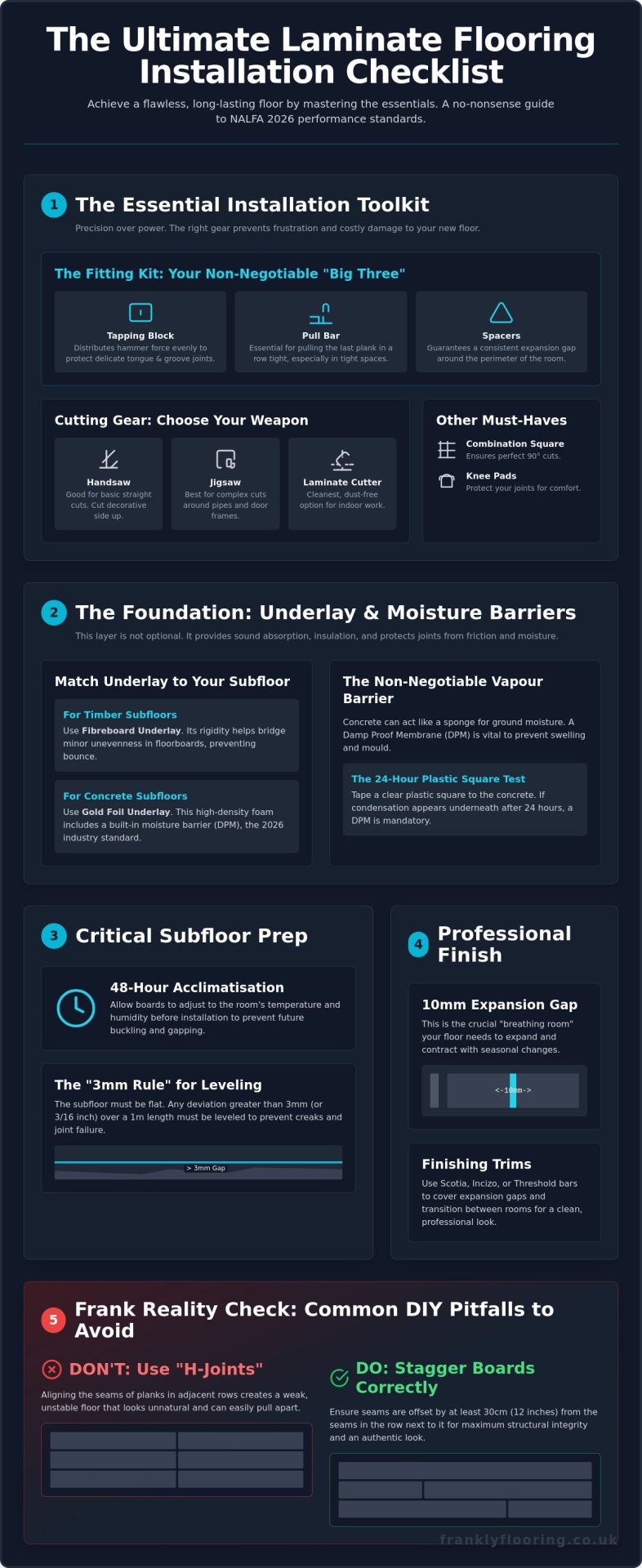
The “Big Three” of any installation are the tapping block, the pull bar, and the spacers. A tapping block is designed to sit against the edge of a plank, distributing the force of your hammer blow evenly. This prevents you from crushing the delicate tongue and groove system. Never use a hammer directly on the laminate; you will almost certainly chip the finish or deform the joint.
The pull bar is your best friend when you reach the end of a row. It allows you to hook the far edge of a plank and pull it into the previous one, which is essential in tight spaces where there is no room to swing a hammer. For the perimeter, use plastic spacers. While some suggest using offcuts of wood, these can slip or compress. Uniform spacers guarantee a consistent expansion gap, which is the “breathing room” your floor needs to survive seasonal changes.
Cutting Gear: Choosing Your Weapon
Your choice of cutting tool depends on your workspace and your confidence level. For basic straight cuts, a fine-toothed handsaw works well if you cut with the decorative side facing up to prevent splintering. If you need to navigate around radiator pipes or curved door frames, a jigsaw is indispensable for its maneuverability. A dedicated laminate cutter is a manual, guillotine-style tool that provides the cleanest, dust-free option for indoor work, allowing you to make cuts right in the room where you are working without creating a mess.
Don’t overlook the humble combination square. It beats a standard ruler because it locks at a perfect 90-degree angle, ensuring your end-cuts are square. If your cut is even slightly diagonal, you’ll struggle to get a tight fit in the next row. Finally, invest in a pair of professional-grade knee pads. You will spend hours on your knees, and the discomfort of a hard floor can lead to rushed work and mistakes. Protecting your joints is just as important as protecting the boards.
Choosing the Right Underlay and Moisture Barriers
Skipping underlay is the fastest way to ruin a high-quality floor. While the planks provide the visual appeal, the underlay does the heavy lifting. It absorbs sound, provides thermal insulation, and acts as a shock absorber for the click-joint system. When you are considering what do you need to install laminate flooring, don’t treat this layer as an optional extra. Without it, the friction between the boards and the subfloor will eventually lead to squeaks and failed joints.
Matching Underlay to Your Subfloor
Subfloor type dictates your choice. If you are dealing with slightly uneven timber floorboards, fibreboard is the superior choice. It offers more structural rigidity than standard foam and can bridge minor deviations that would otherwise cause the floor to bounce. For concrete subfloors, gold foil underlay has become the 2026 industry standard. It combines high-density foam with a built-in moisture barrier. Our laminate flooring works best with high-density underlay to prevent the boards from flexing too much under the weight of heavy furniture.
The Role of the Vapour Barrier
Concrete might feel dry to the touch, but it often acts like a sponge for ground moisture. Without a Damp Proof Membrane (DPM) or a vapour barrier, that moisture will rise and cause your laminate to swell or mould. You can test your floor using a simple DIY trick: tape a square of clear plastic to the subfloor for 24 hours. If condensation appears under the plastic, you have a moisture issue that requires a dedicated DPM. This is a vital part of any step-by-step installation guide. Once laid, you must use specific underlay tape to seal the seams. Standard masking tape won’t hold; you need a moisture-resistant seal to keep the barrier intact.
If you have underfloor heating, you must check the thermal resistance, known as the TOG rating. A rating that is too high will block heat from reaching the room, making your heating system inefficient. Some modern boards come with integrated underlay, which saves time during fitting. However, if your subfloor is concrete, you might still need a separate vapour barrier underneath that pre-attached backing. It’s about getting the right combination for your specific room. You can find the right materials for your project by checking out our current flooring deals.
Understanding what do you need to install laminate flooring means looking beyond the surface. Taking the time to select a high-quality underlay ensures your floor remains quiet, warm, and stable for years to come. It’s a small investment that protects the long-term character of your home.
Subfloor Prep: The Patience Checklist
A common mistake is rushing to lay the first row. Many DIY projects fail because the installer ignored the ground beneath their feet. When you’re asking what do you need to install laminate flooring, the most important “tool” is actually your own patience. A successful installation is 70% preparation. If you skip the prep, your floor will likely creak, gap, or bounce, regardless of how much you spent on the materials.
Start by clearing the room entirely. You might see advice online suggesting you can lay laminate over old carpet or thick vinyl to save time. This is dangerous advice. Carpet is a soft material that allows too much vertical movement. This movement puts immense pressure on the click-joints, eventually causing them to snap. Strip it back to the base. Once the subfloor is exposed, clean it thoroughly. Vacuuming is better than sweeping, as it removes the fine dust that can interfere with underlay stability. If you’re working on a concrete base, a simple primer can help seal the surface and prevent dust from rising later.
Levelling the Ground
You’ll need a long spirit level, ideally 2 metres in length. Place it across various points of the room to check for the “3mm rule.” This industry standard dictates that the floor shouldn’t deviate by more than 3mm over a 2-metre span. If you find deep hollows in a concrete floor, you’ll need a self-levelling compound to create a flat plane. For wooden subfloors, you might need to sand down high spots or screw down loose boards that cause a “peak.” Consult a suitable subfloor guide to ensure your specific base meets the requirements. The Frank reality is simple: if the subfloor isn’t flat, the laminate will fail.
The Acclimatisation Process
Laminate is a wood-based product. It reacts to the temperature and humidity of its environment. If you take boards from a cold warehouse and install them immediately in a warm living room, they’ll expand. This leads to buckling and “peaking” at the seams. You must leave the unopened boxes in the room for at least 48 hours. Stack them flat on the floor, spaced out to allow air circulation. Don’t lean them against walls, as this can cause the boards to bow before they’re even laid. Skipping acclimatisation is the leading cause of floor buckling in DIY projects.
The Professional Finish: Trims, Scotia, and Thresholds
The difference between a floor that looks DIY and one that looks professional is found at the edges. While the main body of the room is about speed and rhythm, the perimeter requires precision and the right finishing components. When you are finalising what do you need to install laminate flooring, your shopping list must include more than just the boards. Without the correct trims and thresholds, your floor will look unfinished and, more importantly, it won’t be protected from structural movement.
Managing the Expansion Gap
Laminate is a floating floor, meaning it isn’t glued or nailed to the subfloor. It needs a 10mm expansion gap around the entire perimeter to breathe. If you pin the floor against a wall, it will eventually buckle when the humidity rises. To hide this gap, you have two main choices: removing your skirting boards and refitting them over the laminate, or using scotia beads. Scotia is a small concave moulding that sits at the base of your existing skirting.
The golden rule is never to fix scotia to the flooring itself. It must be nailed or glued to the skirting board so the floor can slide underneath it as it expands. Using carpet gripper knowledge helps here; just as carpet needs a specific anchor point, laminate needs a specific clearance. For the best results, use mitre shears or a mitre box to ensure your corner joints are tight and professional. Gaps in your scotia are a tell-tale sign of a rushed job.
Thresholds and Door Bars
Transitions between rooms are where most people get stuck. You need different door bars depending on what the laminate is meeting. Use a T-bar if you are transitioning to another hard floor at the same height. If the laminate is meeting a lower carpet, you will likely need a Z-bar or a reducer. Matching the finish of these bars to your door handles or your laminate creates a cohesive look that feels intentional rather than accidental.
Don’t make the mistake of cutting the laminate board to fit around a complicated door frame. Professional installers always undercut the door frame instead. Use a scrap piece of laminate and a piece of underlay as a height guide, then use a flush-cut saw to trim the bottom of the frame. This allows the board to slide neatly underneath, hiding the expansion gap and providing a much cleaner finish than messy silicone or caulk. For all the finishing touches, check out our flooring accessories to find the perfect match for your boards.
Finally, remember the radiator pipes. Small details like radiator pipe covers, or “roses,” hide the necessary expansion holes you’ve drilled around the pipes. They are inexpensive and snap into place in seconds, but they provide that final layer of polish that makes the whole project feel complete. Precision at the finish line is what ensures your hard work stands the test of time.
Frank Reality Check: Common DIY Pitfalls to Avoid
Even with the perfect kit, the way you assemble the floor determines its lifespan. By now, you should have a clear answer to what do you need to install laminate flooring, but having the tools is only half the battle. The final hurdle is the layout itself. Many beginners rush the first three rows, only to realize later that they’ve created a structural weakness or a visual eyesore. Precision during the laying phase is what separates a professional-looking room from a messy DIY attempt.
One of the most frequent errors is the “H-joint.” This happens when the end joints of every other row line up perfectly, creating an “H” pattern across the floor. This isn’t just a matter of taste; it creates a line of weakness where the boards can more easily pull apart under foot traffic. You must stagger your board ends by at least 30cm to maintain structural integrity. Similarly, avoid “stair-stepping,” where the joints move across the floor in a predictable, diagonal line. A truly random, staggered layout is much stronger and looks far more natural to the eye.
Direction matters just as much as the layout. Generally, you should run the length of the boards towards the primary light source in the room, such as a large window or glass door. This helps to hide the seams and gives the room a sense of depth. If you run them across the light, every tiny variation in height or texture will cast a subtle shadow, making the joints far more obvious than they need to be.
Staggering and Layout
Before you click the first board, calculate the width of your final row. If you find that your last row will be less than 5cm wide, you’ll struggle to lock it into place, and it will likely pop out over time. The solution is to “rip” your first row lengthwise so that both the first and last rows are of a similar, healthy width. These principles of balance and structural integrity are similar to those found in our engineered wood flooring guide, where layout planning is equally vital for a premium finish.
The “Frank” Final Word
Let’s be frank about the process. If you want a floor that lasts, there are a few non-negotiable rules to follow during your final inspection:
- Check every joint for debris before clicking; even a tiny wood chip can prevent a flush fit.
- Ensure the tongue and groove direction is consistent; usually, the tongue faces the starting wall.
- Verify that the expansion gap remains clear of spacers and debris before fixing your scotia.
- Never force a joint with a hammer; if it won’t click, the angle or the alignment is wrong.
Quality tools and materials are an investment in your home’s character, not an unnecessary expense. Take your time. Precision beats speed every time in flooring. A floor laid with care in 2026 will still look and feel foundational a decade from now. Once the last board is in and the trims are fixed, do a final walk-through. Check for any “bounce” or gaps before you move the furniture back in. If you’ve followed the checklist, you’ve built something that will stand the test of time.
Getting Your Project Off the Ground
Installing a new floor is a rewarding home improvement project when you respect the technical requirements of the material. We’ve covered the essential toolkit, the absolute necessity of a level subfloor, and why you must never skip the 48-hour acclimatisation period. Getting a clear handle on what do you need to install laminate flooring before you start is the most effective way to avoid common pitfalls like buckling or joint failure. Precision in the planning stage ensures a result that looks professional and stays stable for years.
As a family-run UK business with over 20 years of experience, we pride ourselves on providing transparent, expert advice alongside our extensive product range. We offer national delivery on all our flooring and tools, ensuring you have every component required for a stress-free installation. Browse our full range of Laminate Flooring and Accessories today to find the perfect foundation for your home’s character. With the right equipment and a steady pace, you’re more than ready to transform your space with confidence.
Frequently Asked Questions
Do I really need underlay for laminate flooring?
Yes, underlay is a non-negotiable requirement for a successful installation. It provides a vital cushion that prevents the boards from grinding against the subfloor, which reduces noise and wear. Additionally, it helps to level out minor imperfections in the base. If you are wondering what do you need to install laminate flooring that lasts, a high-quality underlay is at the top of the list.
Can I install laminate flooring over carpet?
You should never install laminate over carpet. Carpet is far too flexible, and the constant vertical movement underfoot will place immense stress on the interlocking joints. Over time, these joints will snap or separate. For a stable result, always strip the floor back to a solid, level subfloor like concrete or plywood before you begin your project.
How long should laminate flooring acclimate before installation?
Laminate boards require a minimum of 48 hours to acclimate to their new environment. During this time, keep the boxes unopened and laid flat in the room where they will be installed. This process ensures the wood-based core reaches the same temperature and humidity level as the room. Skipping this step is the most common reason for floors buckling or gapping shortly after fitting.
What is the best saw for cutting laminate flooring?
A jigsaw with a downward-cutting blade is generally the best all-around tool for DIYers. It allows you to make straight cuts and navigate complex shapes like radiator pipes or door frames easily. If you want to avoid the mess of sawdust indoors, a manual laminate cutter is an excellent alternative. It works like a guillotine to provide clean, silent cuts without creating any airborne dust.
How big should the expansion gap be for laminate?
An expansion gap of 10mm should be maintained around the entire perimeter of the room. This includes areas around door frames, pipes, and fixed cabinetry. Laminate is a natural product that expands and contracts with seasonal changes in humidity. Without this gap, the floor will have nowhere to go when it expands, which leads to the boards lifting or “peaking” in the centre of the room.
Do I need a professional to install my laminate floor?
Professional installation isn’t strictly necessary for a standard room, as laminate is designed for DIY fitting. However, you do need a steady hand and a commitment to following the technical instructions precisely. If your room has many complex angles or you’re unsure about what do you need to install laminate flooring correctly, taking your time and following a guide will help you avoid costly mistakes.
Can I use a regular hammer for laminate installation?
You can use a regular hammer, but it must only be used in conjunction with a tapping block. Striking the edge of a laminate plank directly with a metal hammer will instantly crush the tongue or groove. This damage makes it impossible to achieve a tight fit with the next board. A rubber mallet is a safer alternative, but a tapping block remains the industry standard for precision.
What happens if I don’t use a damp proof membrane on concrete?
Omitting a damp proof membrane (DPM) on a concrete subfloor allows ground moisture to seep into the boards. Since laminate is made from fibreboard, it acts like a sponge, absorbing this moisture and swelling. This leads to permanent structural damage, including warped boards and the growth of mould. A DPM is a cheap and vital insurance policy for any concrete-based project.