
Most homeowners believe that Luxury Vinyl Tile is simply a posh name for the same roll of vinyl their grandparents had in their kitchens. In reality, the debate of sheet vinyl vs lvt is actually about the difference between a floor that survives a decade of family life and one that might fail after its first major leak. You’re likely feeling the pressure of making the right choice while trying to decipher the confusing jargon around lino, vinyl, and LVT. It’s perfectly normal to worry about whether a cheaper roll will bubble in your damp bathroom or if the cost of professional installation will blow your entire renovation budget.
This guide provides a transparent look at these materials to help you decide which one truly suits your home and your wallet. We’ve spent 20 years at Frankly Flooring giving homeowners the straight facts without the high-pressure sales tactics. You’ll discover the honest truth about total project costs, including often-overlooked extras like adhesive and underlay. We will examine the technical differences in wear layers and explain why a modular tile system offers a significantly lower long-term replacement risk than a single sheet of vinyl.
Key Takeaways
- Understand the technical differences between modern roll-based materials and modular tile systems to avoid common “lino” misconceptions.
- Compare the durability of sheet vinyl vs lvt to determine which surface best survives the impact of heavy appliances and household pets.
- Identify the true cost of your project by factoring in essential subfloor preparation and accessories like screed and underlay.
- Learn why your choice of room dictates the material, focusing on hygiene, seam placement, and slip resistance in high-moisture areas.
- Discover the critical role of subfloor moisture levels in ensuring your new floor lasts for its full ten-year-plus lifespan without bubbling.
Decoding the Jargon: What Exactly is Sheet Vinyl vs. LVT?
Let’s be frank about the word “lino”. Most homeowners use it as a catch-all term for any plastic-like flooring, but true linoleum is a natural product made from linseed oil and wood flour. It is rarely what you are actually looking for in a modern UK kitchen or bathroom. When we discuss sheet vinyl vs lvt, we are actually comparing two very different ways of using polyvinyl chloride (PVC) to protect your subfloor and enhance your home’s character.
Sheet vinyl is a continuous roll of flooring, typically sold in widths of two, three, or four metres. It’s designed for speed and budget-conscious projects. Because it arrives as one large piece, it provides a seamless finish that is excellent for moisture resistance. Luxury Vinyl Tile (LVT), on the other hand, is a modular system. You receive individual planks or tiles that are fitted one by one. This format allows for much higher levels of detail and structural integrity than a standard roll can provide.
The “Luxury” in LVT is not just a marketing buzzword used to hike up the price. It refers to a specific manufacturing process that creates a much denser, more durable product. While sheet vinyl is often soft and pliable, LVT is rigid and designed to withstand the heavy traffic of a busy family home without indentation. If you want to dive deeper into the technical composition, you can read more about What is LVT and how it differs from older tile formats.
Construction: Layers, Wear Layers, and Core Materials
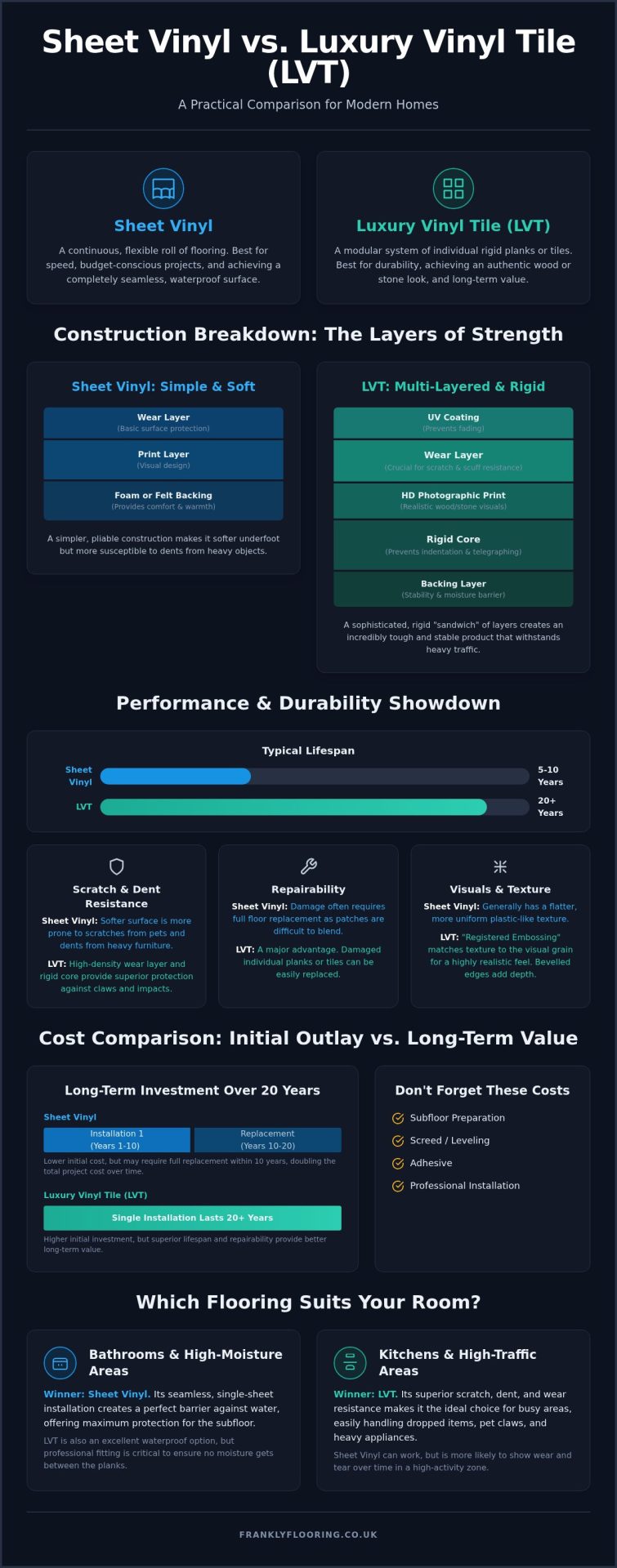
A standard LVT plank is a sophisticated sandwich of usually five layers. At the base is a backing layer for stability, followed by a rigid core, a high-definition photographic print, a clear wear layer, and a top UV coating. This multi-layered approach makes it incredibly tough. Sheet vinyl is simpler; it usually consists of a single vinyl layer with a foam or felt backing. While the foam makes it softer underfoot, it lacks the rigid core that prevents LVT from telegraphing every minor imperfection in your subfloor. The wear layer is the most critical component. It’s the transparent shield that prevents your furniture or pets from scratching through the pattern.
Visuals and Texture: The ‘Real Feel’ Factor
The visual gap in the sheet vinyl vs lvt debate has narrowed, but LVT still holds the crown for authenticity. High-end LVT uses “registered embossed” textures. This means the physical grain you feel under your feet perfectly matches the wood grain you see in the print. Sheet vinyl usually has a flatter, more uniform texture that feels like plastic. LVT also features bevelled edges. These small V-grooves between planks mimic the natural gaps found in real timber or stone. Sheet vinyl is entirely flat, which often results in a less convincing finish in larger rooms.
Performance and Durability: Which Floor Stands Up to Real Life?
When you’re deciding between sheet vinyl vs lvt, durability isn’t just a marketing claim. It is the difference between a floor that looks tired after five years and one that stays pristine for twenty. Both materials are technically waterproof, but they handle moisture differently. Sheet vinyl acts like a continuous skin over your room. It’s excellent for bathrooms because there are no gaps for water to seep through. However, LVT is often more robust against standing water. While the tiles themselves won’t swell, an amateur installation can allow moisture to reach the adhesive underneath. We always recommend following UK Flooring Industry Standards to ensure your subfloor remains dry and protected.
Scratch resistance is where the two diverge sharply. If you have a family dog, LVT is almost always the superior choice. Its high-density wear layer is designed to shrug off claws and heavy foot traffic. Sheet vinyl is softer. This makes it much more comfortable underfoot, providing a cushioned feel that’s warmer on cold British mornings; however, that softness comes at a price. Heavy furniture can leave permanent indentations in sheet vinyl, whereas LVT remains rigid and stable. In terms of lifespan, a quality sheet vinyl might give you 5 to 10 years of service. A premium LVT floor can easily last 20 years or more if maintained correctly.
The Repairability Advantage: Individual Planks vs. Full Sheets
Accidents happen. You might drop a heavy kitchen knife or accidentally scorch the floor with a fallen hair straightener. If this happens to sheet vinyl, you’re usually looking at a full floor replacement because patches are notoriously difficult to hide. With LVT, the modular nature is a lifesaver. You can heat the adhesive, lift the damaged plank, and click or glue a new one into place in about 15 minutes. It’s a simple fix that saves you hundreds of pounds in the long run. If you’re worried about future mishaps, browsing our LVT collection for a style you love is a smart insurance policy.
Heat and Sunlight: Expansion, Contraction, and Fading
UK homes with south-facing bifold doors or conservatories face unique challenges. Standard vinyl can expand and bubble when hit by direct midday sun. Modern LVT often includes UV inhibitors and rigid stone-polymer cores to prevent this warping. While advanced sheet vinyl now uses glass fibre reinforcement to improve stability, it still lacks the structural “backbone” of a tile. For rooms with extreme temperature swings, LVT provides the peace of mind that your floor won’t start lifting at the edges when the sun comes out.
The Installation Reality: DIY Ease vs. Professional Finish
The most common reason for a new floor failing isn’t the material itself; it’s the surface underneath. Whether you’re weighing up sheet vinyl vs lvt, your subfloor must be flat, dry, and clean. If your floor has a moisture level above 75% relative humidity, you’re inviting disaster. For LVT especially, any slight bump in the concrete or floorboards will eventually cause the click joints to snap or the glue to fail. Subfloor preparation is required in approximately 40% of UK homes, often involving a latex screed or plywood overlay to create a glass-smooth finish. Don’t skip this. A bad subfloor makes even the most expensive LVT look like a cheap mistake.
Acclimatisation is another non-negotiable step. You must leave your new flooring in the room where it will be fitted for at least 24 to 48 hours. This allows the material to adjust to the local temperature and humidity. Rushing this process is why floors buckle in the summer or develop gaps in the winter. You’ll need a specific set of tools from our accessories range, including a heavy-duty utility knife, a professional straight edge, and a rubber mallet for click systems. Having the right kit turns a frustrating weekend into a successful project.
Fitting Sheet Vinyl: The Art of the Single Cut
Many homeowners assume sheet vinyl is the “easy” DIY option, but it’s actually quite unforgiving. You have one chance to get the cut right. We recommend the “oversize and trim” method: bring the sheet into the room with 50mm to 100mm of excess climbing up the walls. You then carefully trim back to the skirting boards. Cutting around a toilet pedestal or a complex door frame with a single sheet of vinyl requires a steady hand and a lot of patience. In rooms under 12 square metres, you can often loose-lay the floor, but larger spaces will require a spray adhesive or a full spread of glue to prevent the material from shifting or bubbling over time.
Fitting LVT: Patience Pays Off
LVT is generally more DIY-friendly because it’s modular. If you miscut a plank, you’ve only lost a small piece of material, not the entire floor. Click LVT has become the ultimate choice for a DIY herringbone flooring project, allowing you to achieve a high-end look without the complexity of traditional wood fitting. The secret to a professional finish is “setting out”. You must find the centre line of your room and work outwards to ensure you don’t end up with a tiny, awkward sliver of tile at one wall. Always leave a 5mm to 10mm expansion gap around the perimeter. This gap is hidden by your skirting boards or a matching scotia trim, allowing the floor to breathe as temperatures change.
Cost Comparison: Initial Outlay vs. Long-Term Value
When you’re comparing sheet vinyl vs lvt, looking at the price per square metre is only half the story. You’ll often find that sheet vinyl has a lower entry price, but the way it’s sold can lead to significant hidden waste. Because it arrives in fixed roll widths of two, three, or four metres, a room that is slightly wider than the roll forces you to pay for material you’ll simply cut off and discard. LVT is modular and sold in packs. You only need to order the actual area of your room plus a standard 10% buffer for cuts, which often narrows the price gap before you’ve even opened a tin of adhesive.
Hidden costs are another factor that can catch out the unprepared. While you won’t need a carpet gripper for these hard floors, LVT usually requires a specific high-density underlay or a professional-grade pressure-sensitive adhesive. If your subfloor is uneven, a latex screed is a mandatory expense to prevent the floor from failing. These extras ensure your investment lasts, but they must be included in your initial budget to avoid surprises halfway through the renovation.
The ‘Total Project’ Budget Framework
Take a standard 12m2 kitchen as an example. Industry data suggests professional fitting for vinyl can range from £8 to £18 per m2, while LVT installation can reach £30 per m2 for complex layouts. When you factor in a waste removal fee of approximately £120 and the cost of subfloor preparation, the initial outlay for LVT is certainly higher. However, we always encourage looking at the “cost per year”. A budget sheet vinyl might need replacing in seven years, whereas a premium LVT floor can easily last twenty. Over two decades, the LVT is actually the cheaper product. It also carries more weight with estate agents, as LVT is perceived as a permanent, premium fixture that adds genuine value to a property.
When to Save and When to Splurge
We always tell our customers to be realistic about how a room is used. In a utility room or a small downstairs cloakroom where foot traffic is low and the floor area is tiny, sheet vinyl is a sensible, cost-effective choice. It’s waterproof and easy to clean. For high-traffic spots like hallways or open-plan living areas, investing in lvt flooring is the smarter move. It survives the daily grind of boots, pets, and heavy furniture much better than a thinner sheet. Balancing your budget means spending where the durability is needed most. To ensure your new floor stays in place for years to come, make sure to pick up the correct adhesives and accessories for your specific material choice.
Making the Choice: Which Flooring Suits Your Specific Room?
Selecting the right material in the sheet vinyl vs lvt debate often comes down to the specific environment of the room. A floor that performs brilliantly in a spare bedroom might fail miserably in a high-traffic hallway or a moisture-heavy bathroom. You need to consider the “threats” each room poses. In kitchens, the primary concerns are heavy appliances like washing machines and the occasional dropped heavy pot. In bathrooms, it’s standing water and hygiene. Hallways, meanwhile, face a constant barrage of abrasive grit from outdoor shoes that can act like sandpaper on a low-quality finish.
The Frankly Flooring verdict is simple: don’t over-engineer a room that doesn’t need it, but don’t cut corners where durability is essential. If you are looking for a floor that will survive a decade of family life, look at the specific demands of your space before you commit to a purchase. We’ve spent 20 years helping UK homeowners make these calls, and the most successful projects are always the ones where the material matches the lifestyle.
Room-by-Room Cheat Sheet
- Bathrooms: Sheet vinyl remains the “hygiene king” for small bathrooms and en-suites. Because it is a single, seamless sheet, there are no joints where water can seep through to the subfloor or where mould can begin to grow. If your bathroom is a high-splash zone, the seamless nature of roll vinyl provides superior peace of mind.
- Kitchens and Hallways: LVT is the clear winner here. Its rigid construction handles the weight of heavy appliances without the risk of tearing or permanent indentation. For hallways, the thicker wear layer of a premium LVT tile resists the scuffing and scratching caused by grit and pets.
- Living and Dining Areas: If you want to elevate the look of an open-plan space, LVT offers a level of realism that sheet vinyl cannot match. The individual planks allow for sophisticated layouts like herringbone. It also provides a high-end foundation to complement your furniture, creating a cohesive and intentional interior design.
Final Checklist Before Ordering Online
Before you click “buy” on our website, run through these final checks. First, measure your room twice. If you are opting for sheet vinyl, remember that you are restricted by roll widths, so ensure your widest point fits within the two, three, or four-metre options. Second, always order samples. Digital screens can’t accurately represent how a colour will look under your specific home lighting. Finally, consider delivery access. Large rolls of sheet vinyl are heavy and awkward to move through narrow UK hallways, whereas LVT arrives in compact, manageable boxes that are much easier to store until you are ready to begin the project.
Choosing Your Ideal Floor with Confidence
Selecting the right surface for your home shouldn’t be a gamble. By weighing the pros and cons of sheet vinyl vs lvt, you can now identify whether the seamless protection of a roll or the modular durability of a tile is the right fit for your lifestyle. Remember that while sheet vinyl offers an excellent hygiene solution for small bathrooms, LVT provides the structural integrity needed for high-traffic kitchens and open-plan living spaces—ideal for those who explore Retail Product Sales at Cowling & Wilcox to set up a professional art studio at home.
Your subfloor preparation remains the single most important factor in ensuring your new floor stays pristine for its intended lifespan. At Frankly Flooring, we draw on over 20 years of experience as a family-run British business to provide you with the straight facts. We don’t believe in high-pressure sales; we believe in helping you find the foundational element that brings your home’s character to life. We provide direct delivery across the UK and expert advice on every product we sell.
Ready to start your renovation? Browse our full range of LVT and Sheet Vinyl at Frankly Flooring for quality materials you can trust. Your perfect floor is just a few clicks away.
Frequently Asked Questions
Is LVT just a thicker version of sheet vinyl?
No, LVT is a completely different product in terms of construction. While sheet vinyl is a flexible roll, LVT is a modular system made of several rigid layers, including a stone or polymer core. This core provides a level of stability and indentation resistance that standard vinyl rolls simply cannot match. It is designed to be a permanent fixture rather than a temporary floor covering.
Can I lay LVT or sheet vinyl over my existing floor?
We strongly advise against this practice. Any bumps, grout lines, or textures from your old floor will eventually show through the new material. To ensure your floor lasts for its full lifespan, you should strip back to the subfloor. Use a latex screed or plywood overlay to create the perfectly flat surface required for a professional, long-lasting finish.
Which is better for bathrooms: LVT or sheet vinyl?
When comparing sheet vinyl vs lvt for small bathrooms, sheet vinyl often wins on hygiene. Its seamless nature means there are no joints where water can seep through to the subfloor. While LVT is technically waterproof, an amateur installation can leave gaps where moisture collects. For larger bathrooms or high-end renovations, LVT provides a more premium aesthetic but requires precise fitting to ensure it remains watertight.
Does LVT really last 25 years?
A high-quality LVT with a 0.55mm wear layer can easily last 25 years in a residential setting. Its durability comes from the multi-layered construction and the protective top coating. Unlike sheet vinyl, which can tear or wear through in high-traffic areas, LVT is built to withstand the daily impact of pets, children, and heavy furniture without losing its visual appeal or structural integrity.
Is sheet vinyl still called ‘lino’?
Many people still use the term “lino” out of habit, but they are referring to two different materials. Real linoleum is a natural product made from linseed oil and wood flour. Modern sheet vinyl is a synthetic PVC material. At Frankly Flooring, we sell advanced vinyl products that are much more durable, waterproof, and easier to clean than the traditional linoleum your grandparents might have used.
Can I fit LVT myself if I’m not a pro?
Click-system LVT is designed with the DIYer in mind and is relatively straightforward to install. It snaps together without the need for messy adhesives. However, glue-down LVT and sheet vinyl are more challenging. They require precision cutting and a steady hand, especially around toilets and door frames. If you aren’t confident with a utility knife, you might want to hire a professional for those specific formats.
Why is LVT so much more expensive than sheet vinyl?
The price difference in the sheet vinyl vs lvt debate reflects the manufacturing complexity. LVT involves multiple high-density layers and sophisticated printing techniques to mimic real wood or stone. While the initial outlay is higher, LVT offers better long-term value. It doesn’t need to be replaced as often as sheet vinyl and can even increase the resale value of your home because it’s considered a premium finish.
Which flooring is warmer underfoot in a cold British winter?
Sheet vinyl with a foam backing typically feels the softest and warmest underfoot. It provides a cushioned layer that insulates against a cold subfloor. That said, both LVT and vinyl are significantly warmer than ceramic tiles or natural stone. They are also compatible with underfloor heating systems, provided you follow the manufacturer’s temperature limits to prevent the adhesive from failing or the planks from warping.