
Ordering exactly what your room measures can leave you short once the cuts begin. But adding a generous amount “just in case” can mean paying for flooring you don’t need. So, how much extra flooring to order for waste? The answer depends on more than the room’s area.
It’s sensible to allow for offcuts, awkward edges and the occasional damaged or miscut piece. The right allowance varies with the flooring material, the room’s shape and whether you’re laying a straightforward pattern or something more intricate. A simple rectangular room and a herringbone layout shouldn’t automatically use the same calculation.
This guide explains how to measure floor area, add a practical waste allowance and round up to full packs before ordering. You’ll also learn why different materials and fitting patterns can change the quantity you need, what to check in product guidance, and how to think about keeping spare flooring for future repairs. A clear calculation can reduce the risk of running short without leaving you with more flooring than the project calls for.
Key Takeaways
- Flooring waste is the material lost to cuts, unusable offcuts and fitting adjustments. It’s separate from the room’s net floor area.
- Measure each room at its widest points. For irregular spaces, divide the floor into simple shapes to make the area easier to calculate.
- To work out how much extra flooring to order for waste, consider the material, room shape and laying pattern rather than applying one percentage to every project.
- Check the product’s coverage per pack and confirm whether thresholds, recesses and adjoining spaces are included in your measurements before finalising the quantity.
- Use the checklist to balance the risk of a shortfall against the chance of being left with unused flooring.
How Much Extra Flooring Should You Order for Waste?
There’s no single allowance that suits every flooring project. The amount of extra flooring you need depends on the room’s shape, the flooring material, the laying pattern and any project-specific guidance from the manufacturer or the person fitting the floor.
A flooring waste allowance is extra material added to the measured floor area to cover cuts, unusable offcuts and fitting adjustments. It’s a planning estimate, not a promise that every room will use exactly that amount. The aim is to allow for likely cutting needs without ordering far more than the project requires.
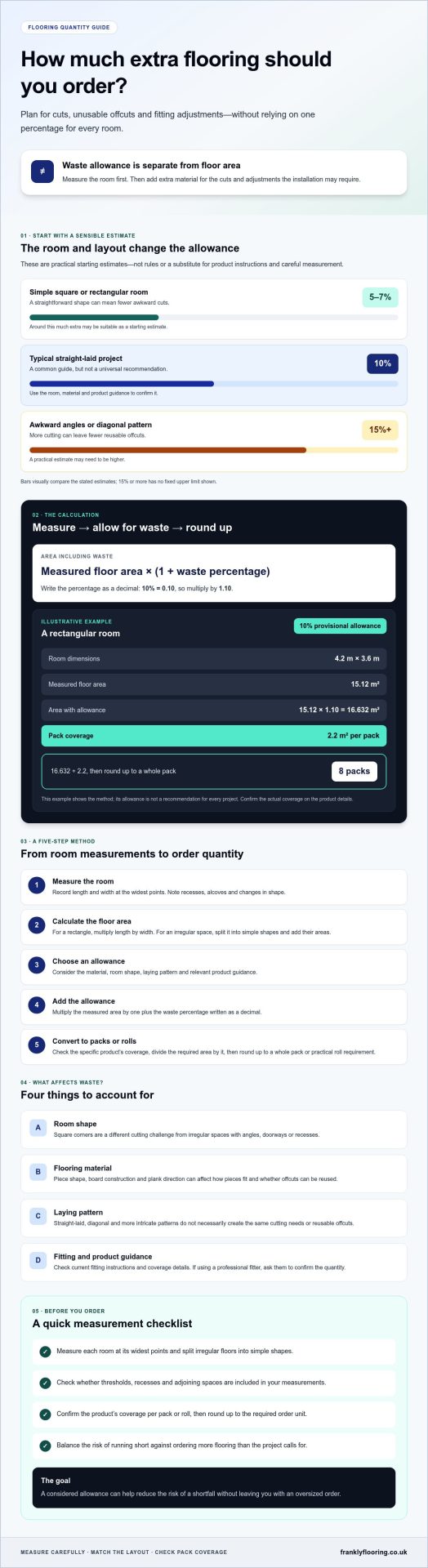
As a starting point, a simple square or rectangular room may need around 5–7% extra, while 10% is a common guide for a more typical straight-laid project. A room with awkward angles or a diagonal pattern may call for 15% or more. These are practical estimates, not rules that replace product instructions or careful measurement.
Why does flooring need a waste allowance?
Flooring rarely fits a room without being cut. Pieces at the edges need trimming, while awkward corners, doorways and recesses can leave offcuts that are too small or the wrong shape to use elsewhere. Some material may also be set aside if a piece is damaged or needs adjusting during fitting.
A straightforward room with four square corners usually presents a different cutting challenge from an irregular space with several angles. The material matters too: plank direction, board construction and the way a pattern meets the walls all affect which offcuts can be reused. For background on solid and engineered options, see this overview of wood flooring.
Is there one percentage that works for every floor?
No. A general percentage is useful for an initial estimate, but it can’t account for every room or fitting plan. A plain straight lay may produce reusable offcuts; a diagonal or more intricate pattern can involve more cutting and fewer opportunities to reuse them. Flooring types also differ in how their pieces are shaped and laid.
For an accurate answer to how much extra flooring to order for waste, check the product’s current fitting instructions and coverage details, then match the allowance to the measured space and intended layout. If you’re using a professional fitter, ask them to confirm the quantity for your project before ordering. Taking care at this stage can help prevent a shortfall and avoid an oversized order based on a blanket rule.
How to Calculate Flooring Waste from Your Room Measurements
Use the same sequence for any flooring type: measure the space, work out its area, choose a suitable waste allowance, add it to the area, then convert the total into packs or rolls. The figures below show the method, but the example allowance isn’t a recommendation for every project.
- Measure the room. Record the length and width at the widest points, and note any recesses, alcoves or changes in shape.
- Calculate the floor area. For a rectangular room, multiply length by width. For an irregular room, split it into simple shapes and add their areas together.
- Choose an allowance. Base it on the flooring, room shape, laying pattern and relevant product guidance.
- Add the allowance. Multiply the measured area by one plus the waste percentage written as a decimal.
- Round to order units. Check the product coverage per pack or roll, then round up to a whole pack or a practical roll requirement.
To include waste, multiply the measured floor area by one plus the chosen waste percentage expressed as a decimal. For example, 10% is written as 0.10, so the calculation is measured area × 1.10.
Illustrative calculation, not a universal recommendation: A rectangular room measuring 4.2 m by 3.6 m has an area of 15.12 m². If you use a provisional 10% allowance, multiply 15.12 by 1.10 to get 16.632 m². If a pack covers 2.2 m², divide 16.632 by 2.2, then round up to 8 packs. Confirm the actual coverage on the product details before ordering.
How do you measure a room with alcoves or an unusual shape?
Break the floor into rectangles or other simple shapes you can measure. Calculate each area separately, then add the results. Measure recesses and alcoves if they’re to be floored. For doorways, thresholds and fixed features, follow the product instructions and confirm what the fitter intends to include. Don’t assume every feature should be measured or excluded in the same way.
How do you convert floor area into packs or rolls?
Use the coverage stated for the specific product, since pack contents can differ. Divide the area including waste by the coverage per pack and round up, as you can’t order a fraction of a pack. For carpet, floor area alone may not settle the quantity: roll width, room dimensions, pattern direction and the cuts needed can affect how the carpet should be planned. Check the product guidance and seek a professional measurement if the layout is complex. For resilient flooring practices, the Resilient Floor Covering Institute (RFCI) is a useful reference.
Once you’ve measured, compare suitable LVT, wood, carpet, laminate and vinyl flooring options, then use each product’s stated coverage to check your order calculation.
How Flooring Type and Laying Pattern Change the Waste Allowance
The room’s area is only part of the calculation. Flooring pieces differ in shape, direction and how easily offcuts can be reused, so the same allowance won’t necessarily suit LVT, laminate, wood, vinyl and carpet. Before deciding how much extra flooring to order for waste, consider both the material and the planned layout.
| Material | Waste drivers | What to verify before ordering |
|---|---|---|
| LVT | Planks or tiles need trimming at edges and around obstacles. The layout direction and any repeating pattern affect where cuts fall. | Check the product’s laying instructions, pack coverage and whether the design has a recommended direction or pattern match. |
| Laminate | Board direction, room proportions, doorways and end-joint positioning influence cuts and whether offcuts can be reused. | Confirm the fitting guidance, board dimensions and pack coverage for the specific product. |
| Wood | Plank length and width, board selection and layout can affect cut planning. Patterned arrangements generally need more considered positioning than a straight lay. | Check product instructions, the layout plan and any guidance from the person fitting the floor. |
| Vinyl | Sheet or plank format changes how edges, recesses and seams are planned. Sheet vinyl may require careful cutting around the room shape. | Check the product format, fitting instructions and measurements needed for seams or joins. |
| Carpet | Roll width, seam placement, room shape, pattern matching and pile direction can affect the cut plan. Floor area alone may not show how much carpet is needed. | Confirm roll width, pile direction, pattern repeat and seam positions with a professional measurer or fitter. |
Do herringbone and diagonal patterns need more extra flooring?
They can. Angled cuts at boundaries and the need to keep a repeating pattern aligned may create more offcuts, some of which won’t fit elsewhere. Herringbone also needs careful positioning so the pattern stays consistent across the room. Follow the manufacturer’s laying instructions and confirm the allowance with the person fitting the floor before ordering. Don’t apply a straight-lay estimate without checking whether it suits the pattern.
Does the right allowance differ for planks, tiles and carpet?
Yes. Planks and tiles are affected by board direction, room proportions and where joints land. A narrow strip at one edge may need a different cutting plan from a balanced layout. Carpet needs a separate check: roll width, seam locations and pile direction influence how pieces can be cut and joined. Ask for a plan based on the actual product and room, rather than treating the measured area as the full order quantity.
A Practical Flooring Measurement Checklist Before You Order
A final check can catch small measurement gaps before they become an order shortfall. Use this list to make sure your room dimensions, chosen layout and product details all refer to the same area.
- Record each room’s dimensions: Measure length and width, including the widest points where the walls or floor plan vary. Keep notes for each separate space.
- Map the shape: Mark alcoves, recesses, angled walls and fixed features. Check whether connected rooms are measured together or as separate areas.
- Confirm what’s included: Decide whether thresholds, doorways and recesses are part of the flooring area. Don’t assume these details are treated the same for every product or fitting plan.
- Note the layout direction: Record the planned plank or tile direction, pattern, and any design or pile direction that needs to be followed.
- Check product coverage: Use the stated coverage per pack or roll, including the unit shown, to convert your measured area and allowance into an order quantity.
- Review the fitting guidance: Look for instructions about layout, pattern matching, cutting and any product-specific waste recommendations.
What should you check on the product information?
Read the details for the exact product you plan to order. Confirm how much floor area each pack or roll covers, and check that you’re comparing like units, such as square metres with square metres. Look for guidance on laying direction and pattern repeats or matching, as these can affect how cuts are planned. If colour or finish consistency matters, check any batch guidance and ask the retailer what to do if you’re ordering more than one pack or roll.
This product check helps refine how much extra flooring to order for waste. A general allowance is useful only when it’s applied to the right coverage and fitting requirements.
When should you get help with measuring?
Consider a professional measurement if rooms are irregular, several areas connect, or the pattern and cutting plan are difficult to judge. For carpet, confirm roll width, pile direction and seam positions before ordering. These details can affect the cut plan beyond the room’s measured area. Frankly Flooring sells flooring products but doesn’t provide installation services, so arrange measurement or fitting guidance with an appropriate professional where needed.
Once your measurements and product checks are in hand, explore flooring options for your project and compare each product’s stated coverage before placing an order.
Final Order Checks: Avoid a Flooring Shortfall or Excess
Before ordering, bring your measurements, chosen waste allowance and product coverage together. Check that the allowance suits the room and laying pattern, calculate the total area, then convert it into whole packs or a suitable roll quantity. No single percentage works for every floor, so confirm the product instructions and ask the person fitting the floor to check your calculation if the layout is complex.
Too little flooring can interrupt work while you check stock and arrange more. Ordering substantially more than the project needs can leave you with unused material. Before purchasing, verify current availability, coverage per pack or roll, any batch guidance and the retailer’s current returns terms. Don’t assume extra stock from the same batch will still be available later, or that surplus packs can be returned.
What happens if you run short after fitting starts?
Contact the retailer promptly with the exact product details and the quantity you need. Ask about current options and next steps, and check whether any batch or shade considerations apply. Product availability can change, so don’t assume an identical match will be available. If you’re still planning the order, confirming these details in advance can help you decide how much to buy.
What should you do with leftover flooring?
If the product guidance allows it, keep suitable spare pieces for future repairs. Store them safely and retain the product information so you can identify what you have. For unopened packs or rolls, check the current returns terms before relying on a return to manage excess; conditions can vary.
The best answer to how much extra flooring to order for waste is the quantity supported by your measurements, the product’s coverage and the fitting plan. Recheck those details before placing the order, and keep a note of the product and batch information for your records.
Ready to choose a floor? Browse Frankly Flooring’s LVT, wood, carpet, laminate and vinyl ranges, then check the coverage and guidance for your selected product before ordering.
Make Your Flooring Order with Confidence
The right waste allowance depends on your measurements, the material and the laying pattern. There’s no single percentage for every project. Measure each area carefully, follow the product guidance and round the final quantity up to the required packs or roll size. If the room or cutting plan is complex, ask the person fitting the floor to check your calculation before you order.
That’s the practical answer to how much extra flooring to order for waste: choose an allowance that reflects your project, then verify coverage, availability and returns terms for the product you’ve selected. Checking these details can help you avoid both a mid-project shortfall and more unused flooring than you need.
Frankly Flooring is a family-run online retailer serving customers across the UK, with over 20 years of flooring-industry experience. Browse its ranges of LVT, wood, carpet, laminate and vinyl flooring, and check the product details as you compare options.
Browse flooring options at Frankly Flooring and take your next step with a clearer idea of what your room requires.
Frequently Asked Questions
How much extra flooring should I order for waste?
There’s no single allowance that suits every project. To decide how much extra flooring to order for waste, start with accurate measurements, then consider the material, room shape and laying pattern. Check the product instructions and ask the person fitting the floor for project-specific guidance if needed. Treat percentage examples as estimates, not guarantees, and round your final quantity up to whole packs or the required roll dimensions.
Is 10% extra flooring enough for waste?
It may be enough for some straightforward projects, but 10% isn’t a universal rule. The quantity required can change with the room layout, product format, pattern direction and cutting plan. Measure the floor carefully, check the manufacturer’s guidance and confirm the allowance with the person fitting it before ordering. Also check pack coverage or roll dimensions, since the final order may need rounding to suit the product’s selling unit.
Do herringbone floors need more extra flooring?
They can need more careful planning than a straightforward layout because angled cuts and a repeating pattern may create offcuts that can’t be reused elsewhere. The amount depends on the room dimensions, product instructions and how the pattern is set out. Follow the manufacturer’s laying guidance, then confirm the allowance with your fitter before ordering. Don’t rely on a percentage intended for a different pattern or room shape.
How do I calculate how much flooring to order?
Measure the floor and calculate its area, splitting an irregular room into manageable shapes and adding their areas together. Add a suitable waste allowance based on the product and planned layout. Divide that total by the coverage stated per pack, then round up to whole packs. For carpet, check roll width and cut planning as well as floor area, since seams and pile direction can affect the quantity required.
Should I order extra carpet for waste?
Yes, but the amount should be based on the carpet and the room’s cut plan, not floor area alone. Roll width, pile direction, seams and the room shape can all affect how the carpet is cut. Check the product details and have the proposed cuts and roll requirements confirmed before ordering. This is especially useful for several rooms or an irregular space, where a simple area calculation may not show the full requirement.
Can I return unopened packs of leftover flooring?
That depends on the retailer’s current returns terms and the condition of the product. Check the policy before ordering rather than assuming surplus packs can be returned. If you might ask about a return, keep the packaging intact and retain your order details. Don’t treat a possible return as a substitute for careful measuring, since the applicable terms and conditions need to be confirmed with the retailer.
What happens if I do not order enough flooring?
You may need to pause the work while checking whether more of the same product is available. Availability and batch details can change, so don’t assume matching flooring will still be in stock. Contact the retailer promptly with the product information and quantity needed, and ask about current options. Before ordering, check the coverage, batch guidance and fitting plan. For a complex room or pattern, seek measurement advice before work begins.