
If you’re asking what flooring can be laid over tiles, the answer depends less on the material name and more on whether the tiles are stable, clean, dry and suitably even for the product you choose. A flooring option that seems simple to lay over tiles may still show flaws in the surface beneath it.
It’s understandable to want a fresh finish without lifting the existing floor. However, loose tiles, cracks, raised edges and deep grout lines can affect the new flooring. Some LVT, vinyl, laminate, engineered wood and carpet products may be suitable over tiles, subject to their specific installation instructions. That doesn’t mean every product can go straight down.
This guide compares flooring categories that may work, explains what to check before you buy and outlines when tiles may need repair, levelling or professional assessment first. It also covers room conditions and product requirements, so you can make a considered choice and reduce the risk of an uneven finish or visible grout pattern.
Key Takeaways
- Compare LVT, sheet vinyl, laminate, engineered wood and carpet rather than assuming one option suits every tiled floor.
- Check the tile condition and floor levels before narrowing down your flooring choices.
- Consider how grout joints, uneven spots and extra floor height could affect the finish, door clearance and transitions.
- Use a pre-purchase checklist to match the room with the exact flooring product’s fitting instructions.
- Find out when preparation or a professional assessment may be needed before choosing an overlay.
Flooring Over Tiles: When is an Overlay Realistic?
An overlay is new flooring installed over an existing tiled floor. LVT, vinyl, laminate, engineered wood and carpet may all be options, but suitability depends on the tile condition and the instructions for the exact product. “Can go over tiles” doesn’t always mean “can be laid directly without preparation”.
The existing surface needs to be stable, clean, dry and suitably even for the flooring you’re considering. Loose tiles can move beneath a new floor, while cracks or uneven edges may affect its finish. Some floating floors, including certain laminate products, may be installed over existing surfaces. A general overview of floating installation explains the method, but the product’s current fitting instructions set out its requirements.
Check the extra floor height before choosing. A new layer can affect door clearance and create a step or awkward transition where it meets another floor, a threshold or fitted units. Measure and consider these points before buying.
Which existing tile conditions should you check first?
Walk over the whole area and look for loose, cracked or moving tiles. Hollow sounds when tapped may warrant closer assessment, but they don’t confirm what is happening beneath the surface. Don’t dismiss defects as cosmetic: movement or damage can undermine the base for a new floor.
Look closely at the grout joints. Deep or uneven lines may affect how smooth the finished surface feels or looks, depending on the flooring and its preparation requirements. Check for visible dampness, residue or contamination, and note changes in level between rooms. These checks can flag issues to investigate, but they can’t diagnose hidden moisture or structural problems.
When should you stop before buying flooring?
Pause your selection if tiles move underfoot, damage is widespread or you can’t explain signs of moisture. The surface may need assessment or preparation before an overlay is considered. Shortlist a flooring type only after checking the product instructions for tiled substrates, underlay and levelling requirements.
- Check height: Consider whether the finished floor could catch doors or leave an unsuitable step at thresholds and adjoining surfaces.
- Don’t disturb suspect old flooring: If you’re concerned that flooring or materials beneath the tiles may contain asbestos, avoid disturbing them and consult current Health and Safety Executive (HSE) guidance before work proceeds.
A careful assessment can help you identify issues before committing to a flooring choice, though it can’t guarantee that every tile is suitable. The tile surface and product instructions, not the material name alone, determine whether an overlay is realistic.
How LVT, vinyl, laminate, wood, and carpet differ over tiles
Each flooring category responds differently to the surface beneath it. Use this comparison as a starting point, not as permission to fit a product over any tiled floor. Check the exact product’s current instructions for substrate suitability, preparation, underlay and fitting method.
| Flooring | Potential advantage over tiles | Surface limitations and conditions |
|---|---|---|
| LVT | Available in separate pieces, with formats and fitting methods that can suit different projects. | Grout joints and unevenness may affect the finish. Requirements depend on the product and installation method. |
| Sheet vinyl | Creates a continuous surface with no tile-like joints in the vinyl itself. | Its finish can show imperfections beneath it. Check the specified flatness and preparation requirements. |
| Laminate | A floating format may be considered over an existing floor where the product allows it. | Tiles must provide a suitable, stable base, and any underlay must be approved for that laminate. |
| Engineered wood | Some products offer fitting options that don’t require fixing directly to the tiles. | Approved installation methods, underlay and substrate conditions vary by product. Follow its instructions. |
| Carpet | Can provide a softer finish over a prepared floor. | Needs a suitable base and fitting system. Don’t assume it can be laid directly over tiles without preparation. |
Can LVT or vinyl go over tiled floors?
Resilient flooring needs particular care around grout lines. Joints or raised tile edges may become visible or affect the finished surface, depending on the product and preparation. LVT formats and sheet vinyl aren’t interchangeable, and their fitting requirements can differ. For a broader introduction to the material, read what LVT flooring is. The Tile Association’s overview of British Tiling Standards provides context on standards for tile installation, but it doesn’t replace the new flooring manufacturer’s instructions.
Can laminate, engineered wood, or carpet go over tiles?
A floating floor doesn’t remove the need to check the subfloor. Laminate still needs a suitable, stable base and product approved underlay. Engineered wood instructions may specify a particular installation method or preparation, so check the selected product rather than relying on general advice. Carpet also needs an appropriate fitting system and base. Direct fitting over tiles isn’t suitable for every product.
So, what flooring can be laid over tiles? The product instructions and the condition of the tiled surface determine the answer. Once you’ve checked compatibility, you can explore flooring options across LVT, vinyl, laminate, wood and carpet.
Will grout lines, uneven tiles, or floor height cause problems?
A new floor won’t automatically hide an unsuitable tiled surface. Grout joints, raised tile edges and dips can affect the appearance or performance of the overlay, depending on how the new flooring is constructed and fitted. This is especially worth considering with thin or flexible coverings, where irregularities may show through or be felt underfoot.
How do grout lines and uneven tiles affect the finished floor?
Deep grout joints can leave a pattern beneath some coverings, while uneven tiles may create high spots or unsupported areas. A rigid floating floor and a thin resilient covering won’t respond to every irregularity in the same way, so there’s no universal rule based on material alone.
Filling, smoothing or levelling may be needed, but only if the selected product’s instructions allow the proposed preparation and materials. For perspective, subfloor guidance associated with standards such as BS 5385 and BS 8204-1 commonly expresses flatness as a tolerance of ±3 mm over a 2-metre span. This is not a substitute for checking the requirements for your specific flooring. The British Standards Institution’s information on the British Standards code of practice is relevant to laminate preparation. Don’t apply one product’s guidance automatically to another flooring type.
Removing tiles may expose a more appropriate base, but it involves extra work and can reveal further preparation needs. An overlay may avoid tile removal if the surface and chosen product are compatible, but it adds height and won’t correct loose or damaged tiles by itself. Neither approach suits every floor.
What changes when the new floor raises the floor level?
Measure the proposed finished height before ordering. Include the flooring, any required underlay and preparation layers. Check door swing and clearance, skirting details, thresholds, appliance gaps and transitions into adjoining rooms. Even a modest increase can mean a door catches or a step forms where floors meet.
Laminate specific fitting and preparation considerations are covered in this laminate flooring guide. Use it for broader context, then follow the instructions supplied with the exact product you’re considering. If the floor height or surface condition remains uncertain, get the substrate assessed before committing to an overlay.
Once you know the tile surface is suitable and have accounted for the finished level, you can browse flooring options with the preparation requirements in mind.
How to decide whether your tiled floor is ready for an overlay
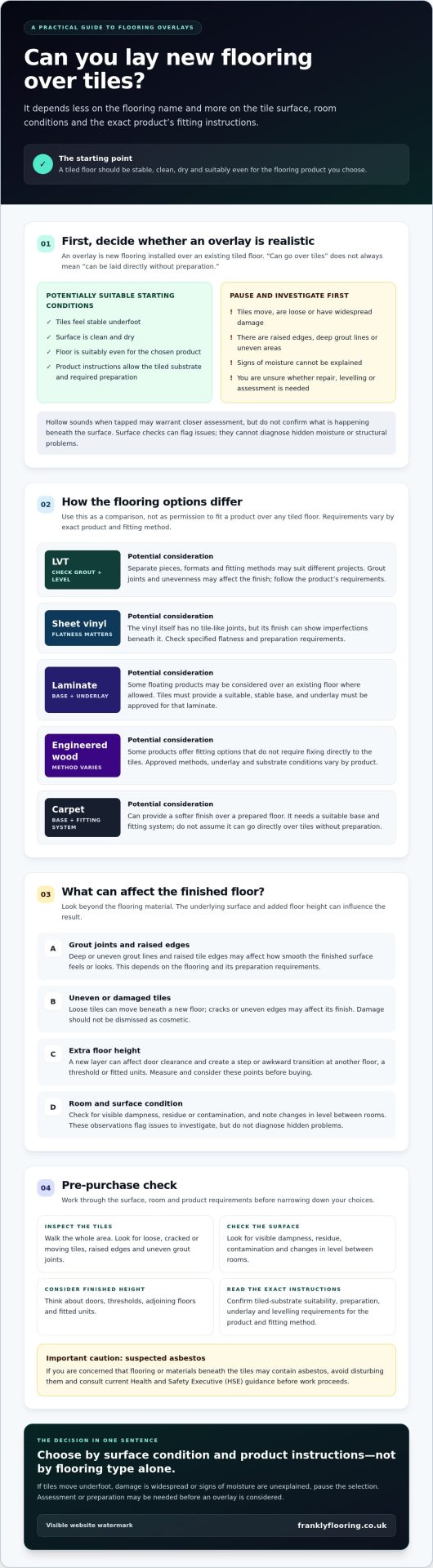
Before choosing what flooring can be laid over tiles, work through these checks in order. They’ll help you identify questions to resolve before you buy, without assuming that every product suits every tiled surface.
- Identify the tiles. Note whether they appear to be ceramic, porcelain or another material, if you know. Record the room dimensions and take clear photos of the floor, grout and any damaged areas.
- Inspect the surface. Look for loose, cracked or moving tiles, deep grout joints, visible contamination and signs of moisture. Record what you can see, but don’t treat a visual check as a diagnosis of hidden damp or damage.
- Measure levels and clearances. Note uneven areas and changes in level across the room. Check door clearance and the height difference at thresholds and adjoining floors.
- Shortlist a flooring category. Consider how the room is used and its exposure to moisture. The demands of a busy hallway or a room where spills are likely may differ from those of a bedroom.
- Check the exact product. Read its current manufacturer instructions before ordering. Confirm whether that format allows installation over existing ceramic or porcelain tiles, and check the stated requirements for substrate condition, moisture, levelling, underlay and adhesive.
What should you measure and record before choosing?
Keep a simple record of room dimensions, tile condition, grout depth, uneven areas and changes in level. Add notes about the room’s use and any moisture exposure. Then consider the total floor build up, including the covering and any required underlay or preparation layer. Check that doors can open freely and that transitions into neighbouring rooms won’t create an awkward lip.
How should you verify the flooring’s requirements?
Use the instructions for the product you’re actually considering, not assumptions based on its general category. Fitting requirements can differ between products and formats, including whether tiles are an acceptable base. For background on engineered wood as a material, see the engineered wood flooring guide, then verify the chosen product’s own substrate and fitting requirements.
If tiles are unstable, there are unexplained signs of damp, or you can’t establish whether the surface is suitable, pause and seek assessment from a qualified flooring professional before ordering. Frankly Flooring sells flooring and accessories but doesn’t carry out installation or site inspections. Once you’ve checked the product requirements, browse flooring options with your measurements and room notes to hand.
Choose Over-Tile Floors with Confidence
There isn’t one best answer to what flooring can be laid over tiles. The right choice depends on whether the tiles are sound, what the room needs and what the specific flooring product permits. Use this decision guide to consider those factors before you order.
- Tiles are stable, dry and suitably even: Compare LVT, vinyl, laminate, engineered wood or carpet according to the room and finish you want. Confirm that the chosen product accepts the tiled substrate and check its preparation requirements.
- Grout joints or surface variation are noticeable: Don’t assume a new covering will conceal them. Check whether the product instructions call for a smoother base or other preparation, and make sure the proposed method is compatible.
- The room may be exposed to moisture: Check the product’s suitability for that room and its moisture related requirements. Don’t infer suitability from the general flooring category alone.
- You want a hard floor finish: Compare LVT, vinyl, laminate and engineered wood by their individual substrate, fitting and accessory requirements. A floating format still needs a suitable base.
- You prefer a softer finish: Carpet may be an option if the base and fitting system are appropriate for the selected product. Don’t assume it can be fitted directly over tiles.
- The floor is unstable, damp or uncertain: Pause. Resolve the concern with a qualified assessment before choosing an overlay.
- The finished height could be an issue: Include the flooring and any required underlay or preparation layers in your calculation. Check doors, thresholds and transitions into adjoining rooms before ordering.
What should you do before placing an order?
First, shortlist a flooring category that suits the room and the finish you want. Then read the current instructions for the exact product and format. Confirm whether it can be installed over your type of tile, what condition the surface must be in, and whether levelling, underlay or adhesive is specified. Check accessory compatibility too. One underlay isn’t automatically suitable for every floor.
Frankly Flooring is an online retailer with flooring categories including LVT, vinyl, laminate, engineered wood and carpet, as well as accessories. Customers arrange installation separately: Frankly Flooring doesn’t provide fitting services. The product instructions, not general advice about a material, determine compatibility with your tiled floor.
Once you’ve checked the room, tile condition, product requirements and total floor height, you can browse flooring options at Frankly Flooring and compare categories at your own pace.
Make Your Next Flooring Choice with Confidence
The answer to what flooring can be laid over tiles depends on the condition of the tiled surface and the requirements of the flooring you choose. LVT, vinyl, laminate, engineered wood and carpet may all be worth considering, but don’t assume any product is suitable without checking its instructions.
Before ordering, look for loose or damaged tiles, consider grout and unevenness, and calculate the finished floor height, including any required underlay or preparation. If the base is unstable or you’re unsure about moisture, pause and seek a qualified assessment rather than risk problems beneath the new floor.
Frankly Flooring is a family run UK online retailer with over 20 years of flooring industry experience. Its range includes LVT, vinyl, laminate, engineered wood, carpet and accessories. Flooring installation is arranged separately, as Frankly Flooring doesn’t provide fitting services.
Once you’ve checked your room and the product requirements, browse flooring options at Frankly Flooring and compare categories at your own pace. A little preparation now can help you choose a finish with confidence.
Frequently Asked Questions
Can you lay new flooring directly over tiles?
Yes, some flooring products may be installed over tiles, but it isn’t suitable in every room or with every product. The tiles must meet the chosen product’s substrate requirements. Loose or damaged tiles, dampness, deep grout joints or uneven areas may need attention first. Check the current manufacturer instructions before buying. If you can’t tell whether the surface is stable or suitable, pause and seek advice from a qualified flooring professional.
What is the best flooring to lay over tiles?
There isn’t one best flooring for every tiled floor. LVT, vinyl, laminate and engineered wood may suit a hard floor finish, while carpet may suit a softer one, but each has different fitting and preparation requirements. Consider the room, tile condition, required preparation and finished floor height. Most importantly, check whether the exact product allows installation over your tiled substrate. Assess the surface before choosing a material category.
Can you lay LVT over ceramic tiles?
Some LVT products may be suitable over a prepared ceramic tiled surface, but confirm this in the instructions for the exact product. Stable tiles, suitable surface flatness and acceptable moisture conditions all matter. Grout joints may also affect preparation or the final appearance. Don’t assume LVT can be laid directly onto ceramic tiles just because it’s a resilient floor covering. Check requirements before buying, and get advice if the surface is uncertain.
Will grout lines show through vinyl flooring?
They may affect the finish, particularly if the vinyl is thin or the grout joints are deep, uneven or not prepared as the product requires. Surface irregularities can sometimes show through or be noticeable underfoot, but the result depends on the tiled base, the vinyl product and its fitting instructions. Don’t assume vinyl will conceal every joint. Check the manufacturer’s guidance on substrate preparation and seek an appropriate assessment if you’re unsure.
Do tiles need to be level before laying laminate flooring?
Laminate needs a stable base that meets the flatness requirements in the instructions for the selected product. Loose tiles, raised edges, uneven areas or grout joints may need attention if they prevent those requirements being met. Don’t assume one tolerance or levelling method applies to every laminate floor. Check the current manufacturer guidance before preparing the tiles, and get the surface assessed if its condition or level is uncertain.
Can you put carpet over floor tiles?
Carpet may be an option over tiles if the tiled base and fitting system are suitable for the product. Check that the tiles are stable and assess whether unevenness or grout joints could affect the finish or how the carpet is secured. Required underlay or other accessories may vary, so consult the carpet and accessory instructions. Don’t assume carpet can always be fitted directly onto tiles without preparation or an appropriate fitting approach.
Should I remove old tiles before laying new flooring?
Not always. An overlay may be possible if the tiles are suitable and the chosen flooring product permits installation over them. Compare the tile condition, preparation needs and finished floor height with the product instructions before deciding whether to overlay or remove them. If old flooring or materials beneath the tiles may contain asbestos, don’t disturb them. Check current Health and Safety Executive guidance and seek appropriate advice before any work proceeds.