
Most homeowners still associate vinyl with the thin, peeling “lino” found in 1980s rentals, but the reality in 2026 is a complete transformation in craftsmanship. If you are searching for the best vinyl flooring for kitchens uk, you have likely realised that the market is now flooded with complex terms like LVT, wear layers, and R11 slip ratings. It is easy to feel overwhelmed, especially when you are worried about water damaging your subfloor or getting caught out by the hidden costs of underlay and accessories.
We understand that you want a kitchen floor that offers the authentic look of reclaimed wood or natural stone without the high maintenance or the fear of a leaky dishwasher ruining your investment. This guide provides a candid, expert breakdown of modern vinyl options to help you find the perfect balance of durability, style, and value. We will demystify the technical specs, explain why the wear layer is your most important metric, and give you the confidence to order the correct amount online. By the end, you will know exactly which floor fits your budget and your lifestyle, ensuring your kitchen remains the heart of your home for years to come.
Key Takeaways
- Modern vinyl is a fully waterproof, high-performance material that bears little resemblance to the thin, outdated “lino” of previous decades.
- Decide between the cushioned comfort of sheet vinyl or the rigid, high-end durability of LVT based on your specific traffic levels and budget.
- Learn how to decode technical specifications like wear layers and R-ratings to identify the best vinyl flooring for kitchens uk for your home.
- Understand why subfloor preparation and the correct accessories are the most critical factors in preventing floor failure and ensuring longevity.
- Master professional measuring techniques and the “10% wastage rule” to avoid the hidden costs and delays of under-ordering.
The Evolution of Kitchen Vinyl: Why It’s No Longer Just ‘Lino’
Many homeowners still cringe at the mention of vinyl, picturing the thin, yellowing sheets found in 1970s flats. That stuff was linoleum, a completely different material. Modern vinyl has undergone a massive technological shift, moving from a cheap cover-up to a high-specification design choice. Finding the best vinyl flooring for kitchens uk means looking past that outdated stigma and understanding how PVC-based products have changed the game for wet zones.
Unlike old lino, modern vinyl is built from robust layers of polyvinyl chloride. It is inherently waterproof, meaning it won’t swell or rot when the washing machine inevitably leaks. The history of vinyl flooring shows a steady move toward stability and durability, resulting in a product that handles the humidity and temperature swings of a busy British kitchen without flinching. Frank’s perspective is simple: real wood is beautiful, but it has no business being near a kitchen sink. Vinyl gives you that organic look with none of the structural risk.
You generally have three formats to choose from when upgrading your space:
- Sheet Vinyl: Large, seamless rolls that provide a continuous waterproof barrier.
- LVT Planks: Individual boards that mimic the size and shape of traditional timber.
- LVT Tiles: Square or rectangular pieces designed to look like stone, slate, or ceramic.
What is Modern Vinyl Flooring?
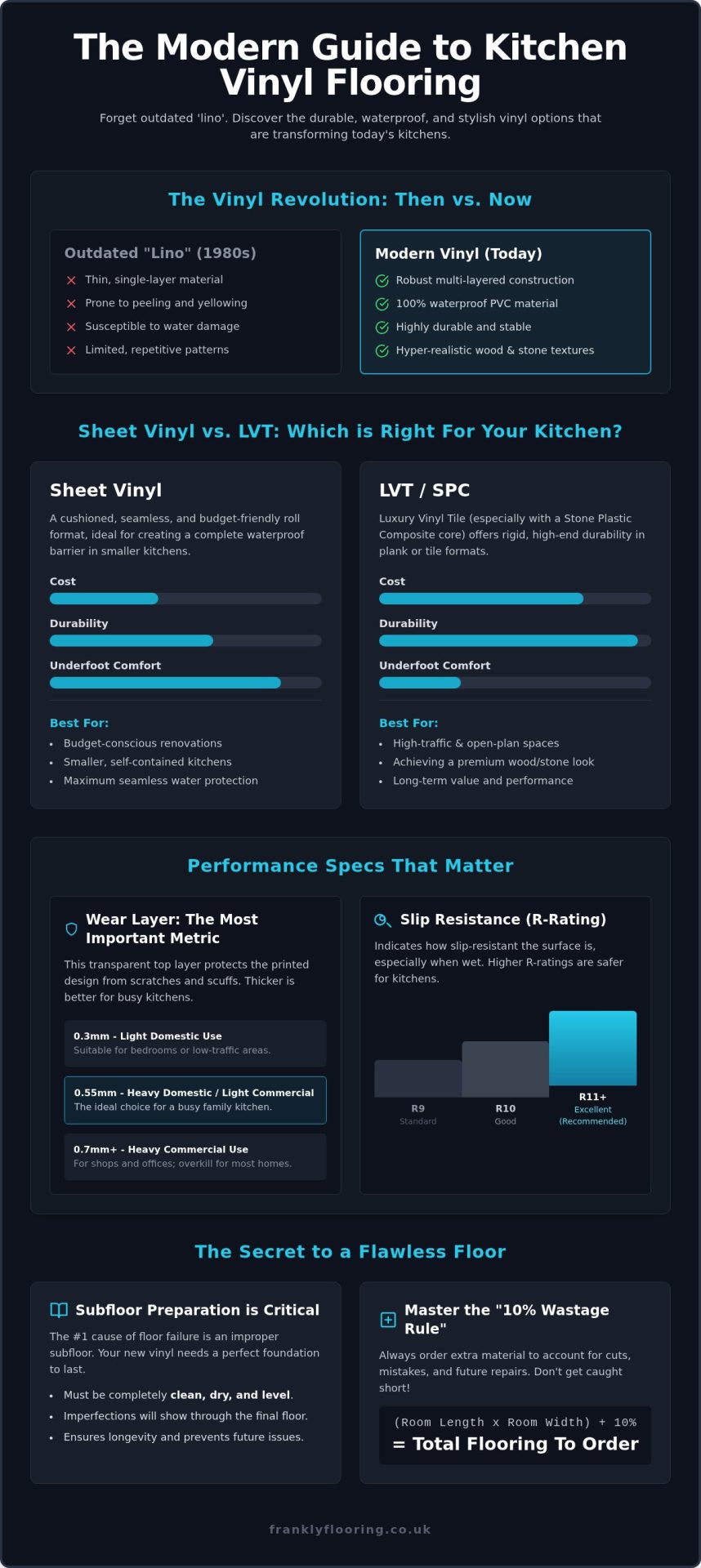
Modern vinyl is a sophisticated sandwich of materials. It starts with a stable backing layer, followed by a high-definition print layer that provides the visual, and is topped with a clear, hardened wear layer. Because these materials are synthetic, they don’t expand or contract like natural wood does when you’re boiling pasta or mopping the floor. Kitchen vinyl is a high-performance, moisture-resistant synthetic surface.
Realistic Aesthetics: Wood and Stone Effects
The biggest leap forward is in the visuals. We now use 3D printing technology to create textures that you can actually feel under your fingertips. High-end options often feature “embossed in register” finishes, where the physical texture of the tile perfectly follows the grain or grout lines of the printed image. This level of detail makes it nearly impossible to tell the difference between vinyl and natural materials once it’s on the floor. For a deeper dive into these premium options, check out our Frank guide to luxury vinyl tile.
Sheet Vinyl vs. LVT: Which Kitchen Floor Offers the Best Value?
Many retailers use the terms “vinyl” and “LVT” interchangeably, but they are distinct products with different performance profiles. If you are hunting for the best vinyl flooring for kitchens uk, you need to decide between the cushioned, seamless nature of a roll and the rigid, modular strength of a plank. The “Frank” truth is that while sheet vinyl is easier on the wallet initially, LVT often provides better long-term value, especially in open-plan spaces where your kitchen flows into a dining or living area.
The feel underfoot is the first major difference. Sheet vinyl is naturally softer and warmer, providing a bit of “give” if you drop a glass. LVT, particularly Stone Plastic Composite (SPC) varieties, feels much closer to real wood or stone. It is solid, heavy, and doesn’t bounce. While sheet vinyl is the fastest way to refresh a room, LVT is the choice for those who want a floor that feels like a permanent architectural feature rather than a temporary covering.
Sheet Vinyl: The Seamless Budget Solution
Sheet vinyl remains a popular choice for smaller, self-contained kitchens. Because it comes in wide rolls, you can often cover the entire floor without a single join. This creates a massive waterproof barrier that prevents spills from ever reaching your subfloor. You will typically choose between foam-back and felt-back options. Foam provides more cushion, while felt-back is more forgiving of minor subfloor imperfections and offers better thermal insulation. It is the most cost-effective way to get a waterproof floor installed in a single afternoon.
LVT and SPC: The Premium Kitchen Standard
Luxury Vinyl Tile (LVT) has become the gold standard for modern UK homes. We specifically recommend Stone Plastic Composite (SPC) for kitchens because it contains a rigid core that won’t warp or expand, even if it’s sitting near a hot oven or under direct sunlight from bifold doors. This stability is vital for maintaining the integrity of the click-lock system.
LVT also wins on durability. The hardened wear layer is incredibly scratch-resistant, making it the ideal solution for households with large dogs or heavy foot traffic. Unlike laminate, which can struggle with standing water, LVT is entirely synthetic. You can read more about how it stacks up against other materials in our comparison of LVT vs laminate. If you’re unsure which format suits your room, you can browse our full range of kitchen vinyl and LVT to see the styles side-by-side.
Performance Specs That Matter: Wear Layers and Slip Resistance
Choosing the best vinyl flooring for kitchens uk isn’t just about picking a pretty oak or stone pattern. To ensure your floor survives the daily chaos of dropped pots and muddy paws, you need to look at the technical data sheet. Two specifications stand above the rest: the wear layer thickness and the slip resistance rating. These numbers tell you how long the floor will look new and how safe it is when you’re rushing around with a boiling pan.
A common concern for UK homeowners with large bifold doors is whether their floor will fade. Modern high-quality vinyl includes UV stabilisers in the top coating to prevent the sun from bleaching the decorative print. Additionally, you should consider indentation resistance. Kitchens house heavy appliances like American-style fridge-freezers and range cookers. A floor with a high-density core, such as SPC, prevents these heavy weights from leaving permanent divots in your new surface.
Understanding the Wear Layer
The wear layer is the clear, protective coating that sits on top of the decorative print. It is measured in millimetres, and this tiny number dictates the floor’s lifespan. While a 0.3mm layer is perfectly fine for a guest bedroom, the “Frank” recommendation for a busy family kitchen is a minimum of 0.55mm. This thicker shield provides significantly better protection against scratches and scuffs. It also ensures the high-definition design stays crisp for decades rather than years. For hybrid products that cross into the laminate category, you might see AC ratings; an AC4 or AC5 rating is the standard you should aim for in a high-traffic zone.
Kitchen Safety: Slip Resistance Ratings
Safety is often overlooked in flooring guides, but in a kitchen, it is non-negotiable. Slip resistance is measured using R-ratings, ranging from R9 to R13. An R9 rating has the least grip and is generally unsuitable for areas prone to spills. For a domestic kitchen, R10 is the industry standard. It provides enough traction to prevent accidents even when the floor is slightly damp. If you have a particularly large utility area or a kitchen that opens directly into a garden, you might even consider an R11 rating for extra peace of mind. Textured surfaces, often called registered embossed finishes, physically improve this grip by mimicking the natural grain of wood or stone. While vinyl handles the wet zones, you might want to consider choosing the right carpet for adjacent dry areas like lounges to keep the house feeling cosy and safe.
Preparation and Accessories: The Secret to a Long-Lasting Kitchen Floor
Even the best vinyl flooring for kitchens uk will fail if you ignore what lies beneath it. It is a hard truth to hear after you have spent a significant amount on premium LVT, but your floor is only as good as your subfloor. If your base is uneven, damp, or moving, your new investment will bubble, click, or lift within months. Preparation is the stage where you should never cut corners to save a few pounds. For readers who require professional assistance with subfloor stability or are considering heavy-duty alternatives, you might visit DelaneyResin&Construction to explore their specialist flooring and construction services.
Before any work begins, acclimatisation is non-negotiable. You must leave your vinyl packs or rolls in the kitchen for at least 24 to 48 hours. This allows the PVC to adjust to the specific temperature and humidity of the room. If you lay the floor while it is cold and the kitchen then heats up during Sunday lunch prep, the material will expand and buckle against your skirting boards.
Choosing the right adhesive is equally vital for a professional finish. For most standard areas, pressure-sensitive adhesive works well, but kitchens often require heavy-duty or high-temperature versions. If your kitchen has large south-facing windows or bifold doors, the sun can heat the floor surface significantly. Standard glue might soften under intense heat, causing tiles to shift or gaps to appear. Heavy-duty adhesive ensures everything stays exactly where you put it, regardless of the weather.
If you are laying over old floorboards, a plywood overlay is essential. Without it, you will eventually experience “telegraphing”, where the lines and grooves of the floorboards show through the vinyl surface. For concrete bases, you must check for dampness using a hygrometer. Laying vinyl over a damp slab traps moisture, leading to mould and adhesive failure. Ignoring subfloor prep is the primary cause of kitchen flooring bubbles.
Do I Need Underlay for Kitchen Vinyl?
Many modern LVT products now come with an integrated underlay, but if yours does not, you may need to purchase a separate one. Underlay provides essential sound reduction and helps smooth out tiny imperfections in the subfloor that might otherwise be felt underfoot. It is a small additional cost that makes a massive difference to the final comfort and longevity of the floor. You can find everything you need to finish the job, from levelling compounds to finishing trims, in our carpet gripper and accessory guide.
To ensure your project is a success from the first measurement to the final trim, you can order all your kitchen flooring accessories along with your new floor for national delivery.
Buying Kitchen Flooring Online: Measuring and Ordering with Confidence
Ordering the best vinyl flooring for kitchens uk online might feel daunting compared to visiting a high-street shop, but it is actually the most transparent way to buy. By skipping the expensive showrooms, you access better prices and a wider selection of high-specification products. We handle the logistics with national delivery, bringing heavy rolls or bulky LVT packs straight to your doorstep. The key to success is not a salesperson in a suit; it is a tape measure and a bit of common sense.
Buying online also allows you to compare technical data sheets side-by-side without any pressure. You can verify wear layers and slip ratings at your own pace, ensuring the product matches the specific needs of your household. It is a logical, step-by-step journey that puts you in control of the budget and the final result.
Measuring Your Kitchen Like a Pro
Measuring is not as complicated as some retailers claim. To get it right, treat your floor as a series of rectangles. If you have an L-shaped kitchen, split it into two sections, measure the length and width of each, and add them together. For alcoves or spaces under appliances, always measure to the deepest point. If you have a kitchen island, we recommend measuring the entire floor area as if the island weren’t there to ensure the pattern remains consistent. For sheet vinyl, check the available roll widths (usually 2, 3, or 4 metres) to ensure you can cover the room with the fewest possible seams.
When ordering, you must follow the 10% wastage rule. This is not a tactic to sell more product; it is a safety net for the intricate cuts around pipes and door frames. It also leaves you with a few spare planks or a small offcut of sheet vinyl for future repairs. If you are also considering other rooms, our laminate flooring buying guide offers similar professional measuring tips.
The Frankly Flooring Difference
Before you hit the checkout, run through this final checklist of essential accessories:
- Underlay: Essential for sound reduction and comfort if not already integrated into your LVT.
- Door Bars: These create a clean, professional transition between the kitchen and the hallway.
- Matching Scotia or Skirting: Vital to cover the expansion gaps around the perimeter.
- Adhesive: Ensure you have the heavy-duty spray or tub recommended for high-temperature zones.
Once your floor is down, you might find your old kitchen table looks a bit tired. You can explore our quality furniture guide to find pieces that complement your new investment and complete your kitchen-diner refresh.
Ready to Transform Your Kitchen Floor?
You now have the technical knowledge to distinguish between basic sheet vinyl and high-performance LVT. Choosing the best vinyl flooring for kitchens uk is no longer a matter of guesswork; it is about matching a 0.55mm wear layer with the specific demands of your home. If you prioritise meticulous subfloor preparation and account for the 10% wastage rule, you will avoid the common pitfalls that lead to premature floor failure. A beautiful, waterproof kitchen floor is an investment in your home’s character and daily functionality.
At Frankly Flooring, we leverage over 20 years of family-run expertise to provide the candid advice you need for a successful renovation. We don’t believe in high-pressure sales, just honest guidance on the products that truly last. With national UK delivery on all orders, we make it easy to get professional-grade materials delivered straight to your doorstep. Browse our full range of Kitchen Vinyl and LVT at Frankly Flooring and find the perfect match for your space. Your project is in safe hands, and we are here to help you get it right the first time.
Frequently Asked Questions
Is vinyl flooring the same as lino?
No, vinyl and linoleum are entirely different materials despite often being confused. Linoleum is a natural product made from linseed oil and wood flour, which is porous and requires regular sealing. Modern vinyl is a synthetic PVC-based product that is inherently waterproof and much more durable. While lino can become brittle over time, the synthetic layers in vinyl remain flexible and resistant to the moisture levels typically found in British kitchens.
Can I put vinyl flooring over my existing kitchen tiles?
You shouldn’t lay vinyl directly over tiles because the grout lines will eventually “telegraph” through to the surface. This creates unsightly ridges and weakens the vinyl over time. If your tiles are secure and level, you can apply a 3mm layer of smoothing compound over them first. This creates the flat, glass-like base required for a professional finish, ensuring your new floor remains smooth and free from permanent indentations.
Is LVT flooring actually 100% waterproof?
Yes, the PVC and Stone Plastic Composite (SPC) materials used in LVT are 100% waterproof and won’t swell or rot. However, it’s a common mistake to assume this protects your subfloor. While the planks themselves won’t be damaged by a leak, water can still seep through the joins if a flood occurs. For the best vinyl flooring for kitchens uk, ensure spills are wiped up promptly to prevent moisture from reaching the timber or concrete below.
How much wastage should I add when ordering kitchen vinyl?
We recommend adding 10% to your total area measurement to account for cutting wastage. Kitchens are often complex spaces with alcoves, pipework, and kitchen islands that require intricate cuts. Ordering exactly the amount you measured leaves no room for error or future repairs. This extra decimetre of material ensures you have enough to complete the job in one go, avoiding the delay and extra delivery costs of ordering a single replacement pack later.
Do I need underlay for click-lock LVT in a kitchen?
It depends on whether your chosen LVT has an integrated acoustic backing. Many modern click-lock planks come with a pre-attached underlay, making a separate one unnecessary. If your product doesn’t have this, you must use a high-density LVT underlay. This provides vital support for the click joints and improves sound reduction. Never use standard carpet or laminate underlay, as these are too soft and can cause the joints to snap under heavy foot traffic.
How do I clean kitchen vinyl to prevent it from becoming dull?
Use a pH-neutral floor cleaner and a damp microfibre mop for daily maintenance. Avoid using harsh chemicals, bleach, or “mop and shine” products, as these leave a soapy film that attracts dirt and makes the floor look dull over time. Crucially, never use a steam mop on vinyl flooring. The intense heat can weaken the adhesive bond or damage the protective wear layer, leading to permanent warping or delamination of the planks.
Is vinyl flooring suitable for use with underfloor heating?
Most modern vinyl and LVT products are perfectly compatible with underfloor heating systems. You must ensure the surface temperature doesn’t exceed 27°C, as excessive heat can cause the PVC to soften or expand. It’s also important to use a suitable high-temperature adhesive if you’re opting for a glue-down installation. Always check the specific manufacturer’s guidelines to ensure the warranty remains valid when used with your particular heating system.
What is the best vinyl flooring for a kitchen with heavy appliances?
Stone Plastic Composite (SPC) is the best vinyl flooring for kitchens uk when dealing with heavy American-style fridges or range cookers. The limestone-core construction provides superior indentation resistance compared to standard flexible LVT or cushioned sheet vinyl. This rigid core ensures that heavy weights don’t leave permanent marks or cause the floor to dip. For the best results, use furniture cups under appliance feet to distribute the weight evenly across the surface.