
Your brand new ergonomic chair might be the best thing for your back, but it could be the worst thing for your floor. Many homeowners invest heavily in a sleek workspace only to find that standard plastic casters have scuffed their expensive wood or LVT within weeks. It’s a common frustration, especially when you are trying to find home office furniture ideas that look professional without turning your spare room into a cold, corporate cubicle.
We want to offer a frank perspective on what actually works for a modern home. You shouldn’t have to choose between a stylish “resimercial” aesthetic and the longevity of your home’s foundation. This guide will show you how to pair high-quality, BIFMA-compliant furniture with the right protective measures to create a workspace that lasts. We will walk through the essentials for 2026, from standing desks that fit small corners to the specific casters and rugs that keep your flooring investment safe.
Key Takeaways
- Learn how to build your workspace from the ground up by matching heavy furniture with durable flooring foundations like LVT or engineered wood.
- Explore practical home office furniture ideas that prioritize ergonomic health without compromising on the “resimercial” aesthetic of your home.
- Discover how vertical storage and modular systems can reclaim your floor space and help you maintain a clutter-free environment.
- Identify the frank solutions for preventing “chair drag” and protecting your flooring investment from long-term scuffs and damage.
- Gain a clear checklist for evaluating furniture quality online to ensure your new setup is as sturdy as it looks.
Planning Your Home Office Layout and Flooring Foundation
Ergonomics is often sold as a fancy chair or a specific keyboard tray. We see it differently. True productivity comes from the synergy between your spatial layout, your Furniture, and the floor beneath your feet. If your desk is on an uneven surface, no amount of lumbar support will stop you from feeling the strain of a wobbling monitor. You need a setup where every element supports the other.
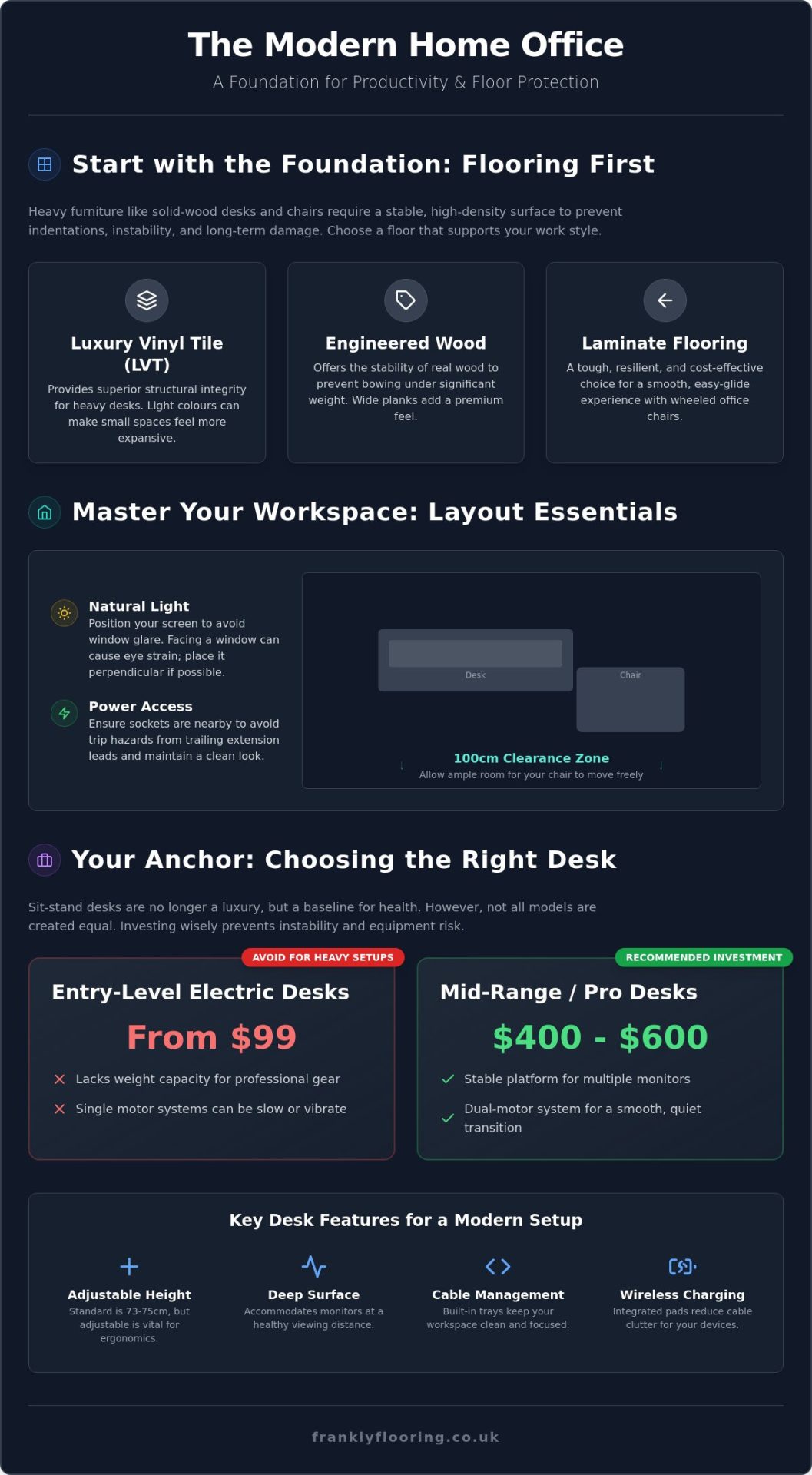
When exploring home office furniture ideas, start with the foundation. Heavy solid-wood desks or large standing units require a stable, high-density surface to prevent indentations or instability. Materials like engineered wood flooring or LVT provide the structural integrity needed to support significant weight without bowing or shifting over time. It’s a technical detail, but it’s the difference between a desk that feels solid and one that feels precarious.
Let’s be frank about your location. A hallway nook is a clever use of space for sorting mail or quick emails, but for deep work, a dedicated room is usually superior. If you are forced into a small corner, your choice of furniture must be twice as precise. Measuring your space isn’t just about length and width; it’s about depth and movement. Effective home office furniture ideas must account for the physical footprint of the chair, not just the desk, to avoid “furniture cramming” that stifles your workflow.
In multi-functional spaces where your office shares floor space with a guest bed, ensuring both areas are well-equipped is essential. For those looking to furnish the rest of the room, Belfast Bed Superstore offers a range of premium bedroom solutions that complement a high-quality home setup.
Assessing Your Space: From Nooks to Spare Rooms
Evaluate your natural light sources first. Placing a screen directly opposite a window causes glare, while facing the window can strain your eyes. Check your power socket proximity too. Relying on trailing extension leads creates trip hazards and looks messy. You also need a “clearance zone” of at least 100cm behind your desk for your chair to move freely. Your choice of floor also impacts the perceived size of the room. Light-coloured LVT or wide-plank wood can make a cramped spare room feel significantly more expansive and inviting.
Why the Right Floor Matters for Furniture Stability
Uneven floors are more than just an annoyance. They lead to desk wobble, which causes micro-adjustments in your wrists and shoulders, eventually leading to joint strain. If you want a smooth, easy-glide experience for your wheeled chair, laminate flooring is a practical and cost-effective choice. It is tough, resilient, and won’t catch on wheels like a deep-pile carpet. Proper subfloor preparation is the secret to furniture longevity and a stable work surface.
Essential Home Office Furniture: Desks and Chairs for 2026
If the floor is your foundation, the desk is your anchor. It dictates the flow of the room and your physical comfort throughout the day. When browsing home office furniture ideas, many people prioritize aesthetics over depth. However, a desk that is too shallow forces your monitor too close to your eyes, leading to strain. In 2026, the standard for a productive workspace has shifted toward deeper surfaces that accommodate multiple monitors and integrated technology. Solid wood remains the gold standard for longevity, but high-quality composites are now engineered to withstand daily wear and tear without the premium price tag.
The frank truth about sit-stand desks is that they are no longer a luxury “extra” but a baseline expectation for health. In 2026, mid-range standing desks typically cost between $400 and $600, offering the stability required for heavy equipment. While entry-level electric models can be found for as low as $99, these often lack the weight capacity for a full professional setup. If you are investing in your health, choose a model with a dual-motor system to ensure a smooth, quiet transition that won’t vibrate your coffee off the edge.
Finding the Right Desk: Size, Material, and Height
Standard desk heights usually sit around 73cm to 75cm, but this doesn’t suit everyone. Adjustable options allow you to tailor the height to your specific frame, which is vital for long-term spinal health. When selecting a finish, look for something that complements your existing furniture to create a cohesive look. Modern designs now include built-in cable management trays and wireless charging pads as standard. These features keep your surface clear and help you maintain a focused mindset. If you are looking to refresh your entire setup, you can browse our furniture range to find pieces that balance durability with style.
Why an Ergonomic Chair is a Non-Negotiable Investment
Your chair is the most important piece of equipment you will buy. Do not be fooled by “executive” styles that prioritize thick padding and bonded leather over actual support. A true ergonomic chair offers adjustable lumbar support, seat depth, and 4D armrests that move in every direction to support your wrists. Budget-friendly ergonomic chairs with solid support can be found in the $230 to $300 range in 2026, making professional-grade comfort accessible. To maintain a healthy ergonomic office setup, follow the 90-90-90 rule. Your elbows, hips, and knees should all be bent at a ninety-degree angle with your feet flat on the floor or a footrest.
Beyond the primary task chair, many home offices benefit from occasional seating for reading or guest use. To find pieces that blend style with comfort, you can learn more about Acacia Home and their curated range of specialist chairs.
Smart Storage Ideas to Maximise Your Workspace
A cluttered desk is a cluttered mind. It’s a cliché because it’s true. When you’re hunting for home office furniture ideas, it’s easy to get distracted by the desk and chair, but your storage strategy determines whether that workspace remains a sanctuary or becomes a dumping ground. Effective storage isn’t just about hiding mess; it’s about creating a system that supports your workflow without eating into your floor space. In 2026, the trend has shifted away from bulky, static filing cabinets toward modular systems that adapt to your needs.
The frank reality of modern home offices, particularly in smaller British homes, is that we often lack the square footage for traditional furniture. This is where verticality becomes your best friend. By shifting your storage needs to the walls, you keep the floor clear, which makes the room feel larger and much easier to clean. However, you must be realistic about weight. A shelf full of heavy reference books or printers requires more than just a few standard screws; it needs proper anchoring into the wall studs or high-quality masonry fixings to ensure it doesn’t become a safety hazard.
Vertical Storage: Shelving and Wall-Mounted Units
Utilising wall space keeps your most-used items at eye level and within arm’s reach. Floating shelves are a popular choice for their clean, minimalist aesthetic, but they have strict weight limits. If you’re storing heavy equipment or archives, look for modular wall-track systems that distribute the load more effectively. This approach keeps your essentials accessible while ensuring your floor remains entirely unobstructed for your chair to move. This is particularly effective in 2026 as more professionals adopt paperless workflows, reducing the need for deep, heavy drawers.
Mobile Storage: Pedestals and Credenzas
If you prefer to keep your walls clear, under-desk pedestals are the go-to solution. These are perfect for multi-functional rooms where you might need to tuck your office away at the end of the day. Mobile units offer great flexibility for “hot-desking” setups within a household, but they come with a warning for your floors. Most standard pedestals come with hard plastic castors. On luxury vinyl tile or wood, these will cause micro-scratches every time you move the unit. We recommend swapping these for soft-tread rubber wheels or placing the unit on a low-profile rug to protect your foundation.
When deciding between open shelving and closed cabinets, consider your own habits. Open shelves look fantastic in staged photos, but they demand constant organisation and attract dust. Closed cabinets are the more practical choice for most people. They provide a “clean” visual break, hiding the inevitable tangle of wires and mismatched folders that come with a busy professional life. Keeping your storage units in the same wood or finish as your desk creates a unified look that makes the office feel like a deliberate part of your home’s character.
Protecting Your Floors from Office Furniture Damage
“Chair drag” is the silent killer of luxury flooring. Every time you roll your ergonomic chair back to stand up or reach for a file, the friction between the wheels and the surface creates micro-abrasions. Over several months, these turn into visible scuff marks that ruin the finish of your room. It is a costly mistake that many homeowners only notice when they eventually move the desk. When you are researching home office furniture ideas, you must account for this friction from day one. It is why lvt flooring is often our top recommendation for a home study. It is exceptionally durable, water-resistant, and designed to handle the repetitive movement of a busy workspace without the immediate wear seen on softer natural materials.
The frank truth is that your floor takes more punishment than any other part of your home office. While we focus on the desk height and chair support, the point where the furniture meets the floor is where most long-term damage occurs. Choosing a resilient surface like LVT or a high-quality laminate provides a protective barrier against the weight of heavy solid-wood desks and the constant motion of swivel chairs. This isn’t just about aesthetics; it’s about protecting the financial investment you’ve made in your home’s foundation.
The Impact of Castors on LVT, Wood, and Carpet
The type of wheels on your chair matters more than you think. Most standard office chairs come with hard plastic castors designed for carpeted floors. If you use these on a hard surface like wood or LVT, they act like sandpaper. For hard floors, you need soft-tread rubber or polyurethane wheels that grip the surface without scratching it. Conversely, if your office has carpet, you need hard castors and a high-density underlay to prevent the chair from sinking and stretching the pile over time. Heavy stationary items like credenzas or large bookcases should always sit on felt pads to prevent permanent indentations in the floor material.
Using Rugs and Mats as Style-Focused Protection
Protective polycarbonate mats are functional, but let’s be frank: they are often a style killer. They look like a corporate relic in a beautifully designed home. A better solution is a low-pile rug. Low-pile options allow wheels to glide easily while providing a layer of protection that actually adds to the room’s decor. A rug also serves as a sound dampener, which is essential if you spend your day on video calls in a room with echoing hard surfaces. While polycarbonate mats provide a transparent shield, natural fibre rugs offer a more sophisticated way to define your “office zone” while keeping your floor safe. If you want to ensure your workspace is both stylish and safe, you can shop our floor-friendly furniture and rugs to find the perfect match for your home.
Putting It All Together: A Frank Guide to Buying Online
Buying office gear online is convenient, but you cannot feel the weight of a desk or the tension in a chair’s spring through a screen. You need a strategy to filter out the flimsy options. When gathering home office furniture ideas, the goal is to find pieces that justify their cost through years of service, not just a few months of looking good on social media. A professional setup is an investment in your career and your home’s value.
We believe in a “floor-up” approach to buying. This means every piece of furniture you order should be evaluated for how it interacts with your room’s foundation. Whether you are matching a reclaimed wood desk to your existing floor or selecting a sleek metal frame for a minimalist look, the technical specs matter more than the marketing photos. Always look for the weight of the item; heavier furniture usually indicates better material density and superior stability.
Quality vs. Price: Identifying Lasting Value
“Cheap” furniture is a false economy. A desk that wobbles after six months or a chair with foam that loses its shape by autumn will end up in a landfill, costing you twice as much to replace. Look past the glossy renders. Check the product specifications for material density and joinery methods. Solid wood or high-grade steel frames are preferable to thin hollow tubes. Reliable brands offer transparent warranties and frank return policies because they trust their craftsmanship. If a manufacturer hides their warranty terms in fine print, it’s usually a sign they don’t expect the product to last.
Coordinating Styles: Matching Furniture with Flooring
Cohesion makes a home office feel like a professional suite rather than a spare room full of leftovers. If you have dark LVT or deep wood tones, light oak or birch furniture provides a striking contrast that keeps the room from feeling heavy. For those aiming for a “Modern Professional” look, pairing glass or metal desks with grey carpets creates a clean, focused atmosphere. Use your furniture’s hardware or chair fabric to introduce accent colours that pop against neutral flooring. This creates a balanced environment that is easy on the eyes during long work sessions. When you use home office furniture ideas to create visual harmony, you’ll find it much easier to transition into a productive mindset.
Before you click "buy," run through this "Frankly" checklist to ensure a stress-free delivery:
- Measure twice: Check the doorway and hallway width, not just the final office space.
- Verify clearance: Ensure you have the 100cm “clearance zone” for chair movement we discussed earlier.
- Prep the floor: Have your felt pads or rubber castors ready before the delivery truck arrives.
- Check assembly: Confirm if the furniture is flat-pack or pre-assembled to avoid surprises on delivery day.
Building a productive workspace is a journey. Your needs in 2026 might be different from your needs in five years. By choosing high-quality furniture and protecting your flooring foundation now, you create a versatile environment that grows alongside your career.
Building Your Future-Proof Workspace
Creating a productive environment is about more than just aesthetics; it is about the technical synergy between your furniture and your flooring. We have explored how a solid foundation like LVT or engineered wood supports your equipment while the right ergonomic chair protects your physical health. When you are implementing these home office furniture ideas, remember that quality materials and proactive floor protection are the keys to a setup that lasts well beyond 2026.
As a family-run business with over 20 years of expertise, we pride ourselves on providing transparent, no-nonsense advice to help you get it right the first time. We don’t believe in high-pressure tactics, just honest craftsmanship and reliable service. Whether you need a durable new floor or the perfect desk to sit on it, we offer national UK delivery to bring professional quality directly to your door. Our team views your office not just as a room, but as a foundational element of your home’s character.
Browse our Frank collection of home office furniture and flooring today to start your project. You have done the research; now it is time to build a workspace that truly works for you.
Frequently Asked Questions
What is the best type of flooring for a home office with a rolling chair?
LVT is the best choice for a home office with a rolling chair because of its superior durability and scratch resistance. It provides a smooth surface that allows castors to glide without the drag found on carpet or the sensitivity of natural wood. If you prefer a wood look, high-quality laminate also offers excellent resilience against repetitive movement. Both options are easy to clean and maintain despite daily office use.
How do I protect my carpet from being crushed by heavy office desks?
You can protect your carpet by installing a high-density underlay specifically designed for heavy traffic areas. For the desk itself, use wide furniture cups or felt pads under the legs to distribute the weight across a larger surface area. This prevents the pile from being permanently flattened. Moving the desk slightly every few months can also help the carpet fibres recover and prevent deep, permanent indentations in the room.
Can I put an office chair with wheels directly on LVT flooring?
You can place an office chair directly on LVT, but you should replace standard hard plastic castors with soft-tread rubber or polyurethane wheels. Standard wheels are designed for carpet and will cause micro-scratches on hard surfaces over time. Using the correct wheels ensures a quiet, smooth glide while preserving the floor’s finish. Alternatively, a low-pile rug provides an extra layer of protection without sacrificing the sleek look of your luxury vinyl.
What is the ideal desk size for a small home office in the UK?
The ideal desk size for a small UK home office is typically 120cm in width and 60cm in depth. This footprint provides enough space for a laptop and a secondary monitor while fitting comfortably into most spare bedrooms or nooks. When considering home office furniture ideas for tight spaces, look for desks with integrated cable management. This keeps your limited surface area clear of clutter and makes the entire workspace feel more expansive.
Are standing desks better for your floor than traditional desks?
Standing desks aren’t inherently better for your floor, but their weight distribution is a critical factor. Electric standing desks are often heavier than traditional models due to the motors and steel frames, which can lead to indentations on softer floors like vinyl or carpet. To protect your foundation, ensure the desk feet have protective pads. The frequent height adjustments don’t affect the floor, but the total static weight definitely does.
How can I stop my office chair from sliding on a hard floor?
A low-pile rug is the most effective way to stop an office chair from sliding uncontrollably on a hard floor. It provides just enough friction to give you control over your movement while dampening the sound of the wheels. If you don’t want a rug, you can purchase “friction” or “locking” castors. These wheels only roll when you are sitting in the chair or have a manual brake to keep you stationary during focused work.
What furniture do I need for a productive home office setup?
A productive setup requires three essentials: a high-quality ergonomic chair, a desk with sufficient depth for your screen, and vertical storage. These home office furniture ideas focus on physical comfort and mental clarity. You need a chair that supports your spine and a desk that keeps your monitor at eye level. Adding wall-mounted shelving ensures your floor remains clear, which makes the room easier to navigate and reduces the feeling of being cramped.
Is it better to have carpet or hard flooring in a study?
Hard flooring, such as LVT or wood, is generally better for a study because it allows for effortless chair movement and easier cleaning. Carpet provides warmth and sound insulation but can be difficult to maintain if you use a rolling chair daily. If you prefer the comfort of carpet, choose a very low pile or a commercial-grade loop. This offers a firmer surface that won’t catch your chair wheels as easily as domestic plush styles.