
Why do we often assume that making a bathroom safe means settling for a floor that looks like a hospital corridor? It is a common frustration for homeowners who want a spa-inspired retreat but fear the very real danger of a slick, wet surface. You shouldn’t have to sacrifice a high-end aesthetic just to avoid a trip to A&E. Finding the right non slip bathroom vinyl flooring is about balancing technical performance with the textures and tones that make a house feel like a home.
We understand that terms like R10 ratings or Pendulum Test Values can feel like a different language, leaving you unsure if a product is truly fit for purpose. This frank guide will explain exactly how to identify vinyl that achieves a PTV score of 36 or higher, which the Health and Safety Executive classifies as having low slip potential. You will discover how to choose a durable, stylish floor that provides genuine peace of mind for every member of the household, ensuring your project is straightforward and successful from the moment you start browsing to the day you first step onto your new floor.
Key Takeaways
- Learn why an R10 rating is considered the gold standard for domestic safety and how to decode the technical jargon behind the Pendulum Test.
- Compare the practical differences between sheet vinyl and LVT to find the non slip bathroom vinyl flooring that perfectly matches your aesthetic and budget.
- Understand the critical role of subfloor preparation and high-quality adhesives in preventing trip hazards and long-term water damage.
- Discover how to maintain your floor’s slip resistance by avoiding specific cleaning products that can create a dangerous, invisible film.
- Identify why a truly safe bathroom floor requires both a waterproof surface and a textured finish that provides grip even when your feet are wet.
Why Non-Slip Bathroom Vinyl Flooring is a Safety Essential (and the Frank Truth About It)
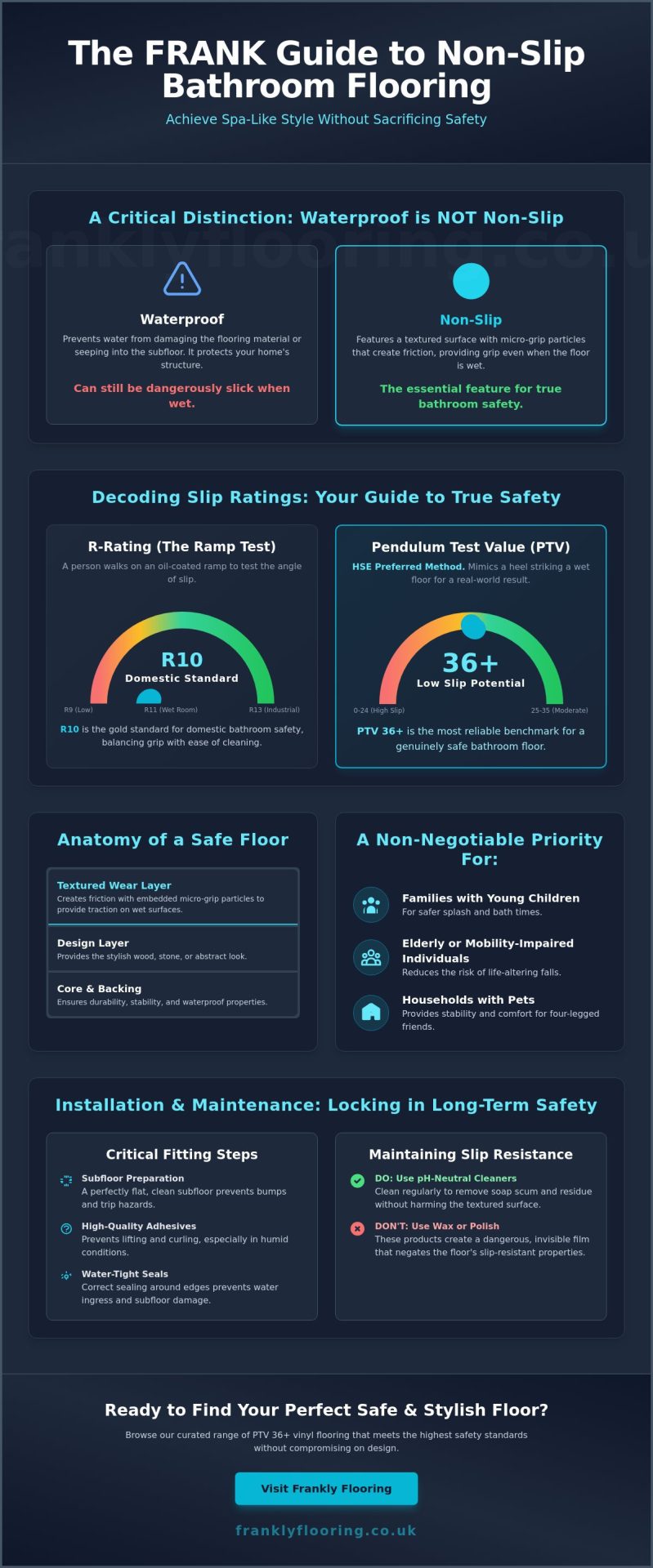
The bathroom is arguably the most demanding room in your home. You are dealing with steam, frequent splashes, and the unique challenge of bare feet on wet surfaces. Choosing non slip bathroom vinyl flooring isn’t just a design choice; it’s a fundamental safety decision. Many people confuse “waterproof” with “non-slip,” but they are entirely different concepts. A floor can be perfectly waterproof, meaning water won’t damage the material or seep into the subfloor, while still being as slippery as an ice rink when wet. You need both to ensure your bathroom remains a functional, safe space.
Let’s be frank: no floor is 100% slip-proof. If you cover any surface in enough soapy water, there’s a risk of a fall. However, high-quality modern vinyl is engineered to significantly reduce that risk. We’ve moved far beyond the “lino” of the past, which was often thin, shiny, and treacherous. Today’s vinyl is a sophisticated, multi-layered product designed for durability and grip. It’s a high-tech solution that provides a foundational element of safety without making your home look like a public facility.
The Anatomy of a Slip-Resistant Surface
The secret to safety lies in the wear layer. High-grade vinyl features a textured surface that creates friction even when moisture is present. Manufacturers often embed microscopic “grip” particles into this layer to enhance traction. This is where floor slip resistance testing becomes vital, as it provides a scientific measure of how a surface performs in wet conditions. When water hits a textured floor, the surface tension is broken by the raised grain or particles. This allows your feet to maintain contact with the floor rather than hydroplaning on a thin film of water.
Who Needs High-Slip Resistance Most?
While everyone benefits from a safer floor, certain households should make it a non-negotiable priority. Families with young children know that bath time often involves more water on the floor than in the tub. For elderly residents, a slip can have life-altering consequences, making a high-traction surface essential for maintaining independence. We also shouldn’t forget our four-legged friends; pets can struggle to find their footing on smooth surfaces, and a textured vinyl provides the stability they need to move around comfortably. It’s about creating a space where everyone feels secure, regardless of how much water ends up outside the shower tray.
Decoding Slip Ratings: Understanding R10, R11, and the Pendulum Test
When you’re browsing for new flooring, you will see “R” numbers everywhere. Most retail descriptions mention these ratings but rarely explain the mechanics behind them. We would rather be frank. An R-rating refers to the Ramp Test, where a person walks on an oil-coated incline to see exactly when they lose traction. These ratings range from R9, which offers very low friction, up to R13, which is essentially industrial-grade grip for commercial kitchens. For your home, R10 is the standard you should look for. An R10 slip resistance rating is the minimum requirement for a safe domestic bathroom.
While the Ramp Test is common, the UK Health and Safety Executive (HSE) prefers the Pendulum Test. This test uses a swinging weight to mimic a human heel striking the floor. It is a more accurate reflection of how a surface performs when it is actually wet. According to the HSE’s flooring assessment guide, a Pendulum Test Value (PTV) of 36 or higher is the benchmark for low slip potential. If you want a floor that truly delivers on the promise of non slip bathroom vinyl flooring, checking for a PTV of 36 or higher is the most reliable way to ensure your family’s safety. If you’re feeling overwhelmed by technical specs, you can always browse our curated range of quality vinyl options that meet these safety standards without looking like industrial safety gear.
R10 vs R11: Which One Do You Actually Need?
For a standard family bathroom where you use a bath mat and have a separate shower cubicle, R10 is usually the perfect balance. It is easy to clean and feels smooth underfoot. However, if you are designing a wet room where the entire floor will be saturated, R11 offers that extra bit of security. Just be aware that higher ratings often come with a more pronounced texture. This can make the floor slightly more stubborn when it comes to mopping up everyday grime and soap residue.
How Manufacturers Test for Safety
It is also vital to check how a product performs in barefoot conditions. Most R-ratings are “shod” tests, meaning they are performed with shoes on. For a bathroom, you should look for the DIN 51097 barefoot rating. A Class B rating is typically recommended for wet areas like bathrooms. Manufacturers also look for “DS” on labels, which stands for Dry Slip. While useful, it does not tell the whole story for a room prone to steam and splashes. Always prioritise the wet slip performance to ensure your non slip bathroom vinyl flooring does its job when it matters most.
Sheet Vinyl vs. LVT: Which is Safer for Your Bathroom?
Choosing between sheet vinyl and Luxury Vinyl Tile (LVT) usually comes down to two things: your budget and how much you value a seamless finish. Both options provide excellent non slip bathroom vinyl flooring, but they achieve safety in different ways. Sheet vinyl is the traditional choice for bathrooms because it can often be fitted as a single, continuous piece. This lack of seams is a significant advantage in wet environments, as it prevents water from seeping through to the subfloor and causing structural damage or mould. When you consult HSE’s guide to slip resistance testing, you will see that the focus is on how the surface performs when contaminated with water. In this regard, a seamless sheet is a very reliable barrier.
The frank truth is that your choice of material is only as good as the fitting. If LVT is fitted poorly, water can get into the joints, leading to tiles lifting and creating trip hazards. However, when fitted correctly, LVT offers superior durability and a much wider range of realistic textures. Many homeowners prefer the look of natural wood or stone, and LVT allows you to achieve this aesthetic without the high slip risk associated with polished tiles or traditional laminate flooring.
Why Sheet Vinyl Remains a Bathroom Favourite
Sheet vinyl is incredibly practical for smaller UK bathrooms. Most rolls come in widths of 2, 3, or 4 metres, meaning you can often cover the entire floor without a single join. Many modern sheet vinyls also feature a cushioned backing. This doesn’t just make the floor feel warmer underfoot; it also provides a slight “give” that can feel grippier to bare feet compared to a rock-hard surface. It remains the most cost-effective way to secure a safe, waterproof floor for rental properties or quick home refreshes.
The Case for Luxury Vinyl Tiles (LVT) in Wet Areas
If you are wondering what is lvt flooring exactly, it is a high-spec, multi-layered product that is significantly tougher than sheet vinyl. The 2026 trend for spa-inspired bathrooms has seen a surge in LVT use because the manufacturing process allows for deep, registered embossing. This means the texture you see on the “wood grain” or “stone” surface is actually there, providing physical friction that helps prevent slips. Rigid core LVT options are particularly popular now because they stay perfectly flat, reducing the risk of uneven edges that could catch a toe in the middle of the night. You get the high-end look you want with the non slip bathroom vinyl flooring performance you need.
Fitting for Safety: Subfloors, Adhesives, and Water-Tight Seals
You can buy the most expensive, high-spec product on the market, but it won’t keep you safe if the fitting is rushed. A poorly fitted floor can negate even the best slip rating. When we discuss non slip bathroom vinyl flooring, we aren’t just talking about the texture of the top layer. We are talking about how that material interacts with the ground beneath it. If your subfloor is uneven, your vinyl will eventually follow those contours, creating small dips where water can pool. These puddles are a major hazard, especially when you’re stepping out of a bath with wet feet. If you are planning a renovation, you can find all the necessary flooring accessories and materials to ensure your project is done right from the start.
Using a full-bond adhesive is another frank necessity for bathrooms. Some people try to “loose-lay” vinyl in smaller rooms to save time, but this is a mistake in a damp environment. Without a proper bond, temperature changes and moisture can cause the vinyl to expand and “bubble.” These ripples are more than just an eyesore; they are trip hazards waiting to happen. Once your floor is laid, sealing the perimeter with a high-quality silicone is your final line of defence. This prevents water from creeping under the edges and rotting your subfloor from the inside out, which would eventually cause the surface to become unstable and dangerous.
Preparing the Subfloor for Vinyl
Before any vinyl touches the ground, you must ensure the subfloor is dry and level. Use a damp meter to check for moisture, as any trapped dampness will eventually cause the adhesive to fail. If you’re fitting over floorboards, a layer of 6mm marine-grade ply is the industry standard to create a smooth base. For concrete floors, a self-levelling smoothing compound, often called screed, is essential. This ensures there are no pits or bumps that could compromise the stability of your new non slip bathroom vinyl flooring.
The Finishing Touches That Matter
Safety doesn’t stop at the edge of the vinyl. You need to consider the transitions between rooms. Using the correct door bars ensures a flush finish that won’t catch your feet as you walk through the house. If your bathroom leads onto a carpeted landing, you will need to use a sturdy carpet gripper to keep the adjacent flooring secure. Finally, always apply a neat bead of silicone around the base of toilets and basins. It’s a small detail, but it’s the only way to ensure water doesn’t find a way underneath your floor.
Maintaining Slip Resistance: How to Keep Your Bathroom Floor Safe for Years
Buying a high-quality floor is only half the battle. To ensure your non slip bathroom vinyl flooring remains effective, you must understand the factors that compromise its grip over time. The most significant hidden danger in any bathroom is soap scum. It creates an invisible, slippery film made of body oils, shampoo residues, and hard water minerals. This film sits on top of the vinyl’s texture, essentially acting as a lubricant between your foot and the floor. Even an R11-rated surface can become treacherous if it is coated in a layer of dried conditioner.
We need to be frank about “shine” products. Many homeowners are tempted to use wax-based cleaners or polishes to give their floor a brand-new glow. In a bathroom, these products are the enemy of safety. They work by filling in the microscopic textures and valleys of the vinyl to create a smooth, reflective surface. By doing this, they remove the very friction that makes the floor slip-resistant. Stick to a simple cleaning routine and avoid anything that promises a high-gloss finish. A clean, matte surface is a safe surface.
You might worry that the textured surface of non slip bathroom vinyl flooring is harder to keep clean than a smooth one. This is a common misconception. While the texture does require a bit more than a quick swipe with a dry cloth, it’s easily managed with a microfibre mop or a soft-bristled brush. A weekly deep clean ensures that no residue builds up in the grain, keeping the friction levels exactly where they need to be for barefoot safety.
The Best Cleaning Products for Non-Slip Vinyl
The safest choice for your floor is a pH-neutral cleaner. Harsh chemicals can degrade the wear layer over time, potentially reducing its lifespan. A common mistake is using too much detergent. When you use an excessive amount of soap, it doesn’t all get rinsed away; it leaves a sticky residue that actually attracts more dirt and creates a slip hazard. If you live in an area with hard water, you might notice white mineral spots. These can be handled with a very diluted white vinegar solution, but always rinse the area with clean water afterwards to prevent any acidic build-up.
Long-Term Care and Inspection
It’s a good habit to inspect your floor every few months for signs of wear. If you notice areas where the texture has been worn smooth, particularly in high-traffic spots like in front of the basin, it may be time to consider a replacement. While we often recommend engineered wood flooring for its warmth and character in living areas, vinyl remains the king of bathroom safety because of its total moisture resistance. If you spot deep scratches that hold water, address them quickly. A well-maintained vinyl floor should provide you with a safe, stylish foundation for well over a decade, provided you treat it with the straightforward care it deserves.
Step Into a Safer, More Stylish Bathroom
Choosing the right floor shouldn’t feel like a gamble. By understanding that an R10 rating is your baseline for safety and that a PTV score of 36 or higher offers low slip potential, you’ve already done the hard part. It’s clear that the success of your project depends on more than just the product; it’s about the quality of the subfloor preparation and your commitment to a straightforward cleaning routine. Whether you prefer the seamless nature of sheet vinyl or the high-end texture of LVT, you can achieve a beautiful look without the fear of a fall.
As a family-run business with over 20 years of expertise, we believe in providing the kind of straight-talking, “Frank” advice you’d expect from a trusted tradesperson. We don’t hide behind jargon or high-pressure tactics. Instead, we offer honest guidance to help you find the perfect non slip bathroom vinyl flooring for your home. Ready to start your project? Browse our full range of honest, high-quality bathroom vinyl flooring and enjoy the convenience of UK-wide delivery on all flooring and accessories. Your ideal bathroom is within reach, and we’re here to make sure it’s as safe as it is stunning.
Frequently Asked Questions
Is all vinyl flooring non-slip for bathrooms?
No, not all vinyl is suitable for wet areas. Standard vinyl can be incredibly slick when wet, so you must specifically look for products marketed as non slip bathroom vinyl flooring. These products feature a textured wear layer or embedded particles that provide a PTV score of 36 or higher, which is the HSE benchmark for low slip potential. Always check the technical specifications before you buy to ensure the product is fit for purpose.
What does an R10 slip rating actually mean?
An R10 rating indicates that the flooring has passed a specific Ramp Test where it remained stable at an incline between 10 and 19 degrees. It is widely considered the gold standard for domestic bathrooms because it balances safety with ease of cleaning. While R11 or R12 ratings offer even more grip, they often have a much rougher texture that can trap more dirt in a home environment.
Can I put non-slip vinyl over my existing bathroom tiles?
You can, but you must prepare the surface properly first. If you lay vinyl directly over tiles, the grout lines will eventually show through the surface, a process known as telegraphing. To avoid this, you should apply a thin layer of smoothing compound or screed over the tiles to create a perfectly flat subfloor. This ensures your new floor stays level and safe for years to come.
How do I clean non-slip vinyl without making it more slippery?
The key is to avoid any products that leave a residue, such as wax, polish, or all-in-one shine cleaners. These chemicals fill in the microscopic texture of the vinyl, making it much smoother and more dangerous when wet. Stick to a pH-neutral cleaner and a microfibre mop. This simple routine removes soap scum without compromising the friction levels of your non slip bathroom vinyl flooring.
Is LVT better than sheet vinyl for bathroom safety?
Neither is objectively better, as they offer different safety benefits. Luxury Vinyl Tile (LVT) often has deeper, more realistic textures that provide physical grip underfoot. Sheet vinyl, however, can be fitted as a single continuous piece, which eliminates seams where water could potentially seep through. Your choice should depend on whether you prioritise the textured grip of LVT or the seamless waterproof barrier of sheet vinyl.
Will a non-slip floor feel rough or uncomfortable on bare feet?
Not at all. Modern manufacturing techniques allow for registered embossing, which creates a texture that mimics natural wood or stone without being abrasive. While the surface provides the necessary friction to prevent slips, it remains comfortable and warm for bare feet. You won’t feel like you are walking on sandpaper; it just feels like a high-quality, natural material with a secure grip.
How long does the slip resistance on vinyl flooring last?
Slip resistance is engineered into the wear layer, so it should last as long as the floor itself. Most high-quality vinyl floors come with a residential warranty of 10 to 20 years. As long as you don’t use abrasive cleaning tools or harsh chemicals that strip the surface, the texture will remain effective. Regular cleaning is essential to prevent a build-up of soap scum, which is the most common cause of reduced grip.
What happens if water gets under my non-slip vinyl flooring?
Water trapped under the floor is a serious issue that can lead to subfloor rot and mould growth. Over time, this moisture can cause the adhesive to fail, leading to bubbling or tiles lifting, which creates dangerous trip hazards. This is why sealing the edges with silicone and ensuring a full-bond fitting is so important. If you suspect water has seeped under your vinyl, it’s best to address it immediately to prevent structural damage.