
Real stone tiles are often the most expensive way to get cold feet. It’s a common dilemma; you want the timeless look of slate or marble, but you don’t want the high cost of professional fitting or the sub-zero temperature underfoot. We understand that choosing tile effect laminate flooring can feel like a gamble if you’re worried about it looking cheap or failing in a busy kitchen.
Frankly, you deserve a floor that looks the part without the typical renovation headache. This guide will show you how to achieve a premium stone aesthetic while keeping your toes warm and your budget intact. We’ll provide the honest facts on the current $3.00 to $8.00 per square foot all-in pricing and explain why an AC3 rating is usually plenty for most homes. You’ll also learn how to identify genuine waterproof technology that survives a 24-hour immersion test, ensuring your new floor remains a foundational element of your home for the next 25 years.
Key Takeaways
- Learn why tile effect laminate flooring provides a warmer surface and more comfortable landing than real stone while significantly reducing your fitting costs.
- Understand how to decode AC ratings to ensure your new floor is durable enough for high-traffic kitchens without overpaying for unnecessary commercial-grade specifications.
- Discover the latest sync-structure textures and bevelled edge designs that make modern laminate look and feel indistinguishable from natural slate or marble.
- Get practical advice on the critical 48-hour acclimatisation period and why the layout of your first row is the most important step for a professional finish.
- Find out how to avoid hidden delivery surcharges and why choosing a curated range from a trusted specialist leads to a more reliable, long-term result for your home.
The Frank Truth: Why Choose Tile Effect Laminate Over Real Stone?
People often choose real stone because they believe it’s the only way to achieve a high-end look. Honestly, that hasn’t been true for years. While natural slate or marble looks stunning, it brings a set of challenges that many homeowners aren’t prepared for. Real stone is heavy, brittle, and incredibly cold. If you’re planning a renovation for an upstairs bathroom, the weight of stone tiles can even require structural reinforcement of your floor joists. Laminate flooring offers a clever alternative, providing the visual depth of natural materials without the structural burden.
The fitting process highlights the biggest difference. Traditional tiles require mortar, grout, and a wet saw, creating a mess that can take days to clear. In contrast, tile effect laminate flooring uses a precision-engineered click system. This allows the boards to float over your subfloor, snapping together securely without a drop of adhesive. It’s a straightforward process that works just as well in a modern kitchen as it does in a busy hallway.
Comfort and Warmth Underfoot
Ceramic and porcelain tiles are notorious heat sinks. During a typical British winter, they’ll pull the warmth straight out of your feet, making a trip to the kitchen for a morning coffee feel like a trek across an ice rink. Laminate provides much better thermal insulation. It doesn’t just look like stone; it offers a “softer” landing that’s kinder on your joints. Most high-quality boards now feature integrated foam layers or high-density cores that trap heat rather than letting it escape. If you have underfloor heating, you’ll find that laminate reaches a comfortable temperature far quicker than heavy stone or thick porcelain.
The Real Cost of Fitting: Tile vs. Laminate
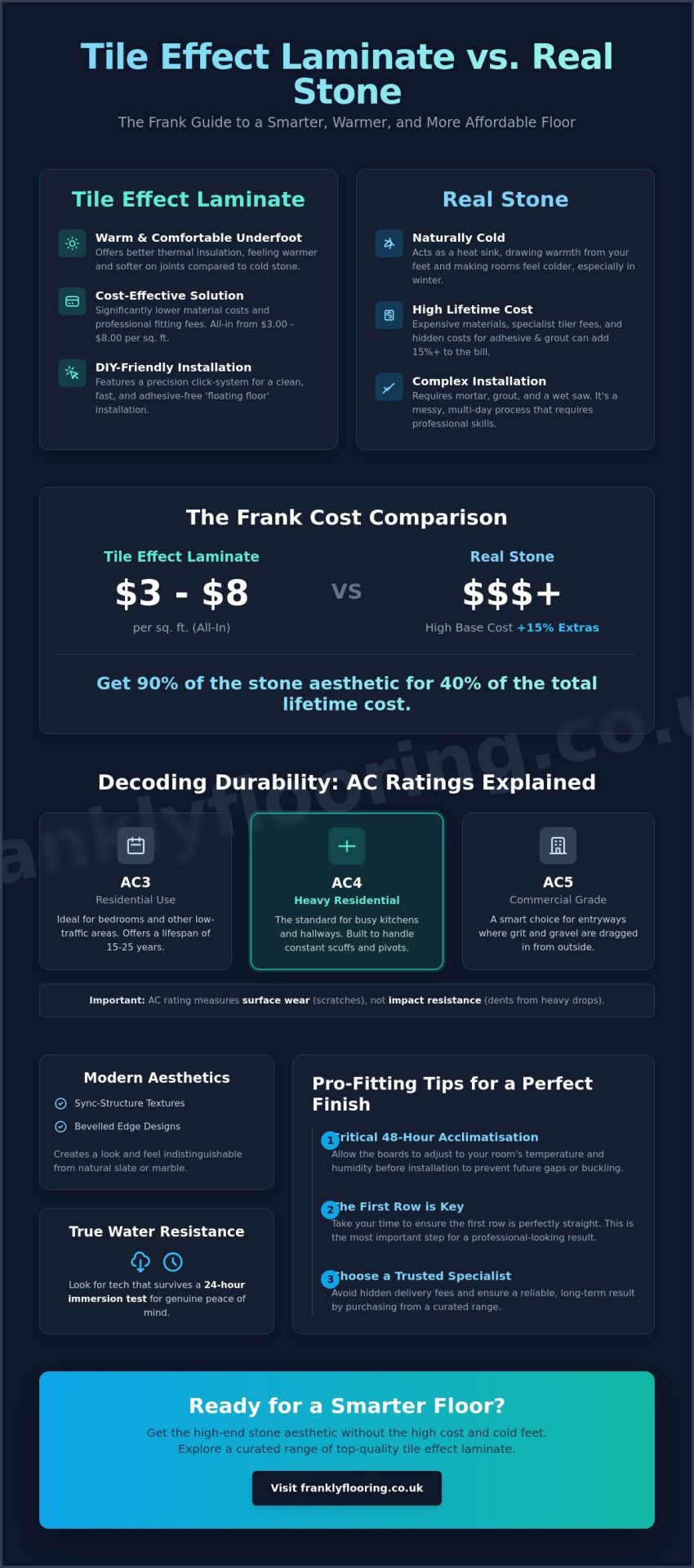
Let’s look at the numbers frankly. According to verified May 2026 data, the all-in cost for materials and professional fitting of tile effect laminate flooring typically ranges from $3.00 to $8.00 per square foot. If you choose real stone, you aren’t just paying more for the materials; you’re paying for a specialist tiler whose day rate is significantly higher than a standard floor fitter.
- Hidden Extras: Real tiles require bags of adhesive, grout, and spacers, which can add 15% to your total bill.
- Preparation Costs: Removing old tile or hardwood can cost between $1.50 and $2.00 per square foot before the new floor even arrives.
- Fitting Fees: Professional laminate fitting adds roughly $1.50 to $4.00 per square foot, but because it’s a DIY-friendly click system, many homeowners choose to handle the job themselves to save that cost entirely.
By choosing a laminate alternative, you’re essentially getting 90% of the stone aesthetic at roughly 40% of the total lifetime cost. It’s a practical, honest compromise that doesn’t feel like a compromise once it’s under your feet.
Understanding the Technical Specs: AC Ratings and Water Resistance
Choosing a floor isn’t just about the colour. It’s about how that colour looks after five years of children, pets, and dropped house keys. The industry uses the AC (Abrasion Class) rating system to tell you exactly how much punishment a board can take. While some shops focus solely on thickness, we prefer to talk about the wear layer. This transparent top coating is what prevents your stone pattern from fading into a dull grey blur over time. Standards set by the North American Laminate Flooring Association ensure these ratings are verified performance benchmarks rather than just marketing fluff.
The printed design on tile effect laminate flooring is protected by a resin-based wear layer. In a bedroom, an AC3 rating is perfectly fine and can last between 15 and 25 years. In a kitchen, where crumbs act like sandpaper under your shoes, you’ll want AC4. This rating tells you the surface won’t wear through, keeping the stone aesthetic sharp even in high-traffic zones. It’s a technical detail that makes a massive difference to the longevity of your home’s character.
AC4 vs AC5: Choosing the Right Durability
AC4 is the standard for busy family kitchens and hallways. It’s built to handle the constant pivot and scuff of a high-traffic area without losing its sheen. AC5 is technically commercial-grade, but it’s a smart choice for entryways where grit and gravel are frequently dragged in from the street. You should remember that an AC rating measures surface wear; it doesn’t measure impact resistance. Even an AC5 floor can dent if a heavy cast-iron pan is dropped from a height, so don’t confuse surface hardness with being bulletproof.
Hydrophobic Tech: Is It Truly Kitchen-Safe?
Can tile effect laminate flooring really handle a bathroom spill? The short answer is yes, provided it meets the current NALFA waterproof standards. For a product to be marketed as waterproof in 2026, it must undergo a 24-hour water immersion test with zero swelling. This is a significant step up from the “water-resistant” labels of the past. Modern boards often feature hydrophobic coatings on the edges and sealed joints to prevent water from seeping into the HDF core.
While Luxury Vinyl Plank (LVT) is inherently waterproof, high-end laminate often outperforms it in scratch resistance. To keep your warranty valid, you should still wipe up major spills within the manufacturer’s stated timeframe, which is often up to 300 hours for premium ranges. If you’re unsure which technical spec fits your specific room, you can always speak with our team for some honest, straightforward advice. We’ll help you find a balance between durability and your project budget without the usual sales pressure.
Exploring Styles: From Rustic Slate to Modern Marble
The biggest fear most homeowners have is that their new floor will look “fake” or cheap once it’s fitted across a large area. Frankly, that was a valid concern ten years ago, but the technology has moved on. Today, the most realistic tile effect laminate flooring uses a process called Embossed-in-Register (EIR) or sync-structure. This means the physical texture of the board perfectly aligns with the printed image. If you see a vein in a marble slab or a cleft in a piece of slate, you can feel it with your fingertips. These aesthetic advancements are often backed by NALFA Certification Standards, which ensure that the visual depth doesn’t compromise the board’s surface integrity.
When you’re browsing styles, you’ll need to choose between bevelled edges and flat-fit boards. Bevelled edges create a small “V” groove between the planks, which mimics a traditional grout line and adds a sense of individual tile definition. If you prefer a seamless, monolithic look, flat-fit boards are better, though they require a perfectly level subfloor to avoid “lipping.” For those choosing bevelled options, we always recommend a mid-to-dark grout tone. Light-coloured grout lines on laminate can trap microscopic dust over time, while darker tones stay looking fresh for years.
Stone and Slate Effects for Traditional Homes
Deep-textured slate effects are a staple for country-style kitchens and utility rooms. One of the practical benefits of a multi-tonal slate design is its ability to hide the small messes of daily life. Pet hair, dried mud, and dust tend to disappear into the varied shades of grey, charcoal, and ochre. If you have dark slate flooring, try pairing it with light-coloured cabinetry or off-white walls. This contrast prevents the room from feeling closed in while highlighting the rugged, natural character of the “stone” underfoot.
Polished Marble and Industrial Concrete Aesthetics
For a more modern UK apartment or a sleek bathroom, industrial concrete and polished marble are the standout choices for 2026. You can achieve a high-end hotel look with large-format marble tiles without the slip hazards or the high cost of the real material. Large-format tile effect laminate flooring is particularly effective in small spaces. By reducing the number of visible joints, you trick the eye into seeing a larger, more expansive floor area. Whether you opt for the cool tones of honed concrete or the classic warmth of white Carrara marble, these modern finishes provide a sophisticated foundation that feels both bespoke and timeless.
The Practical Guide to Fitting Your Tile Laminate
Fitting tile effect laminate flooring is a project many homeowners tackle themselves. It’s rewarding, but you have to be honest about the preparation. Before you even open a pack, those boards need to sit in the room for 48 hours. This acclimatisation period prevents the core from expanding or shrinking after it’s been clicked into place. If you skip this, you risk the joints popping or the boards buckling during the first change in seasonal humidity.
The first row is your foundation. Unlike wood-effect planks where a slight angle might go unnoticed, tile patterns are unforgiving. If your first row isn’t perfectly square to the room, your “grout lines” will visibly drift as you move across the floor, making the whole room look crooked. You’ll need a tapping block, spacers, and a pull bar. You can do without expensive professional jigs, but don’t try to fit around radiator pipes without a decent 12mm drill bit and a sharp saw for clean, circular cuts.
Subfloor Preparation: The Secret to a Seamless Look
One major reason people think laminate looks fake is poor subfloor preparation. If your subfloor has more than a 3mm deviation over a two-metre stretch, the “tiles” will bounce and the joints will eventually fail. You must ensure the surface is dry and level. If you’re fitting over concrete, a damp-proof membrane (DPM) is essential to protect the HDF core from rising moisture. When transitioning to other rooms, using a carpet gripper transition correctly ensures a flush finish that maintains the illusion of heavy stone without a trip hazard.
Choosing the Right Underlay for Tile Laminate
Don’t reach for the cheapest foam underlay you can find. For tile effect laminate flooring, you need a high-density underlay. This provides a solid base that prevents the “bounce” often associated with cheaper installations. It also helps with acoustics, which is vital for upstairs bathrooms or flats where you want to dampen the sound of footsteps. For a deeper dive into the technical side of the process, our Laminate Flooring UK Guide covers general fitting tips in more detail.
Dealing with doorways is often the most frustrating part of the job. We recommend undercutting the door architraves so the floor can slide underneath. It looks much cleaner than trying to cut the board around the wood. If you’re feeling overwhelmed by the technicalities of the layout, you can always book a professional measurement with our team. We’ll give you a straightforward assessment of your subfloor and help you avoid the common pitfalls of a DIY install.
Finding Quality Tile Effect Laminate at Frankly Flooring
Choosing where to buy your flooring is just as important as the material itself. At Frankly Flooring, we’ve spent over 20 years helping homeowners find the right balance between style and durability. We don’t believe in high-pressure sales or hidden extras. When you browse our collection of tile effect laminate flooring, the price you see is the price you pay. We’ve eliminated those frustrating delivery surcharges that often appear at the final stage of a checkout, ensuring our process remains as transparent as our name suggests.
We know that a floor is a foundational element of your home’s character. That’s why we only curate designs that we would be happy to fit in our own houses. We’ve seen every trend come and go since the early 2000s, and we’ve learned that quality always outlasts a quick bargain. Our team is here to provide an advisory role, guiding you through the technical nuances of AC ratings and subfloor preparation without the corporate coldness of larger retailers.
Our Honest Approach to Quality
We are incredibly selective about the brands we stock. You won’t find “bargain-bin” 7mm boards in our showroom because we know they won’t stand up to the rigours of a busy UK home. Every product in our range is chosen for its realistic texture and robust wear layer. We provide detailed technical specifications for every single plank, from the specific AC rating to the moisture-resistance levels. If your project involves a room prone to significant standing water, we’ll be the first to tell you if laminate isn’t the best fit. In those specific cases, you might want to read our guide on What Is LVT Flooring? for a 100% waterproof alternative.
Seamless National Delivery Across the UK
Getting your floor from our warehouse to your front door in perfect condition is our priority. We use specialist couriers who understand that tile effect laminate flooring packs are heavy and can be brittle at the edges if mishandled. If something isn’t right, our returns policy is straightforward and honest. We want you to be confident in your choice, which is why we encourage ordering samples. Seeing the stone texture in your own natural light is the only way to be certain it matches your vision.
Before you commit to your purchase, run through this final checklist for a stress-free experience:
- Have you measured the room twice and added 10% for cutting waste?
- Is your subfloor level within the required 3mm tolerance?
- Have you selected a high-density underlay to prevent joint bounce?
- Do you have the correct transition strips for your doorways and carpet joins?
If you’ve checked those boxes, you’re ready to achieve that premium stone look. We’re here to ensure the process is as seamless as the final result.
Step Into Your New Stone-Look Floor
Achieving the premium look of natural slate or marble doesn’t have to mean living with cold feet or a drained bank account. We’ve explored how modern tile effect laminate flooring provides the thermal warmth and durability needed for busy UK kitchens, especially when you choose the correct AC4 rating. By focusing on proper subfloor preparation and high-density underlay, you can ensure a professional finish that stands the test of time in any residential setting.
As a family-run business with over 20 years of industry experience, we take pride in offering straightforward advice and no-nonsense, transparent pricing. We handle the logistics with seamless national UK delivery, ensuring your boards arrive in perfect condition without hidden surcharges. There are no high-pressure tactics here; just quality products and honest expertise that you can trust with your house keys.
Browse our range of Frank-approved tile effect laminate flooring today and find the perfect foundation for your home’s character. You’re now equipped with the facts to make a choice that looks great and performs even better.
Frequently Asked Questions
Is tile effect laminate flooring suitable for bathrooms?
Yes, modern tile effect laminate flooring is suitable for bathrooms if it carries a waterproof rating. Look for products that meet the NALFA 24-hour immersion standard. These boards use sealed edges and moisture-protected cores to prevent swelling. You should still wipe up large puddles promptly to protect the long-term integrity of the click joints.
How do I clean tile effect laminate without damaging the surface?
Use a microfibre mop that is damp to the touch, not dripping wet. Avoid steam cleaners entirely; the high-pressure heat can force moisture into the core and cause the edges to peel. Stick to pH-neutral cleaners specifically formulated for laminate. This keeps the resin-based wear layer clear of streaks without using harsh abrasives that could dull the stone-effect finish.
Can I install tile effect laminate over existing ceramic tiles?
You can install laminate over ceramic tiles if the subfloor is level and the tiles are securely fixed. If your grout lines are deeper than 3mm, you’ll need to fill them or use a high-density underlay to create a flat surface. This prevents the click joints from flexing and eventually snapping when you walk over the gaps in the old floor.
Do I need a special underlay for tile effect laminate flooring?
Yes, a high-density underlay is essential for tile-effect planks to prevent joint “bounce.” Standard, low-cost foam is too soft and allows the boards to move, which puts unnecessary stress on the click system. A denser base also improves the acoustic feel, making the floor sound more like solid stone and less like hollow plastic when walked upon.
How long does tile effect laminate flooring typically last?
High-quality tile effect laminate flooring typically lasts between 15 and 25 years. This lifespan depends on the AC rating you choose and the volume of foot traffic in the room. For instance, an AC4 rated board in a hallway will hold its appearance much longer than an AC3 board in the same high-traffic area, provided it is maintained correctly.
Does tile effect laminate look fake compared to real stone?
Modern laminate doesn’t look fake thanks to Embossed-in-Register (EIR) technology. This process syncs the physical texture of the board with the printed stone image, so you feel every cleft and vein. While it isn’t real stone, the 2026 printing standards make it incredibly difficult to spot the difference once the floor is fitted and the furniture is in place.
Is tile effect laminate flooring pet-friendly?
Laminate is exceptionally pet-friendly because the top wear layer is harder than most natural wood or LVT surfaces. It resists scratches from claws and is easy to sanitise after accidents. We recommend an AC4 rating for households with large dogs, as it provides the surface hardness needed to keep the floor looking new during daily activity.
What is the best AC rating for a kitchen tile effect laminate?
AC4 is the honest recommendation for a kitchen. It’s designed to withstand the constant scuffing of a high-traffic area where grit and crumbs can act like sandpaper. While AC3 is fine for a guest bedroom, the kitchen needs that commercial-grade durability to ensure the stone pattern remains sharp and doesn’t wear through in front of the sink or cooker.