
What if the most expensive flooring option isn’t actually the best one for your home? When you’re weighing up sheet vinyl vs lvt flooring, it’s easy to assume that a higher price tag automatically means a better result, but that isn’t always the case. Many homeowners worry that choosing vinyl means sacrificing a high-end look for a “cheap” finish, or they feel overwhelmed by conflicting advice on installation costs and water resistance.
We understand those concerns because we’ve seen how the wrong choice can lead to wasted money and avoidable repairs. That’s why we’re taking a frank look at these two popular options to help you find the right balance between style and durability. You deserve a floor that handles the daily chaos of a busy household while looking like it cost a fortune.
In this guide, we’ll explain why sheet vinyl is often the superior choice for seamless waterproofing in bathrooms, while LVT offers unmatched modular style for high-traffic areas. We’ll also break down the technical nuances of each product and the genuine price-to-value ratio. This will give you the clarity you need to decide which floor you can fit yourself and which might require a professional hand.
Key Takeaways
- Understand the physical differences between continuous rolls and modular tiles so you can choose a floor that fits your room’s specific layout.
- Learn how the technical construction of sheet vinyl vs lvt flooring affects scratch resistance and helps you avoid a “cheap” finish in high-traffic areas.
- Discover why the seamless nature of sheet vinyl provides a technical advantage for waterproofing in bathrooms and en-suites.
- Compare the modular ease of LVT click systems against the high-stakes precision of cutting sheet vinyl to determine your best DIY route.
- Identify which rooms justify the higher investment of LVT and where a budget-friendly vinyl roll actually performs better for your home.
What is the Difference Between Sheet Vinyl and LVT Flooring?
Understanding the technical gap between sheet vinyl vs lvt flooring is the first step toward a successful home renovation. While both products are made primarily from PVC, they serve very different purposes in a British home. To be perfectly frank, the choice often comes down to whether you need a seamless “skin” or a structural, modular floor. One is designed to cover a space in a single, continuous sweep, while the other is built to mimic the individual planks of real wood or the heavy tiles of natural stone.
Sheet vinyl is a flexible material that arrives as a large roll, typically in standard widths of 2m, 3m, or 4m. It’s often called “cushion floor” because of its softer, more pliable nature. In contrast, Luxury Vinyl Tile (LVT) consists of individual, rigid units. These are either “click-fit” planks that lock together or “dry back” tiles that are glued down. The “luxury” in LVT isn’t just a marketing buzzword; it refers to the enhanced core stability and much thicker wear layers that make it a more permanent fixture than traditional roll vinyl.
Composition and Construction
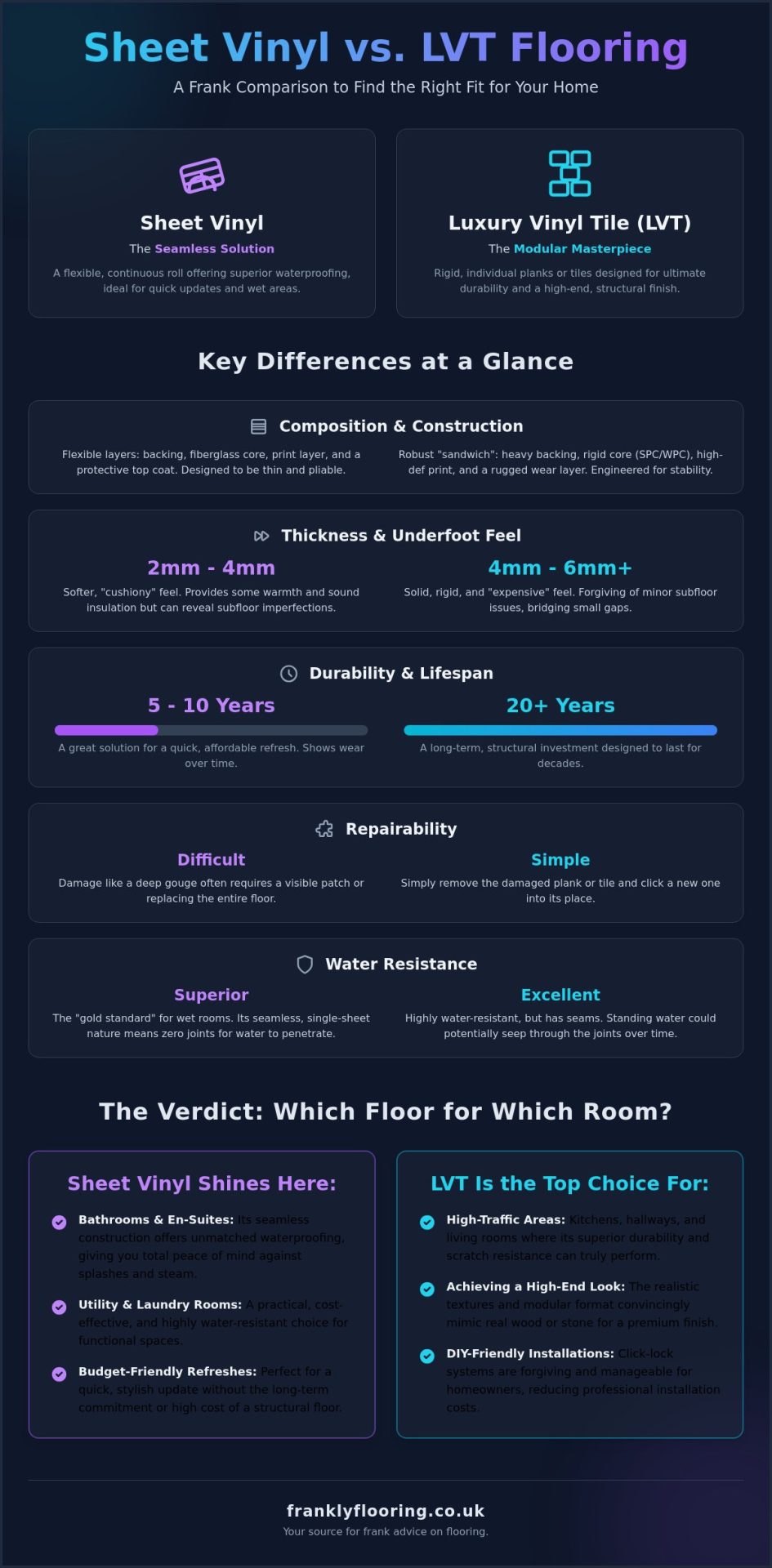
The construction of these two materials reveals why they perform so differently. Sheet vinyl flooring is usually composed of a backing layer, a fiberglass core for stability, a printed design layer, and a clear protective top coat. It’s designed to be thin and flexible enough to roll out and trim with a utility knife.
LVT takes a more robust approach. It’s built like a high-tech sandwich. It features a heavy-duty backing, a rigid core (often made of stone or wood polymer composites), a high-definition print layer, and a rugged wear layer. Understanding what is lvt flooring helps you see why it represents such a leap in technology. It’s essentially a modular version of a high-end floor, engineered to withstand the pressure of heavy furniture and high foot traffic without indenting.
Thickness and ‘Foot-Feel’
The physical sensation underfoot is a major differentiator. Thicker sheet vinyl, often ranging from 2mm to 4mm, can feel “squishy” or bouncy. This provides a bit of natural warmth and sound insulation, which is a bonus in older UK properties with drafty floorboards. However, this flexibility comes with a trade-off. If your subfloor isn’t perfectly smooth, thin sheet vinyl will “telegraph” every bump, screw head, or uneven floorboard underneath. You’ll literally see the imperfections of your house through the floor.
LVT is much more forgiving of subfloor sins. Because the planks are rigid and often 4mm to 6mm thick, they bridge minor gaps and lumps rather than sinking into them. The result is a floor that feels solid and “expensive” underfoot, much like real timber. While LVT is harder, it’s still warmer than ceramic tile, making it a comfortable choice for kitchens where you spend long periods standing.
Durability and Performance: Which Floor Lasts Longer?
When you’re choosing between sheet vinyl vs lvt flooring, you aren’t just picking a pattern; you’re deciding how often you want to replace your floor. The frank reality is that these two products occupy very different spaces on the lifespan spectrum. Sheet vinyl is typically a five to ten year solution. It’s fantastic for a quick, affordable refresh, but it eventually shows its age through thinning or surface wear. In contrast, a high-quality LVT is a structural investment designed to last twenty years or more in a standard residential setting.
One major difference lies in repairability. If you drop a heavy cast iron pan and gouge the floor, sheet vinyl offers no easy fix. You’re often left with a visible patch or the need to replace the entire room. LVT wins this round hands down. Because it’s modular, you can simply pop out the damaged plank and click a new one into place. It’s a much more forgiving choice for clumsy cooks or busy families with young children.
The Battle of the Seams
While LVT wins on overall longevity, sheet vinyl holds a hidden technical advantage in wet rooms. It’s the gold standard for bathrooms because it’s a single, continuous sheet. There are zero joints for water to penetrate. In a space where spills and steam are constant, this seamless nature provides total peace of mind. LVT is highly water-resistant, but it isn’t bulletproof. Standing water can eventually seep into the joints, potentially weakening the bond or affecting the subfloor if left too long.
If you’re fitting LVT in a kitchen where leaks are a risk, you’ll need to be more diligent. Ensuring a tight fit and using the correct carpet adhesive spray or perimeter sealant can help mitigate these risks. However, for a high-moisture en-suite, the “one-piece” logic of sheet vinyl is hard to beat. You can browse our latest vinyl bargains to see just how affordable these waterproof solutions can be.
Scratch and Scuff Resistance
Scratch resistance is where LVT truly justifies its price point. When looking at lvt flooring, pay close attention to the wear layer, usually measured in millimetres. A 0.3mm layer is fine for bedrooms, but a 0.5mm or 0.7mm layer is what you want for hallways and kitchens. This transparent top coating is incredibly tough. It’s designed to withstand the benefits of LVT flooring like antimicrobial properties and high-traffic durability.
Sheet vinyl is much more prone to tearing. If you’ve ever tried to slide a washing machine across roll vinyl, you probably know the sinking feeling of seeing a fresh rip. Pets with long claws and high heels also pose a higher risk to sheet vinyl than they do to the rigid surface of LVT. If your home involves heavy appliances, energetic dogs, or constant foot traffic, the extra durability of a modular tile is usually worth the upfront cost.
Aesthetics: Achieving the ‘High-End’ Look on a Budget
The fear of a floor looking “cheap” is the biggest hurdle for many homeowners. We’ve all seen the dated, shiny vinyl of the past that looked more like plastic than stone. However, modern manufacturing has closed the gap between budget-friendly options and luxury materials. When comparing sheet vinyl vs lvt flooring from a purely visual perspective, the winner usually depends on the specific look you want to achieve. If you’re after a floor that is indistinguishable from real oak or slate, LVT is the clear leader. If you want a bold, decorative statement, sheet vinyl might actually be the smarter play.
LVT uses high-definition 3D printing and sophisticated layering to create a sense of depth. In a large room, sheet vinyl can sometimes suffer from “pattern repeat,” where the same knot in the wood or vein in the stone appears every few feet. Because LVT is made of individual planks or tiles, the patterns are shuffled during installation. This creates a much more natural, random appearance that mimics the organic variation of real timber or stone.
Bevelled Edges and Texture
The secret to LVT’s realism lies in the texture. Many high-end LVT ranges feature “Registered Embossed” finishes. This means the physical texture of the plank perfectly matches the visual grain of the wood print. If you see a knot in the wood, you’ll feel a dip in the surface. LVT also uses bevelled edges to create a tiny “V” groove between planks. This creates a shadow line that makes each piece look like an individual board rather than a flat, printed sheet.
Sheet vinyl generally stays smooth, but it excels in other areas. It’s the perfect canvas for:
- Victorian-style geometric tiles
- Bold, colourful patterns
- Abstract designs that would be difficult to align with modular tiles
Modern sheet vinyl patterns can often look more intentional and stylish than a bottom-tier, “budget” LVT that lacks realistic texture.
Large Spaces vs. Small Rooms
In the UK, most sheet vinyl comes in standard widths of 2m, 3m, or 4m. If your living room is wider than 4 metres, you’ll have to join two pieces together. These joins are difficult to hide and can ruin the aesthetic of an open-plan space. This is where LVT or even high-quality laminate flooring becomes the better choice. Modular planks allow you to cover any width without visible seams.
In smaller, odd-shaped rooms like hallways or utility rooms, sheet vinyl is easier to manage aesthetically. You can cut the entire shape from one piece, ensuring a clean look without worrying about how small “slivers” of tile might look at the edges. It’s about choosing the right tool for the job. Don’t let the “luxury” label fool you; sometimes a well-chosen vinyl roll is the more honest, stylish choice for a specific space.
Installation: DIY Friendliness and Hidden Costs
Many retailers claim that fitting a new floor is a simple weekend task. To be perfectly frank, that depends entirely on which product you choose and how much patience you have. When you’re comparing sheet vinyl vs lvt flooring, the installation process is where the two diverge most sharply. One is a high-stakes game of precision cutting; the other is a modular puzzle that requires more time but offers a much larger safety net for beginners.
Sheet vinyl installation is often described as a “one-shot” cut. You get one chance to trim that large roll into your room. If your utility knife slips while you’re scribing around a door frame or if you miscalculate the width of a 4m roll, there is no “undo” button. You’re left with a visible gap or a wasted roll of material. LVT is far more forgiving for the DIY enthusiast. If you cut a plank too short, you simply set it aside and grab another one. Your mistake costs you a single tile rather than the entire floor.
The DIY Difficulty Scale
Scribing sheet vinyl around complex shapes like toilets, pedestals, or radiator pipes is a genuine technical skill. It requires careful relief cuts and a steady hand to ensure the material lies flat without bunching. Click-lock LVT removes much of this stress. The “Lego-like” assembly allows you to work across the room plank by plank. It’s a slower process, but it’s significantly easier to achieve a professional finish without prior experience. Just remember that carpet gripper should never be used for these installs. Vinyl products need a smooth, flat perimeter to prevent tearing and ensure a clean seal.
Adhesives and Fixatives
The size of your room usually dictates your adhesive choice for sheet vinyl. In small UK bathrooms or utility rooms (typically under 12 square metres), you can often “loose-lay” the vinyl using only double-sided tape at the edges. In larger open-plan spaces, you’ll need a full-bond adhesive to prevent the material from bubbling or shifting over time. LVT typically requires either a specific underlay for click systems or a pressure-sensitive adhesive for dry-back tiles.
Don’t overlook the hidden costs of subfloor preparation. Neither floor will look good over uneven floorboards or pitted concrete. You’ll likely need to budget for 6mm plywood or a self-levelling compound to create a perfectly flat surface. While this adds to the initial project cost, skipping this step is the most common cause of floor failure. If you’re ready to start your project, you can browse our current vinyl and LVT bargains to find the best value for your budget.
The Verdict: Which Room Wins Which Floor?
Deciding on sheet vinyl vs lvt flooring often feels like a trade-off between your bank balance and your Pinterest board. Let’s be blunt: there is no single winner, only the right choice for the specific room you’re standing in. We believe in being honest about where you can save money and where you really shouldn’t. If you’re refreshing a rental property, sheet vinyl is the pragmatic choice. It’s affordable to install and easy to replace when tenants move on. However, if you’re renovating your “forever home,” the longevity of LVT usually justifies the higher upfront cost.
The “Frank” rule of thumb is simple. Buy the best you can afford for the rooms you live in most. You don’t want to be looking at a worn-out, scuffed hallway in three years because you tried to save a few quid on a thinner material. Conversely, putting premium LVT in a rarely used guest en-suite might be over-engineering a space that would be perfectly served by a stylish, seamless vinyl roll.
Room-by-Room Recommendation
Every room has a different set of demands. In living rooms, LVT provides the structural integrity needed to support heavy furniture without leaving permanent indentations. It creates a polished, high-end atmosphere that works as a foundational element of your home’s character. Utility rooms, however, are prone to washing machine leaks and mud. In these spaces, the seamless nature of sheet vinyl offers superior “flood protection” and is much easier to wipe clean.
Bedrooms are another area where sheet vinyl can shine. While it’s less durable than tile, it offers a cushioned warmth and soft “foot-feel” that LVT can’t quite match. It’s a comforting choice for bare feet on a cold UK morning. For kitchens and high-traffic hallways, we always lean toward LVT. The scratch resistance and modular repairability make it the only sensible choice for the busiest parts of a British household.
Cost vs. Value Analysis
When you look at the initial purchase price, the gap is clear. Sheet vinyl represents the entry-level (£) of the market, while LVT sits firmly at the premium end (£££). But you have to look at the long-term value. LVT adds genuine resale appeal to a property. Most UK buyers view it as a permanent, high-quality feature, whereas they might see sheet vinyl as something they’ll need to replace eventually.
The honest conclusion when choosing between sheet vinyl vs lvt flooring is that you should never put a five-year floor in a twenty-year room. If you plan on staying in your home for the long haul, invest in the durability of LVT for your main living areas. If you’re on a tight budget or tackling a room with high moisture risks, a high-quality vinyl roll is a technically sound and stylish alternative. Whatever you choose, ensure your subfloor is flat, your measurements are precise, and your expectations are realistic.
Ready to Invest in Your New Floor?
Choosing between sheet vinyl vs lvt flooring doesn’t have to be a gamble once you understand the technical strengths of each. Remember that LVT offers superior scratch resistance and modular repairability for busy hallways, while sheet vinyl provides a seamless, waterproof barrier that is hard to beat in a family bathroom. Your decision should always balance the specific needs of your room with the reality of your budget and DIY confidence.
We’ve spent over 20 years helping UK homeowners navigate these choices with honest, straightforward advice. As a family-run business, we take pride in our craftsmanship and our commitment to a stress-free experience. We offer direct-to-door national delivery on all our products, ensuring you get high-quality materials without the high-pressure sales tactics.
Frankly, we have the best of both worlds; browse our LVT and Sheet Vinyl ranges here. You now have the clarity needed to choose a floor that looks high-end, handles the daily chaos of home life, and offers genuine long-term value. Good luck with your project.
Frequently Asked Questions
Is sheet vinyl or LVT better for bathrooms?
Sheet vinyl is generally the better choice for bathrooms because it is a single, seamless surface. While LVT is highly water-resistant, standing water can eventually seep into the joints between the tiles or planks. For a high-moisture environment like a family bathroom or en-suite, the one-piece construction of a vinyl roll provides the best protection against leaks.
Can I lay LVT over existing sheet vinyl?
You should not lay LVT directly over existing sheet vinyl. The soft, flexible nature of the old vinyl creates an unstable base that puts too much pressure on the LVT click joints. Over time, this “spongy” feeling will cause the joints to crack or gap. It is always best to strip back to the subfloor and ensure it is flat and rigid before starting your new installation.
Does sheet vinyl need underlay like LVT does?
When comparing sheet vinyl vs lvt flooring, the underlay requirements are very different. Most modern sheet vinyl has a built-in foam or felt “cushion” backing, so it doesn’t require a separate underlay. LVT click systems usually require a specific, high-density underlay to support the locking mechanisms and provide sound insulation between floors.
Which is easier to clean: sheet vinyl or luxury vinyl tiles?
Sheet vinyl is slightly easier to clean because it has no seams or bevelled edges where dirt and crumbs can hide. You can simply sweep and mop the entire surface without worrying about debris getting trapped in grooves. LVT is still very low-maintenance, but the textured surface and joins might require a little more attention during your weekly deep clean.
Is LVT more expensive to install than sheet vinyl?
LVT is typically more expensive to install because the process is much more labour-intensive. Fitting individual planks around door frames and complex corners takes significantly longer than trimming a single roll of vinyl. You also need to factor in the extra cost of specialized underlays or the pressure-sensitive adhesives required for a professional finish.
Will my heavy furniture dent sheet vinyl floors?
Heavy furniture will likely leave permanent indentations on sheet vinyl because it is a softer, more flexible material. If you plan to place heavy wardrobes or sofas on roll vinyl, you should use furniture cups to distribute the weight. LVT is much more resistant to denting thanks to its rigid, high-density core, which makes it better suited for living rooms and bedrooms with heavy pieces.
Can I use either type with underfloor heating?
Both flooring types are compatible with underfloor heating, but you must ensure the system does not exceed the manufacturer’s recommended temperature. In most cases, the surface temperature should stay below 27°C to prevent the material from warping or the adhesive from failing. LVT is often slightly more efficient at conducting heat because it is a denser material.
Why is my sheet vinyl floor bubbling or lifting?
Bubbling in sheet vinyl vs lvt flooring installations usually happens because the material wasn’t bonded correctly to the subfloor. In larger rooms, “loose-laying” the vinyl can cause it to shift and trap air as the temperature in your home changes. It can also be caused by moisture trapped in the subfloor, which forces the vinyl upward as it tries to escape.