
Spending a small fortune on solid oak parquet is no longer the only way to get a high-end home. In fact, for most busy British households, it’s often the wrong choice. You want that classic, sophisticated pattern underfoot, but you’re likely worried about it looking fake or failing the first time the kids spill a drink. It’s a common concern, especially when you’re faced with technical talk about subfloor prep and wear layers that feels designed to confuse rather than help.
This is our frank, no-nonsense guide to herringbone lvt flooring in 2026. We’re skipping the marketing fluff to give you the honest truth about achieving a luxury look on a realistic budget. We will explain the practical differences between click and glue-down systems, why a 0.55mm wear layer is the gold standard for durability, and how to measure accurately to avoid overspending on wastage. By the end, you’ll have the confidence to choose a floor that handles pets, spills, and heavy foot traffic while looking like a designer masterpiece.
Key Takeaways
- Learn the practical differences between click and glue-down systems to choose the right installation method for your subfloor’s condition.
- Discover why herringbone lvt flooring is the superior choice for kitchens and bathrooms, offering a waterproof finish that never needs sanding or waxing.
- Master the planning process by calculating a 10-15% wastage margin to ensure you have enough planks for the intricate staggered pattern.
- Understand why acclimatising your floor for at least 24 hours is a non-negotiable step for a stable, professional-looking result.
- Find your ideal match by testing physical samples of traditional oak and modern grey styles in your own room’s specific lighting.
What is Herringbone LVT Flooring?
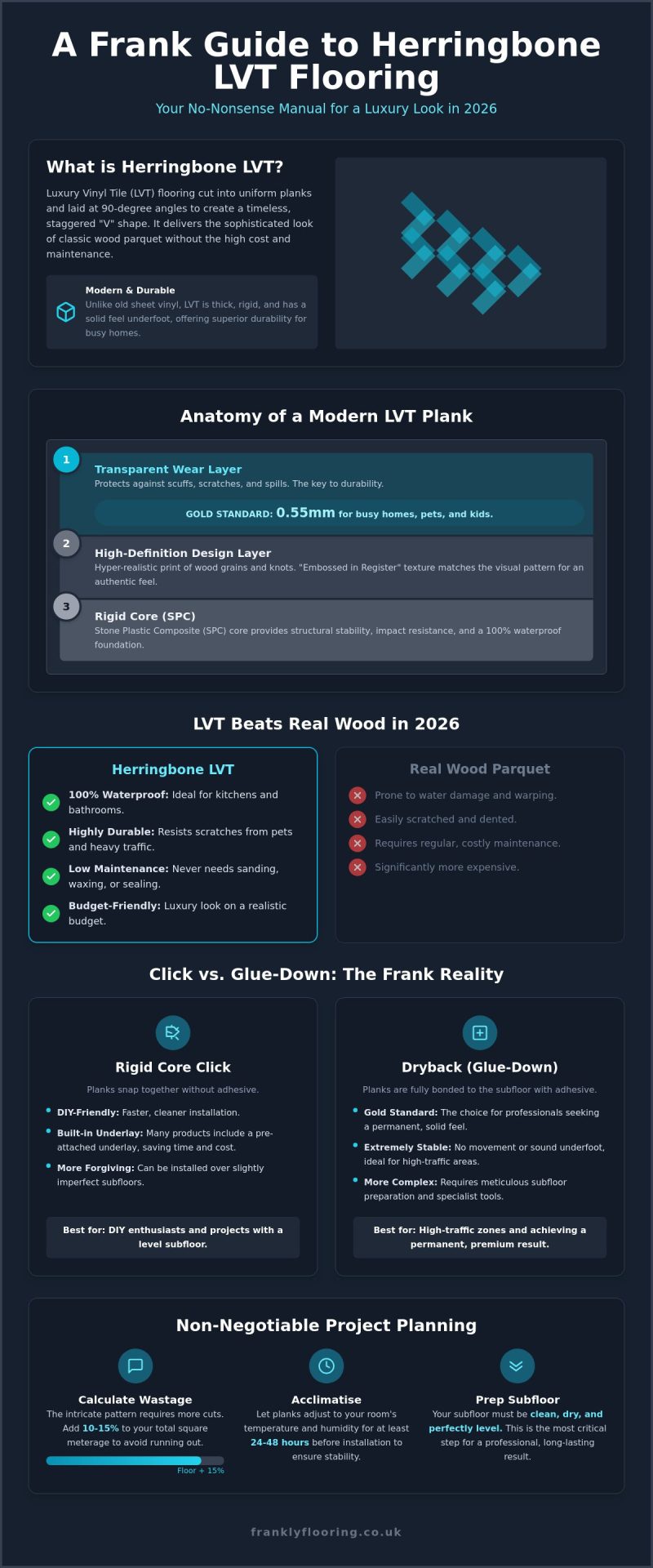
Herringbone lvt flooring is a modern evolution of a classic design that dates back centuries. While traditional parquet involves solid blocks of timber, the LVT version uses Luxury Vinyl Tiles cut into smaller, uniform planks. These planks are laid at 90-degree angles to create a distinctive staggered “V” shape. It is a design that has moved from grand historic estates into everyday British hallways, kitchens, and lounges because it offers a high-end look without the high-end headache.
The construction is what separates “luxury” vinyl from the basic alternatives. This material is built in specific layers to ensure it lasts. At the base, you’ll find a rigid core, often made of Stone Plastic Composite (SPC), which provides structural stability. Above this sits a high-definition design layer that captures the realistic knots and grains of natural wood. On the very top is a transparent wear layer. For a busy UK home, we recommend a 0.55mm wear layer as the gold standard to protect against the daily scuffs of pets and children.
The Aesthetic Appeal of Parquet
The history of the herringbone pattern dates back to the Roman Empire, but its resurgence in UK homes today is driven by its unique ability to transform a room’s proportions. The directional lines of the “V” shape create a sense of movement. This trick of the eye makes narrow hallways feel wider and small lounges feel more expansive. It draws the eye toward the corners of the room, creating an illusion of space that standard straight planks simply cannot match.
It’s a versatile choice that bridges the gap between different architectural styles. It looks just as at home in a high-ceilinged Victorian terrace as it does in a crisp, modern new-build. The “Frank” truth here is simple: you’re getting the prestige of a bespoke parquet floor without the eye-watering price tag or the constant maintenance of real timber. It’s about achieving a premium character for your home while keeping your budget intact.
Why “Luxury” Vinyl is Different from Old Sheet Vinyl
If you’re picturing the thin, spongy sheet vinyl from decades ago, you’ll be pleasantly surprised. Modern lvt flooring is a completely different product. It’s significantly thicker and far more durable thanks to that rigid core technology. This gives the floor a solid, “clunk” feel underfoot rather than a hollow or bouncy sound. It feels permanent and high-quality, which is exactly what you want from a foundational element of your home.
Digital printing has also undergone a massive shift. The textures are now hyper-realistic, often featuring “embossed in register” finishes. This means the physical texture of the plank actually follows the visual grain of the wood shown in the design layer. When you run your hand over it, you feel the ridges and knots you’d expect from real oak. It’s this attention to detail that has made herringbone lvt flooring the standard for homeowners who want durability without sacrificing style.
Click vs Glue-Down Herringbone: The Frank Reality
Choosing the right installation method for your herringbone lvt flooring is just as important as the colour you pick. In 2026, the market is split between DIY-friendly click systems and the traditional glue-down approach. Each has its merits, but being honest about your subfloor and your skill level will save you a lot of stress later on. It isn’t just about how the planks look on the surface; it’s about how they interact with the ground beneath them over the next twenty years.
Installation time varies significantly between the two. Click systems are generally faster because you aren’t waiting for adhesives to tack off. However, the geometric nature of herringbone means you’ll still spend a fair amount of time planning your starting line and making precise cuts. Glue-down requires more patience and a bit more kit, including specialist adhesives and notched trowels, but it offers a permanent result that many homeowners prefer for high-traffic areas.
Rigid Core Click Herringbone
This is often called the DIY-friendly option. It features a click-lock mechanism that allows the planks to snap together without messy glues. Because most high-quality click options now use a Stone Plastic Composite (SPC) core, they are incredibly stable and waterproof. Many of these products include a pre-attached underlay. This saves you the cost and hassle of buying a separate roll, making the project much simpler to manage. The trade-off is that click planks are usually thicker, so you’ll need to check your door clearances before you start. While they are more forgiving than glue-down, you still need a subfloor that is level to avoid putting stress on the clicking joints.
Dryback (Glue-Down) Herringbone
When it comes to underfloor heating (UFH), both systems are compatible. Glue-down offers slightly better thermal conductivity because there is no air gap between the floor and the subfloor, allowing heat to rise more efficiently. Click systems with SPC cores are also excellent performers as they don’t expand or contract significantly with temperature changes. If you’re ready to start planning, you can browse our full range of accessories and flooring to see which setup fits your room best.
Why LVT Beats Real Wood Parquet in 2026
Real timber parquet has a romantic appeal, but the reality of living with it in a modern home is often less glamorous. In 2026, homeowners are prioritising longevity and ease of use over traditional materials. This is where herringbone lvt flooring takes the lead. Unlike real wood, which is a living material that reacts to every change in your environment, LVT is engineered to stay exactly as it was the day it was laid. It provides the same aesthetic prestige without the constant worry about moisture or temperature fluctuations.
The most significant technical benefit is stability. Real wood expands and contracts with humidity, which often leads to unsightly gaps or “cupping” in the planks. Because modern luxury vinyl utilizes a Stone Plastic Composite (SPC) core, it remains dimensionally stable. Whether it is the height of a humid summer or a freezing winter, your pattern stays tight and uniform. You won’t have to deal with the creaks and groans that typically plague older timber floors as they settle and move over time.
Kitchen and Bathroom Suitability
Putting real wood in a bathroom or kitchen is a gamble that usually ends badly. Spills, steam, and leaks can cause timber to rot or warp beyond repair. Herringbone lvt flooring is 100% waterproof. It handles the inevitable splashes of a busy kitchen or the humidity of a family bathroom without a second thought. Cleaning is just as straightforward. You don’t need expensive specialist waxes or oils; a simple damp mop with a pH-neutral cleaner is all it takes to keep the surface looking brand new. It is a “fit and forget” solution for the wettest rooms in your house.
Durability for Busy Households
If you have pets or children, scratch and impact resistance are non-negotiable. Real wood is relatively soft and dents easily under the weight of dropped objects or the claws of a heavy dog. LVT is built specifically for impact. We always recommend a minimum wear layer of 0.55mm for domestic settings. This transparent shield protects the design from scuffs and stains, ensuring the floor survives the rigours of daily life. For those seeking commercial-grade toughness, a 0.7mm wear layer is also an option, though 0.55mm is the sweet spot for most homes.
While laminate flooring has also improved in durability, it still relies on a wood-fibre core that can swell if water gets into the joints. LVT removes that risk entirely. It offers a level of convenience that real timber cannot match. You get the high-end look of a £100 per square metre parquet floor, but you won’t spend your weekends sanding or re-oiling it. It’s a pragmatic choice for anyone who values their time as much as their home’s style.
Planning Your Project: Measuring and Subfloors
Before you even touch a plank of herringbone lvt flooring, you need to let it settle. Acclimatisation is a step many skip to save time, but it is vital for a professional finish. You must leave your flooring in the room where it will be installed for 24 to 48 hours. This allows the material to adjust to the specific temperature and humidity of your home. Skipping this simple step can lead to gapping or buckling once the floor is laid, as the vinyl expands or contracts to find its balance.
You also need the right tools to ensure the job goes smoothly. A heavy-duty utility knife is best for scoring and snapping the planks. A rubber mallet and a tapping block are essential for click systems to ensure the joints are fully engaged without damaging the edges. Finally, don’t forget spacers to maintain an expansion gap around the perimeter of the room. This small gap is what allows your floor to breathe as temperatures change throughout the seasons.
The “Herringbone Tax”: Ordering Correctly
Measuring for a staggered pattern is different from a standard straight plank layout. Because each plank meets at a 90-degree angle, you will inevitably create more offcuts as you reach the walls and corners. We often refer to this as the “Herringbone Tax,” and it usually requires a wastage margin of 10 to 15%. Wastage is the buffer for pattern alignment and mistakes. To calculate your needs, multiply the room’s length by its width to find the square footage, then add 15% to that total. It is far better to have half a box left over for future repairs than to run out three planks from the finish line.
Subfloor Preparation: Don’t Skip This
Your new floor is only as good as what is underneath it. Use a long straight edge to perform a flatness test across the room. Any dip or bump larger than 3mm over a 2-metre span needs attention. If you are laying over old floorboards, 6mm plywood is essential to create a smooth, rigid base. This prevents the planks from bouncing or the joints from failing over time. For concrete floors, moisture is the primary concern. A damp-proof membrane (DPM) is necessary to stop rising damp from compromising the adhesive or the tiles. If the surface is particularly pitted or uneven, a self-levelling compound is the only way to ensure a frankly perfect finish. You can find all the necessary accessories and underlays on our site to get your subfloor up to scratch before you begin the installation.
Finding Your Perfect Style with Frankly Flooring
Choosing the right shade of herringbone lvt flooring is about more than just matching your skirting boards. It is about how the light in your specific room interacts with the texture of the planks. A cool-toned grey that looks sleek in a south-facing room might feel cold and clinical in a north-facing hallway. This is why we always insist on seeing samples in your own home before making a final decision. It is the only way to be certain that the grain and colour meet your expectations under your own light bulbs and windows.
Once you have picked your style, the finishing touches are what make the installation look professional. Matching door bars and accessories ensure a seamless transition between rooms. A floor is a foundational element of your home’s character; it shouldn’t just be an afterthought. Getting the details right now means you won’t be looking at a mismatched threshold for the next two decades.
Colour Trends for 2026
In 2026, we are seeing a significant move toward “Greige.” This perfect middle ground between grey and beige offers a neutral palette that doesn’t feel too sterile. It is incredibly versatile, working well with both minimalist and traditional decors. For those wanting a more historic, library-style aesthetic, darker oaks remain a popular choice. These deeper tones provide a sense of warmth and permanence that suits period properties perfectly.
The key to a cohesive look is how you pair your floor with your furniture. A light oak herringbone can brighten a room filled with heavy, dark wood pieces, while a modern grey floor provides a crisp backdrop for contemporary metal and glass designs. It’s about balance and ensuring the floor supports the overall vision for the space rather than competing with it.
Why Buy From Frankly Flooring?
We are a family-run business with over 20 years of experience, and we do things differently. By operating as an online retailer, we avoid the massive showroom markups that traditional high-street shops have to charge. We pass those savings directly to you. It means you get a premium product without paying for a salesperson’s commission or an expensive retail lease. We believe in providing value through integrity and technical expertise.
Our team provides straight-talking, expert advice. We know engineered wood flooring just as well as we know LVT, so we can help you weigh up the pros and cons based on your specific project needs. We aim to be a one-stop-shop for your entire home. Whether you need herringbone lvt flooring for your lounge or a carpet gripper for the bedrooms upstairs, we have the stock and the knowledge to help. We handle the technical details so you can focus on the transformation of your home.
Start Your Home Transformation with Confidence
You now have the honest facts about herringbone lvt flooring. From understanding why subfloor preparation is non-negotiable to calculating that essential 15% wastage buffer, you’re ready to move past the marketing jargon. We’ve covered why the modern technology behind SPC cores and 0.55mm wear layers makes this a pragmatic choice for busy UK homes. It’s about achieving that high-end parquet aesthetic without the high-end maintenance or the constant worry about spills in your kitchen.
At Frankly Flooring, we believe in keeping things simple and transparent. As a family-run business with over 20 years of industry expertise, we don’t hide behind showroom markups or high-pressure sales tactics. We offer direct UK-wide delivery on all LVT orders, ensuring you get the best possible value without leaving your sofa. Take your time to look at samples in your own light and choose a style that truly fits your home’s character.
Browse our full range of Herringbone LVT and get the look for less. We’re here to help you build a floor that stands the test of time.
Frequently Asked Questions
Is herringbone LVT harder to install than straight planks?
Do I need underlay for herringbone LVT flooring?
This depends entirely on the specific product you choose. Many modern click-lock herringbone lvt flooring options feature a pre-attached acoustic underlay. If your chosen planks don’t have this, you must use a specialist high-density underlay. Standard carpet or laminate underlay is too soft and will cause the vinyl joints to snap under pressure over time.
Can I lay herringbone LVT over existing tiles or floorboards?
You can, but only after proper preparation. Laying directly over old floorboards or uneven tiles is a mistake that will ruin the finish. For timber floors, you should install a 6mm plywood base first to create a rigid surface. For tiles, a layer of self-levelling compound is necessary to fill the grout lines and ensure the subfloor is perfectly flat.
How much extra flooring should I order for a herringbone pattern?
We recommend adding 10-15% to your total square footage for wastage. The staggered 90-degree pattern creates significantly more offcuts than a standard straight-plank installation. Having this extra buffer ensures you can maintain the pattern’s symmetry without running short on the final row. It is also useful to have a few spares left over for any future repairs.
Is herringbone LVT suitable for underfloor heating?
Yes, it is one of the most stable materials for underfloor heating systems. The Stone Plastic Composite (SPC) core used in modern herringbone lvt flooring transfers heat efficiently and won’t warp like real timber when the temperature changes. Just ensure your heating system is calibrated correctly and doesn’t exceed the standard limit of 27 degrees Celsius for vinyl products.
How do I clean and maintain my herringbone LVT floor?
Maintenance is straightforward and doesn’t require the expensive waxes or oils needed for real wood. A regular sweep followed by a damp mop with a pH-neutral cleaner is all you need to keep it looking new. Avoid using steam mops or abrasive scrubbers as these can damage the surface. Because the floor is waterproof, it handles spills easily, but it is still best to wipe them up promptly.
What is the difference between herringbone and chevron patterns?
The difference lies in how the planks are cut and joined. Herringbone uses standard rectangular planks that overlap at a 90-degree angle. Chevron planks are cut at a 45-degree angle at the ends, meeting in a sharp point to create a continuous “V” shape. Herringbone is generally more popular in the UK and offers a more traditional, classic parquet appearance.
Is glue-down or click-lock better for a herringbone floor?
Both systems are durable, but they suit different needs. Click-lock is faster and much more accessible for DIY installations since it doesn’t require messy adhesives. Glue-down is often the professional choice because it feels more permanent and silent underfoot. If you have a perfectly flat subfloor and want the ability to add borders or feature strips, glue-down is the gold standard.