
Most homeowners treat carpet underlay as a hidden tax on their new flooring. It’s often viewed as an annoying extra cost that disappears from view the moment it’s laid, but here is the frank truth: your underlay is the most important purchase you’ll make for your home. This carpet underlay guide explains why that hidden layer is the structural foundation that dictates whether your expensive new carpet lasts fifteen years or starts looking like a flattened mess in five.
It’s easy to feel overwhelmed by the technical jargon. Between deciphering TOG ratings for thermal efficiency and wondering if a 12mm thickness is actually better than an 8mm for your stairs, the process can feel like a minefield designed to make you overspend. You’ve probably even wondered if you can save a few quid by keeping the old stuff that’s already down. We agree that the industry doesn’t always make it easy to know where your money is best spent.
We promise to cut through that noise so you can choose the right material for your specific room and budget. You’ll gain the confidence to select an underlay that maximises comfort and thermal efficiency without paying for “premium” marketing fluff. We will cover the latest 2026 standards for underfloor heating, the real-world differences between PU foam and wool felt, and provide clear recommendations for every area of your home.
Key Takeaways
- Understand why reusing old underlay is a false economy that causes your new carpet to wear out prematurely and lose its comfort.
- This carpet underlay guide helps you navigate technical specs like density and TOG ratings to ensure your home stays warm and well-insulated.
- Learn to distinguish between PU foam, rubber, and felt to select the right material for specific foot traffic levels and floor types.
- Discover a room-by-room strategy that prioritises plush comfort in living areas and high-impact durability for busy stairs and hallways.
- Get practical advice on measuring and ordering online to avoid high-street markups and ensure you have the correct amount of material for a seamless fit.
Why You Actually Need Carpet Underlay (And Why Reuse is a False Economy)
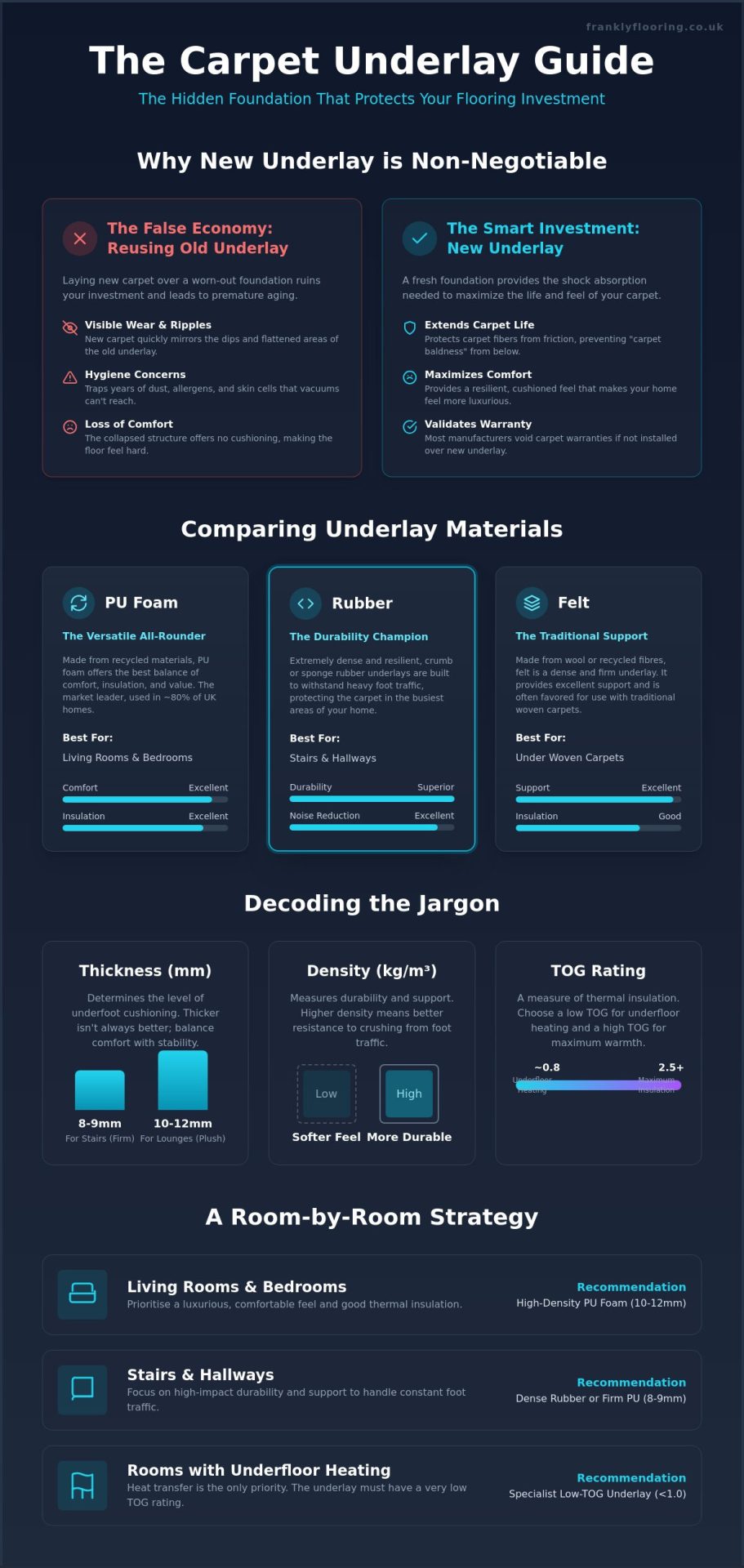
Think of Carpet Underlay as the suspension system for your flooring. It is the shock-absorbing layer that sits between your hard subfloor and your new carpet, performing a role that is far more structural than most people realise. This carpet underlay guide is designed to help you understand that while underlay stays hidden, its impact on the look and feel of your home is visible every single day. Without this protective barrier, the underside of your carpet would grind directly against the floorboards or concrete, leading to “carpet baldness” where the pile wears away from the bottom up.
We often hear from customers who want to save a few pounds by keeping their existing underlay. The frank truth is that reusing old underlay is the quickest way to ruin a brand-new carpet. Over a decade of use, the internal structure of the material breaks down. It loses its ability to bounce back, becoming brittle and flattened in high-traffic areas. Laying a fresh carpet over a collapsed foundation is a false economy; the new carpet will quickly mirror the dips and wear of the old layer underneath, leading to premature aging and unsightly ripples.
There is also a significant hygiene factor to consider. Old underlay acts as a massive trap for years of dust, skin cells, and allergens that have filtered through the carpet pile. No matter how powerful your vacuum is, it cannot reach the debris embedded in a ten-year-old foam or felt layer. Replacing it ensures your room starts with a clean, healthy foundation that is free from trapped particles.
The Mechanical Benefits of a Fresh Foundation
A new underlay provides vital shock absorption by taking the brunt of foot traffic so your carpet fibres don’t have to. This resilience prevents the pile from crushing and keeps the floor looking “new” for longer. Beyond comfort, it serves as a levelling agent that masks minor imperfections in timber or concrete subfloors. It also maintains the structural integrity of your flooring by providing the necessary grip to prevent the carpet from stretching, sliding, or rucking over time.
Is New Underlay a Sales Gimmick?
Some homeowners believe that choosing a thick, high-quality carpet means they can skip the underlay. This is a myth. Even the heaviest carpet requires a flexible base to protect its backing from friction. Furthermore, almost every major manufacturer will void your carpet warranty if it isn’t installed over a suitable new underlay. The cost of a quality underlay is a small investment that is easily offset by adding several years of life to your new carpet.
Comparing Carpet Underlay Materials: PU Foam, Rubber, and Felt
Choosing the right material is where most people get stuck. While high-street shops might push whatever is currently in stock, this carpet underlay guide breaks down the four main players so you can make an informed choice based on how you actually live in your home. The material you select dictates the “feel” of the floor, but more importantly, it determines how well the carpet backing is protected from the hard subfloor beneath.
There are four primary categories you’ll encounter. PU foam is the modern favourite, while crumb rubber, sponge rubber, and traditional felt offer specialist benefits for specific parts of the house. Each has a different balance of “bounce” and “support,” and getting that balance right is the secret to a professional-feeling installation.
PU Foam: The Versatile All-Rounder
PU (polyurethane) foam is the current market leader for a reason. Around 80% of UK homes now choose PU foam because it offers the best balance of price, comfort, and thermal insulation. It is manufactured using recycled foam offcuts from the furniture industry, making it an environmentally responsible choice that keeps waste out of landfills. Because it’s lightweight, it is also much easier to handle and cut than traditional heavy rubber rolls.
If you’ve spent any time researching online, you’ve likely seen Cloud 9 underlay mentioned as a top-tier option. It has earned its reputation by providing a luxury feel that doesn’t collapse over time. For bedrooms and lounges where you want that “sink-in” comfort, high-density PU foam is almost always the right answer.
Rubber and Felt: Specialist Solutions
For high-traffic zones like stairs, landings, and hallways, you might need something more substantial. Crumb rubber is the heavy-weight champion here. Made from recycled car tyres, it is incredibly dense and flat. This density prevents the carpet from “bottoming out” against the stairs, which is the main cause of carpet baldness on the tread. Sponge rubber is another traditional choice, offering a very springy, luxury feel, though it is used less frequently today than PU foam.
Traditional felt remains a brilliant option for older, draughty British homes. It is made from recycled textiles and, while it doesn’t have much “bounce,” it provides exceptional thermal insulation and firm support. It’s often used in heavy domestic or commercial settings where durability is the only priority. When selecting, we suggest following the recommendations from the Carpet and Rug Institute regarding traffic levels to ensure your material matches the demands of the room. If you’re looking for a complete project solution, you can browse our full range of carpet accessories to find the right material for every room in your house.
Understanding the Numbers: Thickness, Density, and TOG Ratings
When you look at a carpet underlay guide, you’re often bombarded with technical specifications. Millimetres, kilograms per cubic metre, and TOG ratings can quickly turn a simple home improvement task into a math problem. It’s easy to assume that a bigger number always equals a better product, but that’s a common misconception. In reality, the relationship between these figures determines whether your floor feels like a luxury hotel or a flat pavement within six months.
Many retailers focus purely on thickness, suggesting that a 12mm underlay is automatically superior to an 8mm one. This is the “Thickness Myth.” A thick, low-density foam underlay might feel wonderfully soft for a week, but it lacks the structural integrity to support your carpet. Under heavy furniture or frequent foot traffic, it will collapse. Conversely, an 8mm high-density rubber underlay provides far better protection because it doesn’t “bottom out.” The Carpet and Rug Institute highlights that the right cushion is about support and resilience, not just height.
Density is measured in kilograms per cubic metre (kg/m³). It tells you how much actual material is packed into the product. Higher density also means better acoustic performance, reducing the “thud” of footsteps in upstairs rooms or apartments. If you want a quiet home, don’t just look for thickness; look for a high density rating to absorb impact sound effectively.
TOG Ratings and Underfloor Heating
A TOG rating measures thermal resistance; the higher the number, the better the insulation. For most British homes, a high TOG rating is a benefit because it traps heat in the room and can help lower your energy bills. However, if you have underfloor heating, the rules change completely. The critical rule is that your total TOG (carpet and underlay combined) should not exceed 2.5. If it does, the heat won’t be able to penetrate the flooring effectively, making your heating system work harder for less warmth.
The Sweet Spot for Thickness and Density
For most UK living rooms, 9mm to 11mm is the “Goldilocks” zone. It provides enough plushness for comfort without being so thick that it creates a tripping hazard or makes the carpet difficult to fit. When you’re buying online, always check the density spec rather than just the price. A 10mm underlay with a density of 100kg/m³ will vastly outperform a 12mm underlay with a density of only 60kg/m³. Investing in density ensures your carpet doesn’t suffer from premature wear in the areas where you walk the most.
A Room-by-Room Strategy: Where to Invest vs. Where to Save
You don’t need the most expensive underlay in every corner of your house. High-street retailers often suggest buying the “premium” option for every room, but that is rarely the most efficient use of your budget. A smart carpet underlay guide should help you prioritise your spending based on foot traffic and the specific purpose of each space. By matching the technical specs to the room’s demands, you can ensure your carpet lasts its full intended lifespan without overspending on features you don’t actually need.
The strategy is simple: invest in density for high-traffic areas and focus on thickness and thermal properties for areas designed for relaxation. We believe in being direct about where you can cut corners and where you absolutely shouldn’t. Using the wrong material on a staircase will ruin a carpet in months, whereas using a basic foam in a guest bedroom might be perfectly adequate for a decade.
The High-Traffic Challenge: Stairs and Hallways
Stairs are the ultimate test for any flooring. Every step concentrates your entire body weight onto a tiny area of the carpet pile. For these zones, you need a “high recovery” underlay that won’t flatten under constant pressure. We recommend a high-density PU foam of at least 100kg/m³ or a traditional crumb rubber. These materials act like a shock absorber, preventing the carpet from grinding against the sharp edge of the stair tread. It is also vital to remember that your underlay is only half of the foundation; check our carpet gripper guide to see how the right fixings keep everything taut and safe on your staircase.
The Luxury Zone: Living Rooms and Bedrooms
The lounge is where you want that unmistakable sink-in feel. Here, you can prioritise comfort by choosing an 11mm luxury foam. This thickness provides the “step-in” quality that makes a house feel like a home. While you are planning the feel of the room, you should also consider the visual impact by choosing the right carpet to complement your underlay choice. In bedrooms, you have the most flexibility to save money. Since foot traffic is lower, a mid-range foam with a high TOG rating is often the best choice to keep the room cosy and warm without the need for high-density industrial specs.
Home offices require a different approach. If you use a desk chair with castors, the constant rolling motion can cause “delamination,” where the carpet backing separates from the pile. In these rooms, a firmer, lower-profile underlay is essential to provide a stable surface for the wheels. If you’re ready to start your project, you can shop our range of underlay and accessories to find the perfect match for every room in your home.
How to Buy Underlay Online and Prepare for Fitting
Buying underlay online is the smartest way to avoid the inflated markups found in high-street showrooms. This final part of our carpet underlay guide focuses on the logistics of getting your materials and ensuring your floor is ready for them. You don’t need to be a professional carpet fitter to get the preparation right, but you do need to be precise with your measurements and thorough with your cleaning. Precision at this stage prevents delays and ensures the finished result looks as good as you imagined.
When ordering, always match the square meterage of your carpet but add a 5% margin for wastage. Even in a perfectly rectangular room, you will lose material during the trimming and joining process. If your space has alcoves, bay windows, or irregular corners, that extra 5% is your safety net. It is much better to have a small offcut left over than to find yourself half a metre short when the fitter is already on-site. We’ve seen many projects stall because of a simple mathematical error, so always round up.
Before any underlay touches the floor, your subfloor needs a frank assessment. For timber floors, check for loose or squeaking boards and screw them down now. Once the carpet is fitted, those noises will haunt you for years. For concrete subfloors, ensure the surface is bone-dry and free from dust. Any dampness trapped under a new underlay can lead to mould and unpleasant odours that are almost impossible to remove without ripping everything back up.
Ordering and Logistics
By sourcing your underlay directly from Frankly Flooring, you’re tapping into direct-to-consumer value that bypasses the middleman. Most standard rolls cover 15m², but you should always double-check the specific product listing before you hit the checkout. We recommend the “all-in-one” approach. Ordering your underlay alongside grippers and door bars ensures everything arrives at once, which makes coordinating your project significantly easier. It’s a complete solution that saves you from multiple delivery fees and the hassle of tracking different parcels.
Pre-Installation Checklist
Follow the “clean and dry” rule religiously. A quick sweep isn’t enough; use a vacuum to get every bit of grit off the floor. When it comes to laying the rolls, people often ask which way up they go. Usually, the “pretty” side or the side with the brand marking faces up towards the carpet. Finally, securing the joins with underlay tape is a non-negotiable step. It prevents the edges from overlapping or wandering while the carpet is being stretched, ensuring a professional, seamless finish across the entire room. If you’re fitting on timber, a heavy-duty staple gun is your best friend, while spray adhesive is the standard choice for concrete surfaces.
Ready to Build a Better Foundation for Your Floor?
Choosing the right underlay doesn’t have to be a guessing game. By now, you know that skipping a fresh layer or reusing old material is a recipe for premature carpet wear. You’ve learned how to balance density for busy hallways and softness for quiet bedrooms. This carpet underlay guide was designed to give you the technical clarity needed to shop with confidence and avoid unnecessary “premium” markups.
At Frankly Flooring, we bring over 20 years of industry experience and our family-run values to every order. We provide UK-wide delivery on all accessories, ensuring you get direct-to-consumer pricing with total transparency. Our team is proud to help you find the exact specifications your home requires, from high-density rubber to luxury PU foam.
Browse our full range of high-quality carpet underlay at Frankly Flooring
Your new carpet deserves a foundation that lasts as long as the memories you’ll make on it. We’re here to make sure your project is a success from the first measurement to the final fit.
Frequently Asked Questions
Do I really need new underlay if my old one looks fine?
Yes, you should always replace it. Even if it looks intact, the internal structure has likely collapsed after years of constant foot traffic. This carpet underlay guide emphasises that a fresh foundation is the only way to protect your carpet warranty and ensure the pile doesn’t flatten prematurely. Plus, removing a decade’s worth of trapped dust and allergens from your home is a major hygiene benefit.
Can I use two layers of cheap underlay to make it feel thicker?
No, you should never stack underlay. Doubling up creates an unstable, “mushy” base that puts immense strain on the carpet backing. It leads to unsightly rucking and ripples that are impossible to stretch out. For a thicker feel, simply invest in a high-quality 11mm or 12mm single-layer PU foam rather than trying to bodge two cheaper products together.
What is the best underlay for underfloor heating?
Specialist low-TOG underlay is the only correct choice for underfloor heating systems. Standard underlays act as insulators that trap the heat beneath the floor, which can damage your heating system and leave your room cold. We recommend a dedicated thermal underlay with a TOG rating under 1.0. This allows the heat to pass through the carpet and into your living space efficiently.
Is thicker underlay always better for my carpet?
No, a thicker underlay isn’t always the best choice for your carpet. While a 12mm underlay feels luxurious in a lounge, it can be a disaster on stairs if the density is too low. High-density materials, even if they are thinner, provide better “recovery” and support. This prevents the carpet from bottoming out against the subfloor, which is the primary cause of bald patches in high-traffic areas.
What does a TOG rating mean for my carpet underlay?
A TOG rating measures thermal resistance and tells you how well the material resists heat flow. In most British homes without underfloor heating, a high TOG rating is a huge advantage. It acts as an extra layer of insulation that keeps your rooms warmer for longer. Choosing a high-TOG product is a practical way to improve your home’s thermal efficiency and potentially reduce your heating costs.
How much extra underlay should I order for wastage?
You should order 5% more than the actual square meterage of your room. This carpet underlay guide recommends this allowance to cover the inevitable wastage that occurs when trimming rolls to fit around alcoves, bay windows, and door frames. It’s much better to have a small offcut left over than to find yourself slightly short of material when your fitter is ready to start.
Can I install carpet underlay myself or do I need a professional?
Installing the underlay is a very manageable DIY task for most homeowners. You’ll need a sharp utility knife, some underlay tape, and either a staple gun for timber floors or spray adhesive for concrete. It’s a great way to save on labour costs. However, we usually recommend leaving the actual carpet stretching and tucking to a professional to ensure a perfectly flat, taut finish.
Which underlay is best for reducing noise in an upstairs flat?
High-density crumb rubber or specialist acoustic PU foam is the most effective material for dampening impact noise. If you’re in an upstairs flat, look for an underlay with a high decibel (dB) rating. These products are specifically engineered to absorb the energy from footsteps and moving furniture. This prevents the “thud” from travelling through the floorboards and disturbing your neighbours in the property below.