
Most homeowners assume that solid oak is the undisputed gold standard for luxury, but in a modern British home, that “premium” choice could actually be your biggest mistake. Choosing between solid wood flooring vs engineered is usually where the excitement of a renovation hits a wall of technical jargon and conflicting advice. You want a high-end aesthetic that adds genuine property value, yet you’re likely stuck between the fear of planks warping and the anxiety that “engineered” is just a fancy word for laminate. It isn’t, but the wrong choice can still lead to expensive regrets.
We’ve spent over 20 years giving homeowners the honest truth, even when it isn’t what they expected to hear. This guide provides a straight-talking breakdown of the pros, cons, and hidden costs of both options to help you find your perfect match. We’ll cover everything from underfloor heating compatibility to the 2026 shift toward warm, honey-toned oaks. By the end, you’ll know exactly which material will deliver a 25-plus year lifespan without the “hollow” sound or seasonal gapping that ruins a room’s character.
Key Takeaways
- Learn the technical truth about solid wood flooring vs engineered to understand why both are real wood but perform very differently in a home environment.
- Discover why engineered planks are the superior choice for modern properties with underfloor heating or moisture-prone concrete subfloors.
- Get the facts on the sanding myth and learn how to calculate the actual lifespan of your floor based on wear layer thickness.
- Identify the hidden costs of installation and how choosing a floating floor method can save you significant time and budget.
- Compare the long-term property value impact of each material to ensure your investment pays off when it is time to sell.
Solid Wood vs Engineered Wood: The Fundamental Differences
The first thing we need to clear up is a common misconception that “engineered” means “fake.” It doesn’t. Both options are 100% natural timber on the surface. When you walk across a finished floor, you are stepping on real oak, walnut, or ash, regardless of what sits beneath the top layer. Understanding the fundamental differences between solid and engineered wood is about looking at the architecture of the plank, not just the surface beauty.
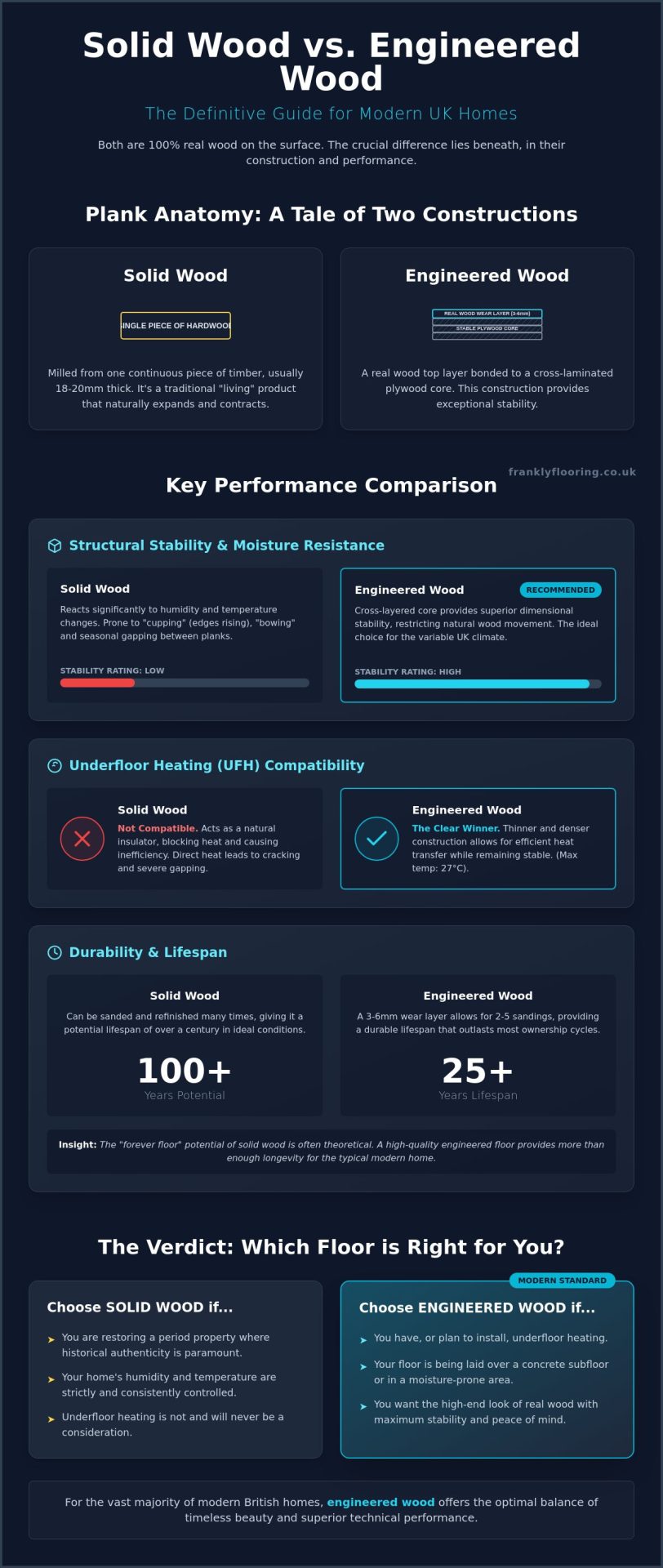
The frank truth is that once these floors are installed, even a professional would struggle to tell them apart just by looking. The grain patterns, the knots, and the way the wood takes a stain are identical because the top layer is the same material. The real distinction is found in how they handle the UK’s fluctuating climate. Solid wood is a single, continuous piece of hardwood, whereas engineered wood is a composite of layers designed for maximum stability. You aren’t choosing between “real” and “imitation”; you’re choosing between traditional craftsmanship and modern structural engineering.
What Exactly is Solid Wood Flooring?
Solid wood flooring is the heritage choice. Each plank is milled from a single piece of timber, usually 18mm to 20mm thick. It’s a “living” product that reacts to moisture and temperature. Because of this, it requires a significant expansion gap around the perimeter of a room to allow for natural movement. While it offers the potential for a 100-year lifespan in the right conditions, it’s also prone to “cupping” or “gapping” if your home’s humidity levels aren’t strictly controlled. It’s a beautiful, long-term investment, but it can be temperamental.
What Exactly is Engineered Wood Flooring?
Engineered wood is the technical solution for the modern British home. It consists of a real wood “wear layer” (usually 3mm to 6mm thick) bonded to multiple layers of high-density birch or eucalyptus plywood. These layers are glued with the grain running in opposite directions. This cross-layered construction is the secret to its success. It prevents the wood from expanding and contracting as aggressively as solid timber. For 2026 renovations, this stability makes it the go-to choice for compatibility with modern heating systems and varying subfloor types. You get the high-end aesthetic of a solid floor with the structural reliability of a modern material. When considering solid wood flooring vs engineered, this stability is often the deciding factor for homeowners who want a stress-free experience.
Structural Stability: Moisture, Heat, and Underfloor Heating
Wood is a hygroscopic material. This means it acts like a sponge, constantly absorbing and releasing moisture from the air. In the UK, our damp winters and dry, centrally-heated summers create a seasonal tug-of-war within every timber plank. When you compare solid wood flooring vs engineered, the biggest technical difference is how they handle this environmental stress. Solid wood is a single, thick block of timber. When it gets damp, it expands across its width; when it dries out, it shrinks. Without enough room to move, solid planks will eventually cup, where the edges rise higher than the centre, or bow. It’s a natural process, but it can be a homeowner’s nightmare.
Engineered wood is designed specifically to kill this problem. By using cross-lamination, where each layer of plywood is bonded at a 90-degree angle to the one below it, the natural movement of the wood is restricted. One layer wants to expand left to right, but the layer beneath it is anchored to move front to back. They effectively cancel each other out. This dimensional stability is why engineered wood is the professional standard for 2026. Modern UK homes are now built to be incredibly airtight and well-insulated. While this is great for your energy bills, it creates a more intense internal environment that can punish less stable materials. You can find more technical details on moisture limits and timber behaviour in the National Wood Flooring Association’s Homeowner’s Handbook.
The Underfloor Heating (UFH) Verdict
If you have underfloor heating, the choice between solid wood flooring vs engineered is already made for you. Solid wood is a natural insulator. It resists the transfer of heat, making your system inefficient and expensive to run. More importantly, the direct heat source causes solid timber to dry out far too quickly, leading to structural cracks and unsightly gaps. Engineered wood is much thinner and denser, allowing heat to pass through efficiently while remaining stable. Just remember to keep your system within the 27°C safety threshold to protect the wood’s natural fibres. If you’re planning a UFH project, it’s worth browsing our range of engineered wood flooring to see how modern construction handles these temperature shifts.
Suitability for Kitchens and Basements
Kitchens and basements are high-risk zones for wood. In a kitchen, a minor leak or a spilled drink is less likely to ruin an engineered floor because the structural layers resist the immediate “expansion shock” that hits solid wood. Basements are even more challenging. Concrete subfloors naturally leach moisture, which is a death sentence for solid planks that are nailed or glued down. Relative humidity levels between 35% and 55% are the critical sweet spot for maintaining the health and warranty of any timber floor.
Durability and the ‘Forever Floor’: Sanding and Maintenance
The biggest argument for solid timber is that it’s a “forever floor.” Because a solid plank is wood all the way through, you can theoretically sand it back to the tongue and groove, which usually gives you about 6mm to 8mm of usable material. In the right conditions, a solid floor can easily last 100 years. But we need to be frank about how people actually live in 2026. Most homeowners don’t stay in one property for a century. They want a floor that looks exceptional for the 20 or 30 years they’re actually there. When you weigh up solid wood flooring vs engineered, the question isn’t just how long it can last, but how much maintenance you’re truly willing to do.
There is a persistent myth that engineered wood is a “disposable” product that can’t be refinished. This is only true if you buy cheap, low-quality boards with a 1mm veneer. Quality engineered planks feature a substantial wear layer, typically between 3mm and 6mm. The math is simple: 1mm of wood allows for approximately one deep sand and seal. If you choose a board with a 4mm wear layer, you can refinish that floor three or four times. Since a floor only needs a full sand every 10 to 15 years, an engineered floor can comfortably provide a 40-plus year lifespan. For more on selecting the right specifications, check out our engineered wood flooring guide.
Refinishing: How Many Times is Enough?
In a busy domestic setting, you’ll rarely need a full, aggressive sand. Most “damage” is actually just surface wear to the finish. If you choose a hardwax oil finish, you can perform spot repairs on high-traffic areas without sanding the whole room. Lacquered finishes are tougher and more scratch-resistant, but they require a full sand and reseal if they become dull. Most families find that two or three refinishing cycles are more than enough for the lifetime of their home ownership.
Daily Wear and Tear for Families and Pets
If you’re worried about dog claws or heavy furniture, the construction of the plank matters less than the species of the wood. Oak is the industry standard for a reason; it’s naturally dense and handles impact well. Walnut is stunning but significantly softer, meaning it will dent regardless of whether it’s solid or engineered. To protect your investment, focus on the finish. A matte, brushed texture hides scratches far better than a smooth, high-gloss surface. When comparing solid wood flooring vs engineered for a family home, the stability of engineered wood often makes it more “durable” in practice because it won’t gap or creak as the years go by.
Installation Realities: Subfloors, Methods, and Acoustics
The decision between solid wood flooring vs engineered often hinges on what sits beneath your feet. Solid wood is a structural material that demands a traditional approach. It generally needs to be nailed down to timber joists or a plywood subfloor, or glued directly to a perfectly prepared surface. Because of its natural movement, you cannot “float” a solid wood floor. This makes the installation process slower, more technical, and significantly more expensive in terms of labour. If you have a concrete subfloor, you’ll need to be certain it is bone dry and potentially install a plywood layer first, adding more height and cost to your project.
Engineered wood offers far more flexibility. Its structural stability allows for a “floating” installation, where the planks are clicked or glued together over an underlay rather than being fixed to the subfloor. This method is a massive time-saver. However, floating floors often get a bad reputation for sounding “hollow” or “clicky” when walked on. This isn’t a fault of the wood; it’s usually the result of using cheap, low-density underlay. If you invest in a high-quality, heavyweight acoustic underlay, you can achieve a solid, premium sound that mimics a fixed floor. To ensure your installation sounds as good as it looks, browse our range of high-performance flooring accessories and underlay.
The DIY vs. Professional Debate
We’ll be frank: solid wood is rarely a project for a DIY beginner. It requires specialist tools like cleat nailers and moisture meters, along with the experience to judge expansion gaps accurately. Engineered wood is much more approachable, especially if you choose a click-system board. If the technical demands of real wood still feel daunting, you might find our laminate flooring UK guide a helpful resource for simpler, DIY-friendly alternatives that still offer a wood-effect finish.
Essential Subfloor Preparation
Regardless of which material you choose, your subfloor must be flat. We follow the “2mm over 2m” rule. This means if you lay a two-metre straight edge across the floor, there should be no gaps larger than 2mm. Flatness is far more important than the floor being perfectly level. If your subfloor is uneven, your planks will flex, leading to creaks or joint failure over time. For concrete subfloors, always use a Damp Proof Membrane (DPM) or an underlay with a built-in vapour barrier to prevent moisture from reaching the timber. Skipping a £50 roll of DPM is the fastest way to ruin a £2,000 floor.
The Frank Verdict: Which Wood Floor Is Right for You?
Choosing between solid wood flooring vs engineered isn’t just a matter of taste; it’s a matter of logic. If you live in a draughty Victorian terrace with original suspended timber joists and no plans for underfloor heating, solid wood is a beautiful, authentic choice that honours the building’s history. However, for almost every other scenario, engineered wood wins on technical merit. It handles the stresses of modern living better, stays flatter for longer, and doesn’t demand the same level of environmental control. It is the practical choice for the way we live now.
While you might find solid oak planks at a similar price point to premium engineered boards, the total cost of ownership tells a different story. Solid wood requires more intensive subfloor preparation and specialist fixing methods that drive up labour costs. When you factor in the adhesives, specialist underlays, and the time taken for the wood to acclimate, engineered wood often provides better value for your total investment. In terms of property value, both options add significant equity. However, modern buyers are increasingly wary of floors that aren’t compatible with UFH or those that show signs of seasonal gapping. A stable floor is a valuable floor.
Just as you invest in the right timber for your floors, ensuring your external boundaries are equally robust is key to property maintenance; Romford Fencing Ltd offers professional fencing supplies that match the high standards of a modern home renovation.
Before you hit the “buy” button, run through this final frank checklist:
- Heating: Do I have or want underfloor heating? (If yes, choose engineered).
- Subfloor: Is my subfloor concrete or timber? (Concrete usually favours engineered).
- Duration: How long do I truly plan to stay in this property? (25 years is plenty for most).
- Maintenance: Am I prepared for the seasonal movement and maintenance of solid timber?
- Environment: Does the room experience significant temperature or humidity swings, like a kitchen or sunroom?
Balancing Budget and Quality
It’s a mistake to buy the cheapest solid wood you can find just to say you have “real” wood. A mid-range engineered board will almost always outperform an entry-level solid plank in terms of stability and finish quality. Don’t forget to budget for the essential extras like door bars and high-quality adhesives that make the project successful. If the total project cost is still looking a bit steep for your current renovation, it might be worth asking what is LVT flooring? to see if a high-end vinyl alternative fits your lifestyle and budget better.
Making the Sustainable Choice
In 2026, sustainability is about more than just a label. Engineered wood is inherently more efficient because it uses significantly less slow-growing hardwood per plank compared to solid timber. The core is typically made from faster-growing species, which is a more responsible use of forest resources. Always look for FSC or PEFC certification to ensure your floor is ethically sourced. When you compare solid wood flooring vs engineered through an environmental lens, the reduced hardwood consumption of engineered planks often makes them the “greener” technical choice for the modern consumer.
Choosing Your Foundation for the Future
We believe in giving you the straight facts so you can invest with confidence. As a family-run UK business, we pride ourselves on no-nonsense transparent pricing and expert technical support. We don’t do high-pressure sales; we just provide the quality products and honest advice you need to get the job done right. If you’re ready to find a floor that combines timeless beauty with modern reliability, browse our Frank selection of Engineered Wood Flooring today. Your perfect home starts with the right choice underfoot.
Frequently Asked Questions
Can you tell the difference between solid and engineered wood once installed?
No, you can’t tell them apart just by looking. Because the top layer of an engineered plank is genuine timber, the grain patterns, knots, and textures are identical to a solid wood floor. The differences are entirely structural and remain hidden beneath the surface once the installation is complete.
Is engineered wood flooring real wood or a laminate?
It is 100% real wood. Don’t confuse it with laminate, which is a synthetic product featuring a printed photograph of wood. Engineered planks consist of a genuine hardwood wear layer bonded to high-density plywood. It feels, looks, and smells exactly like the timber it’s made from.
Which is better for dogs: solid or engineered wood?
Engineered wood is generally the better choice for households with pets. Its cross-layered construction makes it more stable and less likely to gap or creak under the weight and movement of a large dog. To hide potential scratches from claws, we always recommend a brushed, matte finish rather than a smooth, glossy lacquer.
How much does it cost to install engineered wood vs solid wood in the UK?
Installation for engineered planks is typically more affordable. Since they can be installed using the “floating” method, the process is faster and requires less specialist labour. Solid wood demands more technical skill for secret nailing or full-surface gluing, which significantly increases the time and cost of a professional fitting.
Can I install solid wood flooring in my kitchen?
We wouldn’t recommend it. Kitchens are prone to spills and humidity fluctuations that cause solid wood to warp or cup. Engineered wood is far more forgiving in these environments. While neither is waterproof, the stability of an engineered plank makes it the only real wood option we’d suggest for a kitchen area.
Why is my engineered wood floor making a clicking or hollow sound?
This is rarely a fault with the wood itself. A clicking sound usually means your subfloor isn’t perfectly flat, causing the planks to flex when walked on. A hollow sound is typically the result of using a cheap, lightweight underlay. Investing in a high-density acoustic underlay will give you a much more solid, premium feel.
How many times can I sand down an engineered wood floor?
It depends on the wear layer thickness. You can typically sand 1mm of wood per refinishing cycle. A quality board with a 4mm wear layer can be sanded three or four times. Since most floors only need a full sand every 15 years, a good engineered floor can easily last four decades or more.
Does engineered wood flooring increase house value as much as solid wood?
Yes, it does. In the current market, high-quality engineered wood is often more attractive to buyers because it is compatible with modern underfloor heating. When comparing solid wood flooring vs engineered, property experts look for the quality of the finish and the stability of the installation rather than just the thickness of the planks.