
Most homeowners spend weeks picking the perfect plank design only to spend five minutes grabbing the first roll of foam they see. It’s a common mistake, but that “bargain” roll is often the reason floors end up sounding like a drum kit or feeling like a trampoline. Finding the best underlay for laminate flooring isn’t about buying the most expensive option; it’s about matching the material to your specific subfloor’s weaknesses to prevent “bouncy” boards and cold toes.
You want a floor that feels solid and stays quiet, and you shouldn’t have to worry about dampness from a concrete subfloor or wasting money on “premium” extras that your home doesn’t actually need. This guide will show you exactly which underlay your specific subfloor requires to ensure your laminate flooring lasts for decades. We will break down the technical differences between foam, felt, and acoustic barriers while explaining how to meet the latest UK building regulations and British Standards for subfloor flatness. Whether you are dealing with a 3 mm deviation in your concrete or looking for the ideal Tog rating for underfloor heating, we’ve got the straight-talking advice you need to get it right the first time.
Key Takeaways
- Understand why underlay is a non-negotiable buffer that protects delicate click-lock joints from snapping under vertical pressure.
- Identify the best underlay for laminate flooring by matching material density to your subfloor to avoid the dreaded “bouncy” floor feeling.
- Learn how to defend against rising damp on concrete subfloors by choosing materials with integrated moisture barriers.
- Decode technical specs like Decibel (dB) ratings and Tog values to achieve the perfect balance of sound reduction and thermal warmth.
- Master the professional secret of laying underlay at a 90-degree angle to your flooring boards for a stable, long-lasting installation.
Why Underlay is Non-Negotiable for Laminate Flooring
Think of your new laminate floor as a precision-engineered skin. It looks fantastic, but it’s relatively thin and rigid. Without a quality layer underneath, that skin is rubbing directly against a rough, unforgiving subfloor. This layer, often referred to as Underlay or underlayment, acts as the essential buffer that separates your flooring from the structural base of your home. It’s the silent partner in your installation that handles the heavy lifting you never see. Let’s be frank: skipping this step is the fastest way to void your manufacturer’s warranty and ensure your floor fails long before its time.
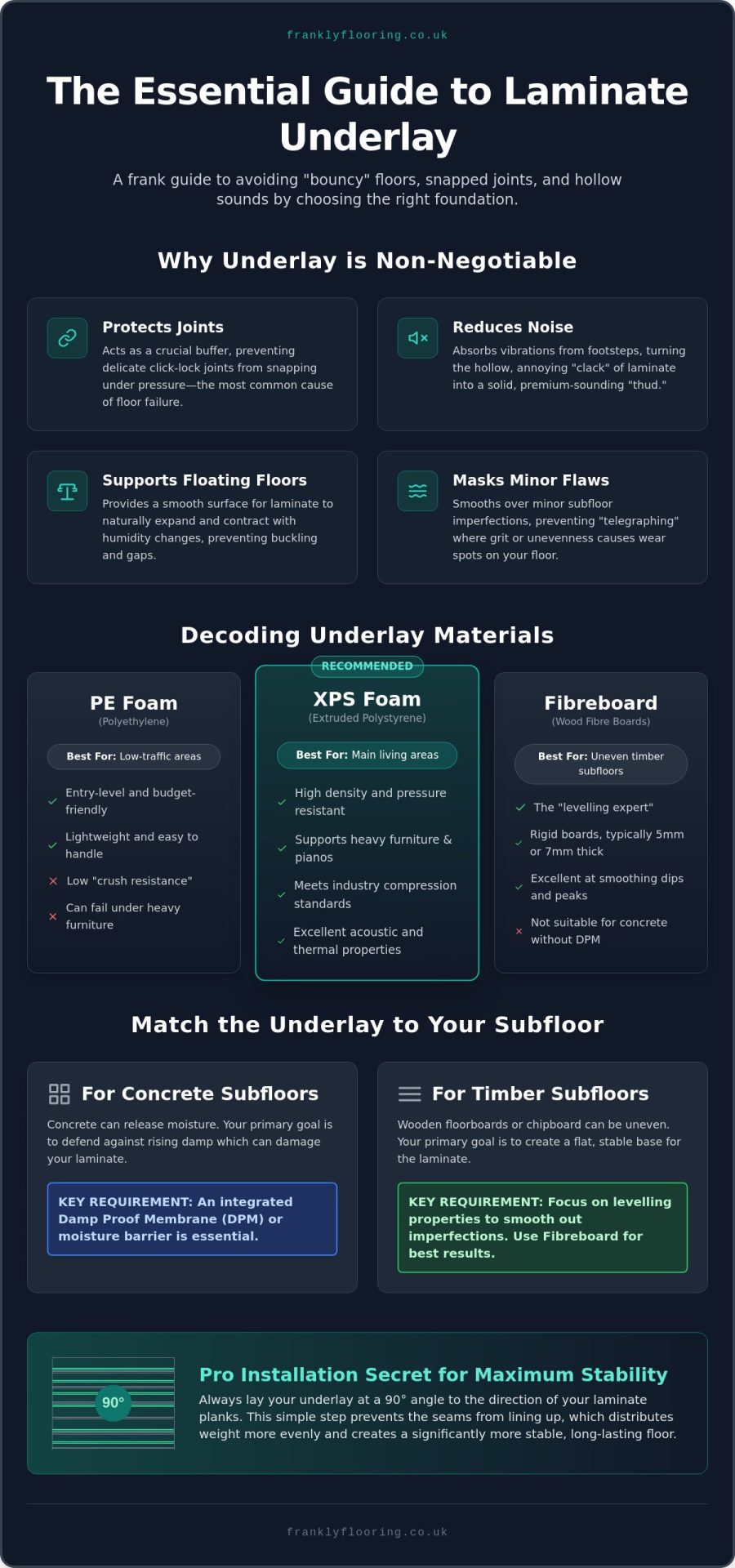
Laminate is naturally resonant. Without a proper buffer, your floor acts like a giant speaker, amplifying the sound of every footstep, pet claw, or dropped toy. The best underlay for laminate flooring absorbs these vibrations before they hit the hard subfloor, turning a hollow, annoying “clack” into a solid, premium “thud.” It also protects the delicate click-lock joints from snapping under vertical pressure, which is the most common cause of floor failure in UK homes.
The Role of a Floating Floor Buffer
Laminate flooring is almost always installed as a “floating” system. A floating floor is a system that relies on its own weight and locking mechanism rather than being glued or nailed to the substrate. Because wood-based products naturally expand and contract with changes in humidity and temperature, they need to be able to slide slightly across the surface. Underlay provides the smooth, low-friction environment required for this movement, preventing the boards from buckling or pulling apart at the seams during seasonal shifts.
Protecting Your Investment
The click-lock joints on your laminate are remarkably strong once assembled, but they are also quite delicate. If there is a minor void or a dip in your subfloor, every step you take puts vertical pressure on those joints. Over time, this repeated stress causes the locks to snap, leading to permanent gaps and “bouncy” sections that are impossible to fix without ripping the whole floor up. A high-density underlay supports these joints by evening out minor subfloor imperfections.
This protection also prevents a phenomenon called “telegraphing.” This is where small bits of grit or unevenness in the subfloor eventually show through or cause wear spots on the surface of your flooring. Finding the best underlay for laminate flooring is about balancing this protection with the right material for your room. At Frankly Flooring, we have seen over two decades that the wrong underlay is often just as damaging as using no underlay at all. It’s about getting the density right to ensure your floor stays stable and silent for years to come.
Decoding Underlay Materials: Foam, Fibreboard, and Foil
Walking into a shop and seeing a dozen different rolls can be overwhelming. Some look like thin plastic wrap, while others look like thick green boards. The truth is that the material you choose determines whether your floor feels like a solid part of the house or a temporary stage. Choosing the wrong material often leads to “bounce,” where the floor flexes visibly under your weight. To find the best underlay for laminate flooring, you need to look past the price tag and check the technical specifications for your specific room.
Density is the most important factor here. A material that feels soft and squishy in your hand might feel great for five minutes, but it won’t support the weight of a heavy sofa for five years. We always advise customers to look for materials that offer high compression resistance to keep those click-lock joints stable. If the material is too soft, the joints will constantly move, eventually leading to the snapping issues we discussed earlier.
PE Foam vs. XPS Foam
Standard Polyethylene (PE) foam is the entry-level choice. It’s thin, lightweight, and works fine for low-traffic guest rooms. However, it often fails in main living areas because it lacks long-term “crush resistance.” Over time, the tiny air bubbles in PE foam pop under the weight of heavy furniture, leaving your floor unsupported. Extruded Polystyrene (XPS) is the denser sibling. It is engineered to withstand higher pressure, meeting the industry standard for laminate flooring regarding compression strength. If you have a heavy sideboard or a piano, XPS is the minimum standard you should consider to prevent floor dipping.
Fibreboard: The Levelling Expert
If your timber subfloor has seen better days, fibreboard is your best friend. Typically available in 5mm or 7mm thicknesses, these rigid boards are the heavyweight champions for levelling out slight dips and peaks. They offer superior thermal properties, making them ideal for chilly ground floors. Just be aware that cutting them creates a fair amount of dust, so keep a vacuum handy during the process. Because they don’t compress like foam, they provide a rock-solid foundation that eliminates the “clicking” sound often heard with cheaper alternatives.
Foil-backed underlays are a different beast entirely. The silver layer acts as a built-in moisture barrier, which is essential for concrete floors. It also reflects heat back into the room, which is a massive bonus for energy efficiency. If you are looking for specific accessories to finish your project, always check if the roll includes an integrated vapour barrier to save yourself the hassle of laying two separate layers. This simple choice can save you hours of installation time and protect your floor from hidden damp issues.
Choosing the Right Underlay for Your Subfloor
Your subfloor is the boss of your flooring project. If you ignore its specific needs, even the most expensive laminate will eventually fail. Finding the best underlay for laminate flooring is a three-step process: identify your material, check for levelness, and test for moisture. While you might be tempted to grab a “universal” roll, concrete and timber have completely different requirements for moisture control and structural support. Understanding the different types of underlayment is crucial because a concrete slab behaves very differently than a timber joist system.
Concrete Subfloors and the DPM Requirement
Concrete subfloors have a hidden enemy: rising damp. Even if a floor looks dry, moisture can travel through the porous concrete and settle under your laminate, causing it to warp or rot. This is why a Damp Proof Membrane (DPM) is mandatory on concrete. You can choose between a separate 1000-gauge plastic DPM sheet or an integrated foil-backed underlay that combines the two layers. Integrated options are usually the smarter choice; they save time and ensure you don’t have gaps in your moisture protection.
If you are working with a new screed, you must be certain it is fully cured. A simple way to check is the “plastic sheet test.” Tape a one-metre square of clear plastic to the floor, seal the edges, and leave it for 24 hours. If condensation appears under the plastic or the concrete looks darker, your subfloor is still too wet for installation. Using the best underlay for laminate flooring won’t save a floor laid on wet concrete; it will only trap the moisture and accelerate the damage.
Timber Subfloors and Uneven Floorboards
Traditional British floorboards are rarely perfect. They often have ridges, gaps, and slight dips that can cause your laminate to “click” or feel bouncy. Timber subfloors need an underlay that offers structural support and breathability. While foam is popular, it often lacks the rigidity to bridge the gaps between old boards. High-density fibreboard is the superior choice here. At 5mm or 7mm thick, these boards provide a flatter surface and reduce the “telegraphing” of imperfections through to your new floor.
Before laying a single sheet of underlay, walk across the room and listen for squeaks. Now is the time to screw down any loose boards. Once you are sure the timber is stable, you can lay your underlay. Remember that timber needs to breathe; never use a non-breathable plastic DPM on a wooden subfloor unless you have specific damp issues, as this can trap moisture and lead to joist rot. Stick to breathable fibreboard or felt to keep the system healthy and silent.
Specialised Needs: Soundproofing, Warmth, and Heating
While the structural benefits of underlay are vital, its impact on the daily atmosphere of your home is where you’ll notice the real difference. The best underlay for laminate flooring does more than just sit there; it dictates whether your living room feels like a cosy sanctuary or a noisy corridor. We often see homeowners focus purely on the look of the boards, but the acoustic and thermal properties of the material underneath determine the “feel” of every step you take. It’s the difference between a floor that sounds premium and one that sounds like a temporary stage.
Acoustic vs. Impact Noise
Sound reduction is measured in Decibels (dB), but it’s a common mistake to assume a higher number is always better. You need to distinguish between two types of noise. Impact noise is the vibration that travels through the floor structure. This is what your downstairs neighbours hear when you walk across the room. If you live in a flat, high impact sound reduction is often a legal requirement under UK building regulations. It keeps the peace and ensures you aren’t “that” neighbour.
Reflected noise, or acoustic noise, is the sound you hear in the room itself. Laminate is notorious for that hollow, “clicky” sound that can make a room feel cold and loud. To fix this, you need an underlay with high mass and density. Instead of a thin, airy foam, look for heavy-duty rubber or high-density XPS. These materials dampen the vibration of the board itself, turning that sharp click into a solid, premium thud. It makes the laminate feel far more like real hardwood underfoot and significantly improves the character of the room.
Understanding TOG Ratings for Insulation
Warmth is measured using the TOG rating. If you have a drafty suspended timber floor or a cold ground floor over a crawl space, you want a high TOG rating, typically 1.0 or higher. This acts as a thermal blanket, keeping the heat in your room rather than letting it escape into the void below. For more context on how board thickness affects these ratings, our guide on Laminate Flooring UK provides a deeper dive into the technical specs of the planks themselves.
However, there’s a critical “Underfloor Heating Rule” you must follow. If you have underfloor heating, a high TOG rating is your enemy. It will insulate the heat away from your room, making your boiler work twice as hard for half the warmth. In these cases, you need a specialised low-TOG underlay. The combined TOG of your underlay and your flooring should generally stay below 2.5 to ensure efficient heat transfer. Choosing the best underlay for laminate flooring in this scenario means looking for “perforated” or ultra-dense, thin materials designed specifically for thermal conductivity.
Getting these technical details right ensures your floor is a long-term asset rather than a noisy, cold regret. If you are ready to select the right materials for your specific setup, you can view our range of flooring accessories to find the perfect match for your subfloor and heating system.
Frank Tips for a Flawless Underlay Installation
You have done the hard work of selecting the best underlay for laminate flooring, but don’t let a sloppy installation ruin the result. Preparation is the thin line between a professional finish and a DIY disaster that you’ll regret every time you walk across the room. It isn’t just about rolling the material out and hoping for the best. It’s about the precision of your prep work and the discipline of your layout. We’ve seen hundreds of floors fail not because of the material, but because of a few skipped steps during the fitting process.
Always lay your underlay at a 90-degree angle to the direction of your laminate boards. This simple step ensures that the seams of the underlay never align with the joints of your flooring. If those lines match up, you create a weak point where the boards can flex and eventually snap. It’s a small detail that makes a massive difference to the stability of the entire system. By running the underlay perpendicular to the planks, you provide a consistent, supportive surface for every single click-lock joint.
Never overlap the edges of your underlay. While it might feel like you’re adding extra protection, you’re actually creating a permanent “hump” in the floor. These ridges are often visible through the laminate and will cause the boards to rock, putting unnecessary stress on the locking mechanism. Instead, use the butt-joint method where the edges meet perfectly without crossing over. This keeps the entire surface perfectly flat and ready for the boards to glide over during natural expansion.
Sealing and Taping
If you are using a foil-backed product for moisture protection, you must use vapour tape on the seams. Standard packing tape or masking tape won’t cut it. Vapour tape creates a continuous, airtight seal that prevents moisture from creeping through the gaps and reaching your laminate. This is the only way to maintain the integrity of your moisture barrier. For a full list of tool recommendations and fitting advice, check our guide on DIY Flooring Accessories. Using the right tape ensures your butt-joints stay exactly where you put them throughout the life of the floor.
The Final Checklist Before Clicking
Before you click the first board into place, run through this final checklist to avoid a costly mistake. Vacuum the subfloor one last time. Even a tiny pebble or a stray screw will be felt through the floor once you start walking on it, and it can eventually puncture your underlay. Check your perimeter expansion gaps to ensure they are clear of underlay debris; the boards need space to move.
Finally, make sure your DPM or foil underlay is turned up the wall slightly. It should sit behind where your skirting board will go, creating a protective “bath” that keeps moisture away from the edges of your laminate. This is the straight-talking secret to a floor that doesn’t just look good on day one, but stays silent, warm, and stable for decades. Getting the best underlay for laminate flooring is only half the battle; fitting it with care is what completes the job.
Get Your Flooring Project Right the First Time
Choosing the right foundation is the most important decision you’ll make for your home’s new look. You now know that the best underlay for laminate flooring isn’t necessarily the most expensive roll on the shelf; it’s the one that solves your subfloor’s specific problems. Whether you’re sealing out moisture on a concrete slab with foil-backed foam or levelling out old timber boards with high-density fibreboard, getting the material right ensures your floor stays silent and stable for years.
At Frankly Flooring, we’ve spent over 20 years providing the kind of transparent, no-nonsense advice that only a family-run UK business can offer. We don’t believe in upselling gear you don’t need, just the quality accessories required for a professional finish. By following the technical specs for sound and heat while sticking to a perpendicular installation layout, you’ll avoid the common pitfalls of “bouncy” or loud floors.
Ready to start? Browse our full range of high-quality underlay with national UK delivery and get your project moving with confidence. With the right prep and the correct buffer in place, you can look forward to a beautiful, long-lasting floor that truly feels like home.
Frequently Asked Questions
Do I really need underlay for laminate flooring if the boards are thick?
Yes, you always need underlay regardless of board thickness unless the laminate has it pre-attached. Even the thickest 12mm boards are rigid; they need a buffer to prevent the click-lock joints from rubbing against the subfloor. Without it, your floor will be loud and the warranty will likely be voided from day one. It’s about structural protection, not just the thickness of the plank.
Can I use two layers of underlay to make the floor warmer or level it out?
Never double up on underlay. It might seem like a shortcut to a warmer or more level floor, but it actually creates a spongy base that allows too much vertical movement. This movement will eventually snap the flooring joints as you walk across them. If your floor is uneven, you should use a levelling compound or thicker fibreboard rather than stacking multiple rolls of foam.
What is the best underlay for laminate flooring on a concrete floor?
The best underlay for laminate flooring on concrete is a high-density material with an integrated Damp Proof Membrane (DPM). Foil-backed options are the industry standard here because they block rising moisture while reflecting heat back into the room. This single-layer solution saves time and provides the essential protection your boards need against hidden damp issues that can cause warping.
How thick should laminate underlay be for the best results?
Most installations require an underlay between 2mm and 5mm thick. Thicker isn’t always better; density is far more important for long-term stability. A 3mm high-density foam will support your floor much better than a 7mm squishy budget roll that compresses under the weight of your furniture. If you go too thick, you risk creating too much “give” which leads to joint failure.
Is foil-backed underlay better than standard foam?
Foil-backed underlay is superior for concrete floors because it includes a moisture barrier that standard foam lacks. If you’re laying over timber, standard foam or fibreboard is often sufficient, but foil still offers better thermal reflection. It’s a small extra investment that pays off in energy efficiency and protection. We always recommend it for ground floor installations to keep the chill away.
Which underlay should I use if I have underfloor heating?
You must use a specialised low-TOG underlay if you have underfloor heating. Look for materials specifically designed for thermal conductivity, often with a TOG rating below 0.4 or 0.5. Using a standard thick underlay will act as an insulator, trapping the heat under the floor and preventing it from warming your room. This makes your heating system inefficient and expensive to run.
Can I use old carpet underlay for my new laminate floor?
No, you cannot reuse old carpet underlay for laminate. Carpet underlay is designed to be soft and bouncy, which is the exact opposite of what a floating laminate floor requires. The lack of support will cause the boards to flex and the locking mechanisms to fail within months. You need a much denser, thinner material to keep the floor stable and the joints intact.
Does underlay help with noise if I live in a flat?
Yes, a high-quality acoustic underlay is essential for reducing impact noise in flats. Look for a product with a high Decibel (dB) rating to dampen the sound of footsteps and furniture movement for people living below you. This helps you comply with UK building regulations and keeps the relationship with your downstairs neighbours much more harmonious. It also stops the floor from sounding hollow in your own room.