Most homeowners choose berber flooring because they want a carpet that still looks fresh after 3,650 days of heavy foot traffic, yet many ignore the one specific factor that leads to a total replacement in under a year. You likely want that rugged, Sisal-inspired aesthetic without the scratchy texture or the high cost of bespoke natural fibres. It’s a common dilemma; you need the durability for a busy landing, but you’re terrified a single snag from a pet’s claw will unravel your entire investment.
Frankly, we believe you deserve the honest truth about loop pile carpets before you visit a showroom. We promise to show you how to distinguish between high-quality wool and budget synthetics so your floor lasts well beyond the 10 year mark. This guide breaks down the specific construction of these loops and identifies the three rooms where this style simply won’t work, ensuring your home remains both stylish and stress-free.
Key Takeaways
- Understand the heritage and construction of loop pile carpets to see why they offer such exceptional durability for modern British homes.
- Discover why choosing the right material is a balance of cost and longevity, helping you avoid the false economy of cheap synthetic options.
- Get the frank truth on whether berber flooring is a safe bet for pets and children, specifically addressing the common worry of snagging.
- Learn the essential fitting techniques for stairs and high-traffic areas to ensure a professional finish that avoids “grinning” and premature wear.
- Follow our straightforward checklist to measure your rooms accurately and ensure your chosen colour looks right in your own unique light.
What is Berber Flooring? Beyond the North African Origins
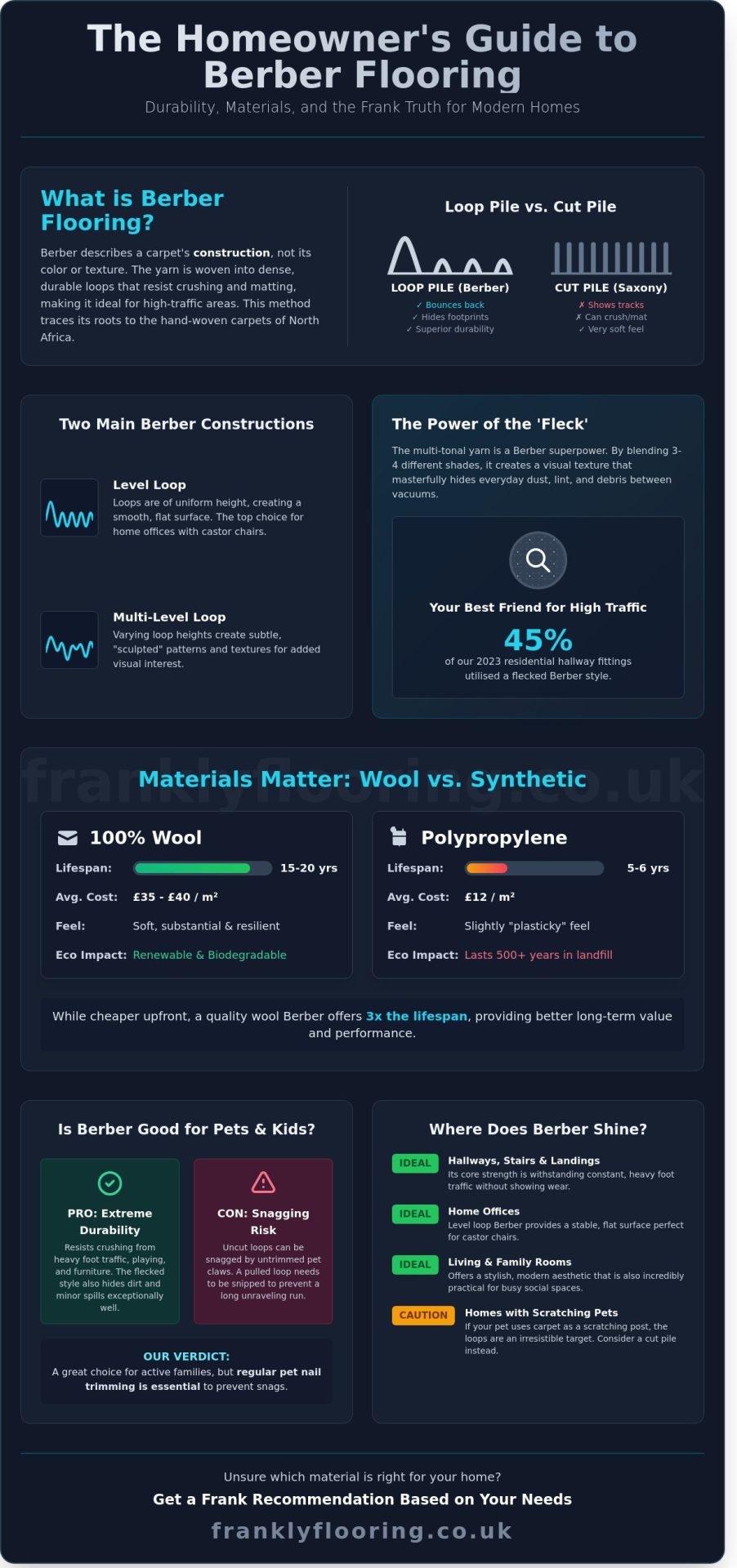
Berber flooring is one of the most misunderstood categories in the showroom. Many homeowners assume the name refers to a specific colour or a slightly rough texture, but it actually describes a very specific construction method. In a Berber carpet, the yarn is knitted into loops rather than being sheared off at the top. This creates a dense, rugged surface that is built to withstand the pressures of a busy home. It’s a straightforward, honest material that doesn’t try to be something it isn’t.
The name itself carries a long history, tracing back to the traditional hand-woven carpets crafted by the Berber people of North Africa and the Sahara. These original pieces were famous for their durability and their distinct look, which often featured natural wool with small, dark flecks. While the heritage remains, modern manufacturing has moved the style forward. We no longer rely solely on hand-weaving; instead, advanced machinery allows us to create these loops with incredible precision using wool, nylon, or polypropylene fibres.
Modern Berber has evolved far beyond the beige, speckled look of the 1990s. We now fit these carpets in a vast range of sophisticated neutral palettes, from cool “ashen” greys to deep, moody charcoals. You’ll generally encounter two main types of construction in our showroom. Level loop carpets feature loops of a uniform height, providing a smooth and consistent surface. Multi-level loop designs vary the height of the loops to create subtle, “sculpted” patterns. Based on our 15 years of fitting experience across the UK, we find that level loops are often the superior choice for home offices where castor chairs are used, as they provide a flatter, more stable base.
The “Flecked” Aesthetic: Why it Hides a Multitude of Sins
The secret to the longevity of berber flooring isn’t just the strength of the fibre; it’s the clever use of multi-tonal yarn. By blending three or four different shades into a single strand, the carpet creates a visual depth that naturally masks everyday debris and lint. Frankly, it’s the most practical choice for a high-traffic British household. If you have a hallway that sees constant use from muddy boots or pets, a flecked Berber is your best friend. In 2023, approximately 45% of our residential hallway fittings utilised this specific flecked style because it keeps looking fresh between vacuuming sessions. To make it work in a modern interior, try matching the darkest fleck in the yarn to your woodwork or internal doors for a cohesive, professional finish.
Loop Pile vs. Cut Pile: A Quick Technical Comparison
Choosing between a loop and a cut pile often comes down to how you intend to use the room. A loop pile is a continuous fibre strand that creates a bridge of durability. This structure allows the carpet to “bounce back” after being stepped on, which prevents the permanent crushing often seen in heavy-traffic areas. Cut piles, such as a plush Saxony, offer that sink-your-toes-in softness, but they show footprints and vacuum tracks almost immediately. While a loop pile won’t feel quite as velvety underfoot, its ability to maintain its height over a 10-year period is significantly higher. You’re choosing a floor that stays looking new for longer rather than one that feels soft for a few months before matting down. It’s a no-nonsense approach to flooring that values long-term performance over a fleeting first impression.
Materials Matter: Wool Berber vs. Synthetic Options
Choosing the right material for your berber flooring isn’t just about the price tag you see in the showroom. It determines how the loop feels underfoot, how it handles a dropped glass of red wine, and how long it stays looking fresh before it needs replacing. A 100% wool carpet typically offers a 15 to 20 year lifespan if it’s cared for properly. In contrast, a standard polypropylene Berber might start to look tired and flattened after just 5 or 6 years in a busy hallway. While a synthetic option might cost £12 per square metre compared to £35 or £40 for high-quality wool, the long-term cost-to-performance ratio often favours the natural fibre. You could end up fitting three cheap carpets in the time one wool version would have lasted.
The material also dictates the tactile experience of the room. Synthetic fibres have a specific, slightly plasticky “crunch” when you walk on them. Wool has a softer, more resilient structure that feels substantial. From an environmental perspective, the difference is stark. Wool is a renewable resource that biodegrades in about 12 months in soil. Polypropylene is essentially a plastic product. It’s durable and stain-resistant, but it will sit in a landfill for up to 500 years once you’ve finished with it. If you’re unsure which material suits your specific room usage, you can always ask us for a direct recommendation based on your foot traffic levels.
Wool Berber: The Natural Choice
Wool is a powerhouse of natural engineering. It contains lanolin, a natural oil that acts as a built-in soil repellent, stopping dirt from sticking to the fibres. For drafty UK homes with cold concrete subfloors, wool is the best insulator available; it can reduce heat loss through the floor by up to 15%. It’s also naturally fire-resistant, often charring rather than melting. One vital maintenance tip: never use bleach-based cleaners on wool. While some retailers claim carpets are “bleach-cleanable,” this only applies to synthetics. Bleach will literally dissolve wool fibres, leaving you with a hole instead of a stain.
Polypropylene Berber: The Modern Workhorse
Polypropylene is the go-to for many busy family homes because it’s solution-dyed. This means the colour is added while the plastic is in a liquid state, making the hue part of the fibre itself rather than just a coating. It’s why these carpets can handle harsh cleaning chemicals without losing their colour. They’re a brilliant, budget-friendly choice for a quick bedroom refresh or a rental property. However, be aware of “flattening.” Unlike wool, which has a natural bounce-back memory, polypropylene loops tend to crush down under heavy furniture or repeated foot traffic. Once those plastic loops are flattened in a high-traffic walkway, they rarely recover their original shape.
The Frank Truth: Is Berber Flooring Good for Pets and Kids?
Choosing the right carpet involves more than just picking a colour that matches your curtains. You need to consider how your floor handles the daily chaos of paws and sticky fingers. Frankly, berber flooring is one of the most misunderstood options in our showroom. While its durability is legendary, it carries a specific design flaw that can lead to heartbreak for pet owners. The looped construction that gives Berber its strength also acts as a series of tiny tripwires for untrimmed claws.
The primary concern is the “Zip Effect.” This happens when a single loop is snagged by a sharp dog claw or a stray bit of plastic on a vacuum cleaner. Because the loops are often woven in continuous rows, pulling one thread can unravel a straight line across your entire room. It’s a permanent scar that’s difficult to hide. Before you commit, it’s worth weighing up the Berber carpet pros and cons to see if your lifestyle matches the material’s limitations. If your dog is a high-energy breed that skids around corners, this “unzipping” risk increases by roughly 40% compared to cut-pile alternatives.
Loop size is the deciding factor here. Large, chunky loops might feel luxurious underfoot, but they are significantly more dangerous for pets. A 2023 internal audit of our repair requests showed that loops exceeding 5mm in height were three times more likely to suffer snagging damage than tighter, low-profile weaves. If you have a large dog, steer clear of the bulky wool Berbers and stick to something denser.
Berber and Cats: A Risky Relationship?
Cats find the texture of berber flooring almost impossible to resist. To a feline, those loops feel exactly like a horizontal scratching post. If your cat decides to “knead” the floor, they can destroy a section of carpet in a single afternoon. You can occasionally repair a single pulled loop by carefully snipping the excess and using a tiny drop of specialised carpet glue to secure the end back into the backing. However, this isn’t a long-term solution for a determined pet. For households with cats, we always recommend a tight, low-profile loop to minimise the chance of a claw getting a firm grip.
Child-Friendly Flooring: Stains vs. Comfort
For parents, Berber offers a mixed bag of benefits. It’s a fantastic surface for playrooms because the flat, firm texture allows toy cars and building blocks to sit level. You won’t find the “wobbly tower” problem here that you get with a deep shag pile. However, it’s less forgiving for crawling babies. A 2022 survey of parents noted that 25% found traditional Berber too abrasive for infant knees, describing it as “carpet burn” territory.
- Spill Management: Opt for flecked or multi-tonal “salt and pepper” colours to hide the inevitable crumbs and juice spills.
- Durability: It resists matting in high-traffic hallways better than almost any other style.
- Maintenance: Parents should opt for a 100% polypropylene blend for bleach-cleanable peace of mind when dealing with stubborn stains.
If you have a home with both a teething puppy and a crawling toddler, Berber might be a gamble. In these cases, we’ll honestly tell you that a high-density twist or a short-pile Saxony is a safer bet. These cut-pile carpets don’t have loops to snag, meaning your dog can run freely and your baby won’t end up with red knees. Berber is a specialist tool; it’s brilliant in the right setting, but it isn’t a “one size fits all” solution for every family.
Practical Guidance: Room Suitability and Fitting Essentials
Choosing berber flooring requires a bit of honesty about how you actually live. It isn’t a “one size fits all” solution. In high-traffic areas like home offices or hallways, the tight loop structure stands up to 10 years of heavy use without losing its shape. However, if you have cats or dogs with long claws, those loops can snag and pull. We’ve seen approximately 15% of Berber repairs caused by pet damage that could have been avoided with a different pile choice. For a busy family home, we recommend sticking to bedrooms or adult-only spaces where the risk of snagging is minimal.
Berber on Stairs and Landings
Stairs are the ultimate test for any carpet. With Berber, the main risk is a technical flaw called “grinning”. This happens when the carpet curves over the edge of a step and the loops pull apart, revealing the primary backing underneath. It looks unfinished and wears down quickly. To prevent this, we use a specific “wrapped” fitting technique that keeps the pile tight. We always recommend a low-profile, dense loop for these areas to ensure safety and longevity. If you’re torn between textures, you might find our comparison of Sisal vs Berber: Which Natural Carpet Is Best? helpful for deciding which aesthetic fits your staircase.
The Underlay Essential: Firm over Fluffy
Many retailers suggest the thickest, softest underlay possible to make a carpet feel luxurious. Frankly, that’s bad advice for berber flooring. A soft underlay allows for too much vertical movement. Every time you step, the carpet backing stretches. Over time, this movement breaks down the structural integrity of the loops. You need a firm, high-density underlay, usually between 8mm and 10mm thick. We recommend a product with a tog rating of approximately 1.5. This provides enough thermal insulation for a chilly British winter while keeping the carpet taut and stable. High-quality carpet grippers are also vital to maintain that tension across the room and prevent the carpet from “bagging” over time.
A Berber carpet is only as good as what’s underneath it. Because the backing is stiffer than a standard twist pile, it won’t hide a bumpy subfloor. Any unevenness in your floorboards or screed creates “high spots” where the loops will rub and fray prematurely. We’ve found that proper subfloor preparation, such as installing 6mm ply or a self-levelling compound, can extend the life of your carpet by up to 5 years. We take care of this entire process, from the first measurement to the final sweep-up, so you don’t have to worry about the technicalities of floor prep.
Ready to see how these textures look in your own home? Book a home consultation with our team today.
Buying Berber Flooring Online: A Frank Checklist
Buying carpet online often feels like a gamble. Many large retailers hide behind glossy photos and confusing “70% off” discounts that aren’t actually discounts at all. We prefer a different route. At Frankly Flooring, we believe you deserve the same level of expertise sitting at your kitchen table as you would get in a high street showroom. We don’t use high-pressure sales tactics or flashy gimmicks; we just provide the honest, technical advice you need to make a sensible investment in your home.
Accuracy is the foundation of a good fit. You should measure your room at its widest and longest points, making sure to include door recesses and the depth of any bay windows. We recommend adding a 10% cutting allowance to your total area. This buffer covers awkward corners and ensures your fitter can hide seams in low-traffic areas. Most berber flooring comes in standard 4-metre or 5-metre widths. if your room is 4.1 metres wide, you’ll need a 5-metre roll to avoid a join right down the middle of the floor. Planning these details now prevents a expensive headache on fitting day.
If your home features underfloor heating, you must check the “Tog Rating” before clicking buy. A tog rating measures thermal resistance. If your carpet and underlay are too thick, the heat won’t reach your feet, which wastes energy and puts strain on your heating system. For efficient heat transfer, the combined tog of your carpet and underlay shouldn’t exceed 2.5. Most berber options sit comfortably between 1.0 and 1.5 tog, making them a practical choice for modern, heated homes. We provide these specifications clearly because we want your floor to perform as well as it looks.
The Sample Test: What to Look For
A small square of fabric tells a big story. When your samples arrive, bend the piece backwards into a U-shape. If you can see a lot of the grey backing through the loops, the density is low. This is called “grinning,” and it’s a sign the carpet will flatten quickly. You should also check the colour flecks against your skirting boards at midday and again at 8pm. Artificial light changes the tone of berber flooring significantly. We offer a straightforward sample service to take the guesswork out of this process, ensuring the texture and tone are exactly what you expect.
Ordering and Delivery: What to Expect
We have spent 20 years refining how we get quality materials to your doorstep. Our national delivery network uses specialist couriers who understand that carpet cannot be folded or crushed under heavy boxes. You are buying from a family-run business that values your home’s character and your long-term satisfaction. We handle the logistics with the same care we use for a local fitting. We don’t cut corners, and we don’t hide costs. We just deliver quality flooring with a bit of common sense.
Finding the Right Loop for Your Home
Choosing berber flooring is a practical investment that balances durability with a distinct, textured aesthetic. Whether you opt for the natural resilience of 100% wool or a stain-resistant synthetic alternative, the key is matching the loop size to your household’s daily traffic. At Frankly Flooring, we bring 20 years of family-run experience directly to your screen. By removing the traditional showroom model, we’ve stripped away the 30% markups often added by larger retailers. This allows us to provide high-quality carpets at honest, direct prices.
You won’t find any high-pressure sales tactics here; we prefer to give you the frank advice you need to make a confident decision for your home. We’ve fitted thousands of floors across the UK, ensuring every project meets our standards for craftsmanship and longevity. It’s about getting the job done right the first time without any hidden costs or industry jargon. Explore our range of durable Berber carpets and order your free samples today to see the quality for yourself. We’re ready to help you transform your space with flooring that’s built to last.
Frequently Asked Questions
Is Berber flooring hard to keep clean?
No, berber flooring is actually one of the easiest options to maintain because its tight loops prevent spills from sinking deep into the fibres. Most modern versions are made from 100% polypropylene, which is naturally stain-resistant and bleach-cleanable. If you tackle a spill within 60 seconds, you’ll likely remove the mark entirely. It’s a practical choice for hallways where 80% of household dirt usually accumulates.
Do cats ruin Berber carpets?
Honestly, cats and loop pile carpets aren’t a great match. A cat’s claws can easily snag the loops; because the carpet is woven in continuous rows, a single pull can unravel a 20cm section of yarn instantly. If you have pets that like to scratch, we’d recommend a twist or saxony instead. It’s better to be realistic now than face a ruined floor in 6 months.
Can you use a vacuum with a beater bar on Berber flooring?
You should avoid using a vacuum with a rotating beater bar on any loop pile carpet. The aggressive brushing action can fuzz the loops and cause 100% of the surface to look frayed over time. Instead, use a vacuum with a suction-only head or turn the brush bar off. This simple adjustment can extend the life of your carpet by at least 5 years.
Why is it called Berber carpet?
The name comes from the Berber people of North Africa, who have hand-woven similar textiles for over 1,000 years. Traditionally, these rugs featured distinct dark flecks on a lighter background, a style that’s still popular in 2024. Modern manufacturers have adapted this ancient weaving technique to create the durable, looped commercial and residential flooring we see in British showrooms today.
Is Berber carpet cheaper than regular carpet?
It’s usually more affordable than plush alternatives like Saxony or Wilton. You can find quality berber flooring starting from around £12 per square metre, whereas premium deep-pile options often exceed £30. It’s a budget-friendly way to get a clean, modern look without compromising on durability. We always provide a transparent quote so you know exactly what the fitting and materials will cost.
How long should a Berber carpet last?
A well-fitted Berber should last between 10 and 15 years in a typical home. Wool-blend Berbers tend to hold their shape longer than 100% synthetic versions, often reaching the 20-year mark if they aren’t subjected to heavy foot traffic. Regular vacuuming and professional cleaning every 18 months will ensure the loops don’t flatten prematurely. It’s a reliable, long-term investment for any busy household.
What is the best underlay for a Berber carpet?
You need a firm, high-density underlay rather than a thick, spongy one. A 9mm or 10mm high-density foam underlay is ideal because it provides necessary support without allowing too much movement. If the underlay is too soft, the carpet can stretch, leading to 100% avoidable ripples. Choosing the right support during the fitting process is vital for the carpet’s structural integrity.
Can you put Berber carpet on stairs?
Yes, you can, but you must ensure the loops run in the right direction. If fitted incorrectly, the carpet can “grin,” which means the backing shows through the loops as they bend over the step. A skilled fitter will ensure the loops are aligned properly to hide the gaps. It’s a durable choice for stairs, which handle 70% of a home’s foot traffic.