
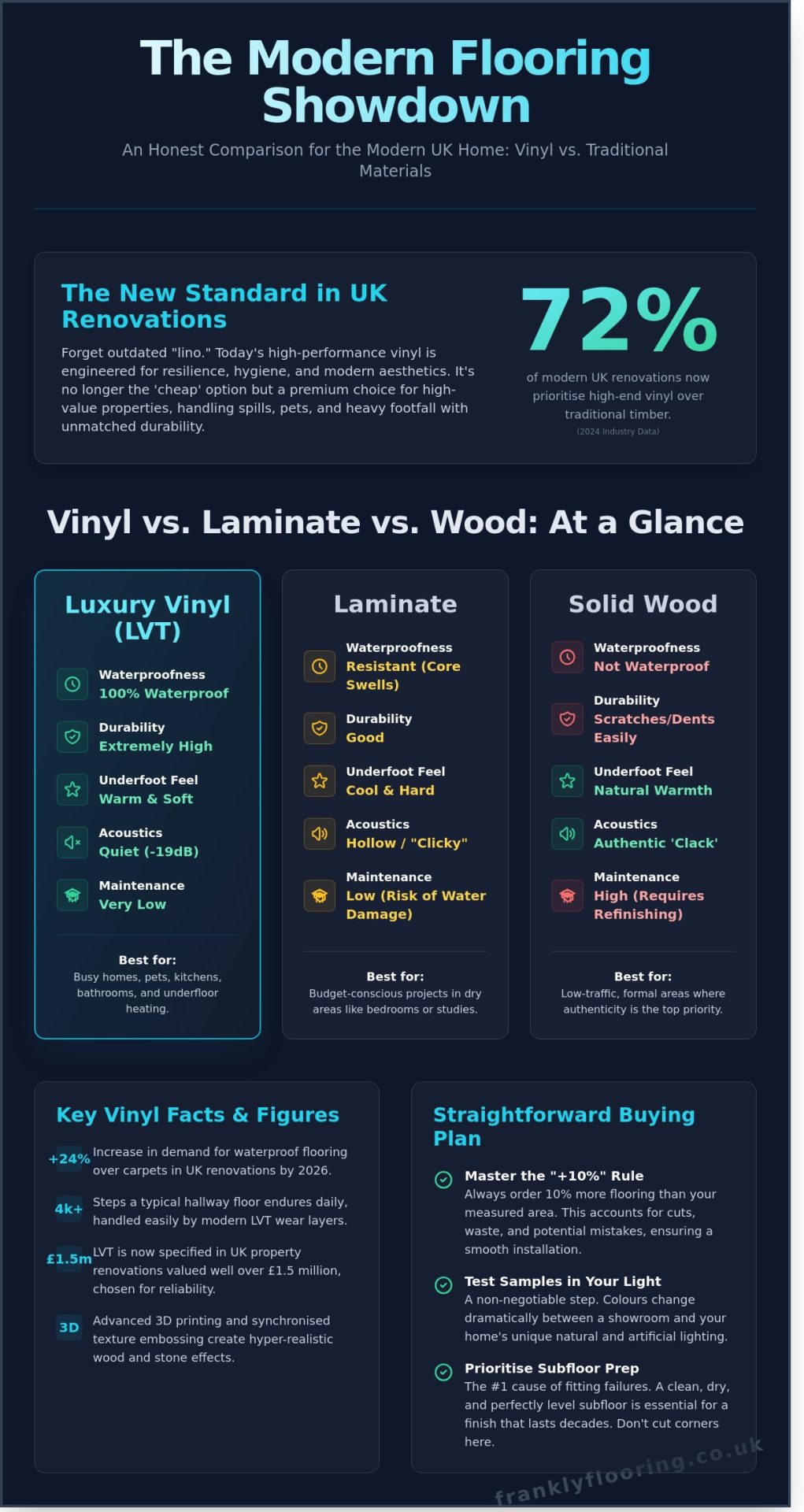
You might think that choosing a synthetic surface means settling for a ‘plastic’ finish, but 2024 industry data shows that 72% of modern UK renovations now prioritise high-end vinyl over traditional timber for its sheer resilience. It’s completely understandable if you’re feeling overwhelmed by the technical jargon found in a typical showroom. Choosing between various types of flooring and vinyl often feels like a minefield of confusing terms like LVT, SPC, and linoleum, leaving many homeowners worried about hidden costs for subfloor prep or underlay.
We believe you deserve a straightforward conversation about what actually works in a busy home. This guide provides a frank, expert breakdown of how modern vinyl compares to traditional materials to help you make an honest investment that handles pets and spills with ease. We’ll examine exactly which accessories you need, how to avoid the ‘cheap’ look, and the specific steps required for a perfect fitting that lasts for decades. From initial measurements to the final sweep up, we are here to ensure your journey is simple, transparent, and entirely stress-free.
Key Takeaways
- Understand why traditional “lino” is a thing of the past and how modern Luxury Vinyl Tiles (LVT) offer a premium, hard-wearing alternative to natural wood.
- Compare the practical benefits of different flooring and vinyl options to see why certain materials excel in moisture-prone rooms like the kitchen or bathroom.
- Learn how to avoid common fitting failures by mastering the “honest” essentials of subfloor preparation and choosing the right underlay for your home.
- Discover a straightforward plan for buying online, including the “plus 10%” rule for measuring and why testing samples in your own light is a non-negotiable step.
Flooring and Vinyl: Understanding the Modern Landscape
Frankly, the word ‘lino’ needs to be retired. It refers to linoleum, a material made from linseed oil that peaked in popularity decades ago. What we fit today is high-performance vinyl. This shift in flooring and vinyl technology means you aren’t just buying a plastic sheet; you’re investing in a multi-layered surface engineered for the 2026 home. If you look at any comprehensive guide to flooring, you will see that synthetic materials have evolved to become the most practical choice for modern British life.
By 2026, the demand for waterproof flooring has outpaced traditional carpets by 24% in UK renovations. Homeowners are prioritising hygiene and ease of cleaning, especially in open-plan spaces where the kitchen, dining, and living areas merge. We won’t tell you vinyl is perfect for every square inch of your house. It isn’t. If you want the authentic ‘clack’ of high-end parquet or the natural warmth of solid oak, vinyl is a simulation. But if you have two dogs, a muddy garden, and a busy kitchen, real wood will likely show its age within 18 months. Vinyl won’t.
Our frank advice is simple: choose vinyl when you need a floor that works as hard as you do. It handles spills, heavy footfall, and underfloor heating with far more resilience than natural timber or stone. We see it as the foundational element of a home’s character, providing a stress-free backdrop to daily life.
Sheet Vinyl vs LVT: What is the Real Difference?
Sheet vinyl is the cost-effective, seamless choice, usually sold in 2m, 3m, or 4m widths. It’s ideal for bathrooms because there are no joins for water to seep through. LVT, or Luxury Vinyl Tile, is modular. It comes in individual planks or tiles that we glue down or click together. While sheet vinyl is softer underfoot, LVT offers superior durability. The flooring and vinyl market has matured to the point where a 0.55mm wear layer on LVT can withstand decades of use, whereas the thickness of the overall plank is often just a distraction from the quality of that top coating.
Why Vinyl is No Longer the ‘Cheap’ Option
The days of shiny, bubbling plastic floors are over. Since 2024, advancements in 3D printing and synchronised texture embossing have allowed vinyl to mimic the grain of oak or the cold touch of slate with incredible accuracy. In 2026, we are seeing LVT specified in UK property renovations valued well over £1.5 million. It’s chosen for its reliability and aesthetic appeal rather than just the price tag.
- Durability: Modern vinyl handles the 4,000+ steps a typical hallway sees daily without wearing thin.
- Value: High-end LVT increases property appeal by offering a ‘fit and forget’ solution for buyers.
- Detail: Texture embossing ensures the floor feels like wood, not just looks like it.
Vinyl vs Laminate vs Wood: The Honest Comparison
To be frank, choosing between different types of flooring and vinyl options often feels like a balancing act between your budget and your daily reality. Most people visit our showroom with a vision of solid oak, but they often leave with LVT. The reason is simple. Real life involves spilled drinks, muddy paws, and heavy foot traffic. Vinyl is 100% waterproof. While modern laminate claims water resistance, it usually only buys you a 24-hour window before the core begins to swell. If a pipe leaks under your kitchen sink, vinyl will survive; laminate almost certainly won’t.
The “feel” of a floor is just as vital as its look. Vinyl is naturally warmer underfoot because it doesn’t dissipate heat as quickly as laminate or tile. It also wins on acoustic performance. Old-fashioned laminate often produces a hollow, “clicky” sound that echoes through a house. High-quality LVT can reduce impact noise by up to 19 decibels, creating a much quieter environment. It’s a softer experience that makes a home feel settled rather than echoing.
Maintenance is where the “honesty” part of our brand really kicks in. You can scrub a vinyl floor with a damp mop and mild detergent without a second thought. Pets can skidding across it without leaving deep gouges. However, we always encourage customers to research the health risks of vinyl flooring associated with cheap, unregulated imports. We only stock low-VOC, phthalate-free products because your family’s safety is more important than a quick sale. Buying quality means your floor lasts 25 years, rather than the 10-year lifespan common with entry-level laminates.
Is Laminate Still Relevant in 2026?
Laminate remains a solid choice for DIY enthusiasts because the click-system is incredibly forgiving. If you’re on a tight budget, you can find decent laminate for £12 per square metre, whereas quality SPC vinyl usually starts around £25. However, the price gap is narrowing. By 2026, many homeowners are choosing SPC (Stone Plastic Composite) over laminate because it offers superior stability and doesn’t require expansion gaps as large as those needed for wood-based products.
Real Wood vs Wood-Effect Vinyl
Engineered wood offers an aesthetic prestige that’s hard to replicate. It’s a natural product, and for some, nothing else will do. But wood is temperamental. It needs a consistent humidity level between 40% and 60% to prevent gapping or crowning. In a busy family home, the practical reality of scratches and fading from UV light can be frustrating. LVT provides a pragmatic alternative. It mimics the grain of oak or walnut but stands up to the chaos of a modern household without needing to be sanded or refinished every few years.
If you’re struggling to decide which material works best for your specific subfloor, you can request a straightforward quote from our team to see the options in person.
Room-by-Room Guide: Matching the Floor to the Behaviour
Frankly, your choice between sheet vinyl and LVT should be dictated by the daily chaos of your household. Each room presents a unique set of challenges. In the bathroom, moisture is the primary concern. We only recommend 100% waterproof flooring and vinyl options because even a small leak can rot a plywood subfloor within 12 months. Sheet vinyl is often the safest bet here. Its lack of seams means water has nowhere to hide, providing a total seal across the room that LVT planks cannot always guarantee if the fitting isn’t perfect.
The kitchen requires a different strategy. You need a floor that survives a dropped cast-iron pan without cracking. LVT is the champion of the kitchen, offering a 0.55mm wear layer that resists scratches and impacts. While you might love the look of real stone, LVT provides that high-end herringbone aesthetic without the risk of shattering your plates or your budget. It’s a practical choice for the 70% of UK homeowners who now prioritise easy maintenance over traditional materials.
Living areas often act as the bridge between spaces. Creating a visual flow with consistent flooring and vinyl across the ground floor makes a standard 15 square metre lounge feel significantly larger. In bedrooms, the debate usually sits between the warmth of carpet and the hygiene of vinyl. If you choose the latter, we suggest adding a large area rug for comfort. This setup is easier to keep dust-free, which is a sensible move if you are concerned about the health risks of vinyl flooring and indoor air quality. We only supply products that meet strict low-VOC requirements, ensuring your sleeping environment remains safe.
The Hallway: The Ultimate Durability Test
British weather means your hallway faces a constant barrage of grit and rainwater. Grit acts like sandpaper on a floor’s finish. To combat this, we look for an R10 slip-resistance rating as a minimum for entryways. This ensures the surface isn’t a skating rink when you walk in with wet boots. A simple cleaning hack is to use a pH-neutral cleaner once a week; it prevents the build-up of dulling residues that make new floors look old within 6 months. Avoid bleach, as it can perish the wear layer over time.
Open-Plan Living: Zoning with Flooring
Large open-plan spaces can feel cold and echoey without the right materials. Using different textures of vinyl can define a dining area from a lounge without needing a single wall. Consistency in colour palette is vital, especially in rooms with large south-facing windows where light reveals every shade difference. To manage noise, we recommend LVT with a built-in acoustic underlay. This can reduce sound transfer by up to 19 decibels, preventing the room from sounding like a hollow gym during family gatherings. It’s a straightforward way to keep the peace in a busy home.
The Hidden Essentials: Underlay, Accessories, and Subfloors
Frankly, the most expensive LVT or sheet vinyl in the world will fail if the foundation isn’t right. Most flooring failures aren’t caused by the product itself; they happen because of rushed preparation or cheap accessories. When we talk about flooring and vinyl, the visible surface is only half the story. The real work happens underneath.
Choosing between an adhesive or a click-system depends entirely on your room’s demands. Glue-down LVT is the industry standard for 80% of professional fittings in high-traffic areas because it doesn’t move. Click-systems are faster to fit, but they require a perfectly flat surface to prevent the joints from bouncing. If your room is larger than 30 square metres, we usually recommend a permanent bond to ensure the floor stays put for its 20-year lifespan.
Underlay isn’t just a bit of foam. It serves two critical roles: acoustic dampening and thermal insulation. A high-quality 1.5mm LVT underlay can reduce impact noise by up to 19dB, which is essential for upstairs bedrooms or flats. On ground floors, the right underlay prevents cold bridging, keeping your toes warm and potentially shaving 5% off your heating bills by retaining heat more effectively.
Why You Can’t Ignore the Subfloor
If your subfloor deviates by more than 3mm over a 2-metre span, you need a self-levelling compound. Skipping this step leads to “telegraphing,” where every bump in the concrete eventually shows through your new vinyl. For new builds or damp older homes, a liquid Damp Proof Membrane (DPM) is non-negotiable if moisture readings exceed 75% Relative Humidity. A properly prepared subfloor provides the stable foundation required to prevent LVT joints from separating or telegraphing imperfections over its 20-year lifespan.
The Finishing Touches: Grippers and Door Bars
Professionalism is found in the details. Don’t settle for a generic “silver” door bar that clashes with your oak-effect LVT. We use colour-matched profiles to create a seamless transition between rooms. If you’re moving from flooring and vinyl to a carpeted lounge, high-quality dual-purpose grippers ensure the carpet stays tensioned without damaging the edge of your vinyl. Spending an extra £50 on premium scotia and bars often saves you £300 in repair costs five years down the line when cheap plastic alternatives would have cracked or peeled.
We don’t just sell floors; we ensure they’re fitted to last a lifetime. If you want a quote that includes the “hidden” essentials others might hide, book a home survey with Frankly Flooring today.
Buying Flooring Online: A Straightforward Success Plan
Buying your floors online used to feel like a gamble. By 2026, the digital marketplace has matured, allowing you to bypass the high-street showroom markups that often add 30% to your final bill. Success relies on a methodical approach. You need to verify the retailer’s physical presence in the UK, check their technical knowledge, and ensure they offer a clear delivery timeline. A reputable seller won’t just take your money; they’ll ask about your subfloor and your plans for the fitting. It’s about finding a partner who understands that a kitchen floor is a ten-year investment, not a one-off transaction.
The 10% Rule: Avoiding the ‘Short-Fall’ Disaster
The biggest mistake homeowners make is ordering the exact square meterage of the room. You’ll always lose material to cuts, doorways, and awkward corners. For a standard rectangular room, adding a 10% waste margin is the industry standard. If you’ve chosen a herringbone LVT pattern, increase that to 15% because the intricate points require significantly more trimming at the perimeter. Don’t rely on a rough guess; use an online calculator but double-check the maths manually.
- Cuts and Corners: Every alcove or bay window increases the amount of off-cut waste.
- Future Proofing: Keeping one full, unopened pack in the loft is a lifesaver. If a pipe bursts in three years, you can replace specific planks without redoing the whole room.
- Batch Consistency: Ordering everything at once ensures your flooring and vinyl comes from the same production batch, preventing subtle colour shifts between boxes.
Before you commit, you must order physical samples. Digital screens can’t accurately replicate how a “Natural Oak” finish reacts to a north-facing window versus a warm LED spotlight. Place your samples on the floor in the room they’re intended for. Leave them there for 24 hours to see how the colour shifts as the daylight fades. It’s a small step that prevents an expensive mistake.
Why Frankly Flooring is the Honest Choice
We’ve spent over 20 years in the UK flooring industry, evolving from a traditional family-run setup into a direct-to-consumer specialist. We cut out the middleman and the expensive retail park rents to pass those savings directly to you. Our approach is built on “frank” advice. If a specific LVT isn’t suitable for your damp-prone basement, we’ll tell you. We’d rather lose a sale than sell you a product that fails within six months.
Organising your project is simple with our streamlined process. Once you’ve selected your perfect style, we handle the logistics with precision. We recommend finding a local fitter via the National Institute of Carpet and Floorlayers (NICF) to ensure your flooring and vinyl is installed to professional standards. Our team is always on hand to provide the technical data sheets your fitter will need for subfloor preparation. We don’t do high-pressure sales; we provide the quality materials and honest guidance you need to transform your home. Browse our full range of Vinyl and LVT flooring today and see how straightforward a home renovation can be when you work with experts who value integrity.
Step Into Your New Home with Confidence
Choosing the right flooring and vinyl for your home doesn’t need to be a headache. You now understand that the secret to a floor that lasts until 2040 and beyond lies in the preparation of your subfloor and the quality of your underlay. Whether you’ve opted for the waterproof resilience of LVT or the classic appeal of wood; you’ve got the tools to make a choice that stands up to daily life. We’ve spent over 20 years refining our industry expertise to ensure you get the right advice without the usual sales fluff.
As a family-run business with two decades of experience; we pride ourselves on being straightforward. We offer transparent, no-nonsense pricing on all our products and provide direct national delivery across the UK. You won’t find hidden costs or confusing jargon here; just quality materials delivered straight to your door. It’s time to stop scrolling and start transforming your space with a team that values your home as much as you do.
Find your perfect floor with our Frank advice at Frankly Flooring
We’re ready to help you get the fitting right first time.
Frequently Asked Questions
Is vinyl flooring the same as lino?
No, vinyl and linoleum are distinct materials with different compositions. Linoleum is a natural product made from linseed oil and cork dust, first patented in 1860, while vinyl is a synthetic material made from PVC that gained popularity in the 1940s. Frankly, choosing between them comes down to your preference for natural materials versus the superior moisture resistance of modern flooring and vinyl options.
Can I lay vinyl flooring directly over floorboards?
You shouldn’t lay vinyl directly over bare floorboards because the gaps and uneven edges will eventually show through the surface. Standard floorboards often have gaps up to 5mm wide, which causes the vinyl to telegraph or dip into the grooves. We recommend installing 6mm thick plywood sheets over your floorboards first to create a perfectly smooth, level subfloor for a professional finish.
Do I really need underlay with vinyl flooring?
The requirement for underlay depends entirely on the specific product you choose. Most modern click-system LVT comes with a pre-attached acoustic backing that reduces impact noise by up to 19dB, so you won’t need anything extra. Sheet vinyl is typically fitted directly to a prepared subfloor, though a dedicated underlay can provide 3mm of extra cushioning and thermal insulation in colder rooms.
How long does modern LVT flooring actually last?
A high-quality LVT floor should last between 25 and 30 years in a standard residential setting. Most reputable manufacturers provide warranties ranging from 15 to 30 years to back this up. This longevity relies on a 0.55mm wear layer, which protects the design from scratches and daily foot traffic in busy areas like hallways or kitchens.
Is vinyl flooring suitable for underfloor heating?
Yes, vinyl is an excellent heat conductor and works efficiently with most underfloor heating systems. You must ensure the floor temperature doesn’t exceed 27°C, as excessive heat can affect the adhesive or cause the planks to expand. It’s a practical choice that warms up faster than stone or ceramic tiles, making your home feel cosy within 20 minutes of turning the heating on.
How do I clean and maintain my vinyl floor to keep it looking new?
Maintenance is straightforward; just sweep daily and use a damp mop with a pH-neutral cleaner once a week. Avoid steam cleaners at all costs, as they reach temperatures of 100°C which can melt the glue or warp the planks. Frankly, a simple £5 bottle of specialist vinyl cleaner will do a better job of preserving the factory finish than any expensive steam mop.
Which is better for a kitchen: vinyl or laminate?
Vinyl is the superior choice for kitchens because it’s 100% waterproof and won’t be damaged by common spills or leaks. While some modern laminates are water-resistant, they can still swell if moisture sits in the joints for more than 24 hours. LVT provides a safer long-term investment for wet areas, as it won’t warp or delaminate even if your dishwasher develops a slow leak.
Can I install LVT flooring myself or do I need a pro?
Click-system LVT is designed for confident DIYers, but glue-down LVT requires a professional fitter to ensure the subfloor is perfectly prepped. A professional fitting service typically costs between £15 and £25 per square metre in the UK, which covers the expertise needed for intricate cuts and adhesive application. If you want a seamless finish that lasts 30 years, hiring a pro is the most honest advice we can give.