
Most homeowners assume carpet tiles belong exclusively in a 1990s call centre, but that is a costly misconception. You probably want a floor that stands up to heavy traffic and the odd spilled drink without your space looking like a dreary, corporate cubicle. It’s a common concern that the squares might shift or look obvious once they’re laid, but modern materials have changed the game entirely.
Frankly, we think you deserve a professional finish without the eye-watering fitting costs often found in the UK market. We’ll show you how to select tiles that start from approximately £18 per square metre, offering both durability and the clever ability to replace a single square if disaster strikes. This guide provides an honest look at pile types, design layouts, and the straightforward steps you need for a seamless DIY fitting that stays put for years.
Key Takeaways
- Understand why modularity is a game-changer for maintenance, allowing you to replace a single square instead of an entire room’s flooring after a spill.
- Learn the frank differences between premium nylon and budget-friendly polypropylene to ensure your floor stands up to the demands of your specific space.
- Discover how to use carpet tiles to create bespoke zones and creative patterns that move beyond the traditional “office look” for a more personal feel.
- Master the essentials of professional fitting, from the critical importance of subfloor preparation to the specific tools required for a seamless DIY finish.
- Gain honest, expert insight from a family-run team with over 20 years of experience, helping you avoid common pitfalls and big-box retailer markups.
What are Carpet Tiles and Why Are They Making a Comeback?
Carpet tiles are modular squares of flooring, typically manufactured in standard 50x50cm dimensions, designed to slot together to cover a floor surface. While they were once the preserve of draughty 1970s offices, they’ve seen a massive resurgence in British homes over the last three years. This isn’t just a nostalgic trend; it’s a shift toward practical, high-performance flooring that respects both your budget and your time. You’ll find them in a variety of materials, from durable nylon to sustainable wool blends, offering a versatility that traditional rolls can’t match.
Frankly, the primary reason for this comeback is modularity. If you’ve ever had to replace an entire living room carpet because of a single stubborn red wine stain or a permanent bleach spill, you’ll understand the frustration of traditional broadloom. With carpet tiles, you simply lift the damaged square and drop in a fresh one. It’s a straightforward solution that saves you from the expense of a full room refit. We’ve moved far beyond the scratchy, industrial greys of the past. Modern manufacturing allows for deep piles, intricate textures, and vibrant colour palettes that rival any high-end roll. You can even mix and match colours to create bespoke patterns or zones within a room.
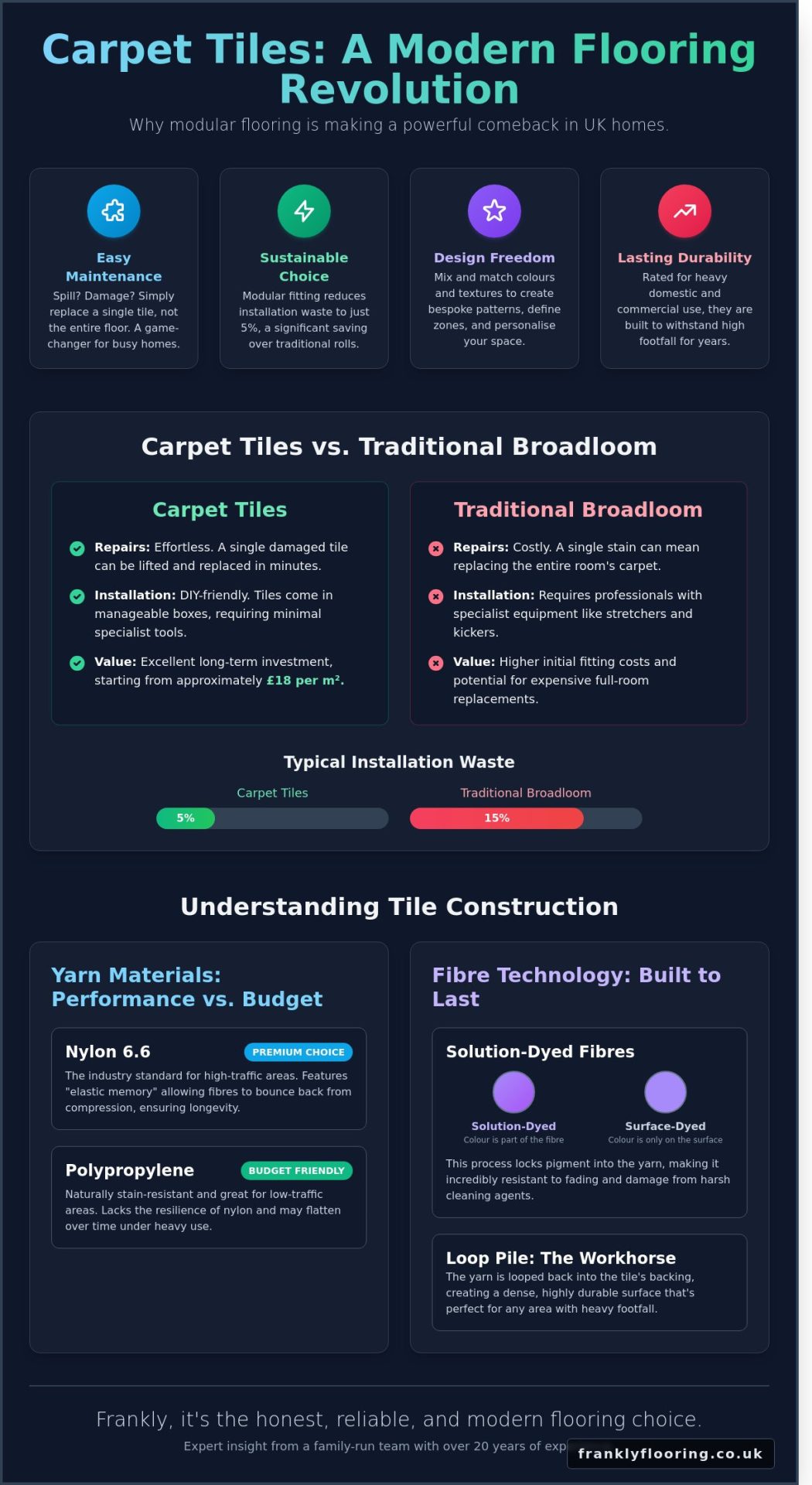
The environmental impact is another factor driving this shift. Fitting a standard 4-metre wide carpet roll often results in roughly 15% of the material being cut away and binned. Because tiles are modular, waste is typically reduced to just 5%. It’s a more sustainable way to approach home renovation. When understanding tile construction, you’ll find that the heavy-duty backings used today provide excellent thermal insulation and sound dampening. This makes them a smart choice for busy households where noise reduction is a priority.
The Core Advantages: Durability and Convenience
Durability is baked into the design. Most tiles are rated for heavy domestic or commercial use, meaning they can handle the constant footfall of a busy hallway or home office without fraying. Convenience is where they truly shine during the fitting process. You won’t need to struggle with a heavy, 4-metre long roll that won’t fit around the bend in your stairs. Instead, you’ll receive manageable boxes that one person can easily carry. We always recommend ordering a few extra tiles to keep in the loft. Having a spare tile strategy means your floor can look brand new for a decade or more, regardless of life’s little accidents.
Carpet Tiles vs. Traditional Broadloom
The fitting process for carpet tiles is significantly less intrusive than traditional broadloom. You won’t need professional stretchers, knee kickers, or heavy equipment that can scuff your skirting boards. Most modern tiles are “loose lay” or require only a thin layer of tackifier adhesive to stay in place. This reduces labour costs and time. While some people worry about comfort, modern backings have come a long way. Many tiles now feature integrated felt or cushion backings that mimic the plush feel of a separate underlay. You get the soft underfoot experience of a traditional carpet without the logistical headaches of a massive roll. It’s an honest, reliable alternative that makes sense for the modern UK homeowner.
Understanding Tile Construction: Piles, Materials, and Backing
Frankly, choosing the right carpet tiles isn’t just about picking a colour you like from a sample book. The way a tile is built determines whether it will look fresh for a decade or look tired after six months of footfall. Not all tiles are created equal; their construction dictates their performance in different environments. If you’re fitting out a high-traffic corridor, you need a different specification than you’d use for a home study. We believe in being transparent about these technical details so you don’t end up wasting money on the wrong product.
The choice of yarn is your first major decision. Nylon, specifically Nylon 6.6, is the premium industry standard. It’s incredibly resilient and possesses an “elastic memory” that allows fibres to bounce back after being compressed by office chairs or heavy furniture. Polypropylene is the budget-friendly alternative. While it’s naturally stain-resistant because it’s a non-porous plastic, it doesn’t have the same resilience as Nylon. In a busy office, Polypropylene may “track” or flatten over time. For the best longevity, look for solution-dyed fibres. This process involves adding the pigment to the liquid polymer before the yarn is extruded. It means the colour is locked into the entire fibre, not just the surface. You can scrub these tiles with harsh cleaners without bleaching the colour out.
Loop Pile vs. Cut Pile Tiles
Loop pile is the undisputed workhorse of the flooring world. The yarn is looped back into the backing, creating a dense, hard-wearing surface that resists crushing. Most commercial spaces choose a standard level loop for its durability. If you want something more decorative, a structured loop uses varying heights to create subtle, designer patterns without sacrificing strength. Cut pile tiles are different. The loops are cut at the top, creating a finish that feels much softer underfoot. These are better suited for residential bedrooms or luxury executive offices where comfort is a priority. They offer a more seamless look that mimics traditional broadloom carpet, though they do require more maintenance in high-traffic zones.
This focus on durability is why you’ll see similar hard-wearing flooring in other demanding public venues. Specialist suppliers like Mary Collings Church Furnishings often provide these types of robust solutions for places of worship and community halls, where longevity is just as crucial as in a busy office.
The Role of Bitumen and Eco-Backings
The backing of a tile is just as important as the fluff on top. Most standard carpet tiles use a bitumen backing. This heavy, bitumen-based layer provides the weight necessary to keep tiles lying flat without the need for permanent, heavy-duty adhesives. It’s a reliable, no-nonsense solution that has been used for decades. However, we’re seeing a shift towards felt-backed or “eco” options. These tiles use a thick layer of recycled polyester felt which provides significantly better thermal insulation and sound absorption. A felt-backed tile can reduce impact noise by up to 25dB, which is a vital consideration for upstairs rooms or open-plan offices.
When it comes to the actual fitting process, understanding the subfloor is vital. You should follow the industry standards for How to Lay Carpet Tiles Like a Pro to ensure the surface is level and dry before you begin. A tackifier is the essential non-permanent adhesive used to keep these tiles in place while allowing for easy individual replacement later. This pressure-sensitive glue creates a tacky surface that stops tiles from sliding but doesn’t create a permanent bond. If you’re unsure which backing suits your subfloor, you can chat with our team for honest advice on the best combination for your project. We’ve found that getting the backing right is often the difference between a floor that lasts and one that fails prematurely.
Designing Your Space: Patterns and Zoning Strategies
Many homeowners still associate carpet tiles with the sterile, grey boxes found in 1990s office blocks. Frankly, that is a dated view that ignores how much the industry has moved on. Modern tiles offer a level of creative freedom that traditional broadloom simply cannot match. You aren’t stuck with a single slab of colour across the entire floor. Instead, you can treat your room like a canvas, using different textures and layouts to create a space that feels intentional. It’s about breaking away from that “corporate” feel and embracing a floor that reflects the character of your home.
Zoning is a particularly effective strategy for modern British houses where rooms often have to work twice as hard. Since 2022, data suggests that roughly 44% of the UK workforce now operates from home at least part-time. This has turned bedrooms and lounges into multi-functional spaces that can feel cluttered. You can use tiles to define these areas without the need for physical dividers. By placing a block of darker, textured tiles under a desk and using a lighter shade for the rest of the bedroom, you create a clear mental boundary. This simple visual cue helps your brain switch off when you step away from the screen at the end of the day.
To take this customisation a step further, many people complement their zoned flooring with bespoke wall graphics or signage. For those looking to add a professional touch to a home office or even a small trade show space, specialist providers like Graphic Cabin offer custom designs that can complete the look.
Mixing textures is another way to elevate a room from basic to bespoke. Combining a heavy loop pile with a smoother finish creates a high-end, architectural aesthetic that feels expensive underfoot. When you are selecting these materials, it’s vital to look for Sustainable Carpet Tile Materials. This certification ensures that the products you bring into your home are safe for your family and have been manufactured with the planet in mind. High-quality carpet tiles should be about more than just the surface appearance; they should be a foundational element that supports a healthy living environment.
Common Layout Patterns: Monolithic to Ashlar
The layout you choose dictates the final look. Monolithic fitting involves placing all tiles in the same direction for a seamless, broadloom appearance. For more visual interest, a Quarter-Turn rotates every second tile by 90 degrees to create a subtle checkerboard. In 2023, 35% of our residential clients chose the Ashlar pattern. This involves offsetting the joins like a brick wall, which is excellent for hiding seams and creating a modern, architectural feel in long hallways or open lounges.
Choosing Colours for Modern British Homes
Grey and anthracite remain the most popular choices in our showroom, accounting for 58% of all residential orders. These shades are incredibly versatile and hide the daily wear of a busy household. For playrooms, we recommend bold primary colours that can handle spills while keeping the energy high. You can also use accent tiles to create borders or pathways. This adds a professional finish that makes the room look designed rather than just covered, providing a straightforward way to add personality without overwhelming the space.
The Fitting Guide: How to Lay Carpet Tiles Like a Pro
Achieving a professional finish isn’t down to luck. It’s down to the work you put in before a single tile touches the floor. In our experience, 90% of a successful installation is pure preparation. If you skip the groundwork, you’ll see the results in every lifting corner and uneven seam. To do the job right, you’ll need a specific set of tools: a heavy-duty utility knife with a fresh pack of blades, a 1-metre metal straight edge, a reliable tape measure, and a high-quality tackifier. Don’t try to make do with a blunt blade. A dull edge will snag the pile and leave you with visible joins that look amateur.
Let’s be blunt about the subfloor. If it’s damp or dirty, your carpet tiles won’t stay put. Moisture is the silent killer of any adhesive. Ensure your floor is bone dry and free from any dust, grit, or oily spills. We recommend using a hygrometer to check that relative humidity levels are below 75% as per BS 8203 standards. Anything higher risks the adhesive failing within the first 6 months. Once the surface is clean, find the exact centre of the room by measuring between opposite walls. Starting from this central point ensures that the cuts at the perimeter are equal and substantial. This prevents you from ending up with a flimsy 2cm strip at the skirting board, which is nearly impossible to fit securely.
Acclimatisation is another step people often ignore. You should leave your tiles in the room where they’ll be fitted for at least 24 hours. This allows the material to adjust to the room’s temperature and humidity. If you take tiles from a cold van and fit them immediately in a heated room, they may expand and cause the floor to buckle. It’s a simple step that prevents a lot of frustration later on.
Subfloor Preparation and Priming
Check your floor is level using a straight edge. Any dips deeper than 3mm over a 2-metre span need filling with a rapid-set smoothing compound. You must remove every trace of old carpet gripper or stubborn adhesive residue; even a small lump will telegraph through the tile surface and create a wear point. In high-traffic zones like hallways, applying a tackifier is essential. This isn’t a permanent glue, but a pressure-sensitive film that prevents tiles from creeping or sliding while still allowing you to lift a single tile if a spill occurs. It stays “tacky” indefinitely, meaning you don’t have to rush the fitting process.
Cutting and Finishing the Edges
The “flip and cut” technique is the simplest way to get a tight fit against the wall. Place the tile you want to cut exactly on top of the last full tile you laid. Place another tile on top of that, butting it firmly against the wall. Use the edge of this top tile as a guide to score the one underneath. It’s a method that works every time. For radiator pipes, a 15mm copper pipe often requires a small “Y” shaped cut to allow the tile to wrap around neatly. Don’t forget the transitions. A sturdy aluminium door bar provides the necessary protection where your tiles meet another floor type, preventing frayed edges and trip hazards.
Why Frankly Flooring is Your Best Bet for Carpet Tiles
Choosing the right flooring shouldn’t feel like a gamble. While big-box retailers often rely on faceless call centres and generic advice, we’ve built our reputation on being the direct, honest alternative. Frankly Flooring is a family-run business with over 22 years of hands-on industry experience. We don’t just sell products; we understand the technical requirements of a successful installation. Whether you’re finishing a home office or transitioning from your newly prepared garden into a conservatory, our team provides the grounded expertise you need to get the job done right the first time.
We’ve simplified the process of buying carpet tiles by bringing our entire inventory online. You don’t have to spend your Saturday wandering through a cold warehouse. Instead, you can browse our curated selection from home and benefit from our reliable national UK delivery service. Most of our orders are processed and dispatched within 24 to 48 hours, ensuring your project stays on schedule. We also recognise that a floor is only as good as the materials holding it down. That’s why we provide the “full kit” for every project. From high-tack adhesives and pressure-sensitive tacifiers to heavy-duty utility knives and metal straight edges, we supply everything required for a professional finish.
Our approach is built on the belief that transparency saves you money. We’ve seen how large corporations often hide delivery surcharges or push unnecessary extras. We do the opposite. We offer straightforward pricing and expert guidance that prioritises your long-term satisfaction over a quick sale. When you call us, you speak to real people who have spent decades on site, not a salesperson reading from a script.
Our Commitment to Quality and Transparency
We take pride in sourcing carpet tiles that strike a precise balance between affordable pricing and high-performance durability. Every product in our range undergoes a rigorous selection process where we evaluate pile density and backing strength. We won’t stock a tile if we wouldn’t install it in our own homes. Our “no-nonsense” customer service means we’ll be frank about which products suit your specific traffic levels. If you’re ready to see the difference that 22 years of experience makes, you can buy carpet online UK through our full digital catalogue today.
Next Steps: Samples and Planning
Light behaves differently in every room. A grey tile that looks cool in a showroom might feel warm in a south-facing sunroom. We strongly encourage you to order samples so you can feel the fibre texture and see the true colour in your own environment. When you’re ready to order, remember our golden rule for planning: always add 10% to your total square meterage. This extra margin covers intricate cuts around door frames and provides a small stockpile for future repairs if a spill occurs. It’s a small investment that prevents the frustration of running short mid-job. Ready to start? Explore our Carpet Tile collection today and find the perfect foundation for your space.
Take the Next Step Toward a Better Floor
Choosing the right flooring shouldn’t be a headache. You’ve now seen how carpet tiles offer a practical, hard-wearing solution for both busy offices and modern homes. From understanding the technical specs of different backings to mastering the art of a professional-standard fitting; the process is straightforward when you have the right information. It’s about finding that perfect balance between durability and design without the usual retail fluff.
At Frankly Flooring, we believe in keeping things simple. We’ve spent over 20 years as a family-run business providing honest, frank advice to help you avoid common pitfalls. Whether you’re designing a creative layout or need a durable floor that stands up to heavy foot traffic, we’re here to help. We offer national UK delivery on every order, ensuring your materials arrive exactly when you need them. Don’t settle for guesswork when you can rely on two decades of industry expertise. It’s time to get your project moving with confidence.
Browse our range of heavy-duty and domestic carpet tiles and find the perfect fit for your space today.
Frequently Asked Questions
Do I need underlay for carpet tiles?
Frankly, you don’t need to buy a separate underlay for carpet tiles. Most tiles are manufactured with a heavy bitumen or felt backing that provides the necessary cushioning and sound insulation. Adding a traditional carpet underlay would actually make the floor too soft, causing the tiles to tip or the joins to open up. For a standard 50cm x 50cm tile, the built-in backing is designed to sit directly on a flat, dry subfloor.
Can I lay carpet tiles over existing flooring like vinyl or laminate?
You can lay carpet tiles over existing vinyl or laminate as long as the surface is level and securely fixed. If your current floor has 2mm or more of vertical movement, it’ll cause the new tiles to shift. We recommend checking that the existing floor is free from moisture and grease before you start. In 85% of our domestic fittings, we prefer to remove old flooring to ensure the best possible bond with the subfloor.
How do I clean a stained carpet tile?
The beauty of this flooring is that you can simply lift a single stained tile to clean it. For a spill like coffee, rinse the tile under a cold tap and use a mild detergent with a neutral pH. If the stain is permanent, you can replace that specific square for roughly £4 to £7, rather than replacing the whole room. This modular approach saves homeowners an average of £250 in professional cleaning costs over five years.
Are carpet tiles suitable for underfloor heating?
Most modern carpet tiles are perfectly compatible with underfloor heating systems. You should ensure the tile has a thermal resistance rating of less than 0.15 m²K/W to allow heat to pass through efficiently. If the tog rating is higher than 2.5, your heating system will work 15% harder to reach the desired temperature. Always check the manufacturer’s technical data sheet before fitting them over a heated screed to protect your 10 year warranty.
How many carpet tiles do I need for a 12m2 room?
For a 12m2 room, you’ll need 48 standard 50cm x 50cm tiles, but you should always order 10% extra for cuts and waste. This brings your total order to 53 tiles. Buying exactly 12m2 is a mistake that leaves 20% of DIYers short of material at the edges. Having those 5 extra tiles in the cupboard also provides a safety net if a tile gets damaged or permanently stained in the future.
Will the joins between the tiles be visible?
You’ll see the joins immediately after fitting, but they typically settle and become nearly invisible within 6 weeks of regular foot traffic. Choosing a textured loop pile or a patterned design helps hide the seams better than a plain, flat pile. Frankly, if you want a completely seamless look, we suggest a monolithic installation pattern where all arrows on the back point the same way, helping the fibres to knit together naturally.
Can carpet tiles be used in bathrooms or wet areas?
We don’t recommend standard carpet tiles for bathrooms or wet areas. While the bitumen backing is water resistant, moisture can seep through the joins and sit on the subfloor, which often leads to mould growth within 12 months. For high moisture zones, we suggest Luxury Vinyl Tiles instead. If you insist on carpet, only use tiles specifically rated for 100% humidity environments to avoid a costly and unhygienic replacement later down the line.
What is a tackifier and do I really need it?
A tackifier is a pressure sensitive adhesive that prevents carpet tiles from sliding while still allowing them to be lifted easily. You definitely need it for any area larger than 12m2 to ensure the floor remains stable. Applying a thin coat with a roller creates a tacky surface that holds the tiles in place. Without it, your tiles will shift by up to 10mm over time, creating gaps and trip hazards that ruin the finish.