
What if your carpet was actually a secret weapon for cleaner air rather than the source of your morning sneezing fits? Many homeowners worry that soft flooring is just a trap for pet dander and the 19,000 dust mites often found in a single gram of household dust. You might feel forced to pick between a cold, hard floor and your respiratory health, but that is a choice you don’t have to make. Frankly, when you explore the right allergy friendly carpet options, you can enjoy a soft home without the constant stuffy nose.
In this guide, you will learn how specific fibers act as a passive filter to trap allergens before they reach your breathing zone. We’ll explain how the right pile can improve your air quality while providing the comfort you want. We also break down the impact of the August 2026 EU REACH formaldehyde limits and the February 2026 Allergy Standards Ltd addendum. Our goal is to provide a straightforward look at the science of flooring so you can create a healthy, sneeze-free home that is easy to keep clean.
Key Takeaways
- Learn why hard floors often allow allergens to circulate and how carpet acts as a filter to keep your breathing zone clear.
- Navigate the differences between natural wool and synthetic fibres to find the best allergy friendly carpet options for your home.
- See why short, tight pile constructions are the only choice for those looking to minimise dust mite buildup.
- Identify the “invisible” factors like VOCs and low-emission adhesives that are just as important as the carpet itself.
- Follow a straightforward 5-step checklist to ensure your new flooring supports a healthy, comfortable environment.
The Carpet Filter Effect: Why Hard Floors Aren’t Always Better
Most people assume that ripping out carpets and fitting hard floors is the only way to escape a stuffy nose. Frankly, the opposite is often true. While a hard surface like LVT or wood looks easy to clean, it acts as a launchpad for allergens. Every footstep, closing door, or light draught kicks dust and dander back into the air you breathe. Without fibres to hold these particles down, they remain airborne, circulating in your breathing zone for hours.
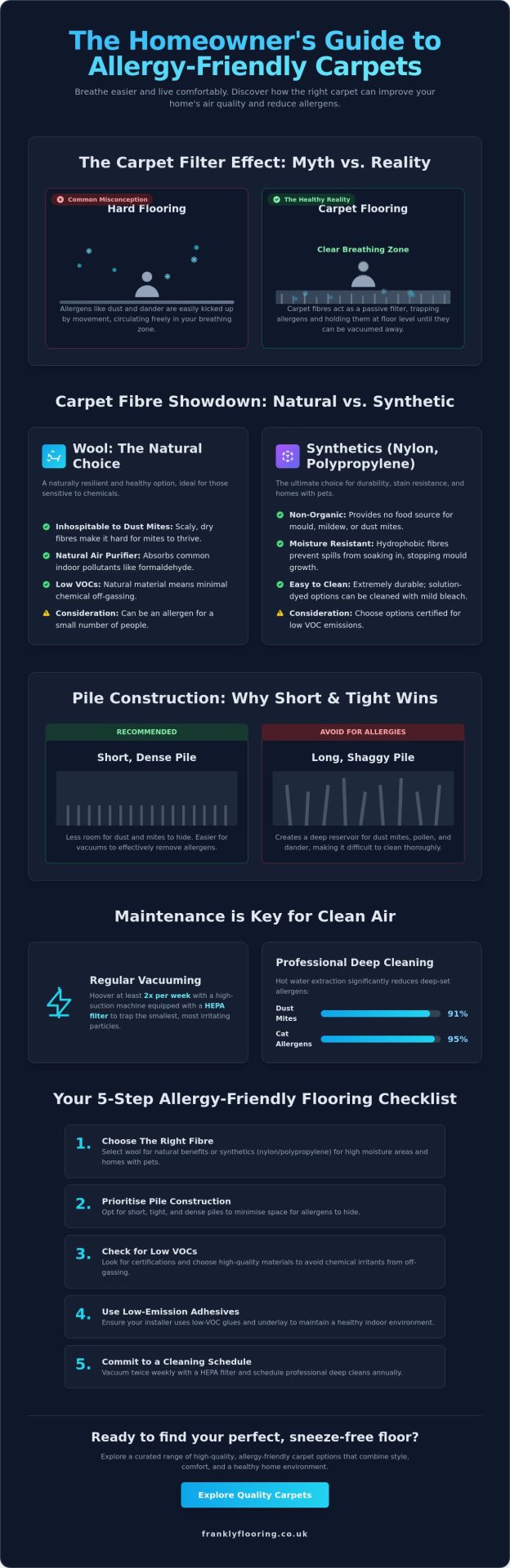
This is what experts call the “Filter Effect.” Carpet fibres act as a passive trap, catching pollen and pet dander as they settle. By holding these irritants at floor level, the carpet prevents them from entering your lungs. For this reason, modern experts are challenging the old myth that carpet is bad for asthma. When you choose the right allergy friendly carpet options, you gain several benefits:
- Reduced airborne particles: Gravity pulls dust into the pile where it stays put.
- Improved sleep: Fewer allergens circulating in the bedroom lead to clearer airways overnight.
- Easier air management: It’s simpler to hoover a floor than to scrub the air.
Air Quality: Carpet vs. Hard Flooring
Scientific studies have shown that the concentration of airborne dust is significantly lower in carpeted rooms compared to those with hard flooring. This is especially important in the bedroom. You spend roughly a third of your life there, often with your face relatively close to the floor. Hard floors allow allergens to swirl around with every toss and turn in bed. A dense, low-pile carpet keeps those particles locked away until you’re ready to remove them.
The Role of Modern Vacuuming
A filter is only effective if you empty it regularly. To keep your home healthy, a frank maintenance schedule is essential. This means hoovering at least twice a week with a high-suction machine. It’s vital to use a vacuum equipped with a HEPA filter. Without one, you risk sucking up dust only to blow the smallest, most irritating particles straight back out through the exhaust.
Deep cleaning is the second half of the equation. Professional hot water extraction can reduce surface levels of dust mite allergens by up to 91% and cat allergens by 95%. Beyond just dust, you should also be aware of Volatile Organic Compounds (VOCs). These chemicals can be released by some synthetic materials and adhesives, potentially irritating sensitive airways. Choosing high-quality allergy friendly carpet options with low VOC emissions ensures your filter doesn’t introduce new problems into your home environment.
Choosing the Best Allergy Friendly Carpet Fibres
Frankly, the term “hypoallergenic” is thrown around far too loosely in the flooring industry. It isn’t a strictly regulated legal standard, so you shouldn’t buy a carpet based on a sticker alone. To truly allergy-proof your home, you have to understand the physical makeup of the fibres you’re bringing through the door. In our damp UK climate, moisture resistance is just as important as dust management. Damp fibres lead to mould, and mould is a primary trigger for many respiratory issues.
Wool: The Natural Choice
Wool is a popular choice for a reason. It’s naturally inhospitable to dust mites because the fibres are scaly and dry. The microscopic coil structure acts as a physical trap, pulling dust and pollen deep into the pile and away from your breathing zone. This prevents the “kick-up” effect common with hard floors. Wool also has a natural ability to absorb common indoor pollutants, which helps improve overall air quality. Because it’s a natural material, it’s usually very low in VOCs, making it a safe bet for those sensitive to chemical off-gassing.
Nylon and Polypropylene: The Synthetic Solution
While wool is great, it isn’t for everyone. Some people have specific wool allergies, and others need a floor that can handle heavy-duty cleaning. Man-made fibres like nylon and polypropylene are non-organic. This means they don’t provide a food source for mites or bacteria. If you have pets, these are often the best allergy friendly carpet options because they are hydrophobic. They don’t soak up moisture from spills or accidents, which stops mould from taking root in the backing.
Solution-dyed nylon is the gold standard here. It’s incredibly durable and can often be cleaned with mild bleach solutions. As of August 15, 2026, new hazard labeling requirements for cleaning chemicals in Great Britain make it easier to see exactly what you’re using on your floors. Being able to deep clean your carpet without ruining the colour is vital for removing pet dander and stubborn allergens. If you’re looking for a low-maintenance, high-performance floor, you can explore our range of quality carpets to find a synthetic that looks as good as it performs.
Ultimately, the choice between natural and synthetic depends on your household. If you want a natural filter and have a low-moisture home, wool is excellent. If you have pets, children, and a busy hallway, a high-quality synthetic will likely serve your health better in the long run. The key is choosing a material that matches your lifestyle rather than just following the latest marketing trend.
Pile and Construction: Why Short and Tight Wins
Deep-pile shag carpets are an absolute “no-go” for anyone dealing with severe allergies. While they feel luxurious underfoot, they act like a cavernous trap for the 19,000 dust mites that can live in a single gram of dust. These long fibres are nearly impossible to clean effectively; even a high-suction hoover can’t reach the debris buried at the base. If you want a healthy home, the rule is simple: short and tight always wins.
Density is your best friend when looking at allergy friendly carpet options. A dense pile prevents particles from sinking down to the primary backing, where they become permanent residents. You should also look for “continuous filament” synthetic fibres. Unlike staple fibres, which consist of short lengths spun together and are prone to shedding, continuous filaments are long, unbroken strands. This means fewer loose fibres floating in the air to irritate your nose and eyes.
Loop Pile and Berber Styles
A low-profile sisal carpet or a tight Berber style is excellent for easy maintenance. The tight weave keeps allergens on the surface, making them easy to whisk away during your bi-weekly hoovering. However, be honest about your household. If you have cats or dogs with long claws, loop piles can snag. In those cases, a dense twist is a safer, more durable alternative that still offers excellent allergen control.
Dense Twist Carpets
A high-density carpet twist offers a great balance of comfort and hygiene. It’s far superior to a loose Saxony, which has gaps that invite dust to settle. You can perform a quick “thumb test” to check quality: press your thumb firmly into the pile. If you can easily feel the hard floor or the carpet backing, the density is too low for an allergy-conscious home. A quality twist should feel firm and resistant, providing a soft surface that doesn’t compromise your air quality.
By choosing a shorter pile, you aren’t just making the floor easier to clean; you’re fundamentally changing how allergens behave in your room. When particles stay on the surface, they are removed rather than redistributed. This straightforward approach to floor construction is the most effective way to ensure your carpet remains a helpful filter rather than a hidden hazard.
The Invisible Factors: Underlay and VOCs
Choosing your top layer is only half the battle. If you want a truly healthy environment, you have to look at what’s happening underneath the pile. Volatile Organic Compounds (VOCs) are chemical gases that “off-gas” from new materials, including some adhesives and underlays. As of August 6, 2026, new EU REACH regulations have limited formaldehyde emissions to 0.080 mg/m³ for textiles sold in Northern Ireland. While this is a step forward, savvy homeowners across the UK should still aim for the lowest possible emissions. When you’re browsing allergy friendly carpet options, don’t ignore the chemicals used to hold everything in place.
Before the new floor goes down, you have to deal with the old one. We call this the “dust bomb” effect. When you rip up an old carpet, you’re releasing up to a decade’s worth of trapped dander and dust. To minimise the flare-up, we recommend giving the old carpet a very light misting with water to weigh down the particles before removal. Keep your HEPA vacuum running nearby and ensure the room is well-ventilated throughout the process. This straightforward preparation makes a massive difference to your air quality during the transition.
Anti-Microbial Underlay
A standard foam underlay might feel soft, but it can become a breeding ground for mould if moisture gets trapped in the subfloor. We suggest looking for underlays with specific anti-microbial treatments. These prevent the growth of bacteria and mildew, which are major triggers for respiratory issues. For a long-lasting finish, we always recommend using a high-quality carpet gripper and underlay together. This ensures the carpet stays taut, reducing the gaps where dust likes to settle.
Low-VOC Certification
Look for the “CRI Green Label Plus” or similar certifications when shopping. These labels ensure the product has been tested for very low chemical emissions. If you’re particularly sensitive, consider natural underlay options like crumb rubber or wool felt. Regardless of your choice, ventilation is your best tool. Keep windows open for at least 72 hours after your fitting to allow any initial off-gassing to clear. You can find a wide selection of healthy, low-emission flooring accessories on our site to complete your project safely.
Your underlay acts as the foundation for your home’s air quality. By choosing a moisture-resistant, low-emission base, you’re ensuring that your new carpet remains a healthy filter for years to come. It’s a small detail that has a significant impact on how you feel in your home every single morning.
The Frankly Verdict: Finding Your Perfect Match
Choosing the right flooring for a sensitive household is about balancing comfort with practical science. Frankly, there’s no single “perfect” carpet that works for every person. Your choice depends entirely on your specific triggers. If you’re allergic to dust mites, a natural wool filter is often the best route. If your allergies are triggered by moisture or mould, a high-performance synthetic is the smarter bet. Honesty about your lifestyle is the first step toward a healthier home environment.
At Frankly Flooring, we believe that your home should be a sanctuary, not a source of irritation. We’ve seen too many homeowners settle for cold, hard floors because they were told carpet was the enemy. By focusing on the “filter effect” and choosing modern, low-emission materials, you can have the softness you want without the stuffy nose. It’s a straightforward trade-off that prioritises your long-term health over quick sales tactics.
Your Allergy-Friendly Buying Checklist
To help you navigate the many allergy friendly carpet options available in 2026, we’ve put together this simple 5-step checklist. Use this when browsing our collections to ensure you’re making a choice that supports your respiratory health.
- Step 1: Identify your fibre. Choose wool for natural dust mite resistance or a solution-dyed synthetic if you need to deep clean with bleach-based products.
- Step 2: Check the pile density. Use the “thumb test” to ensure the pile is dense enough to keep dust on the surface. Avoid long shags or loose saxonies.
- Step 3: Pair with a treated underlay. Ensure your underlay has built-in anti-microbial protection to prevent mould and bacteria growth in the subfloor.
- Step 4: Verify VOC levels. Look for low-emission certifications that meet the 2026 formaldehyde limits of 0.080 mg/m³ to avoid chemical irritation.
- Step 5: Plan your maintenance. Commit to a twice-weekly hoovering schedule with a HEPA-filtered machine to “empty” your carpet’s natural filter.
Expert Advice and Support
We’ve designed our online store to be as transparent as possible. You can easily filter our ranges to find the best allergy friendly carpet options for your specific room. Beyond flooring, we also provide quality furniture and accessories that meet our high standards for durability and style. We want every element of your home to feel cohesive and well-crafted.
If you’re still feeling unsure about which material is right for your family, our team is here to help. We don’t do high-pressure sales; we provide straight-talking advice based on years of experience in British homes. Whether you need a technical breakdown of a specific fibre or just a recommendation for a busy hallway, you can contact us for a frank conversation. We’ll help you find a floor that looks beautiful and lets you breathe easy.
Take the Next Step Toward a Healthier Home
Creating a living space that supports your respiratory health starts with acknowledging that carpet is a functional tool for air quality. By selecting a dense pile and the right fibre for your specific triggers, you turn your floor into a high-performance filter rather than a dust trap. It’s about more than just the top layer; you must also consider the anti-microbial underlays and low-VOC materials that form a healthy foundation for your room. Exploring the best allergy friendly carpet options ensures your home remains a sanctuary where you can truly relax without the fear of a stuffy nose.
As a family-run business with over 20 years of experience, we’re dedicated to providing the transparent, frank advice you need to make an informed decision. We offer national delivery across the UK, bringing quality flooring directly to your door without the typical corporate coldness. You can trust our team to help you balance beautiful aesthetics with the practical requirements of an allergy-conscious household. Browse our range of allergy-friendly carpets at Frankly Flooring to find the perfect match for your home. We’re here to help you breathe a little easier every day.
Frequently Asked Questions
Is wool carpet good for people with asthma?
Wool is an excellent choice for asthma sufferers because it acts as a high-performance natural filter. Its microscopic scales trap allergens like pollen and dust, preventing them from circulating in your breathing zone. Since wool is also naturally flame-retardant and low in chemical emissions, it doesn’t release the irritants often found in cheaper, untreated materials. However, if you have a specific wool protein allergy, you should opt for a high-quality synthetic instead.
Does new carpet smell cause allergies?
The “new carpet smell” is caused by Volatile Organic Compounds (VOCs) off-gassing from the backing and adhesives. These fumes can trigger respiratory irritation or headaches in sensitive individuals rather than a traditional allergy. To manage this, we suggest choosing products that meet the August 2026 formaldehyde limit of 0.080 mg/m³. Opening windows for 72 hours after your fitting is a straightforward way to clear these gases quickly.
What is the easiest carpet to keep clean for allergy sufferers?
Low-pile synthetic carpets made from solution-dyed nylon or polypropylene are the easiest to maintain. These fibres are non-porous and moisture-resistant, meaning they don’t provide the damp environment that mould and mildew require to thrive. Because they are often bleach-cleanable, you can use stronger sanitising agents to ensure all biological triggers are removed. When exploring allergy friendly carpet options, these synthetics offer the most robust defence against stubborn pet dander.
Can dust mites live in synthetic carpets?
Dust mites can live in any floor covering where household dust accumulates, but they don’t eat synthetic fibres. They feed on human skin cells that settle in the pile. A dense, short-pile construction is vital because it keeps these cells on the surface. This makes it much harder for mites to migrate deep into the carpet backing, where they would otherwise be protected from your vacuum cleaner’s suction.
How often should I hoover my carpet if I have allergies?
You should hoover at least twice a week to keep your indoor air quality high. It’s essential to use a vacuum with a HEPA filter to ensure that microscopic particles aren’t blown back into the room. For a deeper clean, professional hot water extraction every 12 months can reduce surface allergens by up to 91%. This regular maintenance schedule ensures your carpet continues to function as an effective filter rather than a storage site for irritants.
Is it better to have carpet or laminate for allergies?
Carpet is often better for air quality because it traps allergens at floor level. On a hard surface like laminate, every footstep or draught kicks dust back into the air where you breathe it in. While laminate is easier to wipe, it doesn’t “hold” the dust between cleanings. If you are prepared to hoover regularly, a short-pile carpet provides a more stable, sneeze-free environment than a hard floor that allows dust to swirl.
What does “hypoallergenic carpet” actually mean?
The term is a marketing claim rather than a strictly regulated legal definition in the UK. It generally describes carpets with very short piles or those made from man-made fibres that don’t shed. To find truly effective allergy friendly carpet options, you should look for performance-based certifications. The February 2026 ASL addendum now allows for scientific evaluation of these claims, providing a more honest way to verify how well a carpet actually performs in a home.
Are there specific carpet brands that are better for allergies?
Focus on products that carry the Allergy UK “Seal of Approval” rather than just a brand name. Forbo’s Flotex is a well-known example that has been scientifically tested to ensure it doesn’t harbour dust mites when cleaned correctly. Rather than following high-pressure sales trends, we recommend looking for specific technical features like anti-microbial treatments and low-VOC certifications. These verified standards are the only way to ensure a product is truly fit for a sensitive household.