
What if the size of your garden wasn’t a limitation, but an opportunity to create something more polished and functional than a sprawling estate? In a compact plot, every square inch counts. You’ve likely found that natural turf doesn’t play fair in tight spaces; it’s often too shaded for growth, too damp for drainage, and far too small to justify dragging a bulky mower out of the shed. It’s frustrating to watch a tiny patch of green turn into a muddy eyesore. Choosing artificial grass for small gardens isn’t just about saving time on maintenance. It’s a strategic design choice that turns a struggling patch of dirt into a high-end, year-round extension of your living space.
We’re being frank: a small garden deserves better than a patchy lawn. We promise to show you how to select the right materials to make your space feel larger and more premium. You’ll discover how to handle technical nuances like drainage and base preparation to ensure your investment lasts for years. We’ll guide you through selecting the right pile height, whether you need a durable 20mm surface for a balcony or a lush 40mm finish for a realistic look. This guide provides the no-nonsense advice you need to reclaim your outdoor space without the stress.
Key Takeaways
- Learn why artificial grass for small gardens is the most practical fix for the shaded, muddy patches that often plague enclosed UK plots.
- Understand the ‘Frank’ sweet spot for pile height, aiming for 30mm to 40mm to achieve a realistic look that stands up to daily scrutiny.
- Master simple design tricks, such as grain orientation and zoning, to create the illusion of a much larger and more functional outdoor room.
- Get the straight facts on sub-base preparation to ensure your new surface remains flat and drains effectively for years to come.
- Identify why prioritising material density over ‘bargain’ prices prevents your turf from flattening and losing its character after just a few seasons.
Why Artificial Grass is the Frank Solution for Small UK Gardens
Small UK gardens often suffer from what we call ‘muddy patch’ syndrome. In a compact, walled courtyard or a North-facing plot, the sun rarely hits the ground long enough to sustain a healthy lawn. Instead of a lush carpet, you end up with a sparse, damp area that’s more moss than grass. This is where choosing artificial grass for small gardens becomes a practical necessity rather than just a luxury. It solves the light-deprivation issues that natural turf simply can’t survive. By replacing a failing lawn with a high-quality synthetic alternative, you’re effectively adding another room to your home. It creates a seamless transition from your indoor flooring to an outdoor living space that stays clean and usable throughout the year.
Managing a tiny lawn with traditional tools is another headache. Petrol mowers are bulky, heavy, and frankly ridiculous for a ten-square-metre patch. Even smaller electric models involve cables that snag on garden furniture or pots. By removing the need for these tools, you free up valuable space in your shed or garage. The history and development of artificial turf shows that these products have evolved from simple sports surfaces into sophisticated landscaping materials. Modern options mimic the feel of a real lawn without the logistical nightmare of upkeep, making them the perfect fit for the constraints of urban living.
Overcoming the Shaded Garden Dilemma
Natural grass needs several hours of direct sunlight to thrive. In most urban gardens, high fences, extensions, and overhanging trees make this impossible. Shaded corners inevitably turn into bogs in winter and dust bowls in summer. Artificial turf provides consistent colouration regardless of the weather or the time of day. It ensures your view from the kitchen window remains green and inviting even in the depths of January. For a small area that’s always on display, having a ‘finished’ look provides a significant psychological boost. It stops the garden from feeling like a chore and starts making it feel like a sanctuary.
Low Maintenance vs. No Maintenance: The Honest Truth
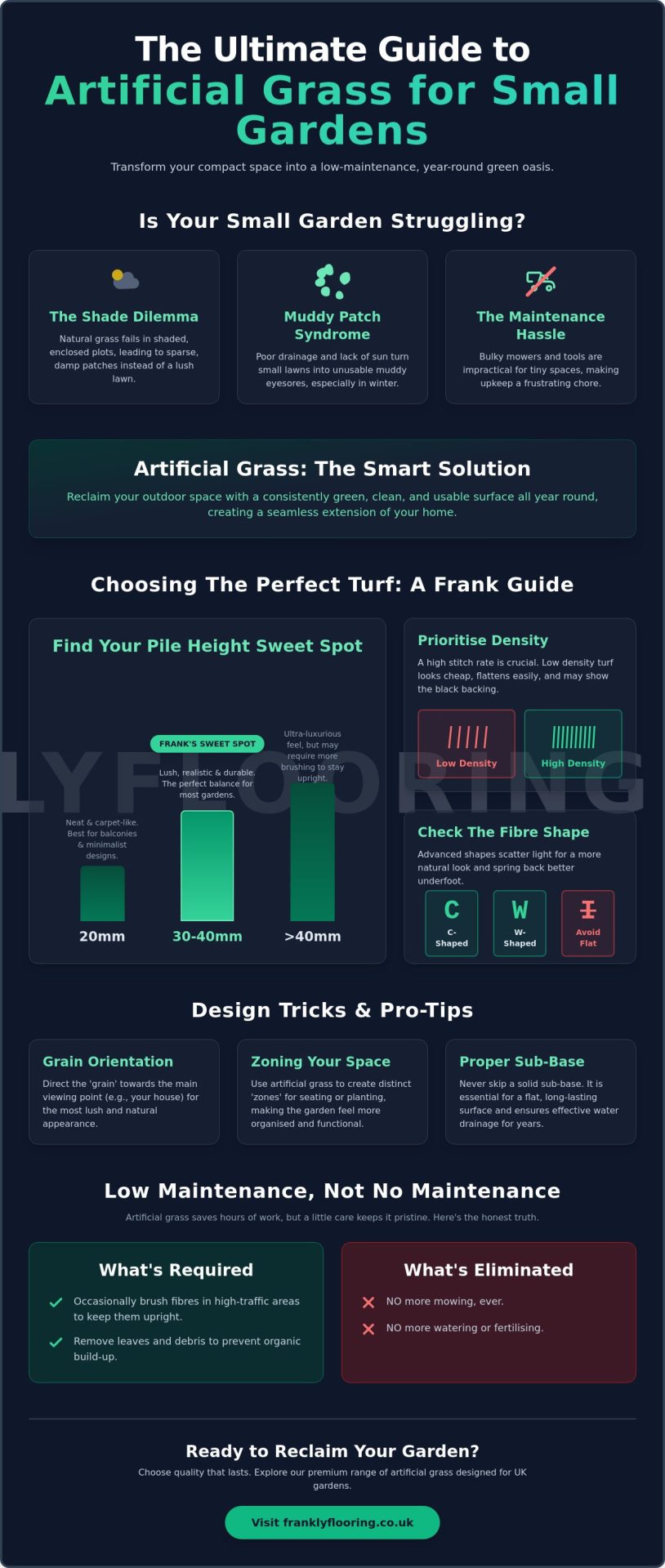
We want to be direct with you: there is no such thing as a ‘zero maintenance’ garden. While artificial grass for small gardens removes the need for mowing, seeding, and fertilising, it still requires a bit of care to look its best. You’ll need to occasionally brush the fibres to keep them upright, especially in high-traffic zones. Debris like fallen leaves or twigs should be cleared to prevent organic matter from breaking down into the pile. The reality is that a five-minute sweep with a stiff brush or a quick leaf-blow is significantly easier than the weekend-long battle of traditional lawn care. It’s about reclaiming your time while maintaining a professional standard of excellence in your outdoor space.
Selecting the Best Pile Height and Density for Compact Spaces
In a sprawling estate, you view the lawn from a distance. In a compact plot, you’re standing right on top of it or looking down from a first-floor window. This proximity means your choice of artificial grass for small gardens is under constant scrutiny. Every fibre and stitch is visible. If you choose a product that is too sparse, the illusion of a natural lawn disappears instantly. We believe the ‘Frank’ sweet spot for most residential gardens is a pile height between 30mm and 40mm. This range provides enough depth to feel luxurious and soft underfoot while remaining upright without the need for aggressive daily brushing. It strikes the perfect balance between a manicured look and practical durability.
Density is just as vital as height. You should look for a high stitch rate to ensure a ‘full’ appearance. A low-density product in a small courtyard is a mistake; you will likely see the black latex backing through the blades, which looks unfinished and cheap. Fibre shape also dictates how light reflects off your lawn. Flat fibres often have a high ‘plastic’ sheen when the sun hits them. Instead, look for C-shaped or W-shaped fibres. These technical shapes scatter light more naturally, mimicking the matte finish of real grass blades and providing better resilience against flattening in high-traffic zones.
The 20mm vs. 40mm Debate for Small Plots
A shorter 20mm pile is excellent for modern minimalism or balconies where you want a neat, carpet-like finish. It’s easy to clean and doesn’t trap debris. However, longer 40mm piles offer a luxury feel that helps soften the hard landscaping of brick walls or timber sleepers. Be careful not to go too long; a 50mm pile in a tiny enclosed space can feel overwhelming, like walking through a deep shag carpet. It can make a small area feel even more claustrophobic. If you’re weighing up these options, exploring the technical specs of the artificial grass range at Frankly Flooring can help you find the right weight for your specific square footage.
Yarn Quality: Polyethylene vs. Polypropylene
Polyethylene is the industry standard for softness and realism. It’s gentle on skin, making it the right choice for pets or children. Polypropylene is often used in the ‘thatch’ layer (the curly fibres at the base) to provide support and spring. UV-stability is non-negotiable, especially for sun-trap patios. Without it, the vibrant green will fade to a dull grey within a few seasons. Always opt for a multi-tone thatch that includes various shades of green and a hint of tan or brown. This non-uniformity is what creates a truly realistic look that survives close inspection.
Design Strategies: Making Your Small Garden Feel Larger
In a compact outdoor space, the direction in which you lay your turf is just as important as the material itself. We often recommend the ‘Long View’ trick. Artificial grass has a distinct grain where the blades lean slightly in one direction. By laying the grass so the grain points towards your main viewing point, usually the back door or a patio window, you increase the perceived depth of the plot. This simple technical adjustment makes the lawn look more natural and prevents it from appearing flat or reflective. It’s a professional nuance that transforms artificial grass for small gardens from a simple floor covering into a strategic design tool.
Don’t feel restricted to wall-to-wall turf. In fact, breaking up the space can actually make it feel larger. Combining a central grass area with LVT-style outdoor tiling or stone creates a zoned, multi-functional layout. You might use the grass as a ‘green path’ that draws the eye towards the furthest point of the garden, perhaps leading to a small bench or a feature plant. This creates a sense of journey and purpose in a space that might otherwise feel like a single, cramped box. To finish the look, consider your border colours. Painting fences in dark, recessive tones like charcoal or deep navy makes the vibrant green of the turf pop, creating a sharp contrast that pushes the boundaries of the garden outward.
Zoning Your Outdoor Space
Effective zoning allows you to separate high-traffic areas from relaxation spots. You can create a dedicated soft zone for pets or children while keeping a separate, firmer area for dining. Using artificial grass as a soft ‘rug’ under a seating area is an excellent way to add texture and comfort without the maintenance of real turf. Integrating quality furniture into these zones completes the ‘outdoor room’ feel. It turns a patch of grass into a purposeful extension of your home’s character, ensuring the space is used daily rather than just looked at from inside.
The Power of Curved Edges
Straight lines and right angles often emphasise the small dimensions of a garden. We suggest using soft, organic curves to break the ‘boxy’ feel of an urban plot. You can easily cut artificial grass with a sharp utility knife to follow the shape of a winding border or a circular patio. Framing these curves with timber sleepers or brick edging provides a professional, grounded finish that keeps the turf secure. These soft shapes trick the eye into seeing more variety and movement, making the garden feel like a curated sanctuary rather than a restricted yard.
Installation Insights: Converting Patios, Balconies, and Shaded Corners
The frank reality of installation is that your lawn is only as good as what lies beneath it. You simply cannot lay artificial grass for small gardens directly onto mud or existing turf. If you do, you’ll face drainage disasters and a lumpy, uneven finish within months. In a walled garden or an enclosed courtyard, water often has nowhere to go. Without a proper sub-base of crushed stone and grit sand, your sanctuary will quickly become a swamp. We prioritise a solid foundation because it ensures the longevity of the project, preventing the sinkage that often ruins DIY attempts. We also ensure our products meet rigorous manufacturing standards, such as DIN 18035-7, which regulates heavy metals to keep your outdoor space safe for everyone.
Securing the edges is a critical step in a small zone. In a tight space, a loose edge isn’t just an eyesore; it’s a trip hazard. We recommend using heavy-duty galvanised pins or timber fixings to keep the lawn taut. This prevents the turf from rippling as the temperature changes throughout the year. A well-secured edge also makes the transition to your flower beds or sleepers look professional and crisp. If you plan to use a barbecue in your new space, remember to place it on a hard, fireproof surface away from the grass edges to prevent heat damage to the synthetic fibres.
Laying Turf on Hard Surfaces
Converting a concrete patio or a balcony requires a different technical approach. To prevent ‘ghosting’, where the outlines of old paving slabs show through the grass, you must use a high-quality underlay. This foam layer provides a smooth surface and adds a bit of ‘give’ underfoot. For balconies and roof terraces, choosing a shorter pile of 20mm to 30mm is often more practical for cleaning. You’ll need specific weather-resistant adhesives to secure the perimeter. It’s also vital to ensure the grass doesn’t block existing drainage holes; water must be able to flow freely to the gutters or downpipes without pooling in the centre.
The Step-by-Step Small Garden Prep
For a soil-based garden, excavation is the first step. You usually need to remove about 50mm to 75mm of topsoil to make room for the new base materials. A weed membrane is essential, especially at the edges where stubborn growth can push through. Once the stone base is compacted, we use kiln-dried sand as an infill. This sand isn’t just for weight; it keeps the fibres upright and protects the backing from UV damage. If you’re ready to start your transformation, you can browse our range of high-quality artificial grass to find the right match for your project.
The Frank Choice: Quality Over Convenience at Frankly Flooring
We don’t believe in selling ‘bargain-bin’ turf that looks like a tired doormat after three months of use. In a compact plot, the quality of your materials is exposed much faster than in a large field. We’ve spent 20 years as a family-run UK expert, and our experience has taught us that durability is the only true measure of value. Choosing the right artificial grass for small gardens means investing in a product that maintains its spring and colour despite the heavy footfall of urban living. We take pride in our transparent approach. If your specific project doesn’t require the most expensive 45mm luxury pile, we’ll be the first to tell you. Our goal is a result that looks right and lasts, not just a quick sale.
Many of our customers use their small gardens as a direct extension of their kitchen or living room. If you have bi-fold or sliding doors, the transition between your interior and exterior floors is a vital design choice. You can coordinate your new lawn with our high-quality engineered wood flooring to create a seamless flow from the house to the garden. This continuity makes both spaces feel significantly larger. By matching the natural tones of timber with a multi-tonal grass thatch, you create a sophisticated, curated look that feels like a single, cohesive living environment rather than two separate areas.
The Frankly Flooring Difference
We’ve removed the high-pressure showroom tactics that often make home improvement stressful. We offer direct-to-door delivery across the UK, allowing you to browse our curated range from the comfort of your own home. Every product in our collection is selected for its ability to handle the British climate, from heavy winter rain to the intense UV rays of a summer sun-trap. It’s a ‘Frank’ guarantee of reliability. We only supply grass that we’d be proud to install in our own homes, ensuring that your small garden remains a lush, green sanctuary for years to come.
Next Steps for Your Small Garden Transformation
Before you commit to a purchase, it’s essential to get the technical details right. Measuring a small plot accurately is the best way to minimize waste and save money. We suggest measuring the widest and longest points of your garden, then adding a 10cm buffer to each side for trimming. Ordering samples is also a critical step. Light behaves differently in enclosed courtyards, and seeing how a specific shade of green looks against your existing walls or fences is the only way to be sure of your choice. Once you’re happy with the look and feel, follow this final checklist:
- Confirm your total square footage including the cutting buffer.
- Check your access points for delivery of the grass rolls.
- Ensure you have the correct sub-base materials and adhesives ready.
- Verify that your existing drainage is clear and functional.
Taking these final steps ensures that when your new lawn arrives, the installation process is as smooth and stress-free as possible.
Reclaiming Your Outdoor Sanctuary
You’ve seen how strategic design choices can turn a cramped, shaded plot into a functional outdoor room. By focusing on the ‘Long View’ grain direction and selecting a dense 30mm to 40mm pile, you can create the illusion of depth while ensuring durability. We’ve been frank about the technical side too. A solid sub-base and proper drainage are non-negotiable if you want your investment to last. Choosing artificial grass for small gardens isn’t just about aesthetics; it’s a practical solution to the muddy patch syndrome that plagues many urban homes.
At Frankly Flooring, we bring 20 years of expertise to every project. We don’t hide behind jargon or high-pressure sales. Instead, we offer direct UK-wide delivery and honest, no-nonsense advice to help you find the right materials for your specific space. Whether you’re converting a concrete balcony or reviving a walled courtyard, we’re here to guide you through the process from initial measurement to final delivery. Our goal is to ensure you get the quality your home deserves without any unnecessary stress.
Browse our Frank range of Artificial Grass and transform your small garden today. Your compact plot has massive potential; it’s time to start enjoying it.
Frequently Asked Questions
Is artificial grass safe for dogs in a small garden?
Yes, it is completely safe and highly practical for dog owners. The polyethylene fibres are non-toxic and much more resilient to digging or running than natural turf. You’ll find it much easier to keep your home clean since there is no mud for them to track back inside. Pet waste won’t discolour the grass; you can simply rinse the area with water and a mild, pet-safe detergent to keep it fresh.
How do I clean artificial grass if I don’t have much space?
Cleaning is straightforward and doesn’t require any bulky equipment. You just need a stiff-bristled brush to occasionally redistribute the infill and keep the blades standing upright. For a small area, a quick sweep to remove leaves or debris is often enough. If you have a spill or a pet mess, a simple wash with a garden hose or a bucket of soapy water will do the job perfectly.
Will artificial grass make my small garden feel even smaller?
No, it actually creates the opposite effect by providing a clean, uniform look. Patchy, overgrown lawns create visual clutter that makes a space feel cramped. Using artificial grass for small gardens allows you to define clear zones and use design tricks, such as grain orientation, to increase the perceived depth of your plot. It turns a chaotic patch of dirt into a polished, intentional outdoor room.
Can I install artificial grass myself in a tiny courtyard?
Yes, installing it yourself is a manageable project for a small, flat area. The key is not to cut corners on the sub-base preparation. You’ll need to excavate the existing soil, lay a weed membrane, and compact a layer of stone and sand. While it’s physical work, the smaller square footage makes it much easier to achieve a professional finish than in a large, complex garden.
Does artificial grass get too hot in small, sun-trap gardens?
It does absorb more heat than natural grass, similar to how a stone patio or timber decking behaves. In the peak of summer, the surface can feel warm to the touch. If it becomes uncomfortable, a quick spray with a hose will cool the fibres down almost instantly. It’s also vital to keep barbecues or fire pits on a hard, fireproof surface to prevent any heat damage to the synthetic material.
How long will artificial grass last in a high-traffic small area?
A high-quality installation will typically last between 10 and 15 years. In a small garden where footfall is concentrated in specific spots, choosing a product with a high stitch density is essential. We recommend materials like nylon or high-grade polyethylene with a supported thatch layer. This ensures the blades don’t flatten easily and the lawn maintains its realistic appearance even with daily use.
Do I need a special underlay for artificial grass on a balcony?
Yes, we always recommend using a specific foam underlay for balcony installations. This layer serves two purposes: it provides a soft, cushioned feel underfoot and prevents the texture of the underlying surface from showing through the turf. It also helps with minor drainage issues by allowing water to flow more freely beneath the grass backing toward the balcony’s existing drainage points.
How does drainage work with artificial grass on top of concrete?
Water drains through the perforated backing of the grass and follows the natural fall of your concrete surface. Most patios and balconies are built with a slight slope to prevent standing water. As long as your existing concrete doesn’t have major puddling issues, the water will simply run off to the drains as it did before. It’s important to keep the area clear of debris so the drainage holes in the backing don’t become blocked.