
Why do so many home renovations end up costing double the price on the sticker? When you’re calculating your diy flooring cost uk, it’s easy to focus solely on the price per square metre of that beautiful LVT or engineered wood. However, the real budget killers aren’t the planks themselves; they’re the underlays, door bars, and subfloor prep kits that you didn’t see coming. We know the fear of overspending or ruining expensive materials can turn an exciting home upgrade into a source of genuine anxiety.
At Frankly Flooring, we believe in being direct about what it actually takes to get a professional finish on your own. You deserve a realistic total project budget before you even open a single box. This guide provides a transparent breakdown of every expense involved in 2026, from material prices to the hidden costs of tools and waste disposal. We’ll show you exactly where to save your money and where it’s vital to invest, giving you the confidence to start your project without any nasty financial surprises. We’re here to help you move from initial inspiration to a completed floor with your budget and your sanity intact.
Key Takeaways
- Calculate a realistic diy flooring cost uk by including the “invisible” extras like adhesives and waste disposal.
- See why skimping on subfloor preparation is a false economy that can lead to expensive repairs later.
- Learn which accessories are non-negotiable for a professional look and which ones you can safely skip.
- Compare the 2026 rates for laminate and LVT to see which material fits your specific room requirements and budget.
- Use our bulk-buying and “Bargains” section tips to keep your total expenditure as low as possible without sacrificing quality.
The Reality of DIY Flooring Costs: DIY vs. Professional Fitting
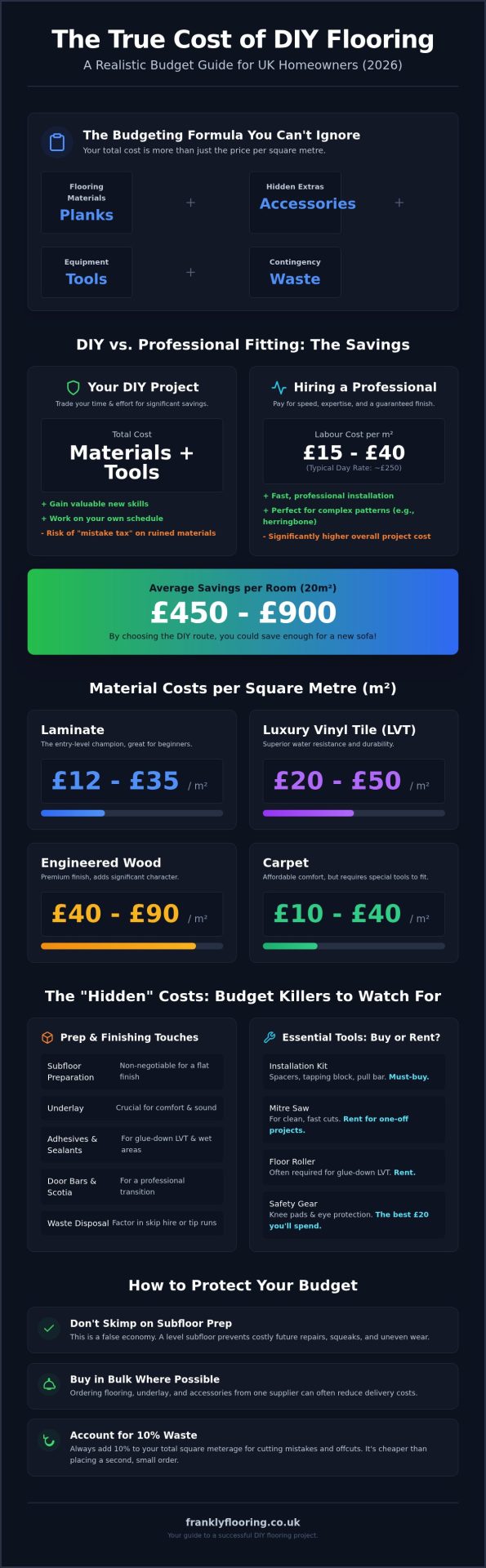
Calculating your diy flooring cost uk involves more than just looking at the price of the planks. To get a realistic figure, you need to use a simple formula: Materials + Accessories + Tools + Waste. If you only budget for the floor itself, you’ll likely run out of cash before the first row is even laid. We believe in being straight with you. While the savings are significant, they aren’t “free” because you’re trading your own time and sweat for that extra cash in your bank account.
The Frank truth is that you can save between £15 and £30 per square metre by fitting the floor yourself. On a standard 20-square-metre lounge, that’s a saving of up to £600. However, you must factor in the “mistake tax”. If you’ve never used a mitre saw before or you rush the subfloor prep, you might ruin enough planks to wipe out your labour savings. Choosing the right flooring materials for your skill level is the first step in protecting your investment.
The Labour Saving Breakdown
In the UK, professional floor fitters usually work on a day rate or a price per square metre. A typical day rate for a skilled fitter in 2026 sits around £250, though these figures can vary across the country depending on local demand and the scale of the project. For laminate and LVT, you’d expect to pay between £15 and £40 per square metre just for the installation. If you’ve set your heart on a complex herringbone or chevron pattern, expect those professional quotes to skyrocket. These intricate designs require significantly more cuts and time, which fitters charge for accordingly.
In 2026, the average UK homeowner can save roughly £450 to £900 per room by choosing the DIY route instead of hiring a professional.
The DIY Investment: Tools You’ll Need to Buy
To do the job right, you need the right kit. Don’t try to “make do” with a hammer and a screwdriver. You’ll need a dedicated installation kit that includes spacers to maintain expansion gaps, a tapping block to protect the edges of your planks, and a pull bar for those tight spots against the wall. These kits are relatively inexpensive but absolutely essential for a professional-looking finish.
For bigger equipment, you need to decide whether to rent or buy. A mitre saw is vital for clean, fast cuts on laminate and wood, while a heavy floor roller is often required for glue-down LVT. If you don’t plan on doing another room for years, renting for a weekend is usually the smarter financial move. Finally, don’t forget safety gear. A pair of decent knee pads will be the best £20 you spend on the entire project, alongside eye protection for when those offcuts start flying.
Material Costs: Budgeting per Square Metre by Floor Type
Choosing your material is the biggest variable in your diy flooring cost uk. While it’s tempting to pick the cheapest option on the screen, you need to consider the long-term value and the ease of installation. Laminate remains the entry-level champion, typically costing between £12 and £35 per square metre. It’s forgiving for beginners and offers a massive range of styles. If you want something more robust, Luxury Vinyl Tile (LVT) sits in the £20 to £50 range, offering superior water resistance and durability.
For those looking for a premium finish, engineered wood is the top-tier DIY investment, ranging from £40 to £90 per square metre. It’s more complex to lay but adds significant character to a home. Carpet is often the most affordable comfort at £10 to £40 per square metre, but don’t let the price fool you. Fitting carpet yourself requires specific tools like knee kickers and a level of tensioning skill that many DIYers find more challenging than clicking planks together. While you’re weighing up these options, remember that certain projects, especially in flats or when changing floor heights, may require Building regulations approval to ensure you’re meeting safety and sound insulation standards.
Laminate and LVT: The DIY Favourites
Click-system LVT is arguably the most cost-effective project for a DIYer because it combines a mid-range price point with an incredibly simple installation process. You won’t need messy adhesives or heavy-duty saws. When comparing budget laminate to premium water-resistant versions, look at the thickness and the joinery quality. A cheaper laminate might save you £5 per metre now, but it may swell at the first sign of a spilled drink. If you’re still weighing up the benefits, take a look at our guide on What Is LVT Flooring? to see why it’s become the go-to choice for modern UK homes. Once you’ve decided on the material, you can browse our latest flooring collections to find the right style for your space.
The 10% Rule: Budgeting for Waste
We’ve seen it happen many times: a customer measures their room to the exact millimetre and orders just enough, only to find they’re two planks short at the end. You must always buy at least 10% more than your net room measurements. This covers the offcuts you’ll inevitably create at the edges and any minor mistakes during the learning curve. If you’re feeling ambitious and tackling a herringbone or chevron pattern, you need to increase that waste budget to 15%. These complex layouts require far more diagonal cuts, which generates more scrap material. To calculate your requirement, multiply your room’s square meterage by 1.1 (or 1.15 for patterns) and then round up to the nearest full pack.
The “Hidden” Costs: Accessories and Finishing Touches
When you’re calculating your diy flooring cost uk, the price of the planks is just the headline. The real work, and the real expense, often lies in the bits you don’t see. Professionals call these “sundries,” but for a homeowner, they’re the difference between a floor that lasts and one that fails in six months. Budgeting for these accessories ensures you don’t hit a wall halfway through your project when you realise you’re missing a vital component. We’ve seen many projects stall because the “extras” were treated as an afterthought rather than a core part of the budget.
Choosing the Right Underlay
Underlay isn’t just a bit of foam; it’s a critical component that typically costs between £4 and £10 per square metre. You need to choose based on your specific room requirements. Are you trying to dampen the sound of footsteps in a flat, or do you need thermal insulation for a cold ground floor? It’s helpful to see Flooring Costs Explained to understand how these foundational choices impact your total spend. If you’re laying LVT, you can’t use standard laminate foam. LVT requires a high-density underlay to support the thinner planks and prevent the click-joints from snapping under pressure. For those sticking with soft flooring, don’t forget to consult a Carpet Gripper Guide to ensure your carpet stays taut and professional-looking.
Finishing the Perimeter
Every hard floor needs an expansion gap around the edge to allow for natural movement. You have two main choices to hide this gap: remove your old skirting boards and fit new ones, or cover the gap with scotia beading. New skirting boards look superior but involve more cost and labour. Scotia is the budget-friendly DIY alternative that pins directly to the existing skirting. Don’t forget the tiny details like radiator pipe roses; they cost only a few pounds but hide ugly holes in the floor. In kitchens and bathrooms, you’ll also need to budget for high-quality silicones and sealants to prevent water from seeping under your new investment. These small items might only cost £5 to £10 each, but they add up across multiple rooms.
Finally, look at your doorways. You’ll need door bars or transition strips to connect different rooms seamlessly. These usually cost between £10 and £25 per bar depending on whether you choose a simple metal finish or a matched wood effect. If you’re laying vinyl or certain types of LVT, you’ll also need to factor in the cost of specific adhesives or pressure-sensitive tapes. These aren’t areas where we recommend cutting corners. Using a cheap adhesive is a recipe for lifting edges and a messy, expensive cleanup later.
Subfloor Prep and Waste: The Budget Killers
If you lay a beautiful new floor over a lumpy, damp, or uneven subfloor, you’re essentially throwing your money away. When calculating your diy flooring cost uk, subfloor preparation is the most common area where budgets spiral out of control. It isn’t glamorous work, but it’s the foundation of your project’s longevity. A bag of self-levelling compound typically costs between £15 and £25. Depending on how wonky your floor is, you might need far more than you think. We’ve seen many DIYers assume a single bag will cover a whole room, only to find it barely fills the deepest dips.
For those laying LVT on timber subfloors, plywood overboarding is a non-negotiable expense. You’ll need to budget roughly £8 to £12 per square metre for decent-quality ply to create a rigid, flat surface. Without it, your flexible LVT planks will telegraph every floorboard join and nail head within weeks. Protecting your investment from moisture is equally vital. A Damp Proof Membrane (DPM) costs between £10 and £15 per square metre. It’s a small price to pay compared to the cost of replacing a floor that has buckled due to rising damp.
Is Your Subfloor Ready?
Don’t guess if your floor is flat. Use a long spirit level to check for gaps. If you see a deviation of more than 3mm over a two-metre span, you need to level it. To estimate your compound requirement, assume one 20kg bag will cover approximately 5 square metres at a 3mm thickness. If your floor is severely uneven or heavily sloped, double that estimate. Ignoring a damp subfloor is the most expensive mistake you can make; it will eventually rot your timber or cause your adhesive to fail completely.
Disposing of Your Old Floor
Getting rid of your old carpet or laminate is rarely free. In 2026, a small rubbish removal load of up to one cubic metre costs between £80 and £150. If you’re doing a whole house, a builders skip will be more efficient but could cost upwards of £300 depending on national waste disposal rates. Hippo bags are a popular middle ground for DIYers, offering more flexibility than a skip but with a fixed collection fee. If you’re on a tight budget, you can save money by taking multiple trips to the local recycling centre, but factor in the cost of fuel and the value of your own time. Before you start the messy work of ripping up the old stuff, make sure you have all the necessary subfloor preparation tools and accessories ready to go.
How to Save Money on Your DIY Flooring Project
Saving money on your diy flooring cost uk doesn’t mean you have to settle for a sub-par finish. It’s about being strategic with your purchases and avoiding the common pitfalls that catch out unprepared renovators. One of the simplest ways to cut costs is through consolidation. Flooring is heavy, and delivery fees for large pallets reflect that weight. If you order your planks today but forget the underlay or door bars until next week, you’ll pay twice for transport. We recommend ordering everything at once to take advantage of single-shipment rates.
Another smart move is to use online calculators to prevent over-ordering. While we’ve already covered the 10% waste rule, a precise measurement helps you avoid buying an entire extra pack that you simply don’t need. If you’re tackling a smaller space like a utility room or a hallway, always check the “Bargains” section of our site first. You can often find high-end LVT or engineered wood from end-of-line batches that are priced significantly lower than the standard range. You don’t always need to pay a premium for a brand name; many high-quality alternatives offer the same durability and aesthetic for a fraction of the cost.
Smart Shopping at Frankly Flooring
We pride ourselves on a refreshingly direct approach to pricing. You won’t find hidden markups or high-pressure sales tactics here. Our goal is to act as a grounded advisory partner, helping you choose the right material for the specific demands of your room. For example, if you’re looking for a cost-effective solution for a high-traffic area, our Laminate Flooring UK guide offers specific tips on finding high-quality products without the brand-name premium. We provide the professional-grade materials you need without the professional labour markup.
Long-term Savings: Durability vs. Initial Cost
It’s tempting to look only at the immediate receipt, but the true cost of a floor is measured over its lifetime. A slightly more expensive LVT might cost more upfront than a budget laminate, but if it lasts ten years longer and resists water damage in a kitchen, it’s the cheaper option in the long run. Maintenance is also a factor. Investing in a proper cleaning kit is far cheaper than paying for professional repairs or sanding down the line. Our final “Frank” tip is simple: the most expensive floor you’ll ever buy is the one you have to lay twice because the first one was poor quality or poorly prepared. Invest in quality materials from the start to ensure your DIY effort is a one-time job.
Take the First Step Toward Your New Floor
Mapping out your diy flooring cost uk doesn’t have to be a guessing game. By accounting for subfloor prep and the necessary accessories from the start, you avoid the mid-project panic that catches many homeowners off guard. We’ve shown that while the labour savings are significant, the real value comes from doing the job right the first time with professional-grade materials. It’s about trading your time for a result that adds genuine character and value to your home.
As a family-run UK business with over 20 years of flooring expertise, we’re here to provide the refreshingly direct and honest advice you need to succeed. We don’t believe in high-pressure sales; we believe in technical craftsmanship and long-term satisfaction. Browse our full range of DIY-friendly flooring and accessories to find everything you need for a stress-free installation. You have the budget and the plan. Now, it’s time to transform your home with confidence.
Frequently Asked Questions
Is it really cheaper to install flooring yourself in the UK?
Yes, you can significantly reduce your diy flooring cost uk by removing the professional labour charge, which typically ranges from £15 to £40 per square metre. However, you must account for the cost of your own time and the potential for wastage if mistakes occur. For many, the saving of several hundred pounds per room makes the learning curve worthwhile. It’s about balancing the financial gain against the effort required.
What is the cheapest flooring to install DIY?
Laminate remains the most budget-friendly option for DIYers due to its low price per square metre and straightforward click-lock mechanism. It requires fewer specialised tools than glue-down vinyl and is more forgiving than carpet. While budget options start very low, investing in a mid-range, water-resistant laminate often provides better long-term value. It allows you to achieve a high-end wood look without the premium price tag or installation complexity.
How much should I budget for flooring accessories?
You should generally set aside 15% to 25% of your total material spend for accessories. This includes essential items like underlay, door transition bars, and perimeter finishing like scotia or skirting boards. Skimping on these “sundries” is a common mistake that leads to a poor finish. By budgeting for these items from the start, you ensure the project looks professional and stays within your overall financial plan.
Do I need to buy special tools for laying laminate or LVT?
You don’t need a professional workshop, but a basic installation kit is essential. This usually includes spacers to maintain expansion gaps, a tapping block to protect plank edges, and a pull bar for tight spots. For cutting, a mitre saw or a specialised laminate cutter is necessary for clean results. While these tools add to your initial diy flooring cost uk, they are vital for preventing damage to your new planks during the fitting process.
How much does skip hire cost for flooring waste in 2026?
In 2026, a standard builders skip typically costs around £300, though this varies by region. For smaller DIY projects, a mini-skip or a rubbish removal service for a single cubic metre of waste might cost between £80 and £150. If you have a suitable vehicle, trips to the local recycling centre are the cheapest option, though you should factor in the time and fuel costs involved in multiple journeys.
Can I lay new flooring over my old floor to save money?
We generally advise against laying new flooring over old materials like carpet or uneven vinyl. Carpet provides an unstable base that will cause click-joints to snap, while old vinyl may hide dampness or subfloor damage. You can sometimes lay laminate or LVT over existing hard floors if they are perfectly flat, clean, and sound. However, removing the old floor is usually the best way to ensure a long-lasting, professional result.
What happens if I don’t use underlay?
Skipping underlay is a false economy that often leads to a failed floor. Underlay provides vital support for the click-system joints, prevents the planks from bouncing, and offers essential sound and thermal insulation. Without it, your floor will feel cold, sound hollow, and your manufacturer’s warranty will likely be voided. It also helps to smooth out minor subfloor imperfections, ensuring your new flooring stays flat and stable for years to come.
How do I calculate how much flooring I need?
Measure the maximum length and width of your room and multiply them to get the total square meterage. Once you have this figure, add 10% to account for cutting waste and minor errors. For complex patterns like herringbone, increase this to 15%. Divide your final total by the square meterage in a single pack and round up to the nearest full box. This ensures you have enough material to finish the job without delays.