
A familiar brand name doesn’t automatically mean a harder-wearing floor. In a Polyflor vs Karndean comparison, Polyflor Camaro and Karndean Knight Tile both have a 0.3 mm transparent wear layer, and their performance in normal residential use is described as comparable over 15 to 20 years. The range and fitting format matter as much as the brand.
When comparing Polyflor vs Karndean, durability and cost matter, but the right choice also depends on where the floor will go and how it will be used. A busy commercial space has different demands from a family living room, and construction and fitting options vary between individual ranges.
This guide compares the brands’ LVT ranges, wear characteristics, residential and commercial suitability, and value. Use the differences to narrow your shortlist to products that suit your room and priorities.
Key Takeaways
- Compare individual LVT ranges, not just brand names: construction, surface treatment and fitting format all affect the choice.
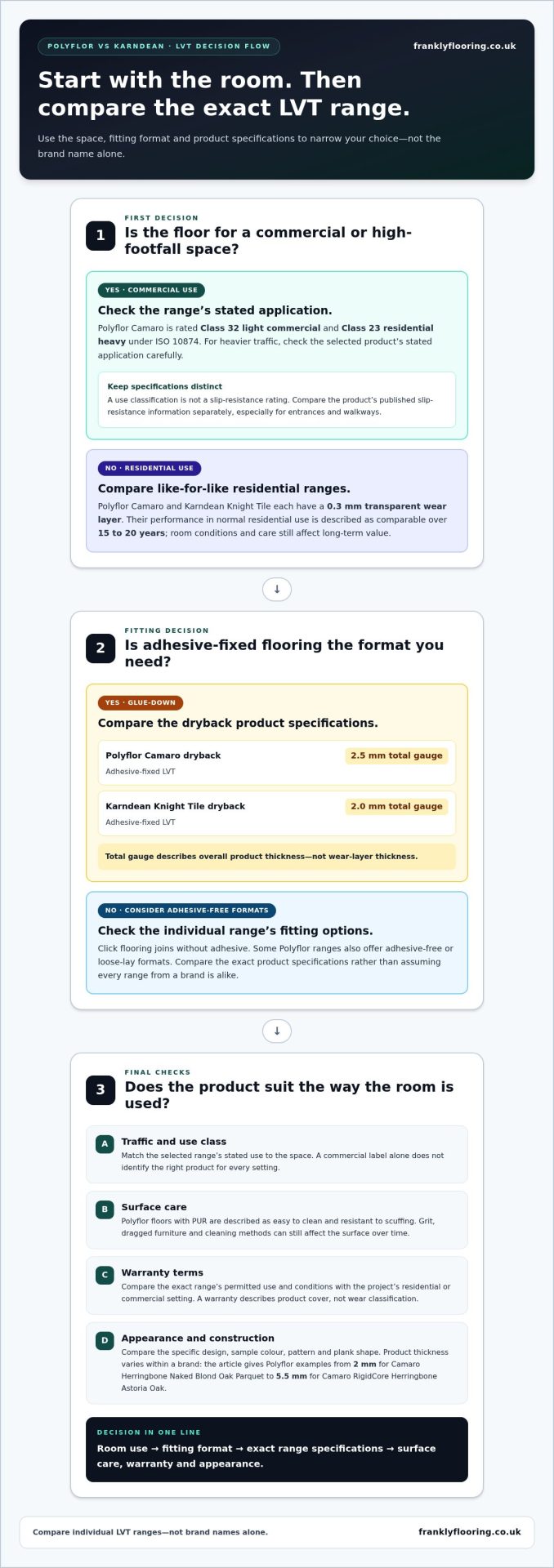
- Polyflor Camaro is rated Class 23 residential heavy and Class 32 light commercial under ISO 10874, useful context when assessing suitability for busy spaces.
- Polyflor Camaro and Karndean Knight Tile both have a 0.3 mm transparent wear layer, so look beyond this shared specification when weighing durability.
- For residential use, the two ranges are described as comparable over 15 to 20 years; room conditions and care still shape long-term value.
- Match the floor to how the space is used, then compare the range’s finish and fitting format to narrow your options.
Brand positioning in commercial and residential flooring
Polyflor and Karndean both make LVT for residential flooring, but ranges differ in construction and fitting format. Polyflor and Amtico also offer commercial flooring ranges for heavy-duty business environments.
Installation and LVT Brand Choice
Start with the room, subfloor and fitting format. Glue-down LVT is fixed with adhesive, while click flooring joins without it. Some Polyflor ranges also offer adhesive-free or loose-lay formats. Compare the individual product’s specifications rather than assuming every product from one brand is alike.
Brand History and Flooring Materials
For this comparison, the useful distinction is each brand’s LVT ranges and their specifications, rather than an unsupported timeline of brand history. Polyflor Camaro dryback LVT has a total gauge of 2.5 mm, while Karndean Knight Tile dryback LVT has a total gauge of 2.0 mm. Those figures describe overall product thickness, not wear-layer thickness, so they answer a different question.
| Option | Example | Total gauge | Format or use |
|---|---|---|---|
| Polyflor | Camaro dryback | 2.5 mm | Adhesive-fixed LVT |
| Karndean | Knight Tile dryback | 2.0 mm | Adhesive-fixed LVT |
Brand Design and Appearance
Both brands offer wood-effect LVT, so compare specific designs rather than broad style claims. Polyflor examples include Camaro Herringbone Naked Blond Oak Parquet and Colonia Plank Schoolhouse Oak, with different looks and layouts. Check sample colour, pattern and plank shape alongside the room’s existing finishes.
Product construction can also shape the choice. Polyflor Camaro Herringbone Naked Blond Oak Parquet is 2 mm thick, while its Camaro RigidCore Herringbone Astoria Oak is 5.5 mm thick. These are different products within one brand, so thickness should not be treated as a simple brand-wide ranking. Match the exact range to the room and intended fitting method.
For business use, Polyflor sits among brands with commercial flooring ranges designed for heavy-duty environments; residential ranges serve a different setting. That distinction matters in reception areas, shops and homes, where footfall and use vary. A commercial label alone does not identify the right product for every space, so compare the range’s stated use and construction.
Match the room’s use and preferred fitting format to a specific range, then compare its appearance.
Durability for high-footfall commercial spaces
In busy settings, compare the exact LVT range with the space’s traffic, cleaning routine and safety requirements. Polyflor Camaro has a stated commercial classification. Consider slip resistance and warranty terms separately.
Durability and Warranties
A warranty describes the cover attached to a product, not its wear classification. Compare the published terms for the exact Polyflor or Karndean range, including permitted use and any conditions. For a shop or reception, residential warranty terms may not reflect the intended traffic. Check the wording against the setting before deciding.
Durability and Quality
Polyflor Camaro is rated Class 23 residential heavy and Class 32 light commercial under ISO 10874. That classification gives a clearer guide to intended use than a general claim that flooring is “hard-wearing”. Karndean also has ranges for different settings, so compare the specific product’s stated application rather than treating either brand as uniform. In both cases, realistic expectations depend on matching the range to the room.
Surface treatment also affects routine care. Polyflor floors with PUR are described as easy to clean and resistant to scuffing, which can help manage everyday marks in a busy corridor. The treatment does not make a floor immune to damage: grit, dragged furniture and cleaning methods can still affect the surface over time.
Slip resistance is distinct from wear classification. A Class 32 rating describes use suitability, not how a floor performs underfoot when wet. For an entrance, kitchen or workplace walkway, compare the exact product’s published slip-resistance information alongside its intended-use classification. A realistic choice accounts for spills, footwear and cleaning routines, rather than relying on appearance or a single durability label.
Use this quick comparison to distinguish what each specification tells you:
- Use class: Polyflor Camaro’s Class 32 rating covers light commercial use; don’t read it as a slip rating.
- Surface care: PUR-treated Polyflor floors are described as easy to clean and scuff-resistant.
- Warranty: Compare the exact range’s terms with the project’s commercial or residential use.
- Slip resistance: Assess the product’s stated information separately from its wear classification.
Karndean and Polyflor should therefore be compared range by range, not through brand reputation alone. Start with the space’s traffic and cleaning demands, then weigh use classification, surface treatment and warranty terms. A floor designed for light commercial use may suit a quieter business area, while heavier traffic calls for careful attention to the selected product’s stated application. For a wider view of flooring choices for your project, consider how appearance and maintenance fit alongside durability.
Polyflor vs Karndean LVT: Which Brand Is Better in 2025?
Polyflor Camaro and Karndean Knight Tile share a 0.3 mm transparent wear layer. That makes surface treatment, maintenance and suitability more useful points of comparison than wear-layer thickness alone.
Follow the care guidance for the exact LVT product. Polyflor floors with PUR are described as easy to clean and resistant to scuffing. Repair depends on the damage and fitting format: replacing a section is different from dealing with surface marks.
Wear Layers and Surface Treatments
A wear layer is the clear protective layer above the decorative design. Polyflor Camaro and Karndean Knight Tile each have a 0.3 mm transparent wear layer, so neither has an advantage on that measure alone. Polyflor’s PUR surface treatment is described as easy to clean and resistant to scuffing. Compare the finish and care instructions for the precise range before choosing.
The number of layers and total product gauge describe different things. A thicker overall tile doesn’t automatically mean a thicker wear layer or better resistance to everyday damage. For example, the Camaro dryback gauge is 2.5 mm, while the Knight Tile dryback gauge is 2.0 mm. Keep those measurements separate when reviewing luxury vinyl specifications.
Karndean and Polyflor Prices
Compare equivalent products and project requirements, not brands in general. Range, design, construction and fitting format all affect the decision. A difference in purchase price may matter less than choosing a product suited to the room’s traffic and intended lifespan. Compare like with like, such as dryback against dryback, when assessing value.
For a fair comparison, list the selected ranges, floor area, preparation needs and fitting method. Keep material costs separate from other project costs: the product price alone does not represent the full flooring decision. This also helps explain why two LVT options with similar wear layers may offer different overall value.
Underfloor-Heating Compatibility
Underfloor-heating suitability depends on the product, so don’t assume compatibility from the Polyflor or Karndean name alone. Check the specific LVT guidance alongside the heating-system requirements. The fitting method matters too, as adhesive-fixed and click products have different constructions.
Before choosing a range, compare its heating guidance with the planned system and fitting method. This is particularly relevant when replacing flooring over an existing heated subfloor: product thickness, adhesive and installation instructions all matter. Treat compatibility as a product-specification question, not a general advantage for either brand.
Overall, neither brand wins every comparison. Both named ranges share a 0.3 mm wear layer, while Polyflor’s PUR treatment provides a clearly stated cleaning and scuff-resistance benefit. Compare the exact range, surface care guidance and project requirements to decide which luxury vinyl option fits best.
Cost and long-term value
Neither Polyflor nor Karndean has one fixed price across every LVT range. Compare products with similar construction, design and intended use. Fitting format matters too: dryback and click flooring require different installation approaches, so product prices alone don’t show the full project cost.
Identify the exact ranges, then compare the same requirements for each. Polyflor Camaro dryback and Karndean Knight Tile dryback are more relevant to compare than unrelated products from either brand. Check the floor area, fitting format and preparation needed. These details help explain differences in total cost.
Room size affects the amount of flooring required. One UK household was considering around 70 square metres, illustrating why area should be established before comparing options. Measure the room shape and account for cuts around features such as doorways. Then compare the product quantities needed for each design, since plank layout and pattern can affect how flooring is planned.
Cheaper upfront doesn’t automatically mean better value over time. For normal residential use, Polyflor Camaro and Karndean ranges are described as comparable over 15 to 20 years. That comparison makes the selected product, installation and care relevant to the decision. A lower initial outlay may be less attractive if the range doesn’t suit the room’s use or appearance.
For a practical comparison, break the decision into clear parts:
- Product: Compare equivalent ranges, such as Camaro dryback and Knight Tile dryback.
- Quantity: Use the measured floor area and the chosen layout to establish material requirements.
- Fitting: Account for the installation method and any preparation the floor needs.
- Long-term fit: Consider whether the design and product use suit the room over time.
Wood and stone effects can influence value because appearance is part of the decision. A herringbone design, such as Polyflor Camaro Herringbone Naked Blond Oak Parquet, has a different layout from a standard plank. Consider the pattern in the actual room, alongside furniture and existing finishes, rather than judging cost without accounting for the look you want.
Use the same checklist for both brands, then weigh the project requirements against the expected residential lifespan. This gives a more grounded comparison than choosing by brand name or initial cost alone.
Polyflor Camaro and Karndean LVT
Polyflor Camaro and Karndean Knight Tile are useful ranges to compare more closely. Their wear layers match, but their dryback thicknesses differ, making overall construction a clearer point of distinction.
Both ranges have a 0.3 mm transparent wear layer. That shared measurement means it doesn’t settle which floor suits a room better. Look at the total gauge, product format, visual design and intended use together. These details help separate comparable luxury vinyl tile products from ranges that only share a brand category.
Polyflor Camaro dryback LVT has a total gauge of 2.5 mm, compared with 2.0 mm for Karndean Knight Tile dryback. The difference is in the overall thickness, not the wear layer. It shouldn’t be treated as proof that one product lasts longer. A sound comparison keeps those measurements distinct and considers the floor beneath them.
Polyflor also has Camaro rigid-core products. Camaro RigidCore Herringbone Astoria Oak is 5.5 mm thick, which sets it apart from Camaro dryback construction. That contrast within one range shows why brand-level assumptions can mislead. Compare the exact product and fitting format you’re considering, rather than judging every Camaro floor by its name.
Design can help narrow the choice. Polyflor examples include Camaro Herringbone Naked Blond Oak Parquet and Camaro RigidCore Herringbone Astoria Oak. Both have herringbone styling, but differ in construction and total thickness. Karndean Knight Tile offers a dryback comparison. Consider pattern, plank shape and colour in the context of the room.
There is no single winner for every requirement. A premium appearance may be the priority in a living space, while a commercial project calls for close attention to intended use and product specifications. Many Polyflor products achieve an A+ rating for commercial use under the BRE Green Guide. This is one sustainability consideration, not a replacement for checking suitability for the space.
Use this comparison to make the decision practical:
- For dryback construction: compare Camaro at 2.5 mm with Knight Tile at 2.0 mm.
- For wear layer: note that both have a 0.3 mm transparent layer.
- For rigid-core construction: assess Camaro RigidCore as a distinct product, not a direct gauge match.
- For appearance: compare the actual plank design and finish with the room.
For an excellent starting point, match your preferred look to the product’s construction and use. Explore LVT flooring options as you narrow down the right direction for your project.
Frankly Flooring: LVT
Frankly Flooring offers LVT for readers comparing Polyflor Camaro with Karndean ranges. Use the specifications in this guide to narrow your choice by construction, wear layer, intended use and appearance. Carpet and furniture are also available to consider as part of a wider room plan.
Next, compare the LVT options against your room’s practical needs and preferred look. Focus on the exact product rather than brand reputation alone, and consider fitting format and care requirements before deciding.
For help exploring flooring options, visit Frankly Flooring online.
Choose a floor that fits the way you live
A polyflor vs karndean comparison is a useful starting point, but your final choice should feel right for the room as well as meet its practical needs. Think about the atmosphere you want to create, how the space is used day to day, and which flooring style will sit comfortably alongside your existing furnishings. Taking those details into account can make the decision clearer.
Frankly Flooring offers LVT, wood and carpet, giving you options to consider as you plan your home’s flooring. If you’d like advice on narrowing down your choice, contact Frankly Flooring for advice. A considered decision now can help you create a room you’ll be happy to live with.
Frequently Asked Questions
Polyflor vs Karndean: What are the pros and cons?
Neither brand is the automatic winner; the advantage depends on the specific LVT range and project. Polyflor Camaro and Karndean Knight Tile share a 0.3 mm wear layer, while their dryback gauges differ. Polyflor also includes rigid-core Camaro products, giving buyers another construction to compare. A practical drawback of choosing by brand alone is overlooking product-level differences in format, appearance and intended use.
What are the main differences between Polyflor and Karndean luxury vinyl flooring?
The clearest differences are between individual ranges, not the two brand names alone. For example, Polyflor Camaro dryback has a total gauge of 2.5 mm, while Karndean Knight Tile dryback measures 2.0 mm. Both have a 0.3 mm transparent wear layer. Compare the exact product specifications and fitting format, then weigh the design against the room’s practical requirements.
How do Polyflor and Karndean compare for durability, wear layers and expected lifespan?
For normal residential use, the two ranges are described as comparable over 15 to 20 years. Polyflor Camaro and Karndean Knight Tile each have a 0.3 mm transparent wear layer, so that specification alone doesn’t separate them. For commercial use, Polyflor Camaro carries a Class 32 light commercial rating under ISO 10874. Match the product’s intended use to the traffic it will receive.
How do Polyflor and Karndean compare for appearance, designs and realistic wood or stone effects?
Compare actual designs side by side, since each brand offers different looks across its ranges. Polyflor examples include Camaro Herringbone Naked Blond Oak Parquet and Colonia Plank Schoolhouse Oak. Check colour, plank proportions and pattern against the room’s light and existing finishes. Herringbone creates a different visual rhythm from straight planks, even when both imitate oak.
Are Polyflor or Karndean floors easier to install, and what subfloor preparation is needed?
Ease of installation depends mainly on product format and the room, not just the brand. Dryback LVT is fixed with adhesive; click flooring joins without adhesive, and some Polyflor ranges also offer loose lay. Before fitting, prepare a sound, clean and level subfloor, as unevenness can affect the finished surface. Follow the chosen product’s guidance for adhesive, acclimatisation and preparation.
Which is better for bathrooms, kitchens, underfloor heating and busy households?
Check the exact product’s suitability for the room and heating system rather than assuming every range performs alike. Bathrooms and kitchens need flooring specified for those settings, while busy households should consider traffic, cleaning routines and surface treatment. Underfloor-heating compatibility is product-specific too. Compare the guidance for each shortlisted product and choose one that meets the requirements.
What are the environmental credentials and recycling options for Polyflor and Karndean flooring?
Compare environmental credentials at product level, using published documentation rather than assuming every range has the same profile. Check what it covers, such as material impacts and manufacturing information, and whether it gives a route for recovering or recycling that specific floor. Polyflor products with an A+ BRE Green Guide rating offer one commercial-use example, but the rating does not replace checking disposal options.