
Your office chair is likely the most destructive piece of furniture in your entire home. While we often focus on desk ergonomics or lighting, the real pressure is happening right under your feet, where castor wheels can quickly turn an expensive investment into a scuffed mess. We understand the frustration of trying to balance a professional Zoom backdrop with a surface that doesn’t echo like a hollow hallway or leave your toes numb during a long January afternoon. It’s a common dilemma for the modern UK professional who needs a space that’s both functional and inviting.
In this frank guide, we’ll help you find the ideal flooring for home office environments that actually works as hard as you do. You’ll discover which materials, from luxury vinyl to wide-plank wood in trending honey tones, offer the best resistance to daily wear. We’ll also address the technical side of things, like why a 10mm laminate might be your best bet for better acoustics and how to handle the specific mechanical stress of rolling chairs without resorting to ugly plastic mats. We’re moving past the marketing fluff to give you a clear, honest look at creating a workspace that’s durable, easy to clean, and professionally polished.
Key Takeaways
- Learn why LVT and laminate are the most practical choices for high-use desk areas, specifically because of their superior scratch resistance.
- Discover how the right flooring for home office setups can significantly reduce echo and noise during your daily video calls.
- Understand the frank reality of using chair mats and why switching to soft rubber casters is a smarter way to protect your investment.
- Explore how to balance professional style with warmth by pairing durable hard surfaces with rugs or choosing engineered wood for a premium feel.
- Get practical advice on the full project lifecycle, from ordering free samples online to achieving a stress-free delivery to your door.
Choosing the Best Flooring for Home Office Use: The Frank Essentials
When you’re Choosing the Best Flooring for Home Office Use, you aren’t just picking a pattern that looks nice under a coffee table. You’re selecting a performance surface. Unlike a bedroom where the only traffic is a pair of slippers, your office deals with the concentrated weight of a desk, heavy monitors, and a chair that moves constantly. This room requires a different checklist than your lounge because it functions as a mini-commercial environment inside your home.
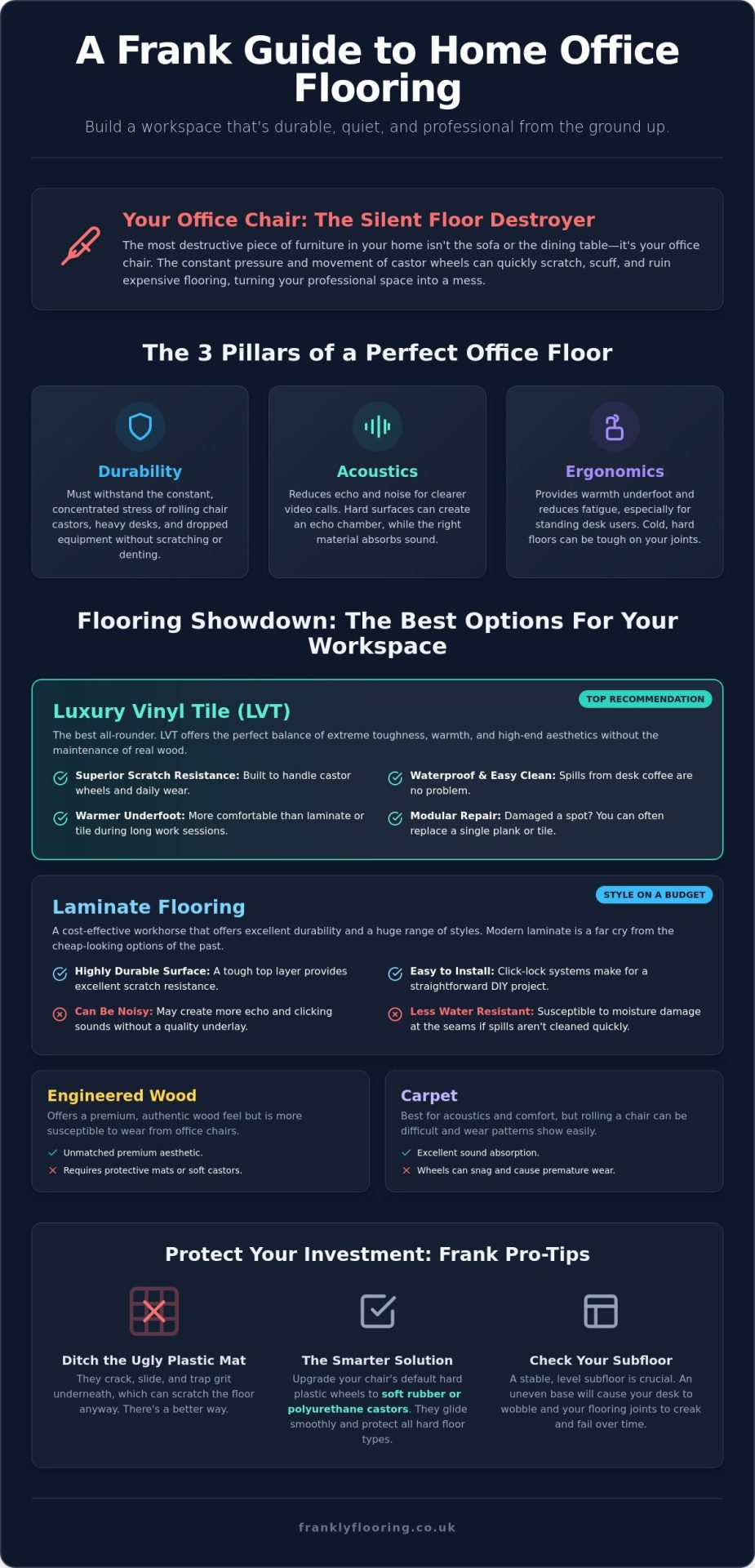
Frankly, if you’re spending 40 hours a week in this room, the cheapest bargain-basement vinyl isn’t going to cut it. You need what we call the “Big Three”: durability to survive the chair, acoustics to stop the echo on Teams calls, and ergonomics to keep your joints happy. We’ve seen too many people regret a “cheap fix” after six months of wheel scuffs and cold feet. Investing in quality here is about long-term sanity, not just aesthetics.
Don’t ignore your subfloor either. If your floor isn’t level, your desk will have a permanent wobble that no amount of folded paper under the leg will fix. A stable, flat subfloor is the foundation of a professional workspace, ensuring your furniture stays put and your flooring joints don’t creak every time you reach for a coffee.
Durability vs. Comfort: Finding the Balance
There’s a trade-off between a floor that’s easy to mop and one that’s easy on your ears. Hard floors like LVT are the gold standard for cleanliness and rolling ease, but they can turn your office into an echo chamber. Our frank assessment is that while hard floors are easier to maintain, they can be tough on your back if you use a standing desk for long shifts. You need to balance that professional look for video calls with the physical comfort of a home environment. Often, the best solution is a high-quality hard surface paired with a strategic, low-pile rug to dampen sound.
The Castor Wheel Challenge
The biggest enemy of any flooring for home office setup is the castor wheel. These small wheels exert immense pressure on a tiny surface area, effectively grinding dust and grit into your floor’s finish. It’s mechanical stress at its most persistent. Many manufacturers will actually void your warranty if you use a standard office chair without a protector or specific wheel types. A castor wheel rating is a technical standard that indicates a floor’s ability to withstand the repeated circular motion and weight of office chair wheels without delaminating or scratching.
LVT and Laminate: The Heavy-Duty Workhorses
If you’re looking for the most resilient flooring for home office setups, you’ll likely end up choosing between Luxury Vinyl Tile (LVT) and laminate. These materials are the heavy-duty workhorses of the industry. They are designed to take the brunt of daily desk life without flinching. While real wood has its charms, the mechanical reality of a rolling chair makes these engineered options far more practical for a space where you’re actually working 40 hours a week.
One of the biggest advantages of both materials is their resistance to the inevitable “desk coffee” spills. Unlike natural timber, which can swell or stain if a leak goes unnoticed during a long meeting, modern vinyl and high-quality laminate are built to handle moisture. This makes them incredibly easy to clean. A quick wipe is usually all it takes to keep your professional backdrop looking sharp. You can dive deeper into the technical specifics in our LVT flooring guide to understand how these layers work together.
Why LVT Wins for Most Office Spaces
LVT is currently our top recommendation for the majority of UK home offices. Its multi-layered construction, often featuring a rigid core, provides a unique combination of warmth underfoot and extreme toughness. The Frank Assessment is simple: LVT is the best all-rounder for those who want the look of golden oak or honey-toned wood without the constant worry of maintenance. If you happen to damage a section, perhaps by dropping a heavy piece of equipment, you can often replace a single tile or plank rather than the entire floor. This modularity is a lifesaver for a long-term workspace. For a truly ergonomic setup, consider Protecting Your Floor: Castors, Mats, and Maintenance by choosing a product with a built-in underlay to help with foot fatigue during standing-desk sessions.
Laminate: Style on a Budget
Laminate remains a popular choice for spare-room conversions because it offers a high-end look at a lower entry price. However, you must pay attention to the AC rating. For a home office, don’t settle for AC3, which is standard for bedrooms. You need AC4 or higher to survive the constant friction of an office chair. The Frank Assessment here is that while laminate is incredibly scratch-resistant, it can produce a hollow “click” sound when you move around. This can be distracting on calls if you don’t use a high-quality dampening underlay. If you’re planning a DIY project, our laminate flooring buying guide covers everything from expansion gaps to the best textures for 2026. You can browse our collection of durable office laminates to find a style that fits your home’s character.
Carpet and Engineered Wood: The Premium Office Feel
While hard surfaces are the practical champions for durability, they aren’t the only way to design a workspace. For some, the ideal flooring for home office use is about creating a sanctuary that feels warm and sounds professional. If your work involves back-to-back video calls or if you’re tucking your desk into a corner of a bedroom, carpet and engineered wood offer a level of comfort and “executive” style that synthetic alternatives often struggle to match. These options prioritize the atmosphere of the room, turning a functional area into a space where you actually want to spend eight hours a day.
Acoustics and Video Call Clarity
There’s nothing quite as distracting as a hollow echo during a high-stakes presentation. Hard floors reflect sound waves, which can make your voice sound thin and metallic over a microphone. Soft surfaces, particularly carpet, act as natural acoustic panels. They absorb background noise from the rest of the house, which is a massive benefit if you share your home with children or pets. The Frank Assessment is simple: if your office is in a high-traffic family home, carpet is your best friend for maintaining a professional boundary. It keeps the “home” sounds out of your “office” headspace.
However, you can’t just pick any deep-pile shag carpet. You need a low-pile, dense weave. This allows your chair to move with less resistance and prevents the carpet fibers from being crushed into a permanent “track” under your desk. If you prefer the look of a hard floor but need the acoustic help, using high-quality rugs from our accessories range over LVT or laminate provides a smart hybrid solution. This setup gives you the best of both worlds: the durability of a hard surface where the chair rolls and the sound-dampening of a soft textile elsewhere.
Engineered Wood: The Executive Aesthetic
Engineered wood provides the authentic grain and texture that LVT tries to mimic. It’s constructed with a real timber top layer over a stable core, making it a far better choice for a temperature-controlled office than solid wood. Solid timber can warp or gap when your central heating kicks in, but engineered boards are designed to stay flat and stable. You can find more about these technical nuances in our engineered wood flooring guide.
The Frank Assessment here is that while wood looks stunning and adds genuine value to your property, it requires the most vigilance. It’s a premium material that won’t tolerate the relentless grinding of grit under castor wheels. If you choose this path, you’ll need to be disciplined about protection. The upside is that unlike many other materials, engineered wood can often be sanded and refinished years down the line. This means your office floor can truly last a lifetime if you treat it with respect and follow a basic maintenance routine.
Protecting Your Floor: Castors, Mats, and Maintenance
Once you’ve selected the ideal flooring for home office use, the focus shifts to preservation. It’s one thing to have a floor that looks professional on day one. It’s quite another to keep it that way after 2,000 hours of rolling your chair back and forth. Most people assume a plastic mat is the only answer, but the reality is more nuanced. If you don’t take specific steps to mitigate the mechanical pressure of your workspace, even the toughest LVT or laminate will eventually show signs of distress.
The frank truth about plastic chair mats is that they are often a double-edged sword. While they stop the wheels from touching the floor, they frequently trap tiny particles of grit and dust underneath. As you move, the mat acts like a sanding block, grinding that grit into your floor’s finish. If you must use one, you’ll need to lift and clean under it weekly. A better, more modern approach is to address the source of the problem: the wheels themselves. Switching your standard hard plastic castors for “soft” rubber castor wheels is the best £20 you’ll ever spend on your office. These wheels roll silently, provide better grip, and won’t gouge your surface.
Maintenance in a workspace also requires a different rhythm. The “chair zone” is a magnet for dust, which acts as an abrasive under pressure. We recommend a quick daily sweep of the area immediately around your desk to prevent buildup. This simple habit does more for the longevity of your floor than any expensive cleaning chemical ever could.
Castor Wheels vs. Floor Protectors
Hard castors are designed for carpets, while soft castors are designed for hard floors. If your chair came with standard wheels, it’s almost certainly a hard variety that will eventually mar a wood or vinyl surface. Our frank assessment is that a low-pile rug is often a more stylish and effective protector than a clear plastic mat, as it traps dust within the fibers rather than letting it sit on the surface. For furniture that doesn’t move, you should always apply heavy-duty felt pads to static desk legs to prevent deep indentations or scratches during occasional repositioning.
Underlay: The Hidden Hero
You shouldn’t skimp on what’s underneath your floor. A high-density underlay is crucial for office furniture because it supports the clicking joints of laminate or LVT under the heavy weight of a desk and filing cabinets. High-performance options like Cloud 9 underlays are excellent for noise reduction, preventing the sound of your chair from echoing into the rooms below. The underlay essentially acts as a shock absorber, ensuring the floor remains stable when your workspace is fully loaded with equipment. You can browse our protective rugs and office accessories to find the right finishing touches for your floor protection strategy.
Designing Your Workspace with Frankly Flooring
Designing a room where you’ll spend a third of your life requires more than just a quick glance at a colour swatch. It’s about bringing together the technical durability we’ve discussed with an aesthetic that makes you feel productive. Our family-run team has seen every mistake in the book over the last 20 years. We’re here to make sure your flooring for home office project doesn’t end with a wobbly desk or a colour that looks completely different under your LED office lights than it did on your screen. Frankly, we’d rather you get it right the first time.
Buying online shouldn’t feel like a gamble. We provide free samples and direct-to-door UK delivery to ensure the process is as transparent as our pricing. By seeing the material in your own light, you can avoid the disappointment of a mismatched grain or an unexpected texture. Our goal is to guide you through a logical journey from initial inspiration to a finished room that stands up to the rigours of daily use.
Matching Flooring to Furniture
Grey LVT remains a firm favourite for modern UK professionals, especially when paired with minimalist white desks. It creates a clean, distraction-free environment that looks incredibly sharp on a high-definition webcam. If your office is part of a guest bedroom or lounge, use one of our low-pile rugs to define the “work zone.” This creates a mental and physical boundary between your career and your home life. We also offer a range of office-appropriate furniture to help you complete the room without having to source pieces from multiple different retailers.
The Frankly Flooring Advantage
We pride ourselves on being a one-stop shop for everything you need to get the job done. You can order everything from your main planks to your carpet grippers in one go. This end-to-end convenience is part of our commitment to a stress-free experience. There are no hidden fees or high-pressure sales tactics here; just straightforward advice from people who know the industry inside out. We value long-term satisfaction over quick wins, which is why we’re so direct about what works and what doesn’t.
Before you hit the checkout, run through this final Frank checklist:
- Have you added a 10% waste margin for cuts and expansion gaps?
- Did you choose an AC4 or higher rating if you’re buying laminate?
- Have you checked that your subfloor is level to avoid furniture wobble?
- Do you have the right high-density underlay for noise reduction?
- Have you ordered your soft rubber castor wheels yet?
If you’re ready to transform your workspace, browse our full range of home office flooring today. We’ll handle the logistics and get your materials delivered directly to your UK address, so you can focus on getting back to work.
Building Your Professional Foundation
Creating a workspace that truly works requires a balance of technical toughness and personal comfort. We’ve explored why LVT and high-rated laminate are the heavy lifters for durability, and how low-pile carpets can transform your video call clarity. By choosing the right flooring for home office use and pairing it with protective rubber castors and high-density underlay, you ensure your workspace remains a productive sanctuary for years to come. It isn’t just about the look; it’s about a surface that stands up to the relentless movement of your daily routine.
At Frankly Flooring, we bring over 20 years of family-run expertise to every recommendation. We don’t believe in high-pressure tactics; we just provide no-nonsense, transparent advice to help you get the job done right. Whether you’re after the executive look of engineered wood or the practical resilience of modern vinyl, we offer direct UK delivery on our entire range to make your renovation as simple as possible. Your floor is the foundation of your career at home. It’s time to invest in a surface that supports your ambition without showing the scars of the daily grind. Shop our durable Home Office Flooring range now and take the first step toward a more professional, comfortable workspace.
Frequently Asked Questions
What is the most durable flooring for a home office with a rolling chair?
LVT is the most durable choice for a home office with a rolling chair. Its rigid core and protective wear layer are specifically engineered to resist the constant friction and weight of castor wheels. While high-quality laminate with an AC4 rating is also a strong contender, LVT’s moisture resistance gives it the edge for long-term reliability in a busy workspace where spills are likely.
Do I really need a chair mat for LVT or laminate flooring?
You don’t strictly need a plastic chair mat if you follow a few simple maintenance steps. In fact, these mats often trap grit underneath, which can scratch your laminate or LVT over time. A better approach is to keep the area clean and switch to soft rubber castor wheels, which are much kinder to the surface than the standard hard plastic ones that come with most chairs.
Is carpet a bad idea for a home office?
Carpet is an excellent choice for a home office if you focus on acoustics and warmth. The key is choosing a low-pile, dense weave that won’t crush under the weight of your chair or make rolling difficult. It’s particularly effective at stopping echoes during video calls, though it does require more regular vacuuming to keep the “chair zone” clear of debris that can wear down the fibres.
How do I stop my office chair from making so much noise on a hard floor?
To stop a chair from making noise, you should upgrade your underlay and your wheels. A high-density underlay acts as a shock absorber to deaden the sound of movement through the floor. Pairing this with soft-roller polyurethane castors will eliminate that annoying rumble on hard floors, making your workspace much quieter for you and anyone else in the house during late-night sessions.
Can I install home office flooring myself?
You can certainly install most types of flooring for home office use yourself. Click-system LVT and laminate are designed for straightforward DIY fitting, and a standard 150 sq. ft. office can often be finished in just 2 to 3 hours. You’ll just need some basic tools and the patience to ensure your subfloor is level and you’ve left the correct expansion gaps around the perimeter.
Which flooring is best for keeping a home office warm in winter?
Carpet provides the best natural insulation for a cold office. However, if you prefer a hard floor, LVT and engineered wood are surprisingly warm when used with a high-performance underlay. These materials don’t hold the cold like stone or ceramic tiles do, making them a comfortable choice for those long winter workdays when you’re stuck at your desk for eight hours or more.
Does engineered wood flooring add more value to a home office than LVT?
Engineered wood typically adds more perceived value to a home because it’s a premium, natural material. It has a real timber top layer that many buyers find more attractive than synthetic alternatives. That said, LVT is often more appealing to those who prioritise a “performance surface” that won’t scratch or stain, making it a very strong practical investment for a dedicated, high-traffic workspace.
How do I protect my new floor from heavy office desks and filing cabinets?
Protecting your floor from heavy desks and filing cabinets starts with a high-density underlay. This layer supports the floor’s locking system, preventing joints from snapping under concentrated pressure. For the furniture itself, always use heavy-duty felt pads on the legs. These pads distribute the weight more evenly and prevent the feet from gouging the surface if the desk is ever shifted or repositioned.