
Can a material made primarily of wood fibers really survive a bathroom floor without turning into a warped, swollen mess within six months? It is a question we hear constantly, especially when you are searching for waterproof laminate flooring for bathrooms that actually lives up to the name. Most homeowners are understandably skeptical because they have seen the horror stories of “blown” joints and peeling layers after a simple shower splash. You want the warmth of wood under your feet, but you don’t want to wake up to a floor that has buckled under the pressure of daily life.
We agree that the industry has made things confusing. Choosing the right material often feels like a gamble when the term “waterproof” itself is not a regulated designation in the market. In this guide, we are going to be frank about what actually works. We promise to strip away the marketing fluff and show you how to identify certified products that endure rigorous testing. We will preview the essential technical specs, from AC ratings to high-density cores, to help you secure a high-end look that offers genuine longevity for your home.
Key Takeaways
- Learn how modern core engineering has transformed laminate from a moisture-absorbing “sponge” into a reliable choice for high-humidity spaces.
- Discover the specific technical features, like pre-tension click systems, that define high-quality waterproof laminate flooring for bathrooms.
- Compare laminate against LVT and vinyl to see how it offers better value for money and a warmer feel underfoot.
- Master the “belt and braces” installation techniques that protect your expansion gaps and prevent the dreaded joint swell.
- Follow the Frank checklist to pick the right thickness and finish, ensuring your new floor stands up to years of splashes and steam.
Can You Really Put Laminate in a Bathroom? The Frank Truth
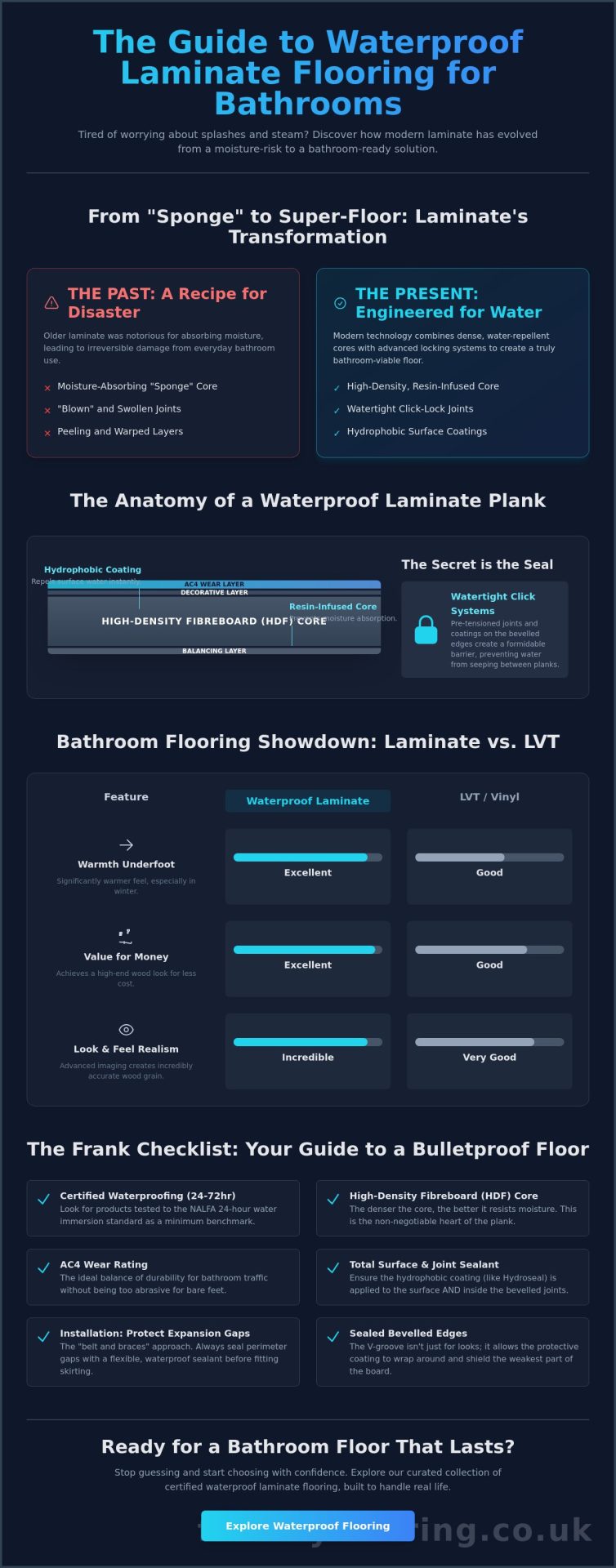
In the past, putting laminate in a bathroom was a recipe for disaster. It earned a reputation as a “sponge” because the compressed wood fibers would soak up humidity and spills, leading to unsightly swelling at the seams. However, the industry has moved on. Modern waterproof laminate flooring for bathrooms is a completely different beast compared to the products of ten years ago. It is no longer just about a plastic wear layer on top. The real magic happens within the core and the precision of the locking mechanism. Today, Laminate flooring stands as a genuine rival to traditional tile because it offers a high-end aesthetic without the cold, hard feel or the complexity of grout lines.
Modern bathroom laminate is a viable rival to tile for several reasons:
- Warmth: It is significantly warmer underfoot during winter months than ceramic or stone.
- Value: You get the look of expensive hardwood for a fraction of the material cost.
- Realism: Advanced imaging technology now replicates natural grain variations and knots with incredible accuracy.
The “Frank” reality is that while technology has advanced, you still need to be realistic. Most products are tested to the NALFA standard, which requires them to endure a 24-hour water immersion test with zero swelling. This is the industry benchmark. If you have a major plumbing failure that goes unnoticed for days, any wood-based product will eventually struggle. But for the daily reality of splashes, steam, and wet footprints, today’s engineering is more than capable of handling the pressure.
Water-Resistant vs. Waterproof: Know the Difference
There is a lot of marketing noise around these terms. Most standard laminates are water-resistant, meaning they can handle a splash in the middle of a plank. The real challenge is joint integrity. True waterproof systems use hydrophobic coatings and tightened click systems to prevent seepage. You should know that “waterproof” usually refers to a specific window, typically between 24 and 72 hours of standing water resistance.
The Evolution of HDF Core Technology
The foundation of any bathroom floor is its core. Since 2020, High-Density Fibreboard (HDF) has undergone a massive shift. Manufacturers now infuse these cores with specialized resins and waxes. This creates a much denser, less porous material that repels moisture. When you are looking at samples, core density is the most critical factor in preventing joint swell. This technical leap is why we can confidently recommend waterproof laminate flooring for bathrooms for high-moisture areas today.
The Science of Waterproofing: Hydroseal and Click Systems
Understanding how waterproof laminate flooring for bathrooms actually works requires looking past the surface. It is not just a thick layer of plastic. Instead, it is a combination of surface chemistry and mechanical engineering. When you see water beading on a plank, you are seeing a hydrophobic coating in action. This coating does not just sit on top; it creates a barrier that prevents liquid from soaking into the wood-based core. For a bathroom, we recommend looking for an AC4 rating. While AC5 is tougher, it is often too abrasive for bare feet, and AC3 may not provide the surface integrity needed to withstand constant moisture exposure over a decade.
Bevelled edges are another critical component. Many people think the “V-groove” is purely for aesthetics to make the floor look like real timber. In reality, these grooves allow the protective coating to wrap around the edge of the plank. This ensures the weakest part of the board, the joint, is shielded. High-quality manufacturers who adhere to NALFA performance standards use these wrap-around coatings to ensure that water cannot find a way in through the sides. If you are browsing our laminate options, you will notice that the best bathroom-ready products have a very distinct, sealed feel to these bevels.
Hydroseal Technology Explained
Hydroseal is a specialized coating that makes a plank truly watertight. It is applied not just to the surface, but deep into the click-lock grooves. This is why it matters for bathroom longevity. Without this wrap-around protection, water eventually finds a microscopic gap in the joint. Non-Hydroseal products might survive a splash, but they will fail in a wet room environment where steam and standing water are constant threats. It is the difference between a water-resistant floor and a truly waterproof system.
Why Click-Lock Tension is Your Best Friend
The click system provides the physical force needed to keep water out. Modern waterproof laminate flooring for bathrooms uses a “pre-tension” click. This means the boards are designed to be under constant physical pressure once locked together. This pressure creates a seal so tight that water molecules cannot pass through.
- Vertical Pressure: This occurs when you step on the joint. A weak click will “give,” opening a gap for water.
- Horizontal Pressure: Pre-tension pulls the boards together, closing the seam permanently.
You can test a sample by trying to slide a fingernail into the joint once it is clicked; if it feels like a single, solid unit, the tension is doing its job.
Bathroom Flooring Showdown: Laminate vs LVT and Vinyl
Deciding between waterproof laminate flooring for bathrooms and Luxury Vinyl Tile (LVT) usually comes down to three things: budget, feel, and the state of your subfloor. While LVT has long been the default choice for wet areas, modern laminate has closed the gap significantly. From a financial perspective, laminate remains the more accessible option. Even in 2026, where the price difference between the two has narrowed to roughly $0.50 to $1.00 per square foot, laminate still offers a superior balance of visual realism and cost-effectiveness for many homeowners.
Then there is the question of comfort. LVT is often described as cold and clinical underfoot. Because laminate is constructed with a high-density wood fiber core, it naturally retains more ambient heat. It provides a softer, more forgiving surface that feels like a real home rather than a commercial space. If you are stepping out of a warm bath onto a bare floor, that temperature difference is immediately noticeable. Laminate simply feels more substantial under your feet.
Laminate is also remarkably forgiving of “wonky” subfloors. Because the planks are thicker and more rigid, they can bridge minor dips and peaks in the floorboards beneath. Thin vinyl products tend to “telegraph” these imperfections, meaning every bump eventually shows through the surface.
- Rigidity: Laminate hides subfloor flaws that would ruin thinner vinyl.
- Warmth: Wood-based cores retain heat better than plastic-based LVT.
- Cost: Higher value per square metre without sacrificing the premium look.
If your subfloor isn’t a masterpiece of level engineering, laminate is likely your safest bet for a smooth finish.
Laminate vs. LVT: The Rigid Core Debate
The debate often centers on rigidity. LVT is more flexible, which is great for some areas but a nightmare if your subfloor has character. Laminate’s rigid construction prevents it from dipping into every small crevice. It is also a very DIY-friendly product; the click systems are intuitive and require fewer specialist tools than some high-end vinyl options. For a deeper dive into these differences, check out our guide on LVT vs Laminate Flooring: Which Is Right For You?
Laminate vs. Sheet Vinyl
When you compare laminate to sheet vinyl, the aesthetic difference is night and day. Modern laminate uses high-definition imaging to replicate natural grain variations and knots. It looks and feels like real wood because of advanced textures. Sheet vinyl, while waterproof, often lacks this depth and can look dated or “cheap” within a few years. You can assess the durability of a particular laminate by its AC rating; most bathroom-grade options are far more scratch-resistant than sheet vinyl, making them ideal if you have pets or heavy bathroom furniture.
Installation and Maintenance: Preventing the Dreaded Joint Swell
You can buy the most expensive planks on the market, but if you ignore the perimeter, you are wasting your money. The biggest risk to waterproof laminate flooring for bathrooms isn’t the splash in the middle of the room; it is the water that finds its way under the skirting boards. Even the best click systems cannot protect the underside of the plank if water seeps into the expansion gap. This is where most installations fail, and it is usually because the installer treated the bathroom like a dry hallway.
To ensure your floor stays flat and functional, we recommend a “belt and braces” approach. While modern click-lock technology is designed to be watertight, some professionals still use a thin bead of waterproof PVA glue in the joints for added security. This isn’t always strictly necessary for warranty purposes, but it provides peace of mind in high-traffic family bathrooms. If you are ready to start your project, you can browse our full laminate range to find a style that fits your vision.
Perimeter sealing is the one step you absolutely cannot skip. If you leave an open expansion gap around a bathtub or shower tray, you are inviting moisture to sit against the raw HDF core. Once that moisture is trapped under the floor, it has nowhere to go but up into the boards, causing the edges to “peak” or swell. This damage is irreversible and usually voids your manufacturer warranty.
The 10mm Rule and Silicone Sealing
Every laminate floor needs a 10mm expansion gap to allow for natural movement. In a bathroom, you must fill this gap with a compressible PE foam backing rod. Once the rod is in place, cap it with a high-quality, flexible bathroom silicone. This creates a watertight “tub” that allows the floor to expand while keeping water on the surface where it belongs. Don’t forget to use a waterproof door bar at the threshold to prevent seepage from moving into the next room.
Long-Term Care for Bathroom Laminate
Maintenance is about being smart rather than working hard. We advocate for a “dry-mop” philosophy. You should never soak your laminate floor with a bucket and mop. Instead, use a damp microfiber cloth and a dedicated laminate cleaner. Most importantly, keep steam mops away from your floor. The high-pressure heat can break down the hydrophobic coatings and force moisture into the seams, destroying the very technology you paid for.
- Spills: Wipe them up immediately; the 24-hour rule is a safety net, not a target.
- Ventilation: Use your extractor fan to prevent steam from settling as standing water.
- Mould: Proper perimeter sealing prevents moisture traps where mould thrives.
By following these simple rules, your floor will look as good in 2030 as it does on the day it is laid.
Choosing Your Bathroom Laminate: Quality Without the Fluff
Selecting the right waterproof laminate flooring for bathrooms should not be a guessing game. When you have a sample in your hand, you need to look beyond the surface color. The frank truth is that many products look great on a display board but lack the structural integrity required for a high-moisture environment. We recommend a thickness between 8mm and 12mm. Thicker planks generally offer a more stable click-lock system, which is your primary defense against water ingress. A thin plank might be cheaper, but it is more likely to flex, potentially breaking the watertight seal at the joints over time.
You also need to be realistic about warranties. A “waterproof warranty” is not a license to ignore leaks. These warranties typically cover standing water for a specific duration, such as 24, 48, or 72 hours. They are designed to protect you from everyday accidents, not long-term plumbing failures. Buying your flooring online from Frankly Flooring allows you to skip the “showroom tax.” Physical stores have high overheads, from retail rates to heating large spaces, and those costs are always baked into the price you pay. By cutting out the middleman, we provide high-spec materials without the unnecessary markup.
The Frankly Flooring Checklist
Safety and convenience should be at the top of your list. In a bathroom, the floor will get wet, so slip resistance is a non-negotiable feature. Look for planks with an “Embossed-in-Register” (EIR) texture. This technology aligns the surface texture with the visual grain, providing a more natural feel and better grip for bare feet. You might also see options with integrated underlay. While these can save time, ensure the underlay is specifically rated for high-moisture areas. For a full breakdown of technical specs, see our Laminate Flooring UK: The Frank 2026 Buying Guide.
Final Advice from the Experts
Before you commit, remember that bathrooms are notoriously difficult to measure. Because of the tricky cuts required around toilets, pedestals, and pipes, you should factor in at least 10% to 15% wastage. It is better to have half a box left over than to run short on the final row. Once your order arrives, do not rush the process. Your new waterproof laminate flooring for bathrooms needs to acclimatize to the humidity levels of your home for at least 48 hours. This prevents the planks from expanding or contracting too aggressively after they are laid. If you are ready to find a floor that stands the test of time, browse our waterproof laminate range today.
Secure Your Bathroom’s Future with the Right Floor
You now have the technical knowledge to navigate the market without being misled by marketing jargon. Modern waterproof laminate flooring for bathrooms is no longer a risky experiment. It’s a calculated choice that balances visual warmth with engineered durability. By focusing on high-density HDF cores and ensuring your perimeter is properly sealed with silicone, you can enjoy the look of real wood without the fear of joint swell. Choosing a floor is about more than just picking a color; it’s about trusting the engineering beneath your feet.
At Frankly Flooring, we believe in transparency. As a family-run business with over 20 years of expertise, we don’t hide behind corporate buzzwords. We offer no-nonsense technical advice and direct-to-door UK delivery to make your renovation as stress-free as possible. You don’t need a showroom when you have access to honest guidance and premium materials at fair prices. We take pride in helping you find a foundation that adds character to your home.
Ready to transform your space? Shop our range of “Frankly” durable waterproof laminate flooring and start your project with confidence. Your home deserves a floor that’s built to handle the splashes of daily life.
Frequently Asked Questions
Is laminate flooring really 100% waterproof for bathrooms?
No laminate is 100% waterproof in the same way as ceramic tile; it is engineered to be water-resistant for specific windows of time. Most high-quality waterproof laminate flooring for bathrooms is tested to withstand standing water for up to 24 or 72 hours. This gives you plenty of time to clean up splashes from a bath or shower. If a pipe bursts and water sits for a week, even the best laminate will eventually struggle.
How long does waterproof laminate flooring last in a bathroom?
You can expect a high-quality bathroom laminate to last between 15 and 25 years with proper care. Longevity depends heavily on the AC rating and how well you maintain the perimeter seals. An AC4 or AC5 rated floor is tough enough to handle heavy foot traffic and the occasional dropped shampoo bottle without scratching or denting. Regular checks of the silicone around your bathtub will ensure the core stays dry.
Do I need a special underlay for bathroom laminate?
Yes, you must use a moisture-resistant underlay, especially if you are laying the floor over a concrete subfloor. Over concrete, a 6-mil poly film moisture barrier is a standard requirement to prevent rising damp from reaching the underside of the planks. Some products come with an integrated underlay, but you should still verify that it provides the necessary moisture protection for a bathroom environment.
Can I use a steam mop on waterproof laminate flooring?
Never use a steam mop on any laminate floor, even those marketed as waterproof. The high-pressure steam can penetrate the click-lock joints and reach the HDF core, causing the wood fibers to expand and warp. This damage is usually not covered by manufacturer warranties. Stick to a damp microfiber mop and a pH-neutral cleaner to keep your waterproof laminate flooring for bathrooms in top condition.
What happens if water gets under the laminate floor?
If water reaches the underside of the floor, it will likely lead to irreversible damage like joint swelling or “peaking.” Unlike the surface, the bottom of the plank is rarely treated with hydrophobic coatings. This is why perimeter sealing with foam rods and silicone is the most important part of the installation process. Once moisture is trapped beneath the boards, it has nowhere to go and will eventually rot the core.
Is bathroom laminate flooring slippery when wet?
Like any hard surface, laminate can become slippery when it is wet, but modern textures have improved grip significantly. We recommend choosing a floor with Embossed-in-Register (EIR) technology. This aligns the surface texture with the wood grain pattern, creating a more slip-resistant finish than traditional smooth laminates. It is always a good idea to use a bath mat with a non-slip backing for added safety near the tub.
Can I install bathroom laminate over existing tiles?
You can install laminate over existing tiles as long as they are flat, solid, and free from cracks. The existing tile serves as a stable base, but you must ensure the surface doesn’t have a variance of more than 3mm over a two-meter span. If the grout lines are deep, a good quality underlay will help bridge those gaps and prevent the laminate planks from flexing or clicking when you walk on them.
How do I seal the edges of laminate flooring in a bathroom?
Sealing the edges requires a two-step process using a compressible PE foam backing rod and high-quality silicone. First, push the foam rod into the 10mm expansion gap around the perimeter of the room. Then, apply a bead of flexible bathroom silicone over the top. This creates a watertight seal that allows the floor to move naturally while preventing water from seeping under the skirting boards.