
Let’s be frank. Choosing a new rug can feel like a chore. You scroll through thousands of options, worrying which ones will slide across your LVT floor and which might stain or shed. The sheer choice of materials-from natural wool to polypropylene-is often more confusing than helpful. It’s a significant investment in your home’s comfort and style, and you want to get it right without the guesswork. That’s precisely why we’ve created this guide.
Consider this your straightforward map to navigating the world of rugs UK retailers offer in 2026. We’ll cut through the jargon to explain materials in plain English, show you how to measure for the perfect fit in any room, and help you find a quality rug that adds warmth, protects your beautiful floors, and perfectly completes your home’s aesthetic. It’s time to find a rug you’ll love for years to come, with complete confidence.
Key Takeaways
- Master the ‘Golden Rule’ of rug sizing to avoid the common ‘floating rug’ mistake and ensure your new piece perfectly anchors your furniture.
- Learn which rug backings are genuinely safe for LVT and wood floors, preventing costly damage from unseen chemical reactions.
- Compare the durability of natural vs. synthetic fibres to find the right material for your household, especially if you have pets or children.
- Understand what defines quality when buying rugs UK homeowners can trust, looking beyond the price tag to focus on construction and longevity.
Understanding the UK Rug Market: Why Quality Matters in 2026
Choosing a rug for your home is about more than just colour and pattern. In today’s market, a quality rug serves a dual purpose: it must be a beautiful design anchor while also performing as a durable, functional layer for your floor. What defines “quality” has evolved. It’s now a blend of expert craftsmanship, material integrity, and suitability for modern living. We’re seeing a significant shift toward sustainable, natural fibres and high-performance, easy-clean synthetics that can handle the demands of a busy household. Frankly, understanding this is key, as a cheap, poorly made rug often costs you more in replacements and dissatisfaction in the long run.
The Evolution of Home Decor Trends
The rise of open-plan living in UK homes has made rugs an essential tool for “zoning” – creating distinct areas for living, dining, or relaxing within a single large space. This has driven demand for both natural textures like wool and jute, which add warmth and depth, and advanced synthetics that offer incredible stain resistance. While it’s tempting to follow fast-fashion interior trends, our honest advice is to prioritise a rug’s construction and material. A well-chosen, high-quality piece will outlast fleeting styles and serve your home for years to come.
Just as a quality rug anchors your floor, the right wall decor completes the room’s atmosphere. If you’re looking for inspiration, you can explore Ready-to-Hang Framed Art to find pieces that complement your new style.
For those with a love for classic photography or cinema, Galerie Prints offers a curated collection of fine art prints that can serve as a stunning focal point.
Similarly, for a modern and sophisticated touch, you can explore Abstract Art to discover unique pieces that tie a room’s colour palette together.
Rugs as a Functional Flooring Layer
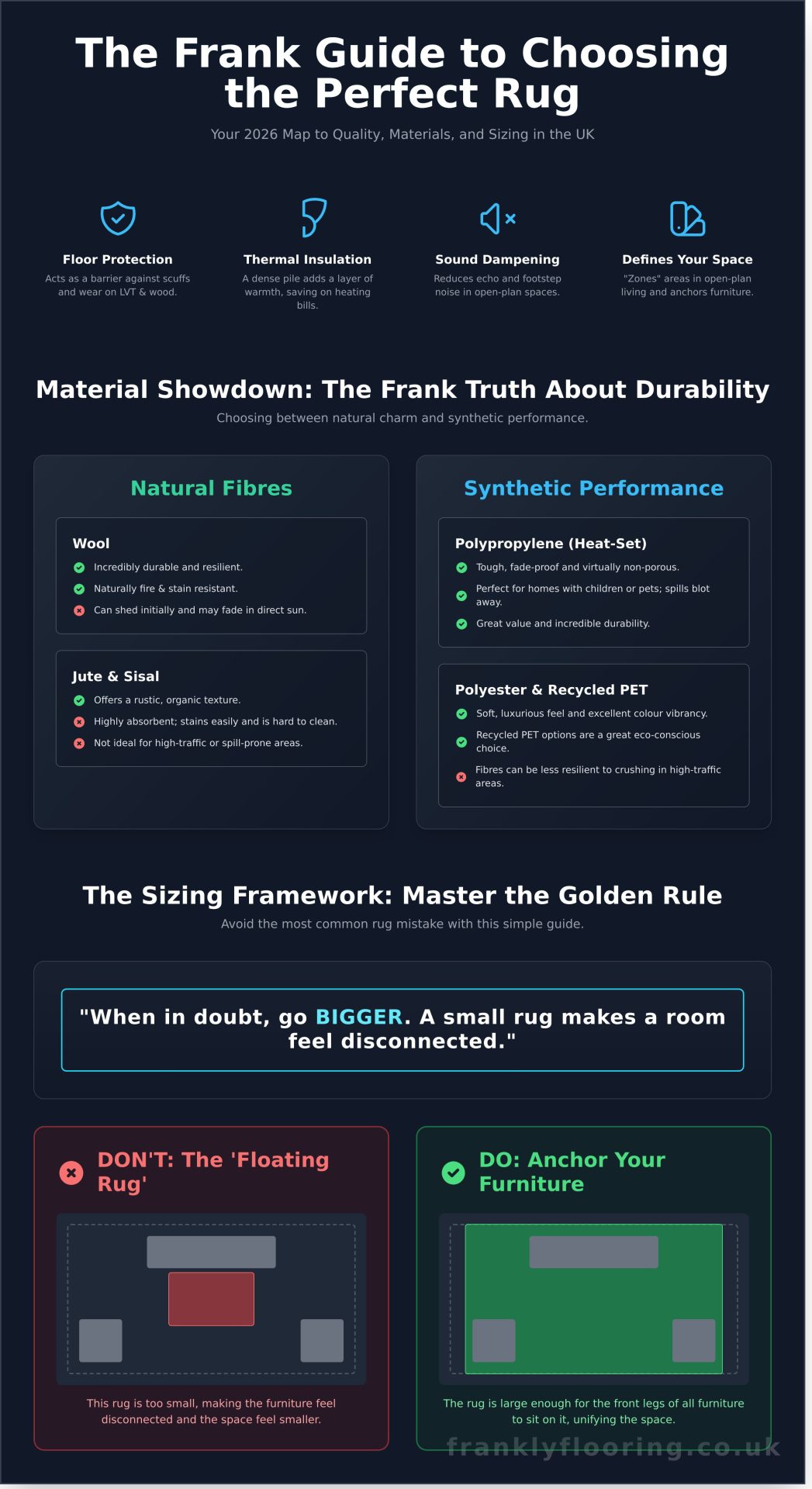
Beyond aesthetics, a rug is a practical investment in your home’s comfort and your floor’s longevity. More than just a decorative piece, a quality rug acts as a practical textile floor covering with several clear benefits. It offers a protective barrier for high-traffic areas, preventing scuffs and wear on popular flooring like LVT and engineered wood. In modern apartments and houses, its sound-dampening qualities can make a significant difference, reducing echo and footstep noise. Furthermore, a dense rug provides a tangible layer of thermal insulation, helping to keep rooms warmer and potentially trimming a little from your heating bills.
When you start your search for rugs UK, keeping these foundational roles in mind ensures you select a piece that not only looks right but works right, adding genuine value and comfort to your home.
Rug Materials Explained: The Frank Truth About Durability
Choosing the right rug involves more than just matching your curtains. The material underfoot dictates its lifespan, its feel, and, frankly, how it copes with the realities of a busy home. We often talk about the “stain-to-clean” ratio: how likely a spill is versus how easy it is to remove. Pile height is also a crucial factor, not just for comfort but for safety; a thick, loose-laid rug can become an environmental hazard in the homes of young children if not properly secured. A low pile is best for high-traffic hallways, while a deep, shaggy pile is a luxury saved for the bedroom.
Natural Fibres: Wool, Jute, and Sisal
Natural fibres bring an organic, timeless quality to a room. Wool is the gold standard for a reason; it’s incredibly durable, naturally fire-resistant, and its lanolin-coated fibres offer good initial stain resistance. It does have a tendency to shed at first and can fade over time in direct sunlight. Jute and sisal provide a wonderful rustic, coastal texture but are far less forgiving. Being highly absorbent plant fibres, they have a poor stain-to-clean ratio, making them a risky choice for anywhere spills might happen. Our frank advice is to avoid these in kitchens, dining rooms, or main living areas where they are likely to get marked.
Synthetic Performance: Polypropylene and Polyester
For the majority of modern rugs UK households need, synthetic fibres offer unbeatable performance. Modern “heat-set” polypropylene is a game-changer; it’s tough, completely fade-proof, and virtually non-porous. Spills sit on the surface, waiting to be blotted away, making it the perfect choice for homes with children or pets. Polyester offers a softer, more luxurious feel underfoot and holds colour beautifully, but its fibres can be less resilient to crushing in high-traffic zones. Finally, keep an eye on recycled PET rugs; made from plastic bottles, they are a growing eco-conscious trend offering a soft feel similar to polyester and a great story of sustainability.
The Sizing Framework: How to Measure for UK Homes
Choosing the right size rug can feel daunting, but we believe in a straightforward approach. Frankly, the single most important rule is this: when in doubt, go bigger. A rug that is too small for a space can make the entire room feel disconnected and undersized. This is particularly true in many UK homes where proportions can be unique. The goal is to anchor your furniture and define the space, not to have a small “island” of a rug floating in the middle of your floor.
Living Room Layouts and Rug Placement
In the living room, a well-sized rug unifies your seating area. There are three common placement strategies, and the best one depends on your room’s scale. The “front legs on” approach is often the most balanced and practical choice for our range of rugs uk homes favour.
- All Legs On: Requires a large rug (e.g., 200x300cm) where all your seating and tables sit completely on top. This creates a luxurious, cohesive feel in a spacious room.
- Front Legs On: The most popular method. The front legs of your sofa and armchairs rest on the edge of the rug (typically a 160x230cm size). It connects the furniture without overwhelming the room.
- Coffee Table Only: Best suited for smaller spaces or where you want to highlight your flooring. A 120x170cm rug can work well, but be careful to avoid the “floating” look.
Our honest advice? Before you commit, use masking tape to outline your potential rug’s dimensions on the floor. This simple trick allows you to visualise the scale and placement properly, ensuring a perfect fit.
Dining Room and Bedroom Sizing
The rules for dining rooms and bedrooms are more functional. For a dining area, the rug must be large enough so that when you pull a chair out to sit down, its legs remain on the rug. A good rule of thumb is to add at least 60cm to each side of your dining table’s measurements. This area demands durability, so a quality wool rug is an excellent investment; not only is it resilient, but wool is also a naturally sustainable fabric.
In the bedroom, a rug should provide a soft landing when you get out of bed. For a standard UK Double bed, a 160x230cm rug placed horizontally underneath the lower two-thirds of the bed works beautifully. For King or Super King sizes, a larger 200x300cm rug offers a more generous border. For narrow hallways or galleys, choose a runner that is 10-15cm narrower than the width of the hall, leaving a small border of floor visible on all sides. In high-spill zones like kitchens, a hard-wearing and washable runner is always a practical choice.
Beyond the tactile comfort of a soft rug, completing a bedroom’s relaxing atmosphere often involves other senses. To add a calming, natural fragrance, many homeowners turn to specialists in home scents. As an excellent example, the Michigan-based Lavender Life Company creates a wide range of products perfect for creating a peaceful sanctuary.
Floor Protection: Rug Grippers and Backing Myths
Frankly, one of the most common questions we hear is, “Will a new rug ruin my LVT or wood floor?” It’s a valid concern. You’ve invested in a beautiful floor, and the last thing you want is to damage it. The truth is, a rug itself won’t cause harm, but the wrong type of backing or a lack of protection certainly can. Some low-quality rubber or latex backings can react with the finish on vinyl and polyurethane-sealed wood, leading to permanent discolouration.
This is why a quality rug gripper is a non-negotiable accessory, not a mere upsell. It acts as a crucial protective barrier, preventing any chemical transfer while also stopping the rug from slipping or bunching. It’s a small investment to protect two much larger ones: your floor and your rug.
Choosing the Right Rug Gripper
Not all grippers are created equal, and the right choice depends entirely on the floor beneath. For hard surfaces like LVT, wood, or laminate, a solid pad with a felt surface and a natural rubber underside is ideal. It offers cushioning and a breathable, non-reactive barrier. For laying a rug over a carpet, a thinner, mesh-style gripper is more effective. It’s designed to grip the carpet pile below and the rug above, preventing the frustrating “walking” effect. Most importantly, a secure rug is a safe rug, significantly reducing trip hazards for toddlers and elderly family members.
Cleaning and Maintenance for Longevity
Proper maintenance ensures both your floor and the beautiful rugs UK homes deserve will last for years. To prevent “shadowing” or uneven fading on your subfloor from sunlight, we recommend rotating your rug 180 degrees every six to twelve months.
- Vacuuming: Let’s be frank. For high-pile or delicate wool rugs, disengage the beater bar on your vacuum and use suction only to avoid damaging the fibres. For durable, low-pile synthetic rugs, a beater bar can help lift dirt effectively.
- Dealing with Spills: The mantra is blot, don’t rub. Immediately blot any spill with a clean, dry cloth, working from the outside in. Rubbing only pushes the stain deeper into the pile.
- Professional Cleaning: For deep-set grime or a serious spill on a valuable piece, it’s time to call in the experts. A professional clean every few years can restore your rug’s vibrancy and extend its life significantly.
If you’re ever unsure about the best way to care for your flooring and rugs, we’re always here to provide straightforward, honest advice. You can browse our full collection and find more tips at franklyflooring.co.uk.
Buying Rugs Online: Why Frankly Flooring is Different
Buying a rug online can feel like a gamble. With countless retailers and confusing descriptions, it’s difficult to know what you’re truly getting. At Frankly Flooring, we approach things differently. With over two decades as flooring specialists, we bring a level of expertise to the world of rugs UK that you simply won’t find at a general home goods store.
Our collection isn’t a random assortment; it’s a carefully curated selection chosen to complement the styles and practical needs of British homes. We understand what textures work best on a period property’s wooden floor, what materials stand up to the demands of a busy family hallway, and what designs add the perfect finishing touch to a contemporary living room. We are completely transparent about sourcing and materials. No confusing jargon, just straightforward facts to help you make an informed decision.
We also understand the hesitation that comes with buying something so tactile without seeing it first. That’s why our delivery and returns policies are designed to be as clear and fair as possible. There are no hidden clauses or difficult processes-just a frank commitment to ensuring you’re completely happy with your choice.
Our Commitment to Quality
Every rug in our collection passes a simple test: would we be happy to have it in our own home? As a family-run business with a reputation built on quality, we stand behind our products. Our “No-Fluff” guarantee means the specifications you read are exactly what you get-accurate pile heights, precise material compositions, and honest descriptions. You’re not just buying a rug; you’re getting the support of a team that knows the industry inside out.
Next Steps: Find Your Perfect Rug
Ready to find the one? Our website makes it simple. Use the filters to narrow your search by size, colour, material, or style to quickly see the most suitable options. If you’re undecided, you can order samples for many of our ranges or contact our team directly for bespoke advice. We’re here to help you make the right choice, without the pressure. Take the first step today and browse our full range of Rugs UK.
Frankly: The Final Word on Finding Your Perfect Rug
Choosing the right rug doesn’t need to be a complex task. As we’ve covered, the path to the perfect piece is paved with understanding quality materials and mastering the simple framework for sizing in UK homes. When you focus on these fundamentals, you’re not just buying a rug; you’re making a long-term investment in the comfort and character of your space.
At Frankly Flooring, we cut through the noise to make that process straightforward. As a family-run business with over 20 years of flooring expertise, we stake our name on honest advice. We believe finding quality rugs uk should be a seamless experience, which is why we offer direct UK delivery and a transparent returns policy, ensuring you feel completely confident in your decision.
Ready to find a rug that truly completes your home? Shop our curated collection of Rugs UK and discover the difference that genuine care and expertise make. The perfect foundation for your room is waiting.
Frequently Asked Questions About Rugs
How do I stop my rug from sliding on a laminate floor?
Frankly, the most reliable solution is a quality non-slip rug underlay. For hard surfaces like laminate or LVT, we recommend an underlay with a rubberised grip. These are far superior to temporary tapes or sprays as they hold the rug firmly in place without leaving any sticky residue. Simply trim the underlay to be slightly smaller than your rug, place it on the clean floor, and lay your rug on top for a secure, cushioned finish.
Can I put a rug over a carpet, and does it need a gripper?
Yes, layering a rug over a carpet is an excellent way to add colour, texture, or define a specific zone within a room. We do advise using a gripper, but it must be one specifically designed for carpet-on-carpet use. These underlays have a unique texture that grips both the rug’s backing and the carpet pile below, preventing the rug from wrinkling, bunching, or ‘creeping’ across the floor with foot traffic. This ensures it stays looking neat and tidy.
Which rug material is best for high-traffic areas like hallways?
For high-traffic zones, durability is paramount. Wool is an outstanding natural choice; its fibres are incredibly resilient, spring back easily from crushing, and have a natural resistance to dirt. For a highly durable and more budget-friendly alternative, consider a synthetic material like polypropylene. It’s exceptionally hard-wearing, stain-resistant, and very easy to clean, making it a practical and long-lasting option for the busiest parts of your home.
Are wool rugs worth the extra money compared to synthetic ones?
In our professional opinion, a quality wool rug is a sound long-term investment. Wool’s natural durability, flame retardancy, and ability to repel stains mean it maintains its appearance for years, often outlasting synthetic alternatives. Its inherent elasticity helps it resist furniture marks and flattening. While the initial outlay is higher, the longevity and timeless appeal of a well-made wool rug often provide better value over its entire lifespan.
How do I get the creases out of a new rug that has been rolled up?
Creases from transport are common and usually easy to fix. The simplest method is to lay the rug flat and place heavy, flat items like large books on the affected areas for a day or two. Alternatively, you can try ‘reverse rolling’ the rug-rolling it up tightly in the opposite direction to how it was packaged and leaving it for 24 hours. This helps to gently stretch the fibres and backing back into their correct flat position.
What rug size do I need for a standard UK living room?
A good rule for a standard UK living room is to choose a rug that is large enough for the front legs of your sofa and armchairs to rest on it. This anchors the seating area and creates a cohesive look. Typically, sizes like 160x230cm or 200x290cm work perfectly for this. Before you buy, we always recommend measuring your space to ensure you select the best fit from our collection of rugs UK homeowners can trust for quality and style.
Do rugs cause discolouration on real wood or LVT floors?
A rug itself doesn’t cause discolouration, but it can contribute to two issues. Firstly, the floor area exposed to sunlight may lighten over time, creating a contrast with the protected area under the rug. Secondly, some low-quality rubber or latex backings can react with the floor’s finish. We always recommend using a high-quality, breathable felt or natural rubber underlay to create a protective barrier and prevent any chemical reactions with your wood or LVT.
Is it better to buy a rug with a fringe or without?
This decision comes down to a balance of aesthetics and practicality. A fringe can add a traditional or bohemian detail that beautifully finishes a rug’s design. However, fringes can be a magnet for dirt and may get tangled in a vacuum cleaner. A rug without a fringe, often called a ‘bound’ or ‘serged’ edge, offers a cleaner, more contemporary look and is generally easier to maintain, making it a more practical choice for busy households.