
Let’s be frank: choosing a bathroom floor is usually a battle between style and survival. You want the organic warmth of wood or the elegance of stone, but you’re rightly worried about steam, splashes, and the nightmare of moisture seeping into your subfloor. Choosing waterproof lvt for bathrooms shouldn’t be a gamble based on confusing jargon like SPC or WPC, nor should it leave you with a floor that looks like cheap plastic once it’s actually fitted.
At Frankly Flooring, we believe in a more straightforward approach. In this guide, we’ll cut through the showroom fluff to help you find a floor that handles puddles with ease and feels reassuringly warm underfoot on a cold British morning. We will explore how to achieve a high-end finish that fits seamlessly around pedestals and toilets, ensuring your investment is as durable as it is beautiful. From understanding core materials to avoiding unnecessary markups, here is everything you need to know to choose a floor that looks the part and stands the test of time.
Key Takeaways
- Understand why LVT is a warmer, more cost-effective alternative to ceramic tiles while being significantly quicker for a professional to fit.
- Discover why Stone Plastic Composite (SPC) is now considered the gold standard for UK bathrooms compared to traditional WPC cores.
- Learn the frank truth about the pros and cons of click-lock versus glue-down installation for long-term performance in wet environments.
- Identify the essential safety standards you need, including why an R10 slip rating is the honest minimum for any family bathroom.
- Master the process of ordering waterproof lvt for bathrooms online, from using samples to correctly calculating the 10% wastage rule for awkward layouts.
Why Waterproof LVT is the Honest Choice for Modern Bathrooms
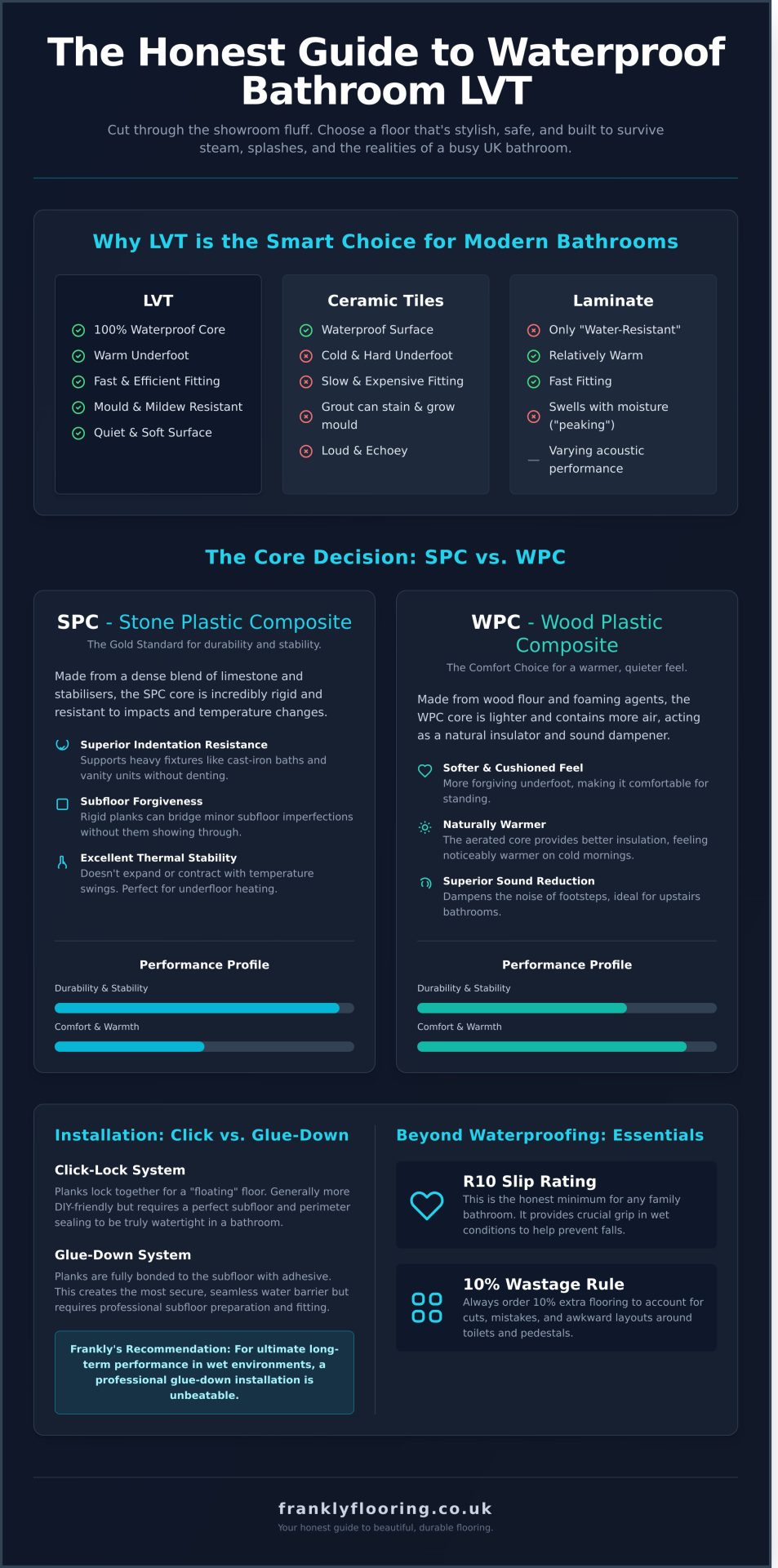
When you are looking for waterproof lvt for bathrooms, it is important to understand exactly what you are putting underfoot. Luxury Vinyl Tile (LVT) isn’t just a fancy name for the thin, sheet “lino” of the past. It is a high-performance, multi-layered flooring solution designed specifically to handle the unique stresses of a high-moisture environment. While the history of Vinyl composition tile shows how far synthetic flooring has come, modern LVT is a far more robust product, consisting of a rigid core, a high-definition design layer, and a tough wear layer.
Frankly, many homeowners default to ceramic tiles because they assume they are the only “safe” option. However, tiles are often cold, expensive to buy, and time-consuming to fit. LVT offers a much faster fitting process and a naturally warmer surface. When we say LVT is 100% waterproof, we mean the material itself will not swell or degrade when submerged. However, honesty is our policy: while the planks are waterproof, your subfloor still needs professional preparation to ensure no moisture is trapped beneath the surface during the fitting process.
LVT vs. Laminate: Why “Water-Resistant” Isn’t Enough
In a busy family bathroom, “water-resistant” is often a recipe for disaster. Most laminate floors use a high-density fibreboard (HDF) core made of compressed wood. If water sits in the joints-which it inevitably does after a splashy bath time-the wood fibres soak it up and swell, causing the floor to “peak” or blow. Waterproof lvt for bathrooms uses a PVC or stone-polymer core that is entirely impervious to water. It won’t fail, even if the kids turn the floor into a temporary pond.
The Benefits of LVT in a Humid Environment
Beyond just resisting splashes, LVT excels in the humid atmosphere of a British bathroom. Its non-porous surface naturally resists the growth of mould and mildew in damp corners. It also offers superior temperature stability; unlike natural stone or ceramic, which can crack if the room temperature fluctuates rapidly when the heating kicks in, LVT remains flexible. Finally, there is the acoustic benefit. LVT is significantly softer than tile, reducing the “echo” effect and making those early morning routines a little quieter for the rest of the household.
SPC vs. WPC: Understanding the Core of Waterproof LVT
To choose the right waterproof lvt for bathrooms, you must look beneath the decorative surface. The performance of your floor depends almost entirely on its core construction. Generally, you will choose between two technologies: Stone Plastic Composite (SPC) and Wood Plastic Composite (WPC). While both are 100% waterproof, they offer different benefits depending on the layout and usage of your home.
SPC is a dense, rigid material made from a blend of limestone and stabilisers. WPC, on the other hand, uses wood flour and foaming agents to create a lighter, aerated core. According to the Resilient Floor Covering Institute, these core advancements are what allow resilient flooring to maintain its integrity in high-moisture environments. Regardless of the core, a high-quality wear layer sits on top, acting as a transparent shield that prevents water ingress and protects the design from stains and scratches.
Why SPC Wins in Bathrooms
For most UK homeowners, SPC is becoming the “Gold Standard” for bathroom fitting. Its primary advantage is its incredible rigidity and dimensional stability. Bathrooms are subject to frequent temperature swings-think of the steam from a hot shower followed by a cold draught. SPC remains stable and won’t expand or contract like lesser materials.
- Indentation Resistance: Because the core is stone-based, it can support heavy fixtures like cast-iron baths or bespoke vanity units without denting.
- Subfloor Forgiveness: The rigid nature of SPC means it can often be fitted over minor subfloor imperfections without them “telegraphing” through to the surface.
- Direct Heat: It is exceptionally efficient when paired with underfloor heating systems.
WPC: The Softer, Warmer Alternative
Frankly, if your priority is comfort underfoot, WPC is worth considering. Because the core is foamed, it contains more air, which acts as a natural insulator. This makes the floor feel noticeably warmer and more “cushioned” than SPC-a welcome feature on a cold January morning.
While it is slightly less resistant to heavy impacts, WPC is an excellent choice for upstairs bathrooms. The aerated core provides superior sound reduction, helping to dampen the noise of footsteps or running water. It offers a more forgiving feel while still providing the essential benefits of waterproof lvt for bathrooms, ensuring your floor remains beautiful and functional for years to come.
Click-Lock or Glue-Down? The Frank Truth About Bathroom Installation
Choosing the right fitting method is just as vital as the style of the plank itself. When you are looking at waterproof lvt for bathrooms, you will generally be presented with two distinct options: Click-Lock (floating) or Glue-Down (dry back). To be perfectly frank, neither is “better” in a vacuum; the right choice depends entirely on your subfloor, your budget, and who is actually doing the work.
Regardless of the system you choose, the golden rule for any wet room is the perimeter seal. You must use a high-quality bathroom-grade silicone around the edges. Without it, water can seep under the skirting boards and sit beneath your floor, which is a recipe for trouble no matter how waterproof the LVT is.
Click LVT: The DIY Favourite
Click-lock LVT is the go-to for homeowners who want a straightforward, “no-mess” transformation. Because the planks click together without the need for adhesive, the fitting process is remarkably fast. If you have a rigid core system, you can often lay it directly over existing tiles, provided they are level. However, there are trade-offs:
- Expansion Gaps: These floors require a gap around the edge to allow for natural movement. If not sealed correctly, standing water can find its way into these gaps.
- The “Bounce” Factor: If your subfloor isn’t perfectly flat, a floating floor can sometimes feel slightly hollow underfoot.
Glue-Down LVT: The Bulletproof Option
Most professional fitters will tell you that glue-down is the superior choice for a high-traffic bathroom. By permanently bonding each tile to the subfloor, you eliminate any risk of the floor shifting or lifting over time. This method also allows for bespoke designs, such as a classic herringbone pattern fitted tightly around a pedestal sink or a freestanding bath.
Of course, fitting flooring perfectly around fixtures like a pedestal sink or a freestanding bath often means they need to be temporarily disconnected and reinstalled. This is a job for a qualified plumber, and it’s worth coordinating with one to ensure a professional finish. For an example of a local service that handles these kinds of residential tasks, see norwich-plumbing.co.uk.
The catch? Subfloor preparation. Glue-down LVT is thin and flexible, meaning it will telegraph every minor lump or bump in the floor beneath it. It requires a “glass-smooth” finish, usually achieved with marine-grade plywood or a fresh layer of smoothing compound. While it’s more labour-intensive, it results in a seamless finish that is incredibly easy to maintain.
Safety should also be a primary concern when choosing your waterproof lvt for bathrooms. We always advise checking the slip resistance of your chosen product. Organizations like the National Floor Safety Institute provide extensive research into floor safety, reminding us that a floor’s performance when wet is just as important as its aesthetic appeal. A professional fit ensures that these safety properties remain consistent across the entire surface.
Beyond Waterproofing: Slip Ratings and Underfloor Heating
When selecting waterproof lvt for bathrooms, it is a mistake to focus solely on how the floor handles water from below. You must also consider how it handles water on the surface. To be frank, a floor that is 100% waterproof is of little use if it becomes a skating rink the moment you step out of the shower. Beyond the core construction, safety and comfort are the two pillars of a successful bathroom fitting.
Safety First: Navigating Slip Resistance
In the flooring industry, we measure grip using the “R-Rating” system. While ratings range from R9 to R13, we recommend an R10 rating as the absolute minimum for any domestic bathroom. This ensures the plank has enough surface friction to provide stability underfoot when damp.
- Dry vs. Wet Slip: Most standard tests measure “dry slip,” but in a bathroom, “wet slip” (the grip provided when the floor is saturated) is what truly matters.
- Textured Finishes: We suggest looking for Embossed-in-Register (EIR) finishes. This manufacturing process matches the surface texture to the visual grain of the wood or stone, providing a more natural feel and significantly better physical grip than smooth planks.
- Wet Rooms: If you are fitting a dedicated wet room rather than a standard family bathroom, you should consider moving up to an R11 rating for added peace of mind.
Staying Cosy: LVT and Underfloor Heating
One of the reasons many homeowners are moving away from traditional tiles is the temperature. Ceramic and stone are notoriously cold, whereas LVT is naturally warmer to the touch. This is due to its thermal conductivity; it doesn’t draw heat away from your feet as quickly as stone does. However, for those seeking ultimate luxury, waterproof lvt for bathrooms is an exceptional partner for modern underfloor heating (UFH) systems.
LVT is thin and highly conductive, meaning it allows heat to transfer into the room far more efficiently than thick timber. It is perfectly compatible with both “wet” (water-based) and “dry” (electric wire) systems. Ensuring your heating source is up to the task is a crucial part of the project; for those with water-based systems, you can explore Boiler Repair & Installation options to support the new setup. To ensure a quality, long-lasting finish with the flooring itself, there are two straightforward rules to follow:
- Temperature Limits: Most LVT manufacturers specify a maximum surface temperature of 27°C. Modern UFH thermostats make this very easy to regulate, preventing any risk of the planks warping.
- The Correct Underlay: You must use a high-density, low-tog underlay specifically designed for UFH. This ensures the heat isn’t “trapped” beneath the floor, which can lead to wasted energy and potential damage.
If you are unsure which slip rating or underlay is right for your project, the team at Frankly Flooring is always available to provide honest, expert advice to ensure your bathroom is as safe as it is stylish.
Buying Bathroom LVT Online: How to Get it Right First Time
Buying waterproof lvt for bathrooms online shouldn’t be a gamble. While big-box retailers offer convenience, they often lack the technical depth required for wet-room environments. At Frankly Flooring, we believe in a direct approach: start by ordering samples. Screen resolutions can be misleading; your bathroom’s specific lighting-whether cool LEDs or natural window light-will drastically change how a plank looks in situ.
Measuring Your Bathroom Like a Pro
Bathrooms are notoriously awkward spaces. Between pedestals, shower trays, and alcoves, a simple “length times width” calculation usually falls short. We recommend measuring to the widest points of the room and accounting for the 10% wastage rule. This extra margin is essential for intricate cuts around pipes and ensures you have spare planks from the same batch for any future repairs. Don’t forget to factor in door bars and transitions where the LVT meets your hallway or bedroom flooring.
The Frankly Checklist for Bathroom LVT
To ensure your floor stands the test of time, run through this straightforward checklist before clicking “buy”:
- Check 1: Is it 100% waterproof? “Water-resistant” is not enough; you need a product that will not swell if a bath overflows.
- Check 2: Does it have a minimum 0.3mm wear layer? This is the benchmark for durable residential use.
- Check 3: Is the slip rating R10 or higher? Safety is paramount in a splash zone.
- Check 4: Do you have the correct waterproof adhesive or a suitable integrated underlay?
Finally, always scrutinise the warranty. A specialist like Frankly Flooring provides honest advice on the difference between “Lifetime Residential” and “Commercial” ratings, ensuring your waterproof lvt for bathrooms is actually fit for purpose. Unlike general DIY stores, we prioritise the quality of the fitting and the long-term integrity of the material over a quick sale. We handle the technicalities so you can focus on the finish.
Ready to transform your space? Explore our range at Frankly Flooring for expert advice and transparent, no-nonsense pricing.
Making a Frank Choice for Your Bathroom Floor
Choosing the right waterproof lvt for bathrooms shouldn’t feel like a gamble. As we’ve explored, whether you opt for the rigid durability of SPC or the slightly cushioned feel of WPC, the key is matching the material to how your household actually lives. From ensuring you have the correct slip rating for a wet environment to deciding between a straightforward click-lock fitting or a permanent glue-down finish, getting these functional details right now prevents expensive headaches later.
At Frankly Flooring, we believe in keeping things simple and transparent. We are a family-run business with over 20 years of expertise, and we’re here to offer the same frank, honest advice we’d give our own neighbours. We don’t do high-pressure sales; we just provide quality floors that are built to last. To help you make the right decision for your home, we offer free samples delivered to your door so you can see the craftsmanship for yourself.
Browse our hand-picked range of Waterproof Bathroom LVT
With the practical elements sorted, you can focus on the finishing touches that make a bathroom a personal retreat. For a touch of affordable luxury, you might want to explore Inspired Perfumes for Women to complete the new ambiance.
Take your time, weigh up the options, and when you’re ready, we’re here to help you get the job done right.
Frequently Asked Questions
Is LVT flooring really 100% waterproof for bathrooms?
Frankly, yes. The material itself is 100% synthetic, meaning it won’t swell, warp, or rot like laminate or real wood when exposed to moisture. However, it’s vital to remember that while the planks are waterproof, your subfloor isn’t. Professional fitting ensures seams are tight, but you should still mop up standing water to keep your home healthy. It remains the most reliable choice for splash-heavy environments.
Can I lay LVT directly over my old bathroom tiles?
You can, but we wouldn’t usually recommend it if you want a perfect finish. To achieve a seamless, professional result, the subfloor needs to be level. If you lay LVT over old tiles, the grout lines can eventually “telegraph” through, leaving visible indentations on your new surface. For a long-lasting result, we suggest removing the tiles or using a smoothing compound to create a flat base.
Is LVT slippery when wet, especially for children?
Safety is a priority, especially in family homes. Most LVT products come with an R10 slip-resistance rating, making them much safer underfoot than polished ceramic or natural stone. While no floor is entirely slip-proof when soaking wet, the textured wear layer on LVT provides much-needed grip for little feet, offering a practical and reassuring solution for busy family bathrooms where splashes are inevitable.
Do I need a special underlay for bathroom LVT?
It depends on the specific product. If you are fitting click-system LVT, a high-density, moisture-resistant underlay is often required to support the joints. However, for glue-down LVT, the planks are bonded directly to a prepared subfloor, so no underlay is used. We will always give you a straightforward recommendation based on your chosen material to ensure the best performance and longevity for your floor.
How do I clean and maintain LVT in a bathroom to prevent water marks?
Maintaining waterproof lvt for bathrooms is remarkably straightforward. A quick sweep followed by a damp mop using a pH-neutral floor cleaner is all it takes to keep it looking new. Avoid harsh bleach or abrasive scrubbers, as these can dull the protective wear layer. Because the surface is non-porous, water marks aren’t usually an issue if you use a well-wrung mop and allow the floor to air dry. For those managing specific health concerns where home hygiene is paramount, specialist at-home testing kits are also available from providers like mrsatest.co.uk.
Can LVT be used in a walk-in shower or wet room?
While LVT is excellent for bathroom floors, we advise against using it inside the actual shower tray area or on a dedicated wet room floor. These specific zones require specialist drainage gradients and tanking systems that LVT isn’t designed to accommodate. However, it is the perfect, honest choice for the rest of the room, providing a warm and stylish transition right up to the shower edge.
How much does it cost to floor a standard UK bathroom with LVT?
Transparency on pricing is part of our service. For a standard UK bathroom (roughly 4-5m²), you can expect to pay between £30 and £60 per square metre for quality LVT. When you factor in professional fitting and essential subfloor preparation, a typical project usually ranges from £400 to £800. This investment ensures a bespoke finish that is far more durable than cheaper lino alternatives.
Will the weight of a roll-top bath damage LVT flooring?
A heavy roll-top bath is no problem for LVT, provided you choose the right installation method. We typically recommend glue-down LVT for bathrooms with heavy, fixed features. Because the planks are bonded to the subfloor, they won’t shift or buckle under the weight. If using a click system, the subfloor must be perfectly flat to prevent the joints from stressing under the pressure of the bath’s feet.