
Why would you pay upwards of £95 per square metre for a floor that feels like an ice block underfoot as soon as the British clocks go back? Most of us appreciate the timeless appeal of a slate or marble finish, but the practical reality of natural stone often includes cracked tiles and grout lines that lose their lustre within 12 months of use. It’s a high price to pay for a surface that requires constant maintenance and a pair of thick woollen socks just to walk to the kettle on a January morning.
We agree that your home deserves a premium look, but it shouldn’t come at the cost of your comfort or your bank balance. In this guide, we’ll show you how stone effect lvt flooring provides the sophisticated appearance of real masonry with the warmth and durability your family actually needs. We’ll explain exactly how to achieve a waterproof, easy-to-clean finish that stands up to daily life, covering everything from selecting the right wear layer to the final sweep-up after the fitting is complete.
Key Takeaways
- Understand why stone effect lvt flooring is becoming the preferred choice over traditional ceramic tiles for British homeowners seeking warmth and durability.
- Learn how the 100% waterproof construction and protective wear layers make this flooring an ideal, low-maintenance solution for busy kitchens and pet-friendly homes.
- Discover how to select the right stone texture-from industrial concrete to classic marble-to complement your cabinetry and enhance your room’s sense of space.
- Get the frank truth on why professional subfloor preparation is the most critical step for a flawless, long-lasting finish.
- Find out how to use our sample service to see how different stone textures and tones interact with the specific lighting in your own home.
The Timeless Appeal of Stone Floors Without the Compromise
Choosing a floor for your home often feels like a tug-of-war between aesthetics and practicality. Natural stone has always been the gold standard for elegance, yet its high price tag and demanding nature make it a difficult choice for many. This is where stone effect lvt flooring steps in. It’s a sophisticated, multi-layered product that uses high-definition photographic layers to replicate the exact textures and mineral patterns of slate, marble, or limestone. Unlike the basic vinyl of the 1990s, modern Luxury Vinyl Tile (LVT) offers a depth of detail that makes it indistinguishable from the real thing once it’s underfoot.
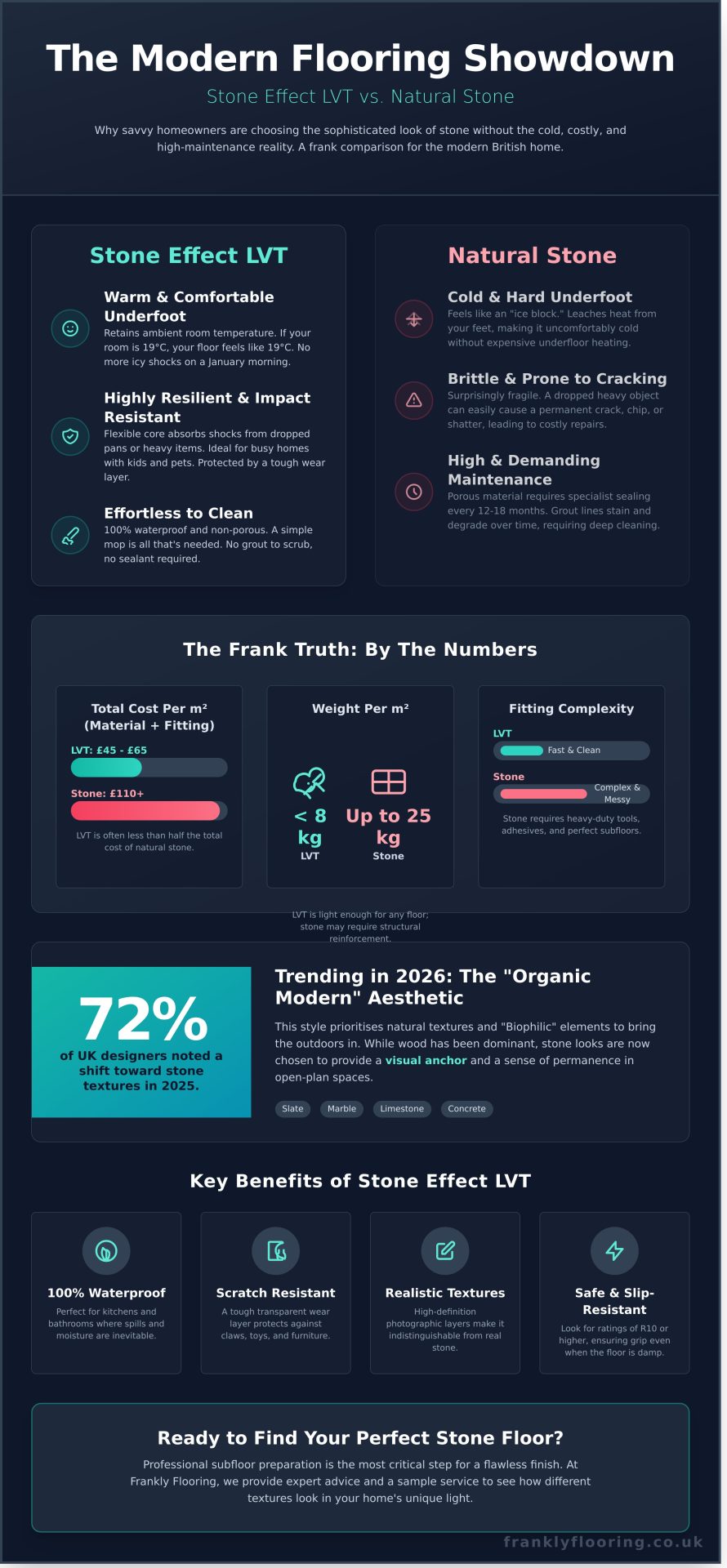
British homeowners are increasingly turning away from traditional ceramic and porcelain tiles. The reason is simple: ceramics are unforgivingly cold. In a climate where the average outdoor temperature in the UK hovers around 10°C, walking on a stone floor in January can be an unpleasant shock. LVT provides superior thermal comfort because it retains the ambient temperature of the room. It doesn’t leech heat from your feet. If your kitchen is 19°C, your floor will feel like 19°C. It’s a straightforward benefit that makes a massive difference to daily comfort without needing to crank up the underfloor heating.
Durability is another area where we need to be frank. Natural stone is surprisingly brittle. If you drop a heavy cast-iron pan on a travertine tile, you’re likely looking at a permanent crack or a costly chip. LVT is engineered with a robust wear layer and a flexible core that offers high impact resistance. It absorbs the shock rather than shattering. For a busy household with kids, pets, or the occasional dropped dinner plate, this resilience is a foundational requirement that natural materials simply can’t match.
LVT vs. Natural Stone: A Frank Comparison
Weight is a factor that many people overlook until the fitting begins. Real stone can weigh up to 25kg per square metre, which often requires structural reinforcement for upstairs bathrooms or bedrooms. LVT typically weighs less than 8kg per square metre, making it a seamless choice for any floor in the house. Maintenance is equally different. Natural stone requires specialist sealing every 12 to 18 months to prevent staining. With stone effect lvt flooring, you can bin the sealants and the grout scrubbers. A quick mop is all it takes to keep it looking pristine.
- Material Cost: Real slate or marble often starts at £60 per square metre; quality LVT averages £25 to £45.
- Fitting Complexity: Stone requires heavy-duty adhesive and diamond-blade cutting, pushing fitting costs to £50 per square metre. LVT fitting is faster and cleaner, usually costing around £20 per square metre.
- Structure: LVT can be laid over most existing subfloors with minimal preparation, whereas stone requires a perfectly level, rigid base to prevent cracking.
Why Stone Looks Are Trending in 2026
As we move into 2026, the UK interior design scene is dominated by the “Organic Modern” aesthetic. This style prioritises natural textures and “Biophilic” elements that bring the outdoors in. While wood has been the go-to for years, 72% of designers surveyed in early 2025 noted a shift toward stone textures to provide a visual anchor in open-plan living spaces. Stone looks offer a sense of permanence and architectural weight that wood sometimes lacks. It creates a clean, sophisticated backdrop that works perfectly with the neutral palettes and raw materials currently favoured in British homes.
Understanding the Benefits of Stone Effect Luxury Vinyl
Frankly, choosing a floor is about more than just looks. You need something that stands up to the chaos of a busy British home. Stone effect lvt flooring provides a practical solution that real limestone or slate simply cannot match. One of the biggest draws is its 100% waterproof nature. In a kitchen or utility room, where a burst pipe or a spilled drink is a matter of “when” not “if,” this moisture resistance is the gold standard. Unlike natural stone, which can be porous and prone to staining, vinyl remains completely impervious to liquids.
The surface of these planks and tiles is guarded by a transparent wear layer. This isn’t just a thin coating; it’s a hard-wearing shield that prevents scratches from pet claws and the dragging of heavy furniture. Industry experts often highlight the various advantages of LVT, particularly its multi-layered construction that balances comfort with extreme resilience. For families with young children or elderly residents, safety is a priority. We look for slip resistance ratings of R10 or higher, ensuring the floor provides enough grip even when damp.
Sound reduction is another area where LVT excels. Traditional stone or ceramic tiles can create an echo chamber, amplifying the “click-clack” of footsteps or the sound of dropped objects. High-quality LVT often includes an integrated underlay or a dense core that can reduce impact noise by up to 19dB. It makes for a much quieter, calmer home environment.
Warmth and Underfloor Heating Compatibility
Natural stone is notoriously cold, often reaching temperatures as low as 10°C in a typical British winter. Vinyl has much higher thermal conductivity, meaning it feels warmer to the touch. It’s the perfect partner for underfloor heating (UFH) systems. LVT transfers heat efficiently at a rate of approximately 0.012 m²K/W, allowing the room to reach its target temperature quickly. This efficiency helps maintain steady room temperatures and can reduce energy waste. Beyond the heat, there’s a physical “softness” to the material that makes standing at the kitchen counter for long periods much more comfortable on your joints than hard porcelain.
Durability in High-Traffic Zones
The longevity of your floor depends heavily on the thickness of the wear layer. For a quiet bedroom, a 0.3mm wear layer is sufficient. However, for hallways and kitchens, we always recommend a 0.55mm layer. This extra thickness is what allows a quality stone LVT to last 20 to 25 years without showing significant signs of age. It’s also incredibly stain-resistant. Whether it’s red wine, dried mud from a walk, or greasy kitchen spills, a simple mop with a pH-neutral cleaner is usually all that’s required. If you’re looking for a floor that won’t require a specialist restoration team every five years, you can explore our range of stone effect LVT options to find a fit that lasts.
- 0.3mm Wear Layer: Ideal for light domestic use and low-traffic rooms.
- 0.55mm Wear Layer: Recommended for busy hallways and commercial settings.
- Stain Resistance: Protective coatings prevent deep penetration of household chemicals.
- Longevity: Expected lifespan of 20+ years when fitted correctly on a level subfloor.
Choosing Your Style: From Industrial Concrete to Classic Marble
Choosing the right stone effect lvt flooring requires a look beyond the surface aesthetics. You need to consider how the format affects your room’s dimensions. Larger tiles, typically 600mm x 600mm or even 900mm in length, create a sense of expansive space by minimising the visual break of grout lines. Light-coloured stones like cream limestone can reflect up to 30% more natural light than dark slate. This is a practical win for narrow British hallways or kitchens with limited window space. If you’re matching floors to kitchen units, follow a simple rule of contrast. Dark navy or forest green cabinets pop against pale grey stone, while oak kitchens benefit from the warmth of a sandstone effect.
Texture plays a massive role in both safety and maintenance. A riven texture mimics the natural cleft of real stone, providing extra grip in a wet boot room. Conversely, a smooth, honed finish is easier to mop but might show every footprint. According to the Resilient Floor Covering Institute, high-quality resilient flooring must meet specific standards for durability and performance, ensuring your choice is as safe as it is stylish. For busy households with pets or children, multi-tonal stones are the smartest choice. A floor with varied flecks of charcoal, tan, and grey will hide dried mud and dust much better than a solid, dark black tile.
Slate and Limestone: For Traditional and Rustic Homes
Slate effects bring a rugged, farmhouse character to a home. We often recommend multi-tonal slate for kitchens because the natural colour variations hide daily wear. If you prefer a softer look, limestone and sandstone effects offer a Mediterranean warmth. These lighter tones work well in south-facing rooms where the sun can highlight the subtle, sandy textures. They’re a brilliant way to add depth to a utility room or a busy boot room without making the space feel cramped or dark.
Concrete and Cement: The Industrial Edge
You can achieve a polished concrete look without the £100 per square metre price tag or the inevitable cracking of the real thing. Grey stone effect lvt flooring in a concrete finish has become the go-to neutral for modern UK flats. It provides a clean, minimalist backdrop that allows metal light fixtures and reclaimed wood furniture to stand out. It’s a functional choice that feels architectural rather than industrial, especially when fitted with a colour-matched grout strip to create a poured-floor effect. This look has seen a 25% increase in specification for open-plan living areas since 2022.
Marble and Terrazzo: Luxury and Playfulness
Marble effect LVT brings high-end glamour to bathrooms and en-suites without the slipperiness or coldness of real stone. It’s a practical way to get that boutique hotel feel while maintaining a 0.55mm wear layer for long-term protection. Terrazzo is also seeing a rise in popularity, offering a playful mix of colour flecks that adds personality to a laundry room or small bathroom. Using large-format tiles in these patterns creates a seamless, high-end finish that’s incredibly easy to keep clean. Because the material is warmer underfoot than ceramic, it’s a much more comfortable choice for rooms where you’re often barefoot.
The Frank Truth About Fitting Stone Effect LVT
Let’s be honest: even the most expensive stone effect lvt flooring will look like a budget DIY job if the preparation is rushed. The secret to a floor that lasts 20 years instead of two isn’t the price of the tile, but what happens before the first piece is laid. At Frankly Flooring, we see many homeowners underestimate the technical side of fitting. Replicating the heavy, solid feel of natural slate or marble takes more than just a steady hand; it takes a perfect foundation.
Installation is 80% preparation and 20% laying the actual tiles. If you try to skip the hard work in the beginning, the material will eventually show every flaw beneath it. We believe in getting it right the first time so you aren’t calling us back in six months to fix a buckling floor.
The Importance of a Level Subfloor
A subfloor must be flat to within 3mm over a 2-metre radius to meet British Standard BS 8203. If your floor has dips or peaks beyond this, you’ll experience “telegraphing.” This is when every tiny bump or grit particle on the concrete eventually shows through the surface of your LVT. For timber floors, we always use 6mm SP101 flooring grade plywood fixed at 100mm centres to create a stable base. For concrete, a high-quality self-levelling compound is non-negotiable. We also insist on moisture testing with a hygrometer. If the reading is above 75% Relative Humidity, you need a liquid damp-proof membrane to prevent the adhesive from failing and the floor from lifting.
Glue-Down vs. Rigid Core Click
Choosing the right format for your stone effect lvt flooring depends on your room and your budget. Glue-down tiles are the professional choice for bespoke patterns, such as herringbone or border work. They’re usually 2.5mm thick and offer a permanent bond that handles temperature fluctuations well. Rigid Core (SPC) is the alternative. It’s thicker, often 5.5mm to 7mm, and features a click-lock system. It’s more forgiving on slightly uneven floors and often comes with an integrated underlay. This can save you the £5 to £8 per square metre cost of a separate acoustic layer, making it a popular choice for quick renovations.
Acclimatisation is another area where shortcuts lead to failure. Your flooring needs 48 hours to settle into the specific temperature of your home, which should be maintained between 18°C and 22°C. Skipping this step means the tiles might shrink or grow once they’re fitted. You also need to factor in expansion gaps. A 5mm to 10mm gap around the edges, hidden by your skirting boards or scotia, allows the floor to breathe. Without it, a large room of LVT can buckle as the temperature rises, ruining the flat finish you’ve worked hard to achieve.
Fitting stone-look tiles requires a different eye than wood planks. You need to consider the grout effect lines and the “stagger” of the tiles to ensure the stone pattern looks authentic rather than repetitive. It’s a meticulous process that rewards patience with a floor that’s indistinguishable from the real thing.
If you want a finish that stands the test of time, book a professional survey to check your subfloor conditions today.
Finding Your Perfect Stone Floor at Frankly Flooring
Choosing the right stone effect lvt flooring involves more than just picking a colour from a screen. It requires a partner who values your home as much as you do. For over 20 years, our family-run team has provided homeowners across the UK with honest, expert advice that cuts through the marketing fluff. We operate from our heritage base in Coleford, but our reach is national. Whether you are in the Highlands or the heart of London, we deliver your chosen floor directly to your door with the same care we would give a neighbour. We don’t just ship boxes; we deliver the foundation of your room’s new character.
We believe in being refreshingly direct. If a specific stone texture won’t work with your existing subfloor or your specific lifestyle needs, we’ll tell you. We don’t use high-pressure sales tactics because we know our products and our two decades of expertise speak for themselves. This straightforward approach has been the foundation of Frankly Flooring since we started. We are here to ensure your renovation is built on quality and longevity, rather than a quick sale. Our goal is for you to feel like you are in safe, capable hands from the moment you browse our site to the final sweep-up after fitting.
Ordering Samples and Measuring Up
A stone tile that looks cool and grey in a showroom might feel surprisingly warm in a south-facing kitchen. Lighting is the most significant factor in how your floor appears once it’s down. Modern LED bulbs with a 3000K warm rating will pull out different tones than natural 5000K afternoon sunlight. This is why our sample service is vital for your project. We encourage you to place samples in various corners of your room to see how the textures and hues react to your specific environment throughout the day. It’s the only way to be 100% sure of your choice.
Accuracy during the planning stage prevents costly delays and unnecessary stress. When you measure your room, calculate the total square meterage by multiplying the maximum length by the maximum width. For stone effect lvt flooring, you should typically add a 10% wastage factor to your final order. This extra material accounts for the intricate cuts needed around doorways, alcoves, and the specific alignment of tile patterns. Having that extra box on hand is much better than running short during the final stages of fitting, especially when trying to maintain a seamless pattern across a large open-plan space.
Next Steps for Your Home Renovation
Your journey to a new floor doesn’t have to be complicated or overwhelming. We have carefully curated our stone LVT collection to include only the most durable and realistic designs currently on the market. Every product we stock meets our high standards for wear layers and aesthetic depth. If you feel stuck or unsure about which technical specification suits your hallway or bathroom, just get in touch. We pride ourselves on having a frank chat about your project requirements, budget, and lifestyle to find the perfect match.
Ready to transform your space with a floor that combines timeless style with modern durability? You can browse our full selection online or speak with one of our experts today. We will handle the logistics from our Coleford warehouse to your front door so you can focus on the design of your home.
Bring the Luxury of Stone Into Your Home Today
Choosing a new floor is a significant investment, but it doesn’t need to be a stressful one. You now understand how stone effect lvt flooring provides the sophisticated appearance of materials like Italian marble or polished concrete while remaining warm underfoot and easy to clean. We’ve covered the frank reality of fitting, emphasizing that a flat subfloor is the foundation of a professional finish. At Frankly Flooring, we draw on 20 years of experience as a family-run business to ensure you get the right product without the typical retail fluff.
We’re committed to a straightforward process from start to finish. You can order free samples today to test our textures against your furniture. Our team provides honest, no-nonsense UK delivery, so you aren’t left guessing when your project can begin. We take pride in being the reliable experts you can trust with your home’s transformation. Browse our Stone Effect LVT collection for a frank deal and start planning a space that looks incredible and works for your lifestyle.
Frequently Asked Questions
Is stone effect LVT better than real stone for a kitchen?
Frankly, stone effect LVT is often the superior choice for a modern kitchen because it’s warmer underfoot and won’t crack if you drop a heavy pan. Real stone is porous and requires sealing every 12 to 24 months to prevent permanent staining. LVT provides a 100% waterproof surface that handles spills without drama. It’s also about 50% cheaper to fit than heavy limestone or slate tiles.
Do I need a specialist fitter for stone effect LVT?
You should always use a specialist fitter to ensure your subfloor is perfectly level. While DIY is possible, 90% of flooring failures stem from poor subfloor preparation. A professional will use a moisture meter to check for dampness before laying any stone effect lvt flooring. At Frankly Flooring, we handle the entire process from the initial survey to the final sweep-up so you don’t have to worry.
Can I use stone effect LVT in a bathroom with underfloor heating?
Yes, stone effect LVT is perfectly compatible with both electric and water-based underfloor heating systems. Most manufacturers certify their products for temperatures up to 27 degrees Celsius. Unlike real stone, which takes a long time to heat up, LVT transfers heat quickly and efficiently. This makes it an excellent choice for the 12.5 million UK homes currently looking to improve energy efficiency through better flooring choices.
How do I clean and maintain my stone effect LVT floor?
Cleaning is straightforward; just use a soft broom or vacuum followed by a damp mop with a pH-neutral cleaner. Avoid steam cleaners, as the intense heat can weaken the adhesive bond over time. We recommend using felt pads on furniture legs to prevent scratches. About 95% of dirt is stopped at the door if you use a quality walk-off mat, which extends the life of your floor.
What is the difference between glue-down and click-lock stone LVT?
Glue-down LVT is fixed directly to the subfloor with adhesive, while click-lock tiles snap together to create a floating floor. Glue-down is more durable for high-traffic areas and allows for easier replacement of individual tiles if damage occurs. Click-lock is often 2mm to 3mm thicker and can be installed faster. Frank advice suggests glue-down for its long-term stability and seamless finish in larger rooms like open-plan diners.
Will stone effect LVT look fake compared to real tiles?
High-quality stone effect lvt flooring uses high-definition digital printing and registered embossed textures to mimic real minerals. You’ll find that premium ranges offer up to 20 unique tile patterns before a design repeats. This variety ensures your floor looks authentic rather than uniform. Most guests won’t tell the difference until they feel the warmth and softness of the vinyl under their feet compared to cold stone.
How long does stone effect LVT flooring last?
A well-maintained stone effect LVT floor typically lasts between 25 and 30 years in a residential setting. Most reputable brands provide a 20 year residential warranty as standard. The wear layer, usually between 0.5mm and 0.7mm thick, protects the design from daily foot traffic and scratches. Its lifespan is roughly double that of cheap laminate or budget lino products found in many large national retailers.
Can I lay stone effect LVT over existing floor tiles?
You can lay LVT over existing tiles, but only after applying a smoothing compound to create a level surface. If you don’t fill the grout lines, they will eventually telegraph through to the surface of your new vinyl. We find that 85% of existing tile floors require at least 3mm of screed to ensure a professional finish. It’s a faster alternative to uplifting old tiles and avoids creating unnecessary landfill waste.