
What if the smartest choice for your home renovation isn’t the most expensive material on the market? Many British homeowners still view sheet vinyl as a temporary fix, but by 2026, it has evolved into a high-performance problem solver for busy households. You likely want a floor that stands up to muddy paws and spilled juice without the stress of visible joins or telegraphing subfloor imperfections. We agree that nobody wants a floor that looks like a cheap imitation or feels flimsy underfoot.
Frankly, choosing the right sheet vinyl flooring rolls uk is about understanding technical specs rather than just picking a pattern. This guide provides a straight-talking look at how to select, measure, and buy the perfect roll for your space. We’ll explain the crucial differences between vinyl and linoleum, show you how to avoid those dreaded seams in rooms wider than 4 metres, and help you find a waterproof, easy-to-clean surface that actually lasts for years to come.
Key Takeaways
- Learn why continuous rolls are the most hygienic choice for kitchens and bathrooms, offering a seamless surface that stops bacteria from hiding in gaps.
- Discover how to select the right sheet vinyl flooring rolls uk by matching your room dimensions to standard 2m, 3m, or 4m widths to eliminate moisture-sensitive joins.
- Understand the technical benefits of cushioned backing and how it provides essential sound insulation and warmth underfoot compared to traditional hard surfaces.
- Identify the specific slip-resistance ratings, like R10 and R11, that you’ll need to keep your home safe in high-traffic or wet areas.
- Get practical advice on ordering samples and checking batch numbers to ensure your new floor looks exactly as expected once it’s delivered to your door.
Understanding Sheet Vinyl Flooring: Why Rolls Are Making a Comeback
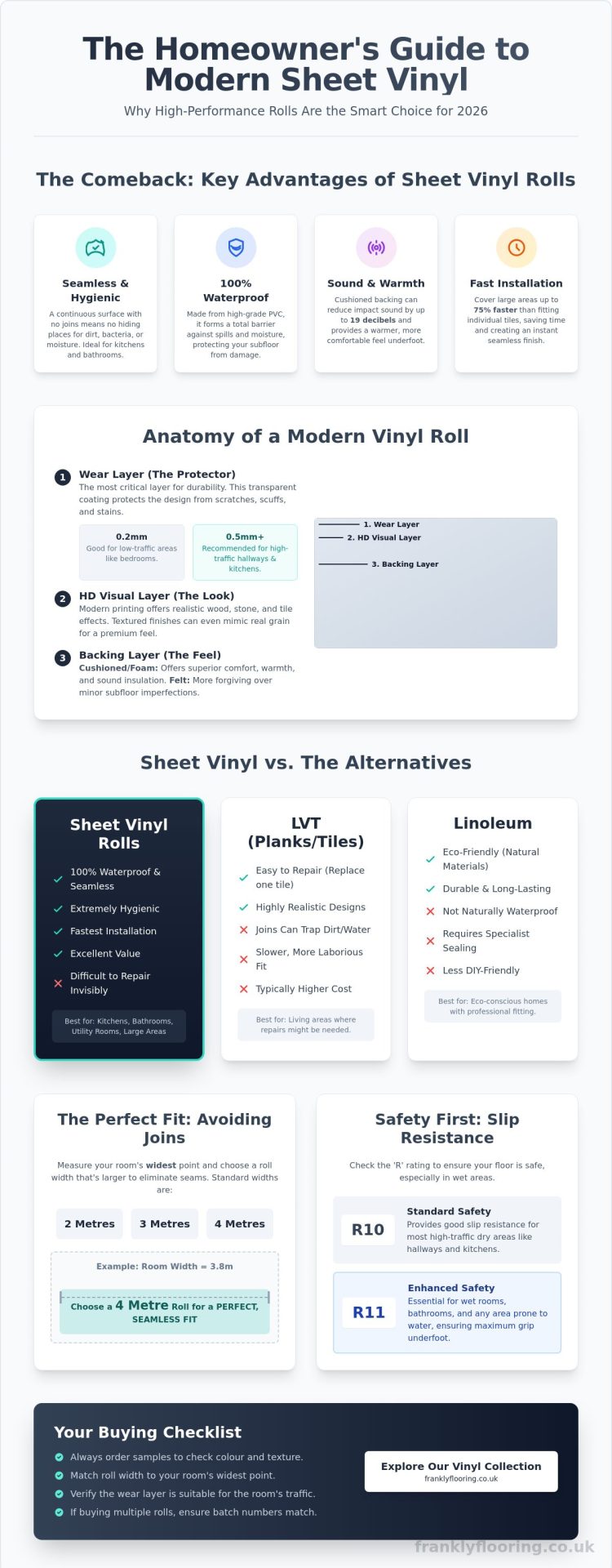
Many homeowners remember the thin, peeling floors of the 1980s and assume the material hasn’t changed. Frankly, that’s a mistake. Modern sheet vinyl flooring rolls uk have undergone a massive technical shift. Today, these floors are engineered from multiple layers of high-grade PVC, designed to provide a totally seamless and waterproof surface. This makes them the ideal choice for British wet rooms, kitchens, and bathrooms where moisture is a constant factor and hygiene is a priority.
The standout feature of 2026 ranges is the cushioned element. Unlike hard wood or stone, many rolls feature a specialized foam backing that adds immediate warmth and sound insulation. If you have kids running around or live in a flat where noise travels, this extra layer can reduce impact sound by up to 19 decibels. It’s a practical solution that prioritizes comfort without sacrificing the high-end look of more expensive materials. Because it comes in a continuous sheet, you don’t have the cracks and crevices found in laminate or tile where dirt and water like to settle.
The Anatomy of a Vinyl Roll
To understand why one roll lasts five years while another lasts fifteen, you need to look at the layers. The wear layer is the most critical part for longevity. A 0.2mm wear layer is fine for a guest bedroom, but for high-traffic areas like your hallway or kitchen, you should look for a 0.5mm layer. This transparent top coating protects the design from scratches and scuffs. Below this sits the high-definition visual layer. Modern printing techniques now include textured finishes, meaning a wood effect floor actually feels like grain under your feet. Finally, the backing determines the feel. Foam backing offers more give, while felt backing can be more forgiving if your subfloor isn’t perfectly smooth.
Vinyl vs. Lino: Being Frank About the Difference
In the UK, we often use the word lino to describe any plastic-looking floor. However, there’s a distinct difference between the two. Linoleum is a natural product made from linseed oil, wood flour, and cork. While it’s eco-friendly, it often requires specialist sealing and can be more difficult to maintain. Vinyl, on the other hand, is a synthetic powerhouse. It’s naturally resistant to water and stains, making it far more straightforward for a busy family home. While Vinyl composition tile (VCT) is a common sight in schools and hospitals due to its extreme durability, modern residential sheet vinyl offers that same resilience with a much softer, more attractive finish. Most retailers use the terms interchangeably, but if you want a floor that’s truly “fit and forget,” synthetic vinyl is usually the better bet.
Sheet Vinyl vs. LVT: Which Solution Fits Your Project?
Deciding between rolls and tiles isn’t just about the price tag. It’s about how you use your space. While some retailers claim LVT is always superior, we prefer a more honest approach. For a large, empty kitchen, sheet vinyl flooring rolls uk can be fitted up to 75% faster than individual tiles. This speed doesn’t just save time; it creates a seamless barrier that’s impossible to achieve with modular products. If you’re working with a 20-square-metre room, a single roll can cover the entire area in one go, whereas tiles require hundreds of individual placements.
Hygiene is where rolls truly shine. In a bathroom or utility room, joins are the enemy. Every gap between tiles is a potential home for bacteria or a path for water to reach your subfloor. The Contract Flooring Association highlights the importance of correct material selection for specific environments to ensure longevity and safety. By choosing a single sheet, you eliminate these vulnerabilities entirely. In terms of price-to-performance, sheet vinyl is hard to beat for cost-effective coverage. However, we have to be frank about the downsides. Repairability is the main trade-off. If you gouge a hole in a sheet floor, patching it invisibly is nearly impossible. With LVT, you simply replace the damaged plank.
When to Choose Sheet Vinyl Rolls
If you’re tackling a bathroom, laundry room, or even a caravan renovation, sheet vinyl is often the champion. Its flexibility allows it to handle the humidity of a small shower room without lifting or warping. It’s also the go-to for rental properties or quick room refreshes on a tight budget. You get a fresh look without the labour-intensive process of laying hundreds of pieces. You might want to browse our latest vinyl collection to see how modern designs have bridged the gap between budget and beauty.
When to Consider Luxury Vinyl Tiles (LVT)
Choose lvt flooring if you want that authentic “click” feel underfoot and a floor that can handle slight subfloor movement. While sheet vinyl needs a perfectly flat base, the rigid core of many LVT products can bridge minor dips. It’s a premium solution for living rooms or open-plan areas where you want the aesthetic of wood or stone but need the durability of a synthetic material. LVT is the better long-term investment for high-traffic hallways where individual tile replacement might be necessary after a few years of heavy use.
Measuring and Widths: How to Avoid Joins in Your Floor
Getting your measurements right is the difference between a professional finish and a waste of money. In the UK, most sheet vinyl flooring rolls uk are supplied in three standard widths: 2 metres, 3 metres, and 4 metres. These benchmarks exist to help you cover most British rooms with a single, continuous piece of material. We call this the “Frank” rule: whenever possible, aim for a single sheet. Eliminating joins isn’t just about aesthetics; it’s about structural integrity. Joins are naturally moisture-sensitive and often become the first point of failure in a busy kitchen or bathroom.
When you measure your space, always add 100mm (about 4 inches) to both the total length and width. This extra material gives you the “slack” needed for precise trimming around skirting boards and uneven walls. If your room is wider than 4 metres, you’ll need to order multiple rolls. This introduces the challenge of pattern matching. You must ensure all rolls come from the same production batch to avoid subtle colour variations, and you’ll need to calculate the pattern repeat distance to align the design correctly across the seam.
Calculating Your Room Requirements
To measure like a pro, grab a metal tape measure and find the absolute widest and longest points of your room. Don’t just measure from wall to wall. You must include the depth of door recesses, alcoves, and any bay windows. If you miss these, you’ll find yourself short of material during the fitting process. Choosing the right sheet vinyl flooring rolls uk is a balancing act. If your room is 2.8 metres wide, buying a 3-metre roll is more efficient than a 4-metre roll, as it significantly reduces waste and cost. Adhering to HSE flooring safety standards starts with a floor that is fitted securely without loose edges or poorly measured sections that could cause trips.
Dealing with Joins (If You Must)
Sometimes a join is unavoidable. In these cases, use a cold-welding liquid to chemically bond the two edges together. This creates a waterproof seal that’s far more durable than simple tape. Position the join away from high-traffic walking paths or areas prone to heavy splashing, such as directly in front of a sink. At doorways and transitions to other rooms, use a proper door bar or a carpet gripper to secure the edges. This keeps the vinyl taut and prevents it from curling over time, which is a common issue in many British homes.
Durability and Fitting: What to Look for in High-Traffic Areas
Choosing a floor that looks good in the showroom is easy; choosing one that survives ten years of family life is harder. When browsing for sheet vinyl flooring rolls uk, slip resistance is the first thing you should check. We recommend looking for an R10 or R11 rating. An R10 rating provides enough grip for standard residential use, while R11 offers enhanced safety in areas that are frequently wet. If you ignore these ratings, you’re essentially installing a skating rink in your home.
We have to be frank about the subfloor. You cannot simply roll out sheet vinyl over old, gappy floorboards and expect it to look professional. Vinyl is a “telescopic” material. This means every single grit particle, nail head, or uneven joint in the subfloor will eventually show through the surface. Within six months, you’ll see a map of your floorboards etched into your new floor. This telescoping effect is the number one reason for customer dissatisfaction in the UK flooring industry.
Fitting methods vary based on the size of the room. Loose-lay is common for small bathrooms under 12 square metres, where the vinyl is held down by skirting and a bit of double-sided tape at the door. Perimeter-fix is better for medium spaces, while fully-adhered fitting using a trowel-applied adhesive is essential for large, high-traffic areas to prevent the material from bubbling or shifting over time.
The Importance of Subfloor Preparation
To get a smooth finish, 6mm plywood is the industry standard for timber subfloors. It creates a flat, uniform base that masks the gaps between floorboards. For concrete floors, a self-levelling compound is necessary to smooth out dips and ridges. Don’t rush the process. Acclimatisation is vital; leave your roll in the target room for at least 24 hours before fitting. This allows the PVC to expand or contract to the room’s temperature, preventing ripples later on.
Fitting for Longevity
When it’s time to secure your sheet vinyl flooring rolls uk, use a high-quality spray adhesive for smaller areas or a full acrylic bond for larger rooms. Professional fitters use a technique called ‘scribing’ to cut the vinyl exactly to the shape of the skirting boards, ensuring a tight, moisture-proof fit. If your subfloor is hopelessly uneven and you don’t want the hassle of plywood, laminate flooring might be a better alternative as its rigid core can bridge many imperfections. To find the right match for your project, you can browse our full range of quality flooring options today.
Buying Sheet Vinyl Online: Getting it Right the First Time
Buying sheet vinyl flooring rolls uk online is incredibly convenient, but it requires a different approach than picking up a tin of paint at a local shop. The most common mistake homeowners make is trusting their smartphone screen to represent a colour accurately. Digital displays vary wildly; a “cool grey” on your laptop might look like a “warm beige” under your kitchen’s specific LED spotlights. This is why ordering physical samples is a non-negotiable step in the process. It’s the only way to be certain the design works in your actual living environment.
When you’re ordering for a large project that requires more than one roll, you must check the batch numbers. Even the most advanced manufacturing plants can have slight variations in pigment between different production runs. If you lay two rolls from different batches side-by-side, the colour shift can be jarring once the natural light hits the surface. We always advise our customers to double-check their labels before they start the fitting process. It’s much easier to swap a roll before it’s been cut than after it’s glued to your floor.
Logistics also play a huge role when buying online. A 4-metre long roll is a substantial, heavy item that doesn’t just fit through a standard letterbox. You need to ensure you have a clear path from your front door to the room of choice. Most specialist delivery drivers will get the roll to your door, but moving a 40kg roll up three flights of stairs is a two-person job. Being prepared for the physical arrival of your floor is just as important as the measurement itself.
The Sample Process
Once your samples arrive, don’t just look at the pattern. Put them through their paces. Place them next to your skirting boards and check how the colour changes from morning sunlight to evening lamp light. We recommend performing a “scratch test” using a coin to see how the wear layer holds up against pressure. This is also your chance to test the “feel” underfoot. If you’re expecting a cushioned experience, a 3mm thick sample will feel significantly different from a 2mm version. Take your time with this; it’s better to wait 48 hours for a sample than to live with a mistake for ten years.
Final Checklist Before You Click Buy
Before you finalise your order, run through the technical requirements one last time. Buying from a specialist means you’re getting a product designed for longevity rather than just a quick fix from a big-box hardware store. Ensure you have everything you need to finish the job properly:
- Double-check the total length and width, including that vital 100mm trimming allowance.
- Confirm the R-rating is R10 or higher for kitchens and bathrooms.
- Check that you’ve added the correct accessories, such as acrylic adhesive or sealant, to your basket.
- Verify that your subfloor is prepped and ready for the 24-hour acclimatisation period.
If you’re ready to transform your space with a seamless, waterproof finish, you can browse our full range of sheet vinyl rolls at Frankly Flooring to find a durable, high-quality solution for your home.
Ready to Transform Your Home with Confidence
Selecting a new floor is a foundational decision for your home’s character. By now, you understand how to navigate technical specs like slip ratings and why choosing the correct width is the only way to achieve a truly seamless finish. These practical details ensure your kitchen or bathroom remains waterproof and easy to clean for years to come. You’re no longer guessing; you’re making an informed choice for your family.
Finding the right sheet vinyl flooring rolls uk is straightforward when you have an expert in your corner. Frankly Flooring is a family-run business with over 20 years of expertise in the British market. We offer transparent, frank advice on every product we sell, ensuring you never feel pressured into a purchase that isn’t right for your space. With national UK delivery, we bring quality materials directly to your doorstep, handling the logistics so you can focus on the transformation.
Find your perfect floor; shop our honest range of sheet vinyl rolls today. Your home deserves a floor that is built to last.
Common Questions About Sheet Vinyl Flooring
Is sheet vinyl the same as lino?
No, they are entirely different materials. Sheet vinyl is a synthetic product made from layers of PVC and glass fibre, while linoleum is made from natural ingredients like linseed oil and cork dust. Vinyl is much more resistant to moisture, making it the practical choice for the damp conditions often found in British kitchens and bathrooms.
Can I lay sheet vinyl over my existing tiles?
You can, but you shouldn’t do it without preparation. If you lay vinyl directly over tiles, the grout lines will eventually show through the surface in a process called telegraphing. Within 6 months, you’ll see a grid pattern on your new floor. To avoid this, apply a 3mm layer of smoothing compound over the tiles first to create a perfectly flat base.
Do I need underlay for sheet vinyl rolls?
Most sheet vinyl flooring rolls uk don’t require a separate underlay because they are manufactured with an integrated foam or felt backing. This built-in layer provides the necessary cushioning and sound insulation. Adding an extra underlay can make the floor too spongy, which increases the risk of the material puncturing under the weight of heavy furniture.
How long does a sheet vinyl floor typically last?
A quality vinyl floor should last between 10 and 20 years depending on the thickness of its wear layer. For high-traffic areas like hallways, a 0.5mm wear layer is essential for reaching that 15-year mark. In contrast, a thinner 0.2mm wear layer is better suited for light-use areas like guest bedrooms where it will easily last a decade.
Is sheet vinyl flooring suitable for underfloor heating?
Yes, it’s perfectly compatible with most underfloor heating systems as long as the floor temperature stays below 27°C. It’s a great heat conductor that warms up quickly. However, you must use a full-spread, heat-resistant adhesive during fitting to ensure the vinyl doesn’t shift or bubble when the temperature changes.
Can I use sheet vinyl in a bathroom?
Sheet vinyl is one of the best bathroom flooring options because it’s 100% waterproof. Unlike laminate or real wood, it won’t warp or swell when exposed to splashes. For the best results, look for a roll with an R10 slip-resistance rating to ensure the surface remains safe even when it’s wet from a bath or shower.
How do I clean and maintain my new vinyl floor?
Cleaning is straightforward; just sweep away grit daily and use a damp mop with a pH-neutral cleaner once a week. Don’t use steam mops on your vinyl. The intense heat from a steamer can reach 100°C, which is high enough to dissolve the adhesive and cause the edges of your flooring to curl and lift.
What is the best way to hide joins in sheet vinyl?
The most professional way to manage a seam is using a cold-welding liquid. This chemical agent melts the two edges together to create a single, waterproof bond that’s nearly invisible to the eye. For the best aesthetic result, always try to place your joins at least 30cm away from main walking paths where they are less likely to be noticed.