
What if the most important part of your new laminate floor isn’t actually the laminate itself? Most homeowners spend weeks choosing the perfect aesthetic, but the real success of the project depends on selecting the best underlay for laminate flooring on concrete. It’s natural to worry about moisture creeping up from a cold slab or that annoying hollow sound when you walk across the room. You want a floor that feels solid and stays warm, not one that risks warping because of a hidden damp issue.
Choosing the right material is about building a technical shield, not just adding a cushion. To be frank, the wrong thickness can compromise your floor’s stability and even void your manufacturer warranty. This guide explains exactly how to decide between 3mm and 5mm options while ensuring your installation includes a vital Damp Proof Membrane. We’ll walk you through the latest 2026 standards for thermal insulation and moisture protection, giving you the confidence to create a professional finish that lasts.
Key Takeaways
- Learn why a Damp Proof Membrane (DPM) is non-negotiable for porous concrete subfloors to prevent moisture from warping your new laminate.
- Discover why choosing the best underlay for laminate flooring on concrete requires a focus on material density over simple thickness to prevent joint failure.
- Compare the performance of foil-backed foam, fibreboard, and heavy-duty rubber to find the right balance of warmth and sound reduction for your space.
- Get a practical checklist for preparing your slab to ensure your underlay and accessories perform exactly as intended for a long-lasting finish.
- Understand how Frankly Flooring curates high-performance accessories specifically to meet the technical demands and longevity requirements of UK homes.
Why Concrete Subfloors Demand a Specific Underlay
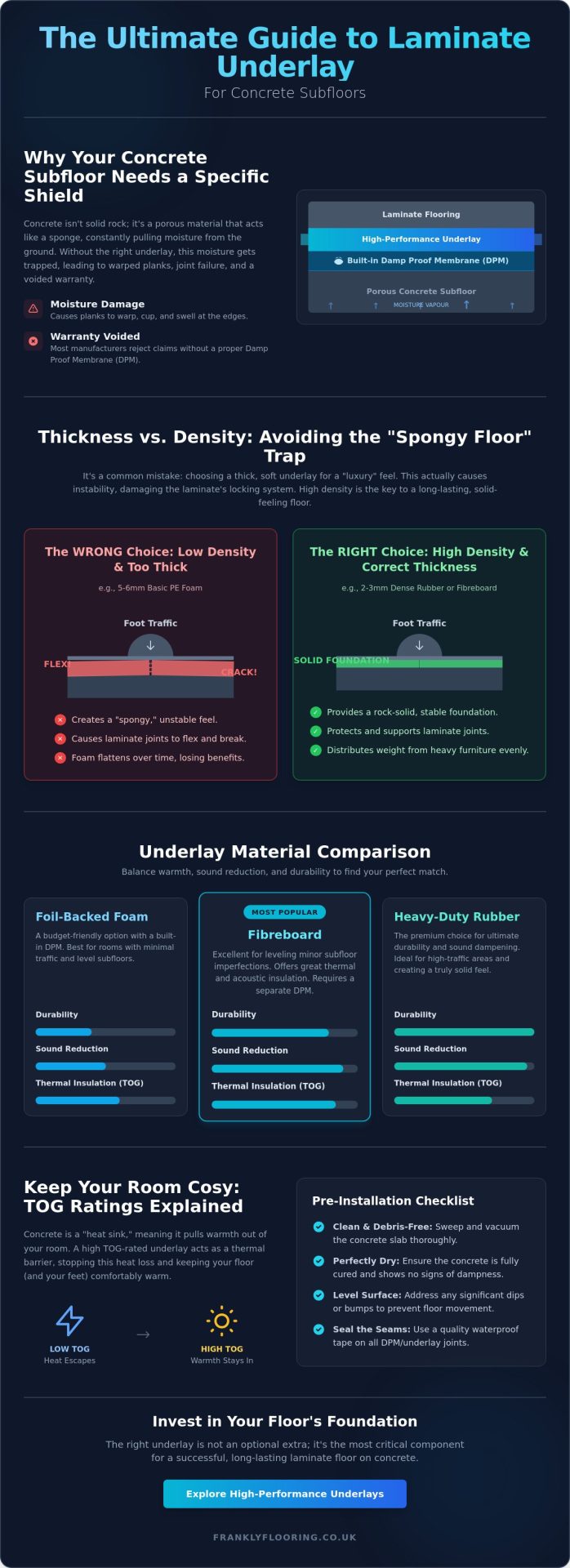
Concrete might look like a solid, impenetrable block, but it’s actually a porous material that behaves much like a hard sponge. Even a slab that has been down for decades can hold residual moisture or pull new dampness up from the ground through capillary action. If you place a floor directly on top of this without the correct barrier, that moisture has nowhere to go but into your planks. This is why finding the best underlay for laminate flooring on concrete isn’t just about comfort; it’s about structural survival.
There is also the technical issue of “alkali attack” to consider. Concrete is naturally alkaline. When moisture moves through the slab, it can carry high concentrations of alkaline salts to the surface. Without a proper shield, these salts can eventually degrade the backings or specialized adhesives found in modern flooring products. A technical shield ensures your investment doesn’t break down from the bottom up. We believe in being direct about these risks because skipping the right underlay is the fastest way to ruin a beautiful room.
The Critical Role of the Damp Proof Membrane (DPM)
A Damp Proof Membrane, or DPM, is a moisture-resistant layer that stops water vapour from reaching your Laminate flooring. While you can buy separate plastic sheeting, it’s far more efficient to choose an underlay with a built-in DPM. These integrated systems are easier to seal with joint tape, ensuring no “moisture bridges” are left open. If moisture reaches the core of your laminate, the wood fibres will swell, causing the edges to peak or the boards to cup. Frankly, most manufacturers won’t even look at a warranty claim if you haven’t used a documented DPM on a concrete subfloor.
Thermal Insulation and TOG Ratings
Concrete is an excellent thermal conductor, which is a fancy way of saying it’s very good at stealing heat from your feet. To keep your room feeling cosy, you need to look at the TOG rating of your underlay. TOG rating is the measure of thermal resistance. For a cold concrete slab without underfloor heating, you generally want a higher TOG rating to provide better insulation. This layer acts as a thermal break, stopping the “cold sink” effect of the concrete and keeping the warmth inside your living space where it belongs. It’s a simple addition that makes a massive difference to how a room feels on a winter morning.
Thickness vs. Density: Avoiding the Spongy Floor Trap
Many people assume that a 5mm or 6mm underlay will make their floor feel softer and more luxurious. To be frank, the opposite is usually true. On a concrete subfloor, an underlay that is too thick and lacks density creates a “spongy” sensation that feels unstable. This isn’t just a matter of comfort. It’s a technical failure that can lead to permanent damage. When you walk across a floor with too much “give,” you’re actually watching your investment degrade with every step.
Laminate planks rely on a precision-engineered click-lock system to stay together. These joints are designed for horizontal stability, not vertical movement. When you walk on a soft, thick underlay, the planks dip under your weight. This constant flexing puts immense pressure on the tongue-and-groove joints. Over time, they will crack or snap, leading to unsightly gaps or even complete joint failure. This is why the best underlay for laminate flooring on concrete focuses on compression strength rather than just millimetres of padding.
Compression strength is the material’s ability to resist heavy loads without collapsing. A high-density underlay might only be 3mm thick, but it provides a rock-solid foundation that protects your floor’s integrity. It ensures that the weight of your footsteps or heavy furniture is distributed evenly, keeping the planks flat and the joints secure for years to come.
The Problem with Cheap PE Foam
Basic polyethylene (PE) foam is the most common budget choice, often found in giant rolls at hardware stores. It’s essentially made of tiny air bubbles. The problem is that these bubbles burst or flatten permanently under the weight of a sofa or even heavy foot traffic. Once the foam collapses, you lose all the thermal insulation and sound-dampening benefits. In high-traffic hallways, the material can flatten in months, leaving your floor sounding hollow and feeling cold against the concrete.
Finding the “Sweet Spot” for Stability
For most concrete installations, the best underlay for laminate flooring on concrete sits in the 2mm to 3mm range. This thickness is sufficient to bridge minor subfloor deviations without introducing too much vertical movement. High-density materials, such as heavy-duty rubber or compressed fibreboard, make the floor feel like solid wood underfoot. They provide a “dead” sound, which is exactly what you want.
This density also solves the annoying “click-clack” problem. Laminate is a hard surface, and when it sits on top of a hollow, low-density foam, every footstep echoes through the room. A dense underlay absorbs that energy instead of reflecting it. It transforms a hollow, cheap sound into a quiet, premium thud. Choosing the right density is a simple way to ensure your floor sounds as good as it looks without risking the structural health of your planks.
The Best Underlay Types for Concrete Compared
Selecting the right material for your project depends entirely on the state of your subfloor and your priorities for the room. While we’ve established that density and moisture protection are vital, the actual material you choose will dictate how the floor performs over the next decade. Frankly, the choice usually comes down to three main contenders. Each has a specific role to play in creating the best underlay for laminate flooring on concrete for your home.
If your concrete slab is perfectly flat and modern, your needs differ significantly from someone dealing with an older, slightly pitted floor. You also need to consider the “Gold” and “Silver” foil options often seen on the market. These aren’t just for show. The metallic layer provides an additional heat-reflective surface and acts as a high-performance vapour barrier, making them a smart choice for ground-floor installations where cold and damp are constant threats.
Foil-Backed Foam: The All-Rounder
Foil-backed foam is the most popular choice for a reason. It combines a high-density polyethylene foam with an integrated foil vapour barrier, solving two problems at once. The foil layer reflects heat back into the room, which is a massive benefit on cold concrete. For DIYers, this is often the easiest path because it’s lightweight and simple to cut. It offers excellent value for money while meeting the updated NALFA LF-01 standards for durability and quality. Just ensure you use moisture-resistant tape on the seams to maintain a continuous shield.
Fibreboard: The Solution for Uneven Floors
If your concrete subfloor has small dips or imperfections of up to 3mm, fibreboard is your best ally. These rigid boards have enough structural integrity to bridge minor gaps that would cause thinner foams to fail. However, there is a catch. Fibreboard is made of wood fibres and has no inherent moisture resistance. If you use it on concrete, you must lay a separate, heavy-duty DPM plastic sheet underneath it first. Without that bottom layer, the boards will soak up moisture from the slab and swell, ruining your laminate from underneath.
High-Density Rubber: The Professional Choice
For those looking for the ultimate “solid” feel, high-density rubber is the professional standard. It offers the best acoustic performance, often providing a significant decibel reduction that eliminates the hollow sound associated with laminate. Rubber is incredibly resistant to compression, meaning it won’t flatten out over time even under heavy wardrobes or pianos. While it is a more substantial investment, its longevity and superior thermal properties make it a foundational element for a high-end home character. It creates a quiet, warm environment that feels much more like traditional hardwood than a budget installation.
Preparing Your Concrete Subfloor for Installation
Even the best underlay for laminate flooring on concrete cannot compensate for a subfloor that hasn’t been properly prepared. Many homeowners make the mistake of assuming a thick underlay will smooth out significant dips or hide structural damage. It won’t. If your concrete is crumbly, uneven, or still damp from construction, the underlay will eventually fail. Preparation is the most time-consuming part of the job, but it’s the only way to ensure your floor doesn’t creak or bounce.
Cleanliness is your first priority. Dust is the natural enemy of adhesive, and if your subfloor is covered in a fine layer of concrete grit, your DPM tape will not stick. This creates gaps in your moisture barrier, allowing dampness to bypass your shield. Before you even unroll your underlay, you should sweep and vacuum the entire area twice. Remove any old paint spills, plaster drops, or carpet adhesive residues that could create high spots under your boards.
Testing for Damp and Levelness
You can perform a simple DIY moisture check using the plastic sheet test. Tape a one-metre square of clear plastic sheeting to the concrete, sealing all four edges with duct tape. Leave it for 24 to 48 hours. If you see condensation under the plastic or the concrete looks darker when you peel it back, the slab is too damp for installation. For new builds, remember that concrete needs at least one month per inch of thickness to dry out properly before you can safely cover it.
Levelness is equally critical. Use a long straight edge or a spirit level to check for dips. The industry standard is a tolerance of 3mm over a 2-metre span. If you find a hole deeper than this, you should fill it with a rapid-setting levelling compound. If you find a hump, it needs to be ground down. Ignoring these deviations will put stress on your laminate joints, leading to the “clicking” sounds that drive homeowners mad.
Sealing the Gaps: Taping and Lapping
When laying your underlay, never overlap the edges of foam or rubber products. This creates a ridge that will be visible through your laminate and cause the boards to pivot. Instead, butt the edges tightly together and seal every single joint with waterproof DPM tape. This creates a continuous, airtight seal that prevents moisture vapour from rising. To finish the job properly, lap the underlay about 50mm up the walls. This creates a “bathtub” effect that protects the edges of your planks. You can trim the excess later so it sits hidden behind your skirting boards.
Getting these technical details right is what separates a DIY attempt from a professional finish. If you need the right materials to get started, you can find high-quality moisture-resistant tapes and other accessories in our curated range.
Choosing the Right Underlay from Frankly Flooring
At Frankly Flooring, we believe in a direct approach to home improvement. When you’re searching for the best underlay for laminate flooring on concrete, it is easy to get lost in marketing jargon and shiny packaging. We have spent over 20 years identifying which products actually stand up to the rigours of a busy UK household. Our range isn’t built on what’s cheapest to stock, but on what provides the technical craftsmanship required to protect your property and your investment. We take pride in being a no-nonsense entity that values your long-term satisfaction over quick sales.
To be frank, the most common mistake we see is people skimping on the Damp Proof Membrane to save a few pounds. On a concrete slab, this is a gamble that rarely pays off. Moisture is patient, and once it starts warping your planks, the cost of replacement far outweighs the initial price of a premium underlay. We only stock products that we would trust in our own homes, ensuring you get a stable, warm, and professional finish every time. Our curated selection is specifically chosen to meet the unique demands of UK housing standards, where cold damp slabs are a frequent reality.
Why We Stand Behind Our Selection
Our team understands that a floor is more than just a surface; it’s a foundational element of your home’s character. We focus almost exclusively on high-density materials because they are the only way to ensure your floor warranty remains valid. Manufacturers are strict about vertical movement, and our selection of accessories is designed to meet those specific tolerances. If you’ve already picked out your laminate flooring, the next logical step is ensuring the layer beneath it is technically sound. We prioritize integrity, providing products that offer longevity and reliability rather than temporary fixes.
Order Samples and Get Expert Advice
We encourage you to feel the difference for yourself before making a final decision. High-density rubber or foil-backed foam should feel substantial and firm, not flimsy or easily crushed between your fingers. We offer a national delivery service for all our flooring accessories, making it easy to get professional-grade materials delivered straight to your project site. Whether you are a seasoned DIY enthusiast or embarking on your first renovation, our goal is to provide the quiet confidence you need to succeed.
Choosing the best underlay for laminate flooring on concrete is about more than just comfort; it’s about building a technical shield for your home. We invite you to Browse our full range of professional underlays and discover exactly which material will provide the stability and moisture protection your specific project requires. Our team is here to guide you through a logical journey from material selection to the final completion of your room.
Build Your Floor on a Technical Foundation
Choosing the best underlay for laminate flooring on concrete is the single most important decision you’ll make for the longevity of your home’s character. You now know that density matters more than thickness and that a built-in DPM is your best defence against moisture. By prioritising compression strength and preparing your subfloor with precision, you ensure your laminate remains stable and warm for years to come. It’s about doing the job properly the first time so you don’t have to face costly repairs later.
As a family-run business with over 20 years of expertise, Frankly Flooring provides a curated range of high-density materials designed specifically for UK homes. We offer direct UK-wide delivery on all our professional accessories, ensuring you have the right tools for a stress-free installation. Don’t leave your project to chance with budget foams that collapse under pressure. Shop our professional-grade underlays with built-in DPM and get the honest quality your property deserves. You have the knowledge to succeed; now it’s time to get started on that transformation.
Frequently Asked Questions
Do I really need underlay for laminate on concrete?
Yes, you absolutely need it. Laying laminate directly on concrete is a recipe for disaster because concrete is porous and releases moisture that will warp your planks. It is also an incredibly hard surface that makes every footstep loud and hollow. The best underlay for laminate flooring on concrete acts as a moisture shield and a cushion, protecting your joints and making the room significantly quieter.
Can I use two layers of underlay to make the floor warmer?
You should never double up on underlay. While it might seem like a good way to add insulation, it creates too much vertical movement. This “sponginess” puts massive stress on the click-lock joints of your laminate, eventually causing them to snap. If you want a warmer floor, choose a single layer of high-density rubber or a foil-backed product with a higher TOG rating instead of stacking multiple layers.
What is the best thickness for underlay on a concrete floor?
The ideal thickness is typically between 2mm and 3mm. Many people assume thicker is better, but density is actually the more important metric. A 3mm high-density underlay provides a rock-solid foundation that prevents joint failure while still offering excellent thermal properties. Going thicker than 5mm often introduces unwanted bounce, which can void your floor’s warranty and lead to gaps between the planks over time.
How do I know if my concrete floor is too damp for laminate?
You can use a professional moisture meter or the simple plastic sheet test mentioned earlier in this guide. Tape a square of clear plastic to the slab for 48 hours. If you see condensation or the concrete has turned a darker shade, the moisture levels are too high. New concrete slabs usually require at least one month of drying time per inch of thickness before they are ready for a floor covering.
Is foil-backed underlay better than plain foam?
Yes, foil-backed underlay is significantly better for concrete subfloors. The foil layer performs two vital roles: it acts as a built-in Damp Proof Membrane and reflects heat back into the room. Plain foam lacks these moisture-blocking properties and often collapses over time. For ground-floor installations where the slab is naturally cold and prone to dampness, the foil-backed option is the best underlay for laminate flooring on concrete.
Do I need a separate damp proof membrane if my underlay has foil?
Generally, you don’t need a separate DPM if your underlay has an integrated foil or film layer. These products are designed to be an all-in-one solution. However, the system only works if you seal every seam with waterproof DPM tape. If you leave the joints untaped, moisture vapour will rise through the gaps and reach your laminate, defeating the purpose of the moisture-resistant backing entirely.
Can I use fibreboard underlay on concrete?
You can use fibreboard, but it requires a separate moisture barrier. Fibreboard is excellent for levelling out minor dips in a slab, but the boards themselves are made of wood fibres that soak up moisture. If you lay them directly on concrete, they will swell and rot. You must first lay a 1000-gauge or 1200-gauge plastic DPM sheet across the entire floor before placing the fibreboards on top.
How much sound reduction should I look for in a concrete underlay?
Look for a sound reduction rating between 18dB and 22dB. This measurement refers to “impact sound,” which is the noise of footsteps or dropped objects. Because concrete is a dense material, it doesn’t vibrate as much as timber, but laminate can still sound “clicky” on top of it. A high-density underlay with a good decibel rating will absorb that energy and provide a much quieter, more premium feel underfoot.