
The word “luxury” in flooring marketing is often just a distraction from the technical specs that actually matter. While many people are swayed by a pretty pattern, industry data suggests that roughly 30% of domestic floors are replaced prematurely because they simply weren’t built for the pressure of a busy household. If you want a surface that survives more than a few seasons, you need to look past the labels and consider commercial grade lvt flooring. It is the same robust solution used in high-street shops, engineered to handle thousands of footsteps while maintaining its appearance.
We know that trying to decode terms like microns and wear layers can feel like a chore. You likely just want a floor that looks like authentic timber but doesn’t scuff the moment the dog runs through the hallway. Frankly, we believe in a “buy once, fit once” approach to your property. This guide will help you cut through the sales talk to find a floor that lasts 15 years or more with minimal fuss. We will explain exactly what makes a quality plank and how to choose a finish that offers genuine value for your money.
Key Takeaways
- Understand why a fraction of a millimetre makes the difference between a floor that looks tired in five years and one that stays pristine for over fifteen.
- Learn why a 0.55mm wear layer is the technical “sweet spot” for commercial grade lvt flooring to ensure your investment survives heavy footfall.
- Discover the frank truth about upfront costs and why a higher initial spend results in a significantly lower price per year over the floor’s lifespan.
- Identify why professional subfloor preparation to SR1 standards is the only way to guarantee a seamless, high-quality finish for your project.
- Explore how to source better value alternatives to big-name brands without sacrificing the bespoke aesthetic of herringbone or plank designs.
What is Commercial Grade LVT Flooring?
Commercial grade LVT flooring is a high-performance floor covering designed to withstand significantly more pressure than standard domestic options. It features an enhanced wear layer, typically 0.55mm or 0.7mm thick, and a denser core construction. To grasp the technical evolution of these materials, it helps to look at the history of What is Luxury Vinyl Tile? and how it shifted from basic plastic tiles to the sophisticated, multi-layered planks we use today.
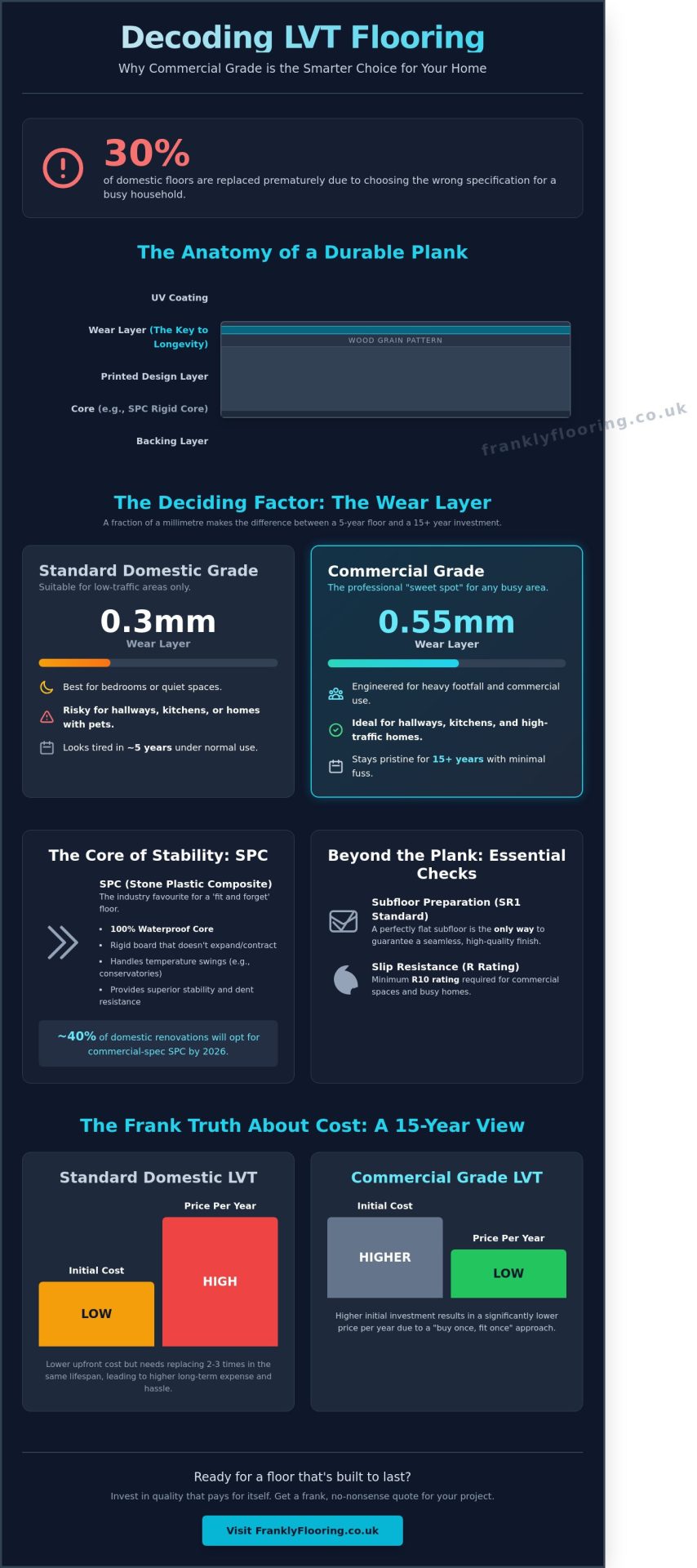
Let’s be frank about the terminology. The distinction between “Luxury” and “Commercial” is often just a fraction of a millimetre. While a standard home tile might have a 0.3mm wear layer, the commercial equivalent adds a tiny sliver of extra protection. That 0.25mm difference is what prevents the printed pattern from wearing away when faced with heavy footfall or dragging furniture. We don’t believe in overcomplicating things; it’s simply about choosing a product that’s fit for purpose and built to last.
The core material also plays a vital role in how the floor performs. Traditional flexible vinyl is excellent for floors with minor imperfections, but Stone Plastic Composite (SPC) is the current industry favourite. SPC uses a blend of limestone powder and stabilisers to create a rigid board. This 100% waterproof core ensures the planks don’t expand or contract like wood. Recent UK market data suggests that by 2026, roughly 40% of domestic renovations will opt for these commercial-spec materials. Homeowners are tired of replacing floors every few years and are moving toward a “fit and forget” mindset.
The Three Pillars of Commercial Quality
Durability is the primary reason for choosing commercial grade lvt flooring. It offers superior resistance to scuffs and deep scratches from grit or heavy furniture. Stability is equally important. Commercial LVT handles temperature fluctuations better than standard vinyl, making it the ideal choice for British conservatories where heat can peak at 35°C in summer. Finally, longevity is a major factor. These products usually carry 10 to 20 year warranties even in high-traffic environments, providing a level of reliability that cheaper alternatives cannot match.
Common Commercial Settings
- Retail and showrooms: These spaces require floors that can handle constant foot traffic and the heavy weight of display units or trolley wheels without indenting.
- Hospitality: Restaurants and pubs need surfaces that resist spills, stains, and the harsh cleaning chemicals used during daily maintenance.
- The “Busy Home” crossover: We’re seeing a massive increase in commercial fitting for hallways, kitchens, and mudrooms. These are the areas where a standard floor often fails within 36 months.
The Anatomy of Durability: Wear Layers and Thickness
When you hold a sample of commercial grade lvt flooring, it is tempting to judge its quality by how heavy or rigid it feels in your hand. However, the true strength of the floor lies in a transparent top coating known as the wear layer. This is the shield that prevents foot traffic from grinding away the printed design underneath. To ensure a product meets the industry benchmark ASTM F1700 – 13a: Standard Specification for Solid Vinyl Floor Tile, manufacturers must adhere to specific construction standards that balance the core material with this protective surface. Without a sufficient wear layer, even the most expensive-looking tile will look dull and battered within months of fitting.
It is important not to be fooled by the total thickness of a tile. A 6mm thick plank might feel substantial, but if it only features a 0.3mm wear layer, it will not survive a busy retail environment. The total thickness provides stability and underfoot comfort, but the wear layer determines the lifespan. Safety is another critical factor. We look at slip resistance ratings, typically R9 to R11, to ensure compliance with UK health and safety standards. An R10 rating is generally the minimum requirement for commercial spaces, while R11 is necessary for areas prone to moisture, such as entrance foyers or communal kitchens.
Microns Decoded: What Do the Numbers Mean?
To be frank, picking the wrong specification for your traffic levels is a recipe for a premature refit. We categorise these wear layers by their millimetre (mm) thickness:
- 0.3mm: This is standard domestic grade. It works well for home bedrooms or low-traffic areas, but it is a risky choice for even a small shop.
- 0.55mm: This is the professional commercial grade. It is the industry standard for UK offices, high-street shops, and restaurants, offering a 10 to 15-year lifespan in most settings.
- 0.7mm and above: This is industrial grade. These products are designed for 24-hour environments like airports, hospital corridors, and major transport hubs where the floor never gets a rest.
UV Coatings and Scratch Resistance
High-end commercial grade lvt flooring often incorporates ceramic bead technology. This involves microscopic, glass-like particles embedded into the wear layer to create a surface that is incredibly difficult to scratch. You can think of this as a sacrificial wear layer, which is the part of the floor that takes the hit so the pattern doesn’t. This ensures the aesthetic remains crisp even under heavy furniture movement or grit from the street.
Sunlight is another silent enemy of commercial flooring. To prevent the “bleaching” effect often seen in shopfronts, quality LVT undergoes UV curing during manufacturing. This process hardens the top coat and creates a barrier against ultraviolet rays, ensuring your floor doesn’t lose its colour depth after one summer. If you are currently weighing up different samples, we can provide honest advice on material selection to ensure you don’t overspend on industrial specs where professional grade would suffice.
Commercial LVT vs. Residential: Is the Upgrade Worth It?
Choosing between residential and commercial products often feels like a gamble on whether the extra spend is justified. To be frank, the difference is found in the wear layer. A budget residential tile usually has a 0.3mm wear layer, which typically shows signs of fatigue within 5 to 7 years. In contrast, commercial grade lvt flooring usually features a 0.55mm or 0.7mm wear layer, pushing the expected lifespan to 15 or 20 years even in high-traffic environments.
Looking at the cost over time, the commercial option is almost always the smarter financial move. If you spend £20 per square metre on a domestic tile that needs replacing in six years, you are paying for the materials and the fitting twice in a twelve-year period. A £35 commercial tile lasts that entire duration and longer. By investing more upfront, you effectively reduce your annual flooring cost by roughly 30% to 45% over the life of the floor.
Visual quality has also moved on from the “cold” industrial look of the past. Modern commercial ranges use high-definition print films and registered embossed textures. These floors don’t look fake; they mimic the depth and grain of real oak or stone with incredible accuracy. For landlords, this durability is a significant asset. A floor that remains pristine through multiple tenancies protects your property value and reduces the “void” periods caused by refurbishments.
Why Homeowners are Choosing Commercial Spec
The “Pet and Kid” factor is the primary reason we see commercial grade lvt flooring appearing in UK hallways and kitchens. Large dogs with heavy claws can easily score a standard domestic floor, but commercial specs are designed to resist much deeper abrasions. It handles the chaotic “track” from the garden to the kitchen without losing its sheen. If you are still weighing up the basics, it is helpful to read our guide on What Is LVT Flooring? A Frank Guide to Luxury Vinyl Tile to understand how these layers are constructed.
Commercial LVT vs. Carpet Tiles
Hygiene is the main reason LVT is currently outperforming carpet tiles in modern office fit-outs. Carpets act as filters for dust, skin cells, and allergens, requiring frequent professional deep cleans to stay fresh. LVT only needs a simple mop with a neutral cleaner to maintain a sterile surface. While carpet is traditionally quieter, many commercial LVT products now feature integrated acoustic underlays that provide up to 19dB of sound reduction, effectively silencing the “click-clack” of footsteps in a busy workspace.
Fitting Commercial LVT: Subfloors and Methods
Frankly, a floor is only as good as what’s underneath it. While DIY might work for a spare bedroom, commercial grade lvt flooring requires a professional fitter. High-traffic environments put immense pressure on the bond and the joints. If the subfloor isn’t perfect, the finish won’t last. Most commercial failures stem from poor preparation rather than the product itself. A professional understands the nuances of moisture testing and surface tension that a general builder might overlook.
Subfloor preparation must meet SR1 standards. This means the surface must be flat enough that there is no more than a 3mm gap under a 2-metre straightedge. Achieving this usually involves a combination of mechanical grinding and high-strength smoothing compounds. You also can’t rush the process. Acclimatisation is vital. The planks need at least 48 hours to settle into the room’s temperature before they’re laid. Skipping this causes the material to expand or contract, leading to peaked joints or unsightly gaps that trap dirt.
The Case for Glue Down LVT
Around 90% of commercial projects opt for dry back, or glue down, LVT. It offers the highest level of stability because the entire surface is bonded to the subfloor. This prevents shifting under heavy foot traffic or wheeled equipment. Maintenance is also simpler. If a specific area gets damaged, a professional can “pop out” a single tile and replace it without lifting the whole floor. For the best results, fitters must use The Best Adhesives for LVT and Vinyl Flooring to ensure a permanent bond that stands up to heat and heavy loads.
When to Use Click/SPC Systems
Click or Rigid Core systems serve a specific purpose. They are ideal for rapid renovations where business downtime must be kept to a minimum. Because these commercial grade lvt flooring options “float” over the subfloor, they can sometimes be fitted over existing hard surfaces, provided they are level and sound. It’s a tactical choice for quick turnarounds. However, we always tell our clients that click LVT is tactical for fast fixes, whereas glue-down is strategic for a 20-year lifespan. If you want a floor that stays put for decades, glue-down is the honest recommendation.
Finding the Right Commercial Floor for Your Project
Choosing the right commercial grade lvt flooring involves more than just selecting a pretty pattern. You have to balance visual impact with technical reality. A herringbone layout looks stunning in a hotel lobby, but it takes longer to fit and requires more skill than a standard plank. We help you decide if the aesthetic gain is worth the extra labour cost for your specific project. In 85% of cases, a standard plank provides the durability needed while keeping fitting costs manageable.
Many clients come to us asking for big names like Karndean or Amtico. While these brands offer quality, you’re often paying for their massive marketing budgets. We provide frank advice on high-value alternatives that offer identical 0.55mm or 0.7mm wear layers and R10 slip ratings for a better price. Whether you’re refurbishing a small office or a large retail space, we’ll ensure you get the durability you need without paying for a logo you don’t.
Always test your samples on-site. The cool-toned oak that looks perfect in our showroom might look completely different under your office’s 4000K LED panels or in the natural light of a south-facing shop front. We’ll send you samples so you can see the true colour in your own space before committing to a large order.
Design Trends for 2026
Biophilic design is a major focus for 2026. Businesses are moving away from clinical, flat finishes in favour of realistic wood grains that improve workplace wellbeing. Another growing trend is zoning. Instead of using physical dividers, designers use different LVT patterns to define spaces. You might use a classic plank in work areas and switch to a parquet pattern for breakout zones. If you’re looking for options in lower-traffic zones, you might find our Laminate Flooring UK: The Frank 2026 Buying & Installation Guide useful for comparing different materials.
Ordering and Samples
Accurate ordering saves time and money. For standard commercial grade lvt flooring planks, we recommend adding 10% for wastage. If you’ve chosen a parquet or herringbone pattern, increase that to 15% to cover the intricate cuts. We also manage batch matching for you. Ordering everything at once ensures your floor comes from the same production run, preventing the slight colour variations that can happen between different batches. We’ll handle the logistics to ensure your fitting schedule stays on track.
Securing a Floor Built for the Long Haul
Choosing the right commercial grade lvt flooring is a decision that balances immediate aesthetics with long-term performance. You now understand that a 0.55mm wear layer is the professional benchmark for durability and that meticulous subfloor preparation is what prevents premature wear. These technical details aren’t just industry jargon; they’re the difference between a floor that lasts five years and one that stays pristine for fifteen.
At Frankly Flooring, we’ve spent over 20 years as a family-run business providing the trade-quality materials your project deserves. By offering direct-to-consumer prices, we ensure you get premium specifications without the inflated costs often found in high-street showrooms. We pride ourselves on giving honest, no-nonsense advice to ensure you select a product that fits your specific environment perfectly. Our team believes in doing things properly, from the first measurement to the final sweep-up.
If you’re ready to upgrade your space with a surface that’s as tough as it is stylish, we’re ready to help. Explore our Commercial Grade LVT Collection and find the foundational element your property needs. We look forward to helping you get your project off the ground.
Frequently Asked Questions
Is commercial grade LVT flooring waterproof?
Yes, commercial grade LVT flooring is 100% waterproof because it is manufactured from high-quality synthetic PVC. Unlike laminate or real timber, these planks won’t swell, warp, or peel when they come into contact with water. This makes it a frankly perfect choice for high-traffic environments like cafes or hair salons where spills are a daily occurrence. You can trust it to stay stable in damp conditions without the risk of structural damage.
How long does commercial grade LVT actually last?
You can expect your commercial grade LVT flooring to last between 10 and 25 years depending on the specific wear layer you choose. A product with a 0.55mm wear layer typically offers a 10-year commercial warranty, while a 0.7mm wear layer can easily handle 20 years of heavy footfall. We’ve seen floors in busy retail units still looking excellent after 15 years of constant use, provided they were fitted correctly from the start.
Can I fit commercial LVT myself or do I need a professional?
While click-system planks are marketed for DIY, we always recommend professional fitting for any commercial project. The success of the floor depends entirely on the subfloor preparation, which often requires damp proofing and smoothing compounds to reach a 3mm tolerance over a 2-meter area. If the base isn’t perfect, the floor will likely fail within 12 months. A professional ensures the finish is seamless and the manufacturer’s warranty remains valid.
What is the best thickness for commercial LVT flooring?
The best thickness for a commercial environment is a total of 2.5mm for glue-down products or 5mm to 6mm for rigid core click systems. However, the most important figure is the wear layer, which should be at least 0.55mm for shops and offices. Anything thinner than this is designed for domestic use and won’t stand up to the pressure of heavy furniture or constant walking. Selecting the right wear layer is the most honest way to ensure longevity.
Does commercial LVT need underlay?
It depends on the fitting method. Glue-down LVT is bonded directly to the prepared subfloor and doesn’t use an underlay at all. Many modern click-system products come with a pre-attached acoustic backing that provides up to 19dB of sound reduction. If your chosen planks don’t have this built-in, you’ll need a specific high-density LVT underlay. Using a standard carpet or laminate underlay will cause the joints to flex and eventually snap under heavy loads.
Is commercial LVT suitable for underfloor heating?
Yes, LVT is an excellent conductor of heat and is safe to use with most underfloor heating systems. You must ensure the system is restricted to a maximum temperature of 27°C to prevent the adhesive from softening or the planks from expanding too much. It’s a frankly superior option to solid wood for heated floors because it remains stable during temperature changes. Always allow the heating to be turned off 48 hours before and after fitting.
How do I clean and maintain commercial LVT in a shop or office?
Maintenance is straightforward and requires no specialist chemicals. You should sweep or vacuum the floor daily to remove grit that can act like sandpaper on the wear layer. Once a week, use a damp mop with a pH-neutral cleaner to remove stubborn marks. Avoid using steam mops or bleach, as these can damage the factory finish. Placing a quality walk-off mat at the entrance can stop up to 80% of dirt from entering the building.
Can I use commercial LVT in a bathroom or wet room?
Commercial LVT is ideal for bathrooms and washrooms because it is waterproof and offers slip resistance, usually rated R10 or higher. It provides a hygienic, easy-to-clean surface that handles humidity without any issues. However, it isn’t a suitable replacement for specialist safety flooring in a dedicated wet room with a floor drain. While the planks are waterproof, water can eventually seep through the joints if the floor is constantly submerged under standing water.