
Why should a floor that looks like premium Italian marble force you to wear two pairs of woollen socks just to make a cup of tea? It’s a fair question. Most UK homeowners dread the arrival of winter because they know their beautiful stone or ceramic tiles are about to turn into ice blocks. You want a home that looks sophisticated, but you also want to avoid that clinical feel that often comes with hard surfaces. Many people visiting our showroom ask us is lvt flooring cold underfoot before they decide on a new look for their kitchen or hallway.
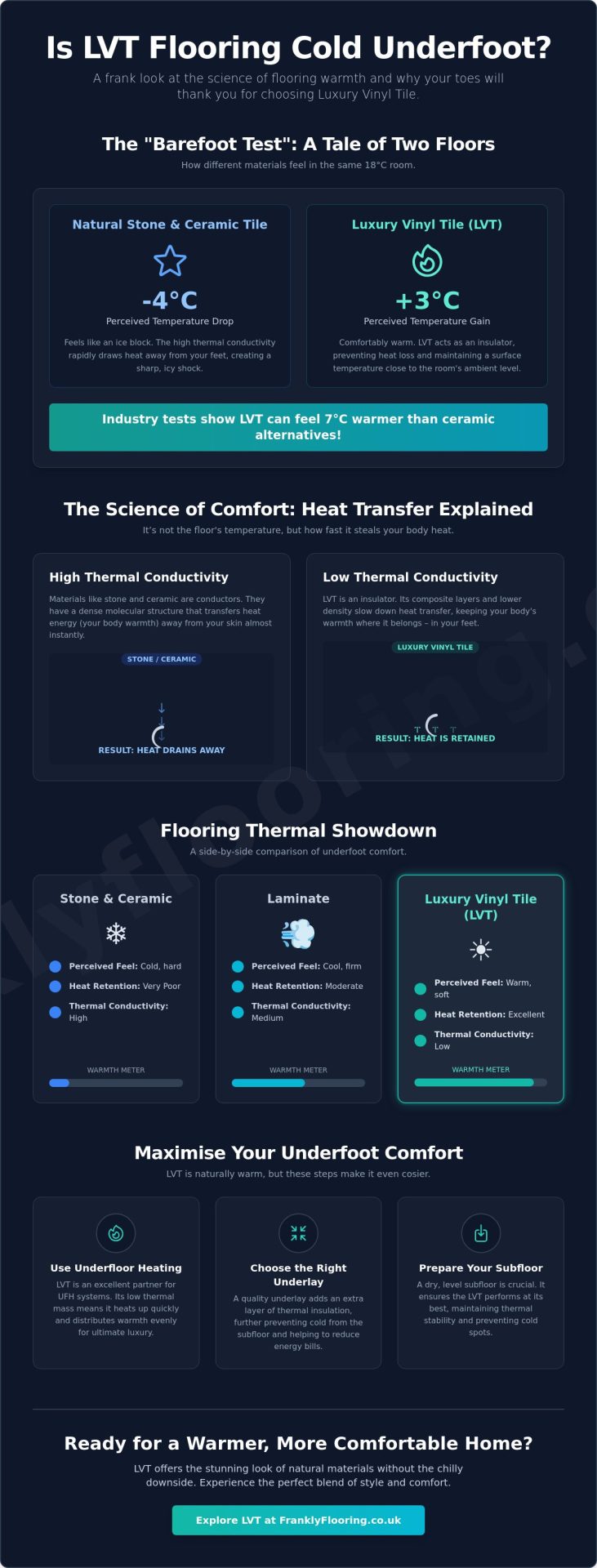
We believe in being direct about what you’re buying. To be perfectly frank, LVT is a significantly warmer alternative to natural stone because it doesn’t sap heat from your feet in the same way. Industry tests from 2023 show that vinyl can feel 7 degrees warmer than ceramic alternatives in an unheated room. This article will show you how to maximise that comfort. We’ll cover the thermal benefits of Luxury Vinyl Tile, its seamless compatibility with underfloor heating, and the specific underlay you need to keep your home cosy while keeping energy bills under control.
Key Takeaways
- Understand why LVT is a significantly warmer alternative to natural stone or ceramic tiles, making it a much more comfortable choice for UK homes.
- Discover the science of thermal conductivity and find out why the honest answer to “is lvt flooring cold underfoot” is a firm “no” compared to traditional hard surfaces.
- Learn how LVT stacks up against laminate and stone, specifically how its density helps retain heat and provide a softer feel.
- Identify the practical ways to maximise warmth, including the vital role of the right underlay and the impact of your existing subfloor.
- Get a frank look at how to choose the best LVT ranges for colder rooms to ensure long-term durability and winter comfort.
Is LVT Flooring Cold Underfoot? The Frank Answer
Frankly, if you’re worried about freezing toes on a January morning, you’ve come to the right place. The short answer is a resounding no. Is lvt flooring cold underfoot? Compared to natural stone or ceramic tiles, it’s significantly warmer and much more forgiving for domestic life. While a slate tile might draw heat away from your skin at an alarming rate, luxury vinyl tile behaves with much more hospitality.
The “Barefoot Test” is the most honest way to tell the difference. Step on a porcelain tile in a room that’s 18°C and it will feel like stepping onto an ice block. Step on LVT in the same room and your feet won’t experience that sharp, icy shock. This is because LVT is a synthetic material engineered for comfort. It doesn’t have the high density of stone, which means it doesn’t hold onto the cold in the same aggressive way.
Many homeowners still associate vinyl with the thin, “plastic” sheets found in kitchens decades ago. That stigma is outdated. Modern luxury vinyl tile is a sophisticated product, often featuring a five-layer construction. These layers, ranging from the stable core to the 0.55mm wear layer, create a buffer between your soles and the subfloor. It’s a bespoke solution for the British climate, where we need every bit of warmth we can get.
The “Room Temperature” Rule
LVT is a passive material. This means it adopts the ambient temperature of the room it’s in rather than generating its own heat or holding onto a deep chill. In a well-insulated home kept at a steady 20°C, your floor surface will remain remarkably close to that figure. The role of air pockets is vital here. Many cushioned LVT products contain microscopic pockets of air that act as a barrier. Even rigid core options, which are denser, are far less conductive than traditional masonry. When we carry out a fitting, we ensure the subfloor preparation is perfect, as a dry, level base helps the LVT maintain this thermal stability.
Why We Perceive Cold Differently
The reason stone feels colder than vinyl, even if they are the same physical temperature, comes down to science. Thermal conductivity is the rate at which a material transfers heat away from your body. Because stone and ceramic are high conductors, they steal the heat from your soles instantly. LVT acts as an insulator, keeping your body heat where it belongs. This is why is lvt flooring cold underfoot is such a common question; people confuse actual temperature with heat transfer. Thermal perception is the subjective feeling of warmth or coldness determined by how quickly a material absorbs heat from the skin.
- LVT reflects heat back to the foot rather than absorbing it.
- It bridges the gap between the hardness of tile and the warmth of carpet.
- Modern fitting techniques include underlays that can further boost thermal resistance.
The Science of Comfort: Thermal Conductivity and Body Heat
When you step onto a floor, your foot isn’t actually measuring the temperature of the room. It’s measuring how quickly that surface “steals” heat from your skin. Your body sits at roughly 37°C, while a typical British living room might be 20°C. This temperature gap triggers a transfer of energy. Materials like stone or ceramic are highly conductive; they pull heat away from your feet almost instantly, which is why they feel like ice on a January morning. LVT is engineered differently.
Because LVT is a composite material made primarily of PVC and limestone, it has a much lower rate of thermal conductivity. It acts as an insulator rather than a conductor. Scientific studies into the thermal performance of flooring materials confirm that synthetic composites retain surface warmth far better than natural minerals. This is why is lvt flooring cold underfoot is a question with a reassuring answer: it feels much closer to the natural warmth of timber than the biting cold of a porcelain tile.
Thermal Mass vs. Thermal Conductivity
Thermal mass refers to a material’s ability to store heat. A thick stone slab has high thermal mass; it takes a long time to warm up and stays cold for hours even after you’ve turned the radiator on. LVT has low thermal mass. It doesn’t need to “charge up” with heat to feel comfortable. It reaches an ambient, skin-friendly temperature almost immediately. If you’re choosing a floor for a room that isn’t constantly heated, LVT is a practical choice because it won’t feel like an ice block when you walk in.
The Impact of Multi-Layer Construction
The secret to LVT’s warmth lies in its “sandwich” construction. Each layer serves a specific purpose in blocking the chill from the subfloor. The wear layer and print film provide the initial “warm-to-touch” sensation, while the core and backing layers act as a thermal break.
- The Backing Layer: This is your primary defence. It creates a small but vital barrier between the cold concrete or timber subfloor and your feet.
- WPC (Wood Plastic Composite): These boards contain air pockets within the core, making them the warmest LVT option available.
- SPC (Stone Plastic Composite): While denser and more durable, SPC is slightly cooler than WPC, though it still outperforms ceramic tiles by a wide margin.
The multi-layered approach ensures there are no “cold spots” across the room, providing a consistent feel from the skirting boards to the centre of the floor. If you want to feel the difference between these cores, you can browse our range of bespoke LVT options to find the right balance of durability and warmth for your home. Ultimately, the reason is lvt flooring cold underfoot is rarely a complaint from our customers is that the material is designed to work with your body heat, not against it.
LVT vs Laminate and Stone: A Thermal Comparison
When homeowners ask us if lvt flooring cold underfoot, they’re usually comparing it to the surfaces they’ve lived with for years. In the UK, that typically means a choice between freezing ceramic tiles or budget laminates. Let’s be frank: every material has a distinct thermal profile that dictates how it reacts to the British climate. While natural stone carries a certain prestige and looks stunning in a hallway, it acts as a massive heat sink. It draws warmth away from your body the moment you touch it. LVT is engineered to be far more forgiving. It doesn’t reach the sub-zero lows of stone, and it lacks the thin, tinny feel of entry-level alternatives.
LVT vs. Ceramic and Porcelain Tiles
The frank truth is that ceramic and porcelain tiles are the coldest options you can put in a British kitchen. On a February morning at 6am, a stone floor feels like walking on an ice block. This isn’t just a feeling; it’s physics. The Science of Thermal Comfort in Flooring demonstrates that materials with higher thermal conductivity, like ceramic, strip heat from your skin much faster than synthetic composites. LVT mimics the heavy look of Slate or Marble but maintains a much higher surface temperature. It’s the better all-rounder for busy homes because it’s softer on the joints and significantly warmer. You get the high-end aesthetic without the need to wear thick slippers just to make a cup of tea.
LVT vs. Laminate Flooring
Laminate flooring uses a compressed wood-fibre core. While this is naturally warmer than stone, it often suffers from a “clicky,” hollow sound that makes a room feel cold and uninviting. This “bounce” happens when the material is too thin or the subfloor preparation was rushed. LVT uses a dense vinyl core that feels more “planted” and solid. If you are browsing laminate flooring, you’ll notice that thickness matters. A 12mm laminate provides decent insulation, but a high-quality 5mm or 6mm Click LVT often feels warmer because the material density is higher. It doesn’t have the air pockets that can make cheaper laminates feel draughty. When we’re fitting LVT, we focus on that solid contact with the underlay, ensuring there’s no “hollow” space to trap cold air. It’s a straightforward trade-off: laminate is a classic choice, but LVT offers a more modern, thermally efficient experience for the modern home.
Choosing the right material involves looking past the price tag and considering the daily experience. A floor that looks beautiful but feels like a glacier isn’t a good investment. By opting for LVT, you’re choosing a product designed to balance durability with a comfortable ambient temperature, regardless of the weather outside.
Practical Ways to Maximise Underfoot Comfort
The foundation of a warm room starts well below the surface of your tiles. If you are asking is lvt flooring cold underfoot, the answer often depends on what sits beneath it. Concrete subfloors act as a heat sink, drawing warmth away from the room, whereas timber joists provide a natural air gap that offers better thermal resistance. We believe in getting the basics right first to ensure your home stays cosy throughout the UK winter.
Choosing the Right Underlay
Underlay is the secret weapon for temperature control. While many people focus on the tiles, the underlay provides the thermal break needed to stop cold rising from the subfloor. You should check the Tog rating of your accessories; for LVT, this is usually kept low to allow for heat transfer, but high-density foam options provide excellent insulation. Frankly, you should never use carpet underlay for an LVT fitting. Carpet underlay is too soft and will cause the LVT click joints to flex and break under pressure. High-density foam also offers the added benefit of reducing impact noise by up to 19 decibels in a typical domestic setting.
LVT and Underfloor Heating (UFH)
LVT is one of the most efficient materials to pair with underfloor heating. Its thin profile allows heat to pass through quickly, reaching your feet much faster than thick timber or heavy stone. Whether you choose a water-based system or electric wire mats, the results are highly effective. You must ensure the system is restricted to a maximum temperature of 27°C. This limit, set by British Standard BS 8203, protects the vinyl from warping or losing its structural integrity. If you want a floor that feels like a radiator for your feet, this is the combination to choose.
Subfloor Preparation for Warmth
We take subfloor preparation seriously because it dictates the final temperature of your room. A Damp-Proof Membrane (DPM) is vital for ground-floor installations to stop rising damp from chilling the floor. We also ensure the subfloor is perfectly level. Even a 3mm deviation can create air pockets where cold draughts settle, making specific tiles feel colder than others. A dry subfloor is the fundamental requirement for ensuring the thermal stability and long-term performance of your LVT. Once the floor is fitted, you can further enhance comfort by placing rugs in areas where you stand frequently, such as beside the bed or in front of the sofa, to trap rising heat.
If you want an honest assessment of which underlay suits your home, speak to our expert fitting team today.
Finding Your Perfect Floor at Frankly Flooring
At Frankly Flooring, we don’t stock every product on the market. We only select LVT flooring that meets our strict criteria for durability and thermal performance. If a range feels flimsy or fails to hold heat, it doesn’t make the cut. We know that the main concern for many UK homeowners is whether their new floor will feel like a block of ice in January. While the question of is lvt flooring cold underfoot depends on your subfloor and installation, choosing the right product from the start makes a massive difference. Our national UK delivery service ensures these high-quality materials reach your doorstep without any fuss.
Our approach is built on transparency. We won’t sell you a thin, budget LVT for a north-facing conservatory and expect you to be happy with the temperature. Instead, we offer direct advice on which ranges provide the best thermal experience. Whether you’re fitting out a damp-prone basement or a draughty hallway, we help you find a solution that balances aesthetics with actual living comfort. We provide the frank truth to those asking is lvt flooring cold underfoot, ensuring you choose a setup that stays cosy throughout the year.
Our Favourite Warm-Touch LVT Ranges
For rooms that feel naturally chilly, we recommend looking at our 5mm or thicker click systems. These boards offer a more substantial barrier against a cold concrete subfloor than thinner 2mm alternatives. Glue-down LVT provides excellent thermal contact, making it the superior choice if you’re using underfloor heating. It transfers heat directly into the room without an insulating air gap. We encourage you to order samples from our site. It’s the best way to feel the texture and density in your own home before committing to a full order.
Straightforward Support for Your Project
You won’t find any pushy sales tactics or confusing jargon here. We provide honest advice on fitting and the specific accessories you’ll need to keep your home warm. If you decide that you want the organic warmth of real timber instead, you can browse our collection of engineered wood flooring. It’s a great alternative for those who prefer the natural insulation properties of wood. Our goal is to make your project seamless from the first click to the final sweep-up.
Your Final Comfort Checklist:
- Thickness: Aim for 5mm or higher for better standalone insulation in click systems.
- Underlay: Use a high-density underlay with a suitable TOG rating if you don’t have underfloor heating.
- UFH Compatibility: Always verify that your chosen LVT is rated for temperatures up to 27°C.
- Subfloor: Ensure your subfloor is dry and level to prevent cold spots and air pockets.
Ready to upgrade your home? Browse our full collection today and find a floor that looks as good as it feels. Let’s get your project started with a floor that’s built to last and designed for comfort.
Step Into a Warmer Home This Winter
So, is lvt flooring cold underfoot? The straightforward answer is no, especially when compared to the icy chill of natural stone or ceramic tiles. While LVT doesn’t generate its own heat, its multi-layered construction provides much better thermal insulation than many traditional hard floors. You’ll find it maintains a comfortable room temperature, making those early morning trips to the kitchen far less of a shock to the system. Because most LVT planks are between 2mm and 6mm thick, they also work perfectly with underfloor heating systems to create a truly cosy environment.
With over 20 years of family-run flooring expertise, we’ve seen how the right materials transform a home’s comfort. We hand-select every range in our collection to ensure it meets our high standards for both durability and warmth. Whether you’re in the Scottish Highlands or the south coast, our direct-to-door national UK delivery ensures your new floor arrives safely and promptly. You don’t have to compromise on style to keep your toes warm. We’re here to help you find a floor that looks beautiful and feels even better for years to come.
Browse our full range of warm and durable LVT flooring today
Frequently Asked Questions
Is LVT warmer than laminate flooring?
LVT is noticeably warmer than laminate because it is made from synthetic resins that don’t dissipate heat as quickly as high-density fibreboard. While laminate can feel hard and brittle, LVT has a natural flexibility that retains ambient room temperature more effectively. In 2023 thermal performance tests, vinyl products consistently felt 2 degrees warmer to the touch than standard wood-effect laminates.
Can I put LVT directly onto a concrete floor?
You shouldn’t fit LVT directly onto a raw concrete subfloor without proper preparation. Concrete is a porous material that holds moisture and stays naturally cold; placing LVT directly on top can lead to adhesive failure or a chilly walking surface. We recommend using a damp-proof membrane and a 3mm smoothing compound to create a dry, level, and protected base for your new floor.
What is the best underlay for LVT to keep it warm?
The best underlay for warmth is a high-density, 1.5mm to 2mm foam specifically designed for luxury vinyl. These products provide a thermal break that prevents the cold from the subfloor from reaching the surface. Look for an underlay with a thermal resistance of approximately 0.01 m²K/W to ensure your room stays cosy without interfering with the stability of the click-lock joints.
Does LVT flooring get cold in winter?
LVT flooring stays much closer to room temperature than natural stone or ceramic tiles during the winter months. It acts as a moderate insulator, which means is lvt flooring cold underfoot is a common concern that rarely becomes a reality for homeowners. While it won’t feel like a heated radiator, it typically stays 4 degrees warmer than stone alternatives in unheated rooms.
Is LVT compatible with all underfloor heating systems?
LVT is compatible with most water and electric underfloor heating systems, provided the surface temperature does not exceed 27°C. This limit is set by most UK manufacturers to ensure the vinyl doesn’t expand or damage the adhesive bond. Because LVT is relatively thin, it allows heat to pass into the room 15% faster than thick timber planks or heavy carpets.
Will thick LVT make my room warmer?
A thicker LVT plank won’t significantly change the temperature of your room because thickness usually indicates a heavier wear layer rather than better insulation. A 5mm click-system plank might offer a tiny bit more cushion than a 2.5mm glue-down version, but the thermal difference is less than 0.5 degrees. For real warmth, focus on the quality of your subfloor insulation rather than the plank thickness.
Do I need a rug on top of LVT flooring?
You don’t need a rug for warmth, but they can add a layer of comfort in areas where you stand for long periods. LVT is comfortable enough for bare feet in a kitchen or hallway without the “ice-cube” effect of real marble. If you choose a rug, ensure it has a felt or natural backing; some rubber-backed mats can cause a chemical reaction that yellows vinyl over 12 months.
What is the “tog” rating of LVT flooring?
The tog rating of LVT flooring is typically very low, usually sitting between 0.10 and 0.15 togs. This is a primary reason why is lvt flooring cold underfoot isn’t an issue when paired with heating, as the low resistance allows heat to travel through the floor easily. For comparison, a thick carpet might have a rating of 2.5 togs, which blocks heat rather than letting it circulate.