
Why do so many high-street retailers keep you in the dark about the real reason a new floor might swell or warp after just a few months? It’s usually because they’d rather sell you a quick fix than give you the frank truth about material quality. When you’re looking for laminate flooring uk, you deserve to know exactly what’s going under your feet without having to decode a manual of technical jargon.
We agree that choosing a floor shouldn’t feel like a gamble. You want a home that looks like it belongs in a design magazine but functions like a real living space, handling pets and spills without a second thought. This guide provides a transparent, expert-led roadmap to help you choose the right materials without the high-pressure sales fluff. We’ll show you how to spot the difference between a cheap board and a high-performance investment that stands the test of time.
You’ll get a clear breakdown of AC ratings and the latest 2026 installation guidance from the Contract Flooring Association. We’ll also explore the shift toward warm “greige” tones and herringbone patterns that you can actually install yourself to save money. Let’s get started on finding a floor that’s as reliable as it is beautiful.
Key Takeaways
- Learn how to decode AC ratings and board thickness so you can select a floor that handles heavy foot traffic without overpaying for unnecessary commercial specs.
- Discover why the best laminate flooring uk projects rely on the “sweet spot” of 8mm to 12mm thickness for that authentic underfoot feel.
- Understand the frank truth about how laminate compares to LVT and real wood, specifically regarding your budget and the ease of DIY click-system installation.
- Identify which rooms are ideal for laminate and where you’ll need specific water-resistant technology to prevent warping in moisture-prone areas.
- Master the “5% Rule” for measuring wastage and ensure you have every accessory ready, from underlay to carpet grippers, before you start.
What is Laminate Flooring? A No-Nonsense Overview for 2026
If you’re asking what is laminate flooring?, you likely want a straight answer without the usual high-street marketing fluff. At its core, laminate is a high-performance, multi-layered synthetic floor. Each plank is fused together through a high-pressure lamination process, creating a dense, durable surface that’s built to last. For anyone browsing laminate flooring uk options, it’s often the smartest choice for balancing high-end aesthetics with a realistic budget.
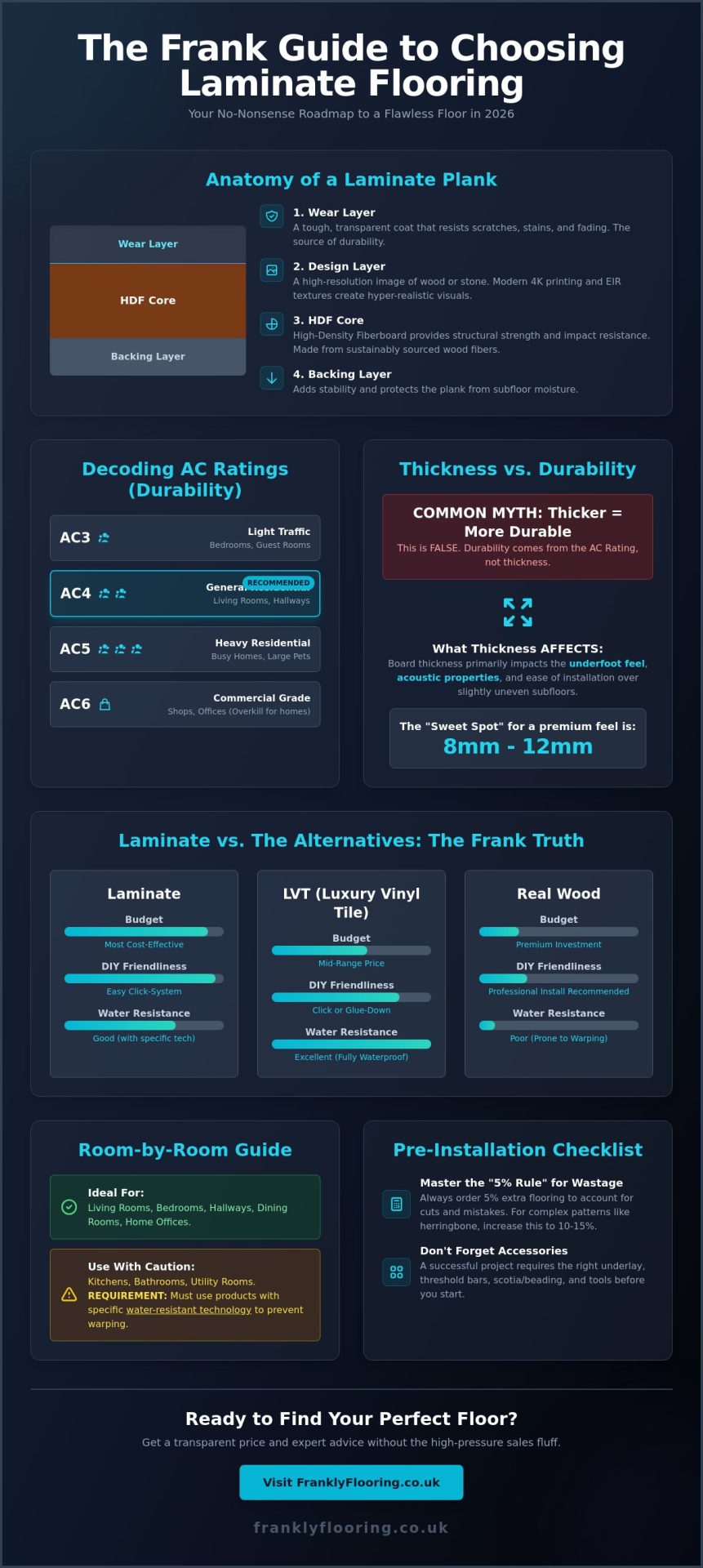
To understand the quality of a board, you have to look beneath the surface. Every plank consists of four specific layers that work in tandem. The top is the wear layer, a transparent, tough coat that resists scratches and stains. Below that sits the design layer, which is a high-resolution image of wood or stone. The muscle of the board is the core layer, made of High-Density Fiberboard (HDF) for structural strength. Finally, a backing layer provides stability and protects against moisture from the subfloor.
We’ll be frank: if you want the look of premium timber but have a house full of muddy paws or energetic kids, this is the product for you. By 2026, technology has advanced so far that even experts struggle to tell the difference between a high-quality laminate and real oak at a glance. It remains the most cost-effective way to transform a room without the maintenance headaches of solid wood.
The Evolution of Laminate Design
Forget the “plasticky” floors of the nineties. Modern 4K printing technology has reached a point where repeating patterns are almost impossible to spot in a standard room. We now use “embossed-in-register” (EIR) textures. This means the physical grain you feel under your fingers perfectly matches the visual grain you see on the plank. When you combine this with a “v-groove” edge, you get a floor that looks like individual timber planks rather than a single sheet of printed material.
Environmental Impact and Sustainability
Transparency matters when it comes to what you put in your home. Modern laminate is increasingly eco-friendly, with most HDF cores now sourced from sustainably managed forests. At Frankly Flooring, we prioritise products with low VOC (Volatile Organic Compound) emissions to ensure your indoor air quality remains healthy. Because modern boards are primarily composed of wood fibre and resin, they are significantly easier to recycle at the end of their long lifecycle compared to older synthetic materials. It’s a choice that looks good and feels responsible.
Decoding Technical Specs: AC Ratings, Thickness, and Water Resistance
Choosing the right laminate flooring uk homeowners trust involves more than just picking a pretty oak effect. To ensure your floor doesn’t look tired after eighteen months, you need to look at the technical specifications. Most high-street shops focus on the visual, but the real value lies in the AC rating and core density. We’ll be frank: a cheap board with a low rating is a waste of money for a busy living room.
The durability of laminate is measured by its Abrasion Class (AC) rating. This system is part of the European Standard No. EN 13329:2000, which dictates how well a floor resists impact, stains, and cigarette burns. If a product doesn’t clearly state its AC rating, walk away. It’s the only way to know if the board is fit for purpose.
Choosing the Right AC Rating for Your Room
- AC3: This is the entry-level standard for residential use. It’s perfectly adequate for bedrooms or guest rooms where foot traffic is light.
- AC4: The “sweet spot” for most UK homes. It’s tough enough for busy hallways and living areas without the commercial price tag.
- AC5: Designed for high-traffic areas. If you have large dogs or a very active family, this provides extra peace of mind.
- AC6: This is commercial-grade. It’s often overkill for a home, but if you want the ultimate in scratch resistance, this is it.
Thickness vs. Durability: The Common Misconception
A common myth in the flooring industry is that a thicker board is always more durable. That’s not quite true. Thickness refers to the HDF core, while durability comes from the wear layer (the AC rating). However, thickness does matter for the “feel” of the floor. An 8mm board is the standard, but moving up to a 12mm plank makes the floor feel more substantial underfoot, mimicking the solid thud of real timber. Thicker planks also allow for deeper, more stable “click” locking systems, which reduces the chance of the joints separating over time.
If you’re using underfloor heating, you need to balance thickness with thermal efficiency. While 12mm boards offer better sound insulation, they take slightly longer to heat up than an 8mm board. If you’re unsure which spec fits your project, you can browse our range of high-quality laminate options to see how these specs translate to real-world performance.
Finally, let’s talk about water. In 2026, “water-resistant” laminate is the standard for kitchens. This usually means the HDF core is treated with wax or resin to prevent swelling. Look for “Aqualock” or sealed-joint technology. These systems prevent water from seeping into the core for a set period, usually 24 to 72 hours. It’s not waterproof like LVT, but it’s more than enough to handle a dropped drink or a wet umbrella.
Laminate vs. LVT vs. Real Wood: The Frank Truth
When you’re browsing for laminate flooring uk, you’ll inevitably encounter Luxury Vinyl Tile (LVT) and real wood. It’s a crowded market. Retailers often push the most expensive product rather than the one that actually fits your lifestyle. Let’s be frank about the trade-offs. Every material has a specific job to do, and picking the wrong one leads to regret six months down the line.
Laminate is the clear winner for initial purchase price. It’s budget-friendly and designed for speed. The “Click-Clock” system makes it a favorite for DIY enthusiasts because it doesn’t require the messy adhesives often needed for glue-down LVT or the complex nailing of real timber. You can lay a laminate floor in a afternoon and walk on it immediately. That’s a huge win for a busy household.
If you’re planning a “forever home,” engineered wood flooring offers a lifespan that laminate simply can’t match. You can sand and refinish real wood to remove deep scratches or change the colour. With laminate, once the wear layer is gone, the board must be replaced. It’s a choice between a lower upfront cost or a fifty-year investment.
Laminate vs. Luxury Vinyl Tile (LVT)
Pet owners often find that laminate is the better choice for scratch resistance. While lvt flooring is softer and quieter underfoot, it can be more prone to surface scuffs from heavy claws. However, LVT remains the undisputed king for bathrooms. It’s 100% waterproof. Even the best water-resistant laminates have a time limit before moisture reaches the HDF core and causes swelling. If the room is prone to standing water, choose LVT. For everywhere else, laminate offers a better price-to-durability ratio.
Laminate vs. Engineered Wood
Real wood provides an authentic warmth and unique grain pattern that no print can perfectly replicate. It also tends to hold more resale value for UK properties. But for a busy family, laminate is the “low effort” king. It doesn’t require the periodic oiling or specialist cleaners that real wood demands. It’s built to be lived on, not just looked at. You get the oak look without the oak maintenance.
The Frank Verdict: Choose laminate for living rooms, hallways, and bedrooms. It’s tough, looks great, and saves you money. Walk away if you’re flooring a wet room or if you absolutely insist on the prestige of solid timber. Knowing the difference helps you spend your money where it actually matters.
Room-by-Room Guide: Where to Lay Laminate (And Where to Avoid It)
Different rooms demand different things from your floor. A bedroom board doesn’t face the same challenges as a hallway plank, and treating them the same is a recipe for a costly mistake. When you’re choosing laminate flooring uk homes need, you have to match the product to the specific environment. We’ll be frank: putting a standard board in a splash zone is just asking for trouble.
The living room is the natural home for laminate. It offers the perfect balance of high-end style and everyday durability. You want a floor that looks beautiful under evening lights but won’t be ruined if someone drags a chair across the room. In the kitchen, the rules change. You must look for “Aqualock” or sealed-joint technology. Spills are inevitable here. If you don’t have a moisture-resistant core, a simple leaky dishwasher can cause the edges of your planks to swell and peak within hours.
Hallways are the frontline of your home. They deal with “wet foot” traffic and abrasive grit carried in from the street. This is where a high AC rating proves its worth. For bedrooms, the focus shifts to comfort and acoustics. The floor itself provides the look, but the underlay does the heavy lifting, ensuring the room stays warm and quiet when you walk across it at night.
Laminate in High-Moisture Areas
Can you put laminate in a bathroom? Honestly, we’d advise against it. Even with modern coatings, standing water is the enemy of HDF cores. If you insist on this look, you must use joint protectors and high-quality silicone sealants around the perimeter. Expansion gaps are also non-negotiable. UK kitchens can get humid. Without a 10mm gap hidden under your skirting boards, the floor has nowhere to go when it expands, leading to unsightly buckling.
Subfloor Preparation for a Flawless Finish
A floor is only as good as what’s underneath it. Use a straight edge to perform a “Flatness Test.” If you find a dip of more than 3mm over a two-metre span, your planks will bounce. Over time, this movement breaks the click-lock system. If you’re installing on a ground floor concrete base, a Damp Proof Membrane (DPM) is a mandatory requirement to stop rising moisture. Finally, don’t rush the process. Your laminate needs at least 48 hours to acclimatise in the room where it will be fitted. This allows the boards to reach the same temperature and humidity as your home before they’re locked together. You can browse our full range of durable laminate options to find the right match for your subfloor type.
Buying Laminate Online: The Frank Guide to a Stress-Free Project
Ordering laminate flooring uk online is often the most efficient way to manage a home renovation, but it requires a bit of foresight. Most people focus entirely on the price per square metre and forget the components that actually make the floor work. We’re here to make sure you don’t end up with a half-finished room because you missed a vital accessory. A successful project is about the total package, not just the boards.
Be precise when measuring. Calculate your room’s length and width at the widest points, then always apply the “5% Rule” for wastage. This extra margin covers the cuts, mistakes, and awkward corners that naturally eat into your supply. Having a spare pack tucked away in the loft is a small price to pay for the peace of mind that you won’t run out on a Sunday afternoon. It also ensures you have matching boards if you ever need to replace a damaged plank years down the line.
Your accessory checklist must include more than just underlay. While the right padding is essential for comfort and sound reduction, transitions are where many DIY projects stumble. If you’re moving from your new laminate hallway into a carpeted lounge, you’ll need a carpet gripper to secure the transition properly. We also strongly recommend ordering samples before committing. Lighting in a typical UK home varies wildly from a warehouse setting; you need to see how that oak grain looks in your own space at sunset.
Don’t Forget the Finishing Touches
The details define the finished look. You have two main choices for the edges: matching scotia or removing your skirting boards entirely. Scotia is the faster, DIY-friendly option that covers the mandatory expansion gap. However, refitting your skirting over the top of the laminate creates a much cleaner, high-end finish. Don’t forget door bars to bridge the gaps between rooms and radiator pipe covers to hide those messy holes in the floor. These small additions turn a good job into a professional one.
Why Buy From Frankly Flooring?
We’ve spent 20 years as a family-run business in the UK flooring market, and we’ve learned that honesty is the best policy. You won’t find “70% off” sale gimmicks here; we prefer transparent pricing and consistent value. We ship laminate flooring uk wide, delivering direct to your door without the high-street markups or the pressure of a showroom floor. Our team is here to provide no-nonsense support from the moment you measure up to the final cleanup. Browse our full range of 2026 laminate flooring and start your project with confidence.
Ready to Transform Your Home?
You now have the frank facts needed to navigate the laminate flooring uk market with confidence. Choosing the right floor is no longer a gamble when you understand that technical specs like AC ratings and core density matter far more than high-street marketing slogans. By focusing on room-specific needs and taking the time for proper subfloor preparation, you’re ensuring your new floor remains a foundational element of your home’s character for years to come.
At Frankly Flooring, we leverage over 20 years of family-run expertise to provide you with the best materials at direct-to-consumer prices. We don’t believe in showroom overheads or high-pressure sales tactics; we believe in integrity and quality. We even offer free samples delivered across the UK so you can see exactly how our designs look under your own roof before you commit.
Explore Our Laminate Flooring Collection today and start your project with the quiet confidence of a professional. Your home deserves a floor that’s as resilient as it is beautiful, and we’re here to help you get it right the first time.
Frequently Asked Questions
Is laminate flooring better than LVT for pets?
Laminate is often the superior choice for homes with large or energetic dogs because its wear layer is typically harder than vinyl. While LVT is softer and quieter underfoot, it’s more prone to surface scuffs from claws. A high AC-rated laminate provides a tough, scratch-resistant surface that handles pet traffic without losing its finish.
How long does laminate flooring actually last in a busy UK home?
You can expect a high-quality laminate flooring uk installation to last between 15 and 25 years in a standard residential setting. This lifespan depends heavily on the thickness of the board and the AC rating you choose for high-traffic areas. While it isn’t a “forever floor” like solid oak, it offers exceptional durability for its price point.
Do I really need underlay for laminate flooring?
Yes, underlay is a mandatory requirement for any successful installation. It acts as a vital shock absorber, levels out minor subfloor imperfections, and provides a necessary moisture barrier. Skipping underlay results in a floor that sounds hollow, feels cold, and is far more likely to suffer from joint failure over time.
Can I install laminate flooring over existing vinyl or tiles?
You can install laminate over existing hard surfaces like vinyl or ceramic tiles as long as they are flat, dry, and securely fixed. Any loose tiles or deep grout lines should be levelled first to prevent the new planks from bouncing. You must never install laminate over carpet, as the soft pile causes too much movement and will break the click joints.
How do I clean laminate flooring without damaging the surface?
Use a microfibre mop and a dedicated laminate cleaning spray rather than a traditional mop and bucket. Excess water is the primary cause of floor failure, as it can seep into the joints and cause the core to swell. Avoid steam mops entirely, as the forced heat and moisture can permanently damage the lamination and cause the edges to peel.
Is laminate flooring suitable for underfloor heating?
Most modern laminates are compatible with both electric and water-based underfloor heating systems. You must verify the manufacturer’s thermal resistance specs and use a specific underfloor heating underlay to ensure efficient heat transfer. It’s also essential to follow a gradual “run-in” process when turning the heating on for the first time after installation.
What is the “click” system and can I really DIY it?
The click system is a glueless locking mechanism where boards snap together using a specially designed tongue-and-groove profile. It was created specifically for DIY enthusiasts to save on professional labour costs. If you can measure accurately and use a basic saw, you can achieve a professional finish without needing specialist tools or adhesives.
What should I do if my laminate floor starts to gap or creak?
Gapping usually occurs if the room’s humidity levels fluctuate or if the expansion gaps around the perimeter are restricted by heavy furniture. Creaking is almost always a sign of an uneven subfloor or the wrong type of underlay. You can often fix minor gaps by using a flooring pull bar to gently tap the planks back into their locked position.